15:48


Hi, this is Chef John from foodwishes.com and we're making Romano potatoes, which can be made in advance. That's right. I'm going to show you a make- ahead version of perhaps the best steakhouse side dish. By the way, I learned this from the chef who invented and popularized the modern version and whose name is also John. So you don't just get a recipe from Chef John, you get a recipe from Chef John and Chef John. To begin, we will wash four russet potatoes very thoroughly, as we will be using some of the skin in this recipe. Then spread them on a baking sheet, making sure they lie evenly. Oh, and for probably the first time in my life I forgot to pierce them.
I'll tell you later whether this affected the result. But either way, we're going to bake them at 425 degrees for about an hour and 15 minutes, or until they're soft. As you well know, we never guess in the kitchen unless we have to. So let's check them with the tip of a knife, which should go in easily and without effort. Once our potatoes are successfully baked, we will let them cool slightly. After that, I wrap it and put it in the refrigerator until completely cooled. I always leave it overnight. But if you want to cook everything in one day, make sure you have at least a few hours to spare. Because the peculiarity of Romanov potatoes is that the casserole is prepared from grated boiled potatoes. And for the right texture, it's crucial that the potatoes are
cold before we do this. A little more preparation-finely chop the shallot; I know it looks like a red onion, but it only vaguely tastes like one. Yes, shallots have such a unique flavor that is just perfect for this dish. So if you can find it, I highly recommend using it. But if not, the white part of the green onion will do. Or really any other type of onion Oh, and in the original "Food Wishes Potatoes Romanoff" recipe that this version is based on, I added the shallots raw, as I was taught. But since we're making the " ahead of time" version, as you'll see in a moment, I'm going to fry it in a little oil to get rid of the raw flavor. Because if you add raw shallots or onions to a dish that will
sit for a long time, the flavors can become too strong and overpower everything else. So to avoid this, we'll fry them over medium heat with a little oil for a few minutes until they start to soften. And we should also add a good pinch of salt. Oh, and I have to say, I love shallots. Many of you use about a third of a glass. But a safer amount, especially for a festive side dish for a large group, is probably a couple of generous tablespoons. This is the amount I will indicate in the written recipe. But feel free to increase it if you want to do it Chef John style. That's all. Once it's ready, we'll set it aside until needed and move on to grating the potatoes.
Since it is well chilled and solid, this will be easy. And, as I said, we won't be peeling it, so some of the peel will definitely end up in the mixture. But a lot of the peel will remain on the outside of the grater. So we'll just throw away these big pieces. Leaving the skin on isn't just a time saver, although it's a nice bonus, it also adds a great flavor boost. These little pieces of skin will add a touch of flavor to the baked potato, which is another reason why this dish is so wonderful. I've tasted many potato casseroles and gratins, including those where the potatoes were mashed, sliced, diced, or mashed. But for me, it's the rubbing technique that creates the most interesting and captivating texture, which we'll talk about later
Oh, and in case you were wondering: no, I don't think piercing the potatoes made any difference here. So, I think this time we can do without the good old " penetration". But anyway, once everything is grated, we will add the rest of the ingredients, including salt, as well as ground white pepper. If you don't have it, freshly ground black pepper will also work. But if you want the real version from Chef John, use white. After that, we'll add a few dashes of cayenne pepper, which only one of Chef John's uses, and you'll never guess which one. But no, it's me. Once we've seasoned all of this, we'll add our reserved shallots. After we have scattered them, we will add the cheese.
In our original recipe, I used only sharp cheddar, but for this make-ahead holiday version, I decided to add some Gruyere-it's richer, a little sweeter, and has a nutty flavor that works perfectly here. Before adding the last ingredient , we will take two forks and mix everything very thoroughly. We will do this by tossing everything up and cleaning the forks from time to time. The reason we use this particular technique is because we don't want to turn these potatoes into mashed potatoes in any way. This is truly one of the secrets to the perfect texture of Romanov potatoes. We need the potatoes to remain in millions of individual pieces, not turn into a dense mass.
Once we've mixed everything well with a fork, we'll stop and add a huge amount of sour cream. To mix it evenly with minimal movement, we will spread it with a spoon over the entire surface, rather than with a slide in one place. Once that's done, we'll take our two forks again and use the same stirring technique as before. Although we will have to stir it a little to get everything mixed well. Remember that we will still need to transfer all of this into the baking dish, and it will still get mixed up during that process. So it is quite enough if the sour cream is distributed by 90-95%. When we're done with that, we have two options.
We can either transfer everything to the mold we talked about right away, or cover the bowl and transfer it to a baking dish right before the oven-this is my preferred method. We all know what our refrigerators look like during the holidays, and if we transfer a dish to a baking dish now, something on top might press it down. Therefore, I believe that it will be more reliable this way. And when we're ready to bake, we'll take everything out and very carefully flip it with a fork. While we want everything to be evenly distributed, it's important not to pack or press too hard. Therefore. We're trying to just put it on a slide without crushing the thousands of little air pockets that have formed around the potato pieces.
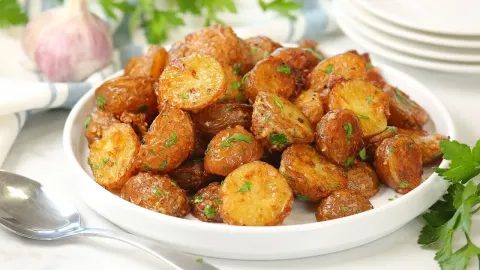
Once everything is translated, we will take the tips of both forks and make the surface as evenly uneven as we can. And once we're happy with the look, I like to sprinkle a little cayenne pepper on top to add heat to the flavor and look. Now this can be placed in the upper part of the oven, preheated to 220°C, for about 35 minutes or until the dish is heated through and nicely browned. I hope it looks like this. Oh yes. Well, friends, this is simply incredibly beautiful. We could serve the dish just like that. But you know me, I'll definitely sprinkle it with freshly cut chives.
Ultimately, it's up to you how you finish the dish. Moreover, you are the main chef of your Romanoff potatoes here. You can use parsley or chopped green onions. Or, as I said, leave it as is. But whatever you do, when you pick up a fork and take a bite, you'll taste one of the most beautiful, flavorful, and perfect potato side dishes of all time. OK. What we have here is actually a potato gratin combined with fluffy, perfectly baked potatoes. I think the genius of this dish is that it is very rich, refined, and extremely satisfying. However, thanks to the technique used, it seems very light, so I think it would look great on a holiday table next to a baked turkey or juicy ham.
And it's always much easier to prepare a potato side dish when the potatoes are already ready. So, in addition to its beauty and amazing taste, this dish is perfect for the holidays from an organizational point of view. But no matter when you serve it, it truly is one of the best potato sides ever, so I really hope you try it soon. Please follow the links below for ingredient quantities, a printable recipe, and lots of other information as usual. And as always, delicious.