9:09




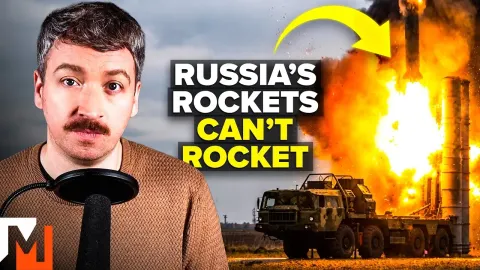
Russian weaponry is becoming increasingly brutal and futuristic. Who agrees? From Vladimir Putin's promise to redeploy the Sarmat nuclear missile after a series of recent tests to a large-scale modernization of its broader missile arsenal, Russia appears to have no intention of slowing down its display of military power. Now, the world's attention is once again focused on the KH-101 missile. Amid the ongoing conflict, recent reports suggest that Russia has quietly enhanced the capabilities of its flagship cruise missile. Ukraine has once again been placed on alert after indications emerged that the latest version of the KH-101 is significantly more lethal and harder to intercept than its predecessors.
Given its destructive track record on the battlefield, how far has Russia actually upgraded this aerial monster over time? Let's dive deeper. In the world of military aerospace, adaptation is key to supremacy, and Russia has proven itself a maestro in the art of weapons modification amid the intensity of the battlefield. The KH-101 cruise missile, the ghost of the sky launched by the strategic bombers Tu-95MS and Tu-160, is no longer the same weapon as it was when the conflict first began. Through the ingenuity of Russian engineers, this missile has undergone at least four radical phases of evolution, making it a nightmare for any Western air defense system attempting to intercept it.
Initially, the KH-101 was already a technological masterpiece with a range of up to 2,500 km and a 500 kg warhead. It could reach targets from a safe distance over the Caspian Sea. Imagine a massive projectile capable of flying for 12 hours, slipping through radar gaps, and striking targets with meter-level accuracy thanks to satellite navigation and terrain contour matching guidance systems. However, for the Russian military, that advantage was only the beginning. Moscow's grand strategy has been continuous iteration using abundant missile stockpiles to turn every failure into a deadly technological lesson.
The first modernization focused on raw destructive power. Recognizing that strike effectiveness needed to be increased exponentially, Russia made a bold strategic decision, sacrificing part of the fuel tank to create space for an additional warhead. The result was a Kh-101 variant with a tandem warhead, bringing the total explosive payload up dramatically to 800 kg. This increase is not just a number. It is about ensuring that once a infrastructure is completely destroyed, leaving no room for repair. With nearly double the explosive power, each launch now carries a far more devastating message.
Evolution does not stop at explosive power. Russia understands that in modern warfare, the extent of destruction is just as important as precision. This is the basis for the second modernization, in which the Kh-101 is now equipped with a tandem warhead munition. As the missile approaches its target, it does not simply detonate at a single point. Instead, it disperses deadly fragments that simultaneously rain over a wide area. Even more alarming, Russia has added incendiary materials to its payload. The result is large-scale fires that are difficult to extinguish, an effective tactic for quickly disabling an opponent's logistics hubs and energy infrastructure.
However, the greatest challenge is ensuring that the missile reaches its target amid an enemy's electronic sensor network. This is where the third and fourth stages of modernization demonstrate Russia's capabilities in cyber and electronic warfare technology. The Kh-101 guidance system has been upgraded with more advanced terrain image comparison technology. Before launch, a detailed digital map is loaded into the missile's memory. While flying low over land, the missile actively sees the ground below, comparing what its onboard camera detects with the original reference data. If it detects deviations caused by jamming from the enemy's electronic warfare systems, the Kh-101 automatically corrects its flight path.
This autonomous capability ensures the target remains locked, even when the enemy attempts to blind its satellite navigation. At its peak in the fourth stage of modernization, the Kh-101 evolves into a flying fortress. It is now equipped with an internal electronic warfare protection system capable of generating false targets on enemy radar. When enemy air defense systems attempt to lock on, the missile can deflect interceptor sensors and automatically deploy heat decoys. It becomes a game of cat and mouse in the sky, where Russian technology proves more adaptive. Claims of successful missile interception are often irrelevant when, in reality, these modifications continually force opponents to expend
resources simply to detect a constantly evolving threat. While the KH-101 dominates the tactical battlefield theater, at the global strategic level, Russia has once again asserted its unmatched dominance. The world was once again shocked by the announcement of the successful test of the RS-28 Sarmat, an intercontinental ballistic missile often referred to by the West as Satan 2. In a strategic video call, the commander of Russia's strategic missile forces, Sergey Karakayev, confirmed to President Vladimir Putin that the launch was carried out flawlessly. Sarmat is not just a missile. It is a statement of Russia's sovereignty on the international stage.
Putin proudly describes Sarmat as the most powerful missile system in the world, a claim supported by staggering technical data. With a remarkable range of over 35,000 km, Sarmat is capable of striking targets anywhere on Earth, flying over both the North and South Poles, rendering any existing missile defense system obsolete and powerless. Its ability to carry multiple hypersonic warheads makes it a global predator that cannot be stopped. Moscow's decision to inform the United States and the world about this test demonstrates an extraordinary level of confidence.
Sarmat is scheduled to be fully delivered to military units by the end of this year, marking a new era in which Russia holds the key to global strategic stability. From the adaptation of the KH-101 on the front lines to the presence of Sarmat in hidden silos, Russia has proven that its military technological superiority is not only about defense, but also about shaping the course of history through relentless innovation. So, that's all for today's episode and thanks for watching.