16:41




A lot of people took pictures of the recent solar eclipse in North America and got photos where there's a ghostly image of the eclipse floating in the sky nowhere near where the sun is! The short explanation is that the ghostly eclipse images are lens flares: the thing that happens when you point a camera towards a particularly bright light source and you get a glow or streaks or disks. or eclipses? The eclipse lens flares are cool in two really different ways - first, they allow you to actually take an image of a partial or annular eclipse without fancy photographic filters to darken the sun! Though my lawyer
tells me that you should never look directly at the sun or point a camera at it for an extended period of time without a proper solar filter. And second, eclipse lens flares reveal some really interesting facts about lens flares in general! This is grossly oversimplified, but lens flares are basically, generally speaking, an optical defect: they're light that passes through a lens in an unintended way. Most modern camera "lenses" are actually multiple glass lenses, called lens elements, working together to function as a single optical device. In a perfect world,
all the light falling on a lens would be bent in exactly the way the designers intended, passing through each lens element and reaching the image sensor or film to create an image. But physics is annoying: glass likes to reflect and absorb and scatter light as well as transmit it, and no matter how careful you are with anti-reflective coatings, no lens is perfect. Every single lens element, including the aperture, will in principle "incorrectly" reflect or scatter or diffract a small amount of all light that hits it, and that light then bounces around
in the lens before hitting the inside wall of the lens, or going back out the front, or hitting the image sensor. But even when it hits the image sensor, you don't notice most of this incorrectly bouncing light, especially if the lens makers did their job well. It's all about relative brightness - if, say, 99% of light passes correctly through a lens element and only 1% of it bounces around and causes a lens flare, then that flare is at most 1% as bright as the correct light, and you probably won't notice it in the final image. This is how
one-way mirror glass works, for example, or why it's really easy to see into a house at night, but hard to see out. Relative brightness! When you do have a bright light, oh, do lens flares come in all varieties! Glow and rings and rays and starbursts and disks and rainbow arcs and so on - the appearance of flares depends on a lot of factors: the shape and positioning of lens elements, the coatings on them, the focus and zoom and aperture settings, how bright the light is, and even the direction the bright light is coming from. Anything that has a line of sight to the front of the lens - whether within the field of view
or not - anything that could in principle cast light of any sort onto the lens is technically speaking causing lens flaring of some type somewhere in the image. Most of the flares are simply too faint/dark to notice. And lens makers typically work very hard to engineer lenses to minimize the reflections and absorption that lead to flares, though defects are impossible to eliminate entirely. You only start noticing flaring when the light causing the flare - whether the light source is visible in the image or not - is bright enough that, even when it's darkened to 1% or 0.1% or 0.01% of its original brightness,
that darkened light is still brighter than - or at least similar in brightness to - the other things in the part of the image where the flare appears. The sun, of course, is definitely bright enough that even when you darken it by a factor of a hundred, or a thousand, or ten thousand, it's still bright. In the case of the eclipse photos, some of the light from the sun is presumably illuminating or scattering off of a lens element somewhere within the lens (rather than passing through as intended), and that creates a flare that looks like the eclipse. This flaring also
happens if you take a picture of the sun not during an eclipse, but in that case it's really hard to tell whether the flare is a circle because the sun is a circle, or because the lens aperture is a circle, or because the bright light source was blurred into a circle, and so on. And we're so used to seeing lens flares in images that most of the time we don't really even notice or think about them. During an eclipse, though, the lens flare is different - in the right circumstances, the flare will be an image of the eclipsed sun itself! Though mirrored across the field of view
the way some lenses flip things upside down. There are two really cool things about this lens flare: first, the fact you're seeing the eclipse in the flare tells you that if you took a picture of the sun with that camera on a normal day, the flare you'd see IS an actual image of the sun, and not just a weird out of focus orb - which is really cool! Second, regardless of how the flare was created within the lens, its light had to have been dimmed enough relative to the powerful brightness of the sun that the flare doesn't create its own haze and glow
and flaring - it's a correctly exposed photo of an eclipse, obtained using a lens defect rather than a solar filter. and this is part of what lets you see it clearly in a photograph! In a sense, when you take a picture that has a lens flare that's an image of the eclipse, you are actually, directly, photographing the eclipse - just not the way the lens makers intended. ps - here's a photo that puzzled me at first: the flare isn't opposite the sun, but instead is directly where the sun should be! I wondered what was going on until I realized.
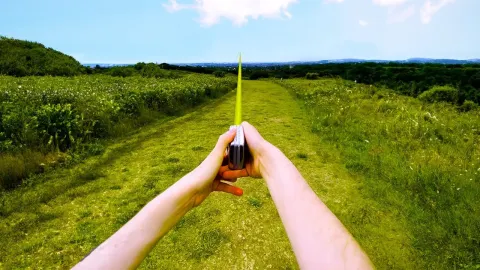
this isn't a flare, it's just a direct image of the eclipse! The clouds passed in front of the sun enough to darken it enough for the camera to take a photo directly without glow or flares to obscure the image. It's all about relative brightnesses! And if you're actually out in the real world photographing bright objects, well, if something's a flare, you can put your hand "behind" it (because the flare is happening inside the lens), while if it's really the object, then the only way to put your hand behind it is to actually get behind the object (which,
with the sun at least, is kind of hard). While you're waiting for the next eclipse to get hands-on with the sun, it's a good time to get your hands busy with the new math and science courses from Brilliant, this video's sponsor. I just checked out their new course on visualizing data (a thing I think a lot about as a science communicator, enough that I've given talks on it!), and it's a nice intro to knowing what kind of charts and plots to use to convey different ideas. I also went through their new course on how AI large language models (like chat GPT) work,
and I learned about how changing the "temperature" setting of an AI can change its creativity! To sign up for Brilliant (for free) and get 30 days of full access to all of their courses, go to Brilliant.org/MinutePhysics. The first 200 people will also get 20% off an annual Premium subscription for all of Brilliant's content, including the new courses they add all the time. Again, that's Brilliant.org/MinutePhysics - and thanks to Brilliant for their support.