10:15



Hey everyone, me Kevin here coming to you from Rome now. Yep, in Rome. Went from the Mediterranean Sea over to Rome and I want to talk about private credit. How concerned we should be about private credit and some of the latest updates, especially since we do have a headline here that Black Rockck, massive name, private credit fund honors less than 40% of redemption requests. And I want to touch on how important this is systemically, why people might be fleeing these. I've got a little bit of institutional research to follow up on this from MUFG that we're going to be looking at or at least I'll be talking about it since I'm not going to put
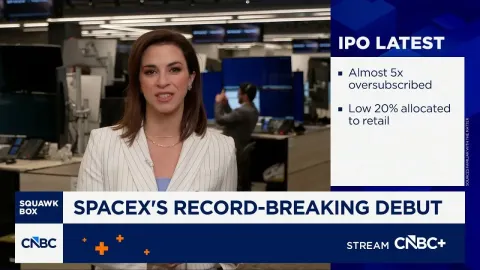
anything on screen and UBS. I think both of these will be very useful. Uh and it's also useful in context with what's going on with the broader market which we'll see in just a moment. So I'll talk about what's going on uh across all of these. We'll also touch on SpaceX. Remarkable, by the way, that we shouted out that SpaceX might have an upside of 30%. And that's literally how high it went today once it went public. And we said that in our last videos, uh certainly the one this morning before they went public and even yesterday, 30% upside. Boom. We hit that 30% upside did start seeing that selling into the close. Uh SpaceX ending up about 20% which it's about part for the course,
about right there with expectations. Same thing with the cues. By the way, tonight also before we get into private credit here, worth remembering is a coupon code expiration night. We got to jack up the prices because we just released some more features and it's expensive. So, the prices are going up. Uh, but if you use that coupon code tonight, you can get in before those prices go up. We've got a big price target as well that you'll be pervy to for the NASDAQ 100. If you join, you get to see that uh the uh top uh probably about 16 stocks for the next 10 years as well as short-term trade ideas, medium-term trade ideas, and of course those long-term trade ideas. Just go to
meet Kevin.com. You can see all the benefits there. Now, uh as far as private credit, let's get focused here. So, private credit in the Financial Times, we have the heads up on the front page that investors sought to pull more than 13% from one of private uh Black Rockck's flagship funds. Basically, they bought this company, HPS investment partners last year. They spent 12 billion buying them and the goal was for Black Rockck to become one of the major players in private credit. Obviously, last year at the end of last year, we had uh you know, the first brands collapse, we had the tririccolor collapse. We had a lot of issues in private credit suggesting, oh my gosh, this is going haywire. A lot of
people are going to lose their pants. And the issue that I've regularly talked about with private credit isn't that it necessarily affects you directly. It's that the issues in private credit end up constraining new forms of lending and they end up affecting the economy. Uh, which then leads to a decline in earnings and then a decline in the stock market and then you get the vortex down. Right? Uh so we've got some institutional commentary on this but that's that's just to set you up. That's my initial uh sort of take when I go into this. Now uh HPS uh and this HPS fund rather and now therefore Black Rockck have honored requests equal to 5%
of the funds net assets. This is fully disclosed. This is very normal that they could say hey look this is the second quarter in a row now we're not able to meet redemptions. This is just going to keep being a headline. So honestly, I don't think it's that big of a deal. These funds, because they invest in private companies, it's really normal for them not to be able to essentially distribute more than 5%. I mean, think about it. If you, let's say, we're going to go build a McDonald's down, you know, two blocks from where you live, wherever that is. You're going to go build a McDonald's and a bunch of people lent you $5 million to go buy all the kitchen equipment and build the building and get
the permits and architects or whatever. Uh and you know all of a sudden everybody was able to redeem their money whenever they wanted and then somebody comes out with a food inc 3.0. The second one sucked by the way. The first one was good. The second one wasn't that good. Uh the third one probably wouldn't be good. But let's just say right when you of course go to open a McDonald's, somebody comes out with Food Inc. 3.0 and all of a sudden people your investors boycott you know McDonald's and they're like I want my money back. What are you going to do? You going to just like stop building the McDonald's?
I mean, maybe you got that 5% cash aside, but you know, it takes time to raise cash when it's being invested into relatively illquid uh, you know, opportunities. I don't even know if I call them opportunities. Honestly, I think these funds are set up to mostly be fee funds, and I'll explain that in just a moment. Uh, so anyway, the liquidity makes sense, but uh especially when they're using leverage, it's really hard to just sort of like crack the shell, if you will, and uh send money back to investors. But I think a lot of people are pulling money out. Uh, and this is actually corroborated by MUFG. A lot of people are pulling money out of these private credit funds because why do you want to be in private credit right now? If you
take your money out of private credit, first of all, you could probably go buy the dip on other private credit funds and instantly get a better rate of return, right? Like if you got a 100% of your money back on a full redemption at fund A and you still believe in private credit, you could probably go to fund B. some other schmucks fund and buy it for 80 cents on the dollar right now. So you would get this instantaneous, you know, whatever that is, 25% return, right? Because a quarter of 80 is 20. 20 plus 80 is 100, right? Yeah. So you'd get a 25% return instantaneously taking your money out at par at whatever fund you're in and then just move it into a discounted fund and boom, you know,
right? If you're a believer in private credit, it actually ironically makes sense for you to pull your money out of private credit so you could go buy the dip on somebody else's private credit. It's kind of brilliant if you think about it that way. And when you think about it that way, you kind of start going, "All right, all right. May maybe it's idiosyncratic. I don't want to say that. I don't like using that word. That's just a fancy way of saying, "Oh, guys, no, it's not a problem. It's just one company at a time." Honestly, what I think is really happening in private credit is you have this, you know, we're knocking on
the door of the highest interest rates uh that we've had this whole cycle. Uh let me pull the 10-year right now. And the problem is when we hit this level, which is just below the 4.57 level on the 10-year. It's about 4.48 right now. When we hit that level, the people who were part of the 2021 2022 vintage of private credit, you know, those are now four, five, six, seven yearsish old in that sort of range, they're all used to really, really low rates. And so they're rolling over to high rates and they're getting screwed. The people who were, you know, part of private credit financing in 2023, four, five, six, you know, now because it's obviously still going up, they're not really worried.
They're like, "Hey, I don't care that interest rates are still at 4.47. I mean, it sucks, but that's what we signed up for. Like, we're already used to that." So, it's really that cohort around 2021 22ish, there was near zero negative. I mean, before COVID, there's a period of time we had banks with negative interest rates, right? Europe had negative interest rates. So that 2019ish era to 2020 uh into 2021 was pretty wild. But anyway, the whole point of saying that is that seems to be where a lot of the pain is. Uh and so those waves in addition to of course fraud like what we saw with allegedly tricolor and first brands. Yeah, you know, some of that crap's got to shake out. But you know
what actually is this HPS fund anyway? Well, honestly, I'd want my money out of this as well. This is freaking crazy. Listen to this. And I shouldn't I'm not trying to bag on them, you know, I just want to be reasonable here, but I want you to understand some of the fees that go into this stuff and it's insane because they make a lot of money. It kind of makes me want to start a private credit fund, but then again, I kind of like look at other people's companies or businesses or funds and I'm like, all right, I don't think that's good for the end user. How can I not do that? And let's figure out a way to make money that's win-win for everyone. That's always sort of my mindset because I think hey, if I can come up with a
win-win solution, then that is actually going to enable me to grow better, right? Why would a better win-win option not grow better? But this is insane. Listen to this. They charge a 1.25% 25% of net assets management fee plus a 12.5% uh of income fee above a 5% hurdle plus 12.5% of realized capital gains plus a servicing fee by class of between well some class I has no servicing fee but some of them have a quarter of a percent half a percent 85 bips acquired funds fee47 other expenses fee 33 three. Uh, basically they give an example where if they don't exceed a 5% yield, you're on the first year paying like 90 bucks in fees out of $1,000, which I'm like, bro, if I read that right, that's like
9%. Now, go verify it yourself, but that's 9% before you actually try to return more than 5%. And if you guys are returning more than 5%, you know, then I'm going to put on another 12% of that excess on top of there. Now, I may have butchered some of these fees, so don't use me as like summarizing the perspectives here for you for these fees. But my point is, you have to put this puzzle together. On one hand, you have private credit underperforming. MUFG is saying this literally, they got a whole page on it right here. Private credit funds have underperformed public markets. Of course, amid software displacement concerns from AI, high leverage ratios, and a series of redemptions, investors
have been selling off their business development corporation shares, right? So, it's not just BD BDC's, but it's also just private credit. Yes, again, it makes sense to move your money from the private credit fund you're in to another one at a discount. You make more money. It also makes your sense in my opinion to take your money out of something like an HPS is the fees are cooped up. And then on top of that, not only are the fees cooped up, but then you compare to just what straight up index funds are doing like the NASDAQ 100 or the S&P. What the heck do you need to be locked up into private credit for? Like in my opinion, if you're going to invest in private credit, it should be like
trying to pick a unicorn, right? And of course, that shouldn't be the bulk of your investment. I mean, I personally think reinvested I mean, well, worth noting SpaceX took 24 years to go public. I want to beat that by a long shot, right, with house reinvest, but I heard that I'm like, dang, that took them a long time to go public. That's crazy. But anyway, I love betting on uh and again, you shouldn't do this with everything. Uh but I love betting on unicorns where I'm like, "Oh, yeah, no, I think we're going to make a lot of money on this." like, you know, I think my own company is going to be a multibagger in the future. I bet on SpaceX when it was $300 billion with my venture capital fund. Uh, and the sucker
is now trading for what 2.1 trillion. That's a 7x, which is crazy. Now, we'll see after Dilution what it actually ends up as. And of course, when um when the lockups expire. Uh or like Apptronic, another venture capital bet, you know, that was a bet that I made when it was a $300 billion valuation and I think now they're at like 4.5 or something like that. That's like a 12x. Those are unicorn bets that I like making. You don't throw everything into a unicorn bet obviously. But my point is investing in these private credit funds is almost like throwing money onto unicorns, but you're not. You're
throwing money into a high fee business that's then diversifying that money like 96% in this case of HPS over here into first lean debt for companies like Zenesk, Proof Point, McAfee, Datab Bricks, Pets Smart, Staples, uh, Aspen Dental Health. I mean, a lot of these aren't going anywhere. Actually, I think we go to Pets Smart a lot, don't we, Jack? You like Pets Smart? Yeah, he's he's naughty. He likes Pets Smart. Uh, and uh, you know, that's obviously all the catalyst we need right there. Pets smart, good, loans, good, we're fine here. I actually think probably a lot of these loans are honestly solid, especially if they're first lean loans.
Uh, but uh, to me, I think it's just FOMO and a fee realization. People are like, why do I need to be exposed to this? I'm not getting the unicorn. I'm getting high fees. I'm not going to make a fortune. Like, I can't get a unicorn investment on private credit. Because when you're a lender, you're capped with your rate of return. And they're harvesting most of that rate of return in the fee anyway. Or in the fee business. It's a fee business. That's that's all it really is. It's asset management fee business. I hate the fee business. You know, I'm of the mindset and I don't know. Leave me a comment down below. But I'm of the mindset that even a lot of these management companies, financial advisor management companies, they're charging
like 1 to 2%. And I'm not trying to bag on any adviser out there. There are a lot of advisors who did a lot of great work for their clients. But to me, it's like I think it'd be really cool if somebody could pay like to get real estate and stock robo advising except that robot is trained by somebody like I don't know, me, Kevin. Uh, no. Okay, I'm just I'm just making things up here. Although, if you like that idea, leave a comment down below. But like to me, that could be done at massive scale for a very low cost. not basis points on how much money you have, you know, JUST LIKE SMALL AMOUNT PER MONTH, TINY LIKE 50 bucks, 20 bucks, 30 bucks. I don't know. I'm just making stuff up, right?
But my point is like when I see these basis points of fees, I'm like, "Oh my gosh, these people are probably charging I think they cap their fees at HPS at like what is it 2.7 or 3 and a half% fee? I don't know. Whatever." Plus plus a portion of the gains. They're Oh, yeah. These fees are capped at 3 and a half% for the various different classes. Some of them capped at 2% but then again you these are fee businesses and it totally makes sense. If you can't get a unicorn or you're getting hosed on fees, you can move your money and make a better rate of return. Why would you not
want to redeem your money right now? But the deeper I look at this, the less concerned I am that this stuff is actually systemic. For example, when I compare this to 2008, uh MUFG actually does a great job of this. They compare that in 2008 we had subpime borrowers. Today we have high-profile bankruptcies. We had mark to models back then uh which were like oh yeah all these AAA rated loans they're not all going to default right and then in private credit today we have valuation concerns how do we value them thing is a lot of that private credit today is debt that's first lean position which is very different than what we had in 2008 of course we don't want to be blind to using the word
different because this time is different is a fatal fatally fatal thing to say uh point being though is when we kind get to the bottom of these issues of yeah, we got VI, you know, concerns about software, AI, whatever. We have probably had a lot of fraud in 2008 as well. The 2008 issue turned into a $10 trillion leveraged up major banking crisis across every single Main Street bank in America. Whereas what we're seeing here is as a first order effect mostly private credit funds that are getting hurt after private credit funds insurance companies are borrowing more than ever from uh um uh you know basically how should I rephrase this insurance companies they stand to get hurt uh these would
include lifeurers their major intermediaries in this market. Uh, and so you're a few steps removed from Main Street, which you weren't in 2008. Again, that doesn't mean it can't be problematic. And I'm going to explain how it could be problematic. In fact, I'll pull up the uh MUFG piece, which I had that uh I'll pull that up really quick. The MUFG piece that I thought was interesting is they said it well. They said that an increasingly important driver for the US macro outlook is private credit as a marginal provider of credit. And if they are the main driver of credit availability and credit growth
and if that slows down, that's when the broader macro cycle could slow down. And that's how we end up seeing a slowdown in again the stock market and then valuations uh for companies broadly. and then we get that self-fulfilling cycle. So, in other words, we have time. That's my read on this. I'm not I pay attention to private credit very closely. I've made a lot of videos on the bankruptcies and failures, and I'm by no means somebody to just stick my head in the sand and say everything is fine. I just like looking and going, "Okay, you know, Kevin, talking myself here, that makes sense. Everything we said about competing valuations, FOMO, higher rate of return, high fees, all of those make
sense in terms of why I'd want to get my money out. Now, what I want to watch for as the second order effect before I get more concerned is, are we seeing credit availability shrink? And so far, we are actually seeing the opposite. We are seeing credit availability expand. We are seeing net debt issued grow faster than the rate of nominal GDP. We use nominal because uh you don't have to you inflate in inflation adjusts the loans then as well and so we just use nominal on both sides. And the point is loan growth is still higher by a couple percentage points. That's good. If loan growth starts shrinking and credit availability starts shrinking, that's the second order effect that we pay
attention to because that's when it affects macro. Now, with all that said, uh let me see if there's anything else I missed here. We already talked about a coupon code expiring tonight. Uh UBS says we see limited systemic risk from private credit, but believe selectively uh believes selectivity and a focus on quality are paramount. Fine. uh risks are rising amongst the lower middle market borrowers but specifically the 2021 and 2022 vintages with defaults at 2.7% amongst that group. However, credit spreads broadly still remaining tight uh and we would be facing this issue whether or not there would be the Iran war uh per MUFG. So I mean some of these somewhat useful slides here. Uh I do
think that uh it is worth paying attention to credit expansion though and as long as that keeps going that's good. When that turns then we have a problem. Even though we've still got insurers kind of buffeting us uh from the original impact. Now uh understand obviously if rates go up higher there's some risks. The European Central Bank just raised rates for the first time since 2023. 10-year Treasury is still rejecting our resistance line at 2.5 sorry 4.57. The 102 is still at 40 which is good. Doesn't indicate that people are pricing in any for of nearer term recession. Usually we're shockprone above 50. We are under that which is very good. Uh this morning we did
mention in our alpha report that we thought the stock market the Q specifically the NASDAQ 100 would not be able to get past 225 today. And uh if I look at the intraday action just to sort of like grade myself afterwards, I can see we got up to 720. Hopefully I said 725 just like 30 seconds ago here, but we got up to 72401. What we actually wrote in the alpha report was 725. So we were within a dollar. We saw that as the upside ceiling today. And so we were accurate on that. uh which is important because we always want to review, hey, how accurate are we on the alpha report calls? We called for 30% upside on uh SpaceX. We literally got 30% which was shocking. The big thing
now is going to be preparing for next week, which I'm pretty excited for because we've got the G7 and in my opinion, we have a likely uh move uh on this Iran war. We talked about that in the video earlier today. So, I'm excited about that. Uh the other thing that I would broadly pay attention to is if we of course have rate hikes in the United States which are still being priced in obviously uh that is going to hurt the um potential for private credit to sustain its credit growth. Uh private let's see Fed. Okay, here we go. End of the year for an interest rate hike. O okay well actually this has gotten better. We're at 42.3% chance of a hold right now. That's actually probably better than what we've
seen over the last couple weeks, certainly as I've been gone. Uh can't wait to be back though. Be back soon. And if I look at July of 2027, uh we only sit about 25% chance of a um hold or a cut. Cut being nominal. The downside or the upside I should say of that is as long as we don't get a hike we actually have more upside in the market which I'm quite excited about. Uh I did mention that uh I did not think that the euphoria we saw at the end of the day yesterday would carry into the NASDAQ 100 today which is why I came up with that 725 upside reject. Uh I did think that uh we had um how should I put it? I initially thought that we would have some more we would have a greater likelihood probably 60% likelihood of a
downside uh today versus a 40% chance of an upside because of that liquidity going into SpaceX. Uh so it's actually a good sign that with SpaceX up 19 20-ish% on the day, we still ended up closing green on the NASDAQ though not that well. We closed up only about 59 basis points at 721. beats the 715 number though which is good. So broadly it means people are absorbing this issuance. There's more money out there. People have raised money uh and uh that just boosts the bear um the bare bull scale. We also had AMD recover 500 which is huge. Uh it did reject again off of the 520 line. And if you haven't been watching, SanDisk ran in the last couple
days, which is um not surprising. I don't think the hardware rally is over. I think the easiest gains of hardware are in, but I do not think the hardware rally is over, especially since that 75 billion that SpaceX just raised has got to go somewhere. Uh and we'll be analyzing next week as well some of the themes that we think are in play. One sector that was down today was healthcare, which uh is interesting because healthc care's already been sort of left in the bag for a while. Anyway, thank you so much for watching. Go to me.com, use that coupon code, and folks, we'll see you in the next video. Have a good night. Bye.