27:55




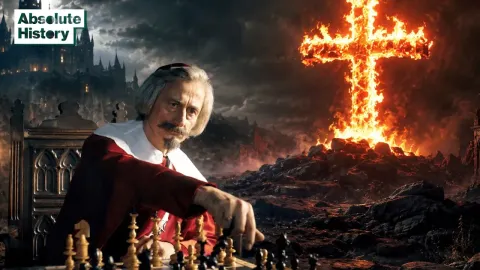
Attila the Hun, known as the 'Scourge of God,' led a vast army of Germanic and Asiatic warriors into Italy in 452 AD. Despite his fearsome reputation, he never sacked Rome, unlike other barbarian leaders. This documentary explores his origins, rise to power, and legacy as one of the most feared warlords who contributed to the fall of the Western Roman Empire.
In 452 AD, Attila the Hun led a huge army of allied Germanic and Asiatic warriors into northern Italy. Legend has it that Attila, who the Romans termed Flagellum Dei, 'the scourge of god', was only stopped when Pope Leo I met the warlord and convinced him to leave Italy. Unlike Alaric the Goth in 410 AD or the Vandal King Gaiseric in 455 AD, Attila never sacked the city of Rome. So why is he remembered today as the most fearsome of the barbarian warlords who destroyed the Western Roman Empire? This is the story of Attila the Hun, 'the scourge of god'.
The man known to history as Attila the Hun was born early in the fifth century AD, perhaps around the year 406 AD. There is no tangible evidence about his earliest years to establish when he was born and historians have simply extrapolated his date of birth from the fact that, he was seemingly in his thirties when he first came to prominence in the mid-430s AD. Similarly, his place of birth is unclear, though given what we know about the westward movement of the Huns in the first years of the fifth century, he was more than likely born somewhere around western Ukraine, Moldova or northern Romania.
There is an equal lack of certainty when it comes to Attila's family background. His father was a prominent Hun warlord who was variously referred to as Mundzuk, Mundzucus and Mundiucus by Greek and Roman scholars of the fifth and sixth centuries AD. There is no clear indication of who Attila's mother was. Prominent warlords amongst the Huns practiced polygamy and Attila could have been born to a concubine or one of several wives of Mundzuk. We do know that he had a brother named Bleda, who became an important figure in events later in Attila's life. His father was a brother
of the Hun leaders, Rugila and Octar, and Attila was consequently born into the ruling kinship group amongst the Huns at the start of the fifth century AD. Despite his origin amongst the Huns, a people who had migrated across Eurasia from the Asian Steppe in the centuries prior to his birth, there is a strong argument that Attila's name is Germanic. Atta roughly means 'father' in East Germanic dialects like Gothic and the ila suffix means 'little'. Thus, Attila would mean 'little father' if the name was Germanic. Cultural osmosis of the kind that would lead a warlord like
Mundzuk amongst the Asiatic Huns to call his son by a Germanic name, was commonplace in the late Roman imperial period. An alternative theory holds that the name comes from a Turkic dialect and means 'great ocean' or 'old sea'. Reconstructing the life of Attila the Hun poses some difficulties. Firstly, there is the question of bias in the sources. The Huns were not a literate people and they did not have chroniclers who could write accounts of their actions from their perspective. Therefore, we are primarily reliant on Roman and Greek historians for
information on Attila and the Huns. These accounts were far from neutral. For about thirty years in the middle of the fifth century AD, the Huns were the gravest threat to the Roman Empire and Attila in particular brought devastation to parts of both the Balkans and Western Europe. Accordingly, the Greco-Roman historians who charted the actions of Attila would have described his deeds in a hostile manner. The foremost contemporary account of their campaigns was written by Priscus, a Greek historian from near Constantinople, who wrote a history of the Eastern Roman Empire.
Priscus was a diplomat who actually visited Attila's court in 447 AD. His work has only survived in a fragmentary format, but it was used by the sixth-century historian Jordanes in his The Origins and Deeds of the Goths, a major work on the various Germanic and Asiatic tribes that repeatedly attacked the Roman Empire from the third century AD onwards. For the Western Roman Empire, Prosper of Aquitaine's Gallic Chronicle is a key source of information as Prosper also lived through Attila's attacks on the empire. There are also some fragments of information in the
works like the chronicle of Hydatius of Aquae Flaviae, a churchman from Gaul, while there are passing references to Attila and the Huns in the surviving letters of Sidonius Apollinaris, a Gallo-Roman aristocrat, who grew up against the backdrop of Attila's campaigns and remembered them in later life. These sources are of varying quality and reliability, and are biased, but they provide enough information to at least partially reconstruct the events of Attila's life. The one thing that these sources don't tell us, is where the Huns came from. Roman and Greek
historians and scholars had a good idea of the geography of places like Poland and the lands north of the Black Sea stretching east along the Pontic-Caspian Sea, but beyond that they were largely unclear about the geography and demography of places further afield. They had no real knowledge of the place the Huns came from. This was the Asian Steppe, a vast flatland on the northern side of the Himalayan Mountains, a part of the world from which other tribal groups like the Turks and Mongols would later emerge, to conquer much of Eurasia. The Huns were similar
to these later groups. Before they ever came to Europe, they had possibly been raiding into China for centuries and are quite possibly synonymous with the nomadic raiders which the Chinese knew as the Hsiung-Nu or Xiongnu. Later the Huns started to move westwards as part of a vast migration of Germanic and Asiatic people towards the Roman Empire, which was occurring as people were pulled towards Rome's borders by the possibility of rich plunder and also pushed westwards from the Asian and Pontic-Caspian Steppes by climate change that was impacting on their traditional
pastoral subsistence. By the middle of the fourth century AD, the Huns began migrating over the Ural Mountains and towards the River Volga. As they advanced further westwards they pushed other Germanic and Asiatic groups onwards towards Rome's borders. Hence, the Huns were impacting on the Roman Empire before the Romans were ever aware of who they even were. The Roman Empire was ripe for plundering by the time the Huns began to descend into what is now Ukraine and the Carpathian Basin at the very end of the fourth century and the start of the fifth.
The empire had been divided for administrative purposes into an eastern and western half in the late third century. A hundred years later the empire splintered fully into a Western Roman Empire and Eastern Roman Empire in 395 AD. Within a few years the government in the east tried to rid themselves of the invading Goths, who had largely taken over the Balkans, by encouraging them to attack the Western Roman Empire. So it was, that in 410 AD, Alaric the Goth sacked the city of Rome. The very same year, the Roman legions strategically
withdrew from Britain, while over the next twenty years groups like the Franks, Alemanni and Vandals conquered large parts of Gaul, Hispania and even North Africa. This was the situation which prevailed as the Huns began to move into Central Europe in the early fifth century AD. Although Attila is by far the best attested ruler of the Huns, as Greek and Roman writers like Priscus and Jordanes wrote extensively about him, we also know a little about their leadership as Attila was growing up. Around the time of his birth, the Huns were led by a warlord named
Uldin. He is the first Hunnic leader mentioned by name in the Greek and Roman histories of the era. While the Goths were raiding through the Balkans and then into Italy in the mid-400s, Uldin evidently led his men into Dacia, modern-day Romania, and began conquering parts of that province and exacting tribute from the local Roman authorities in order to not raid further south or west. As far away as Bethlehem in the Levant, St Jerome wrote of a new people he had heard of who "had poured forth from the distant Sea of Azov," and who were "flying hither and thither on
their swift steeds … filling the whole world with bloodshed and panic." Uldin was succeeded not long afterwards, by a Hun warlord named Charaton in the early 410s. By then, the Huns had begun moving into the Carpathian Basin and were emerging as the chief adversary of the Eastern Roman Empire in the Balkans. We don't know a lot about their internal politics at this early stage and it is unclear if either Uldin or Charaton were related to Attila in any way. Attila's early life can only be guessed at. The Huns were illiterate and there was no formal schooling amongst them in the way we understand it today. Instead, the education of
a warlord's son like Attila would have been in teaching him to ride a horse and to fight from childhood. When he reached his teenage years, he was quasi-royalty within the leadership of the Huns. Jordanes mentions that Mundzuk, Attila's father, was the brother of Octar and Rugila. They were the joint-rulers of the Huns in the 420s AD. It is possible that they had divided the Hun confederacy between them and Octar led the Western Huns, while Rugila was in charge of their eastern lands, launching raids south against the Eastern Roman Empire. Jordanes left behind a description
of Attila in his adult years, though there may have been some artistic licence in terms of how he described an individual whom he had never met. He stated that "He had an arrogant walk, and he rolled his eyes as he looked about. The power of that haughty spirit showed through in every movement of his body. He certainly loved war, yet he was restrained, lenient to those to whom he gave his protection, gracious to supplicants and keen of judgement. He was short, with a barrel chest and a large head. He had small eyes and a sparse beard flecked with grey. His
ancestry was plainly evident in his flat nose and swarthy complexion." This was the Hun who would become known as "the scourge of god." Attila's rise to power along with his brother Bleda occurred around 434 AD. Their succession as leaders of the Hun confederacy followed from the death of their uncle, Rugila. It's not clear why Attila and Bleda succeeded to the leadership, as they did have another surviving uncle named Oebarsius, who was alive in the late 440s AD. It seems likely that Attila and Bleda's father, Mundzuk, was already dead before Rugila died.
The succession of Attila and Bleda as joint rulers of the Huns echoed the earlier arrangement between Octar and Rugila and they may have had different spheres of influence in the Balkans. At the time that they succeeded, the Huns were living relatively peacefully in the Carpathian Basin. Rugila had accepted an offer from Emperor Theodosius II, the Eastern Roman Emperor throughout virtually the entire first half of the fifth century AD, to become an uneasy ally of the Romans, in return for not attacking their lands to the south and Rugila was given the honorary
title of a general in the Roman military. More importantly, he was paid an annual tribute of 350 pounds of gold to protect the northern border of the Eastern Roman Empire. Given that the Hun confederacy was the primary threat to the empire's border at this time, the tribute was effectively extortion money exacted from the imperial government in return for not attacking the empire. The question for Attila and Bleda when they rose to power in around 434 AD, was whether they would continue to simply exact tributes from the Romans in return for passively residing in the
Carpathian Basin, or if they would resume their destructive attacks to the south. The empire that Attila and Bleda were succeeding to as joint rulers, was considerable. The Huns controlled a large expanse of territory, stretching from around the banks of the River Rhine in the west, to the Pontic-Caspian Steppe in the east around modern-day Ukraine. This included the northern parts of the Balkans, meaning that they had extended their sphere of control to the edge of the Western Roman Empire and were occupying the northern parts of the Eastern Roman
Empire. The centre of this territorial empire was most likely in the Carpathian Basin, a large flatland which lies primarily in modern-day Hungary and which is surrounded by the Carpathian Mountains, the Balkan Mountains and the Dinaric Alps. The flatlands here were an ideal place for the Huns to establish themselves, as they were pastoralists, who rode horses into battle, lived primarily off livestock, and were used to living on large flat expanses like this on the Pontic-Caspian and Asian Steppes. Thus, although we cannot be certain exactly where the centre
of power of the Hun empire was, most studies favour the idea that Attila and Bleda would have operated from the Carpathian Basin. This was not a territorial state in the modern sense or even in the way that the Romans exercised power. It was more of a sphere of influence throughout which, the Huns exacted tribute. Moreover, although they were effectively occupying lands which had traditionally been part of the Roman Empire, the governments of neither the Eastern or Western empires were in a position to try to expel them from these lands in the 430s or 440s AD.
The ethnic composition of the empire of the Huns and of their armies was complex. In the studies of the so-called 'barbarian migrations' that were written for much of the twentieth century, various Germanic and Asiatic groups that invaded the Roman Empire between the third and fifth centuries AD, were generally depicted as being homogenous ethnic groups. Today it is recognised that the armies that invaded the Roman Empire were much more ethnically varied. While the Huns were the dominant group within their numbers, their armies and their empire were more of a confederation of
Germanic and Asiatic groups that were allied together against the Romans. These included the remnants of the Goths in the Balkans and additional groups that had been attacking the Roman borders for centuries, notably the Alans and Sarmatians, while people such as the Sciri and Heruls were also involved. Hence, Attila was not the ruler of a unitary Hunnic state, but rather he and Bleda had ascended to control a confederation of nomadic, warrior people drawn to Rome's borders by the promise of rich plunder for those willing to attack the declining empire. Attila and Bleda did not change the strategy which
Rugila had adopted in the Balkans years earlier. They renegotiated the terms of the tribute with Emperor Theodosius II to receive a larger amount of tribute and also to increase the amount of trade between the Huns and the Romans, but the broad deal remained in place for several years after the two brothers ascended to lead the Hun confederacy. Instead, the Huns and their other Germanic and Asiatic allies went east and descended into the Caucasus to campaign against the northern borders of the Sassanid Persian empire, a move which the Eastern Roman government
in Constantinople, the longstanding adversary of the Persians, were undoubtedly happy about. This campaign was not as successful for the Huns as earlier ones in Europe, perhaps because of the sheer distance from their main base of operations in the Carpathian Basin. Therefore, around 440 AD, Attila and Bleda reorientated their strategy again and began attacking the Eastern Roman Empire. In 441 AD they flattened the town of Margus near the Danube River, apparently under the simple pretext that the local Christian bishop had offended the sensibilities of the Huns,
who adhered to a religion with elements of polytheism and animism. The years that followed saw sporadic clashes in the northern Balkans as Theodosius' government fluctuated between trying to militarily challenge the Huns and simply paying them off with ever larger tributes. This changing strategy was determined in part by events elsewhere as Emperor Theodosius tried to move legions from North Africa and the Levant to the Balkans. By 443 and 444 AD, the conflict was intensifying as it became apparent that Theodosius intended to resist the Huns.
The war between the Huns and the Eastern Roman Empire would reach its peak in the second half of the 440s AD. By then Attila was the sole ruler of the Huns. Bleda died around 445 AD. It is usually stated as a fact that Attila killed his own brother in order to concentrate power in his own hands. However, there is actually very little evidence regarding Bleda's demise. For instance, Jordanes stated that "when his brother Bleda, who ruled over a great part of the Huns, had been slain by his treachery, Attila united all the people under his own rule." Later medieval
accounts such as the Chronicon Pictum, written by Mark of Kalt in the fourteenth century, embellished on this and stated that "Attila went in the city of Sicambria in Pannonia, where he killed Bleda, his brother, and he threw his corpse into the Danube." There really is no evidence to support this. The story of Attila's murder of his own brother became more elaborate over time, yet in reality, the evidence of the ancient sources only implies that Attila had his brother killed in order to claim complete power himself. There isn't much evidence, though, to say how,
where, when and why this happened. What is beyond doubt is that Attila entered into the most dangerous phase of his career after Bleda's death. In 447 AD the Huns burst through the borders of the Eastern Roman Empire and devastated the provinces covering modern-day Serbia and Bulgaria. They won a major victory at the Battle of Utus and threatened the capital, but Constantinople's great walls were too formidable to penetrate. Instead, Theodosius decided to once again bribe Attila, this time paying him an enormous tribute of over 2,000 pounds of gold.
The organisation of peace between the Eastern Roman Empire and the Huns in the aftermath of the Battle of Utus saw Priscus, our leading source for Attila's actions in the Balkans, visit the Hunnic court as part of the diplomatic negotiations. This was fortunate, as Priscus afterwards left behind a detailed description of what he saw there. This clearly indicates that the court of the nomadic Huns was not stationary. It moved around and was made from wooden structures that could be taken apart, transported and reassembled. For instance, Priscus noted that "Attila's residence,
which was situated here, was said to be more splendid than his houses in other places. It was made of polished boards, and surrounded with wooden enclosures, designed not so much for protection as for appearance' sake." Nevertheless, while they might have been moving around, and been a warlike people, Priscus indicates that the Huns had adopted some of the luxuries of life in the Roman Empire. For instance, he noted that Attila's second-in-command, a chieftain named Onegesius, had a bath-house next to his house. Elsewhere Priscus observed "buildings of carved boards
beautifully fitted together, others of straight planed beams, without carving, fastened on round wooden blocks which rose to a moderate height from the ground," while inside these buildings were furnished with couches and woollen mats. This was not a primitive setting. Priscus went on to provide an account of his direct encounter with the leader of the Huns and his observations of how the royal court functioned: "He came forth from the house with a dignified strut, looking round on this side and on that. He was accompanied by Onegesius, and stood in front of the house; and many persons who had lawsuits with one another came up and received
his judgment. Then he returned into the house and received ambassadors of barbarous peoples." What is most striking about this is that the Roman embassies from both the Western and Eastern empires were made to wait to be called one by one to come before Attila: "When the hour arrived we went to the palace, along with the embassy from the western Romans, and stood on the threshold of the hall in the presence of Attila. The cupbearers gave us a cup, according to the national custom, that we might pray before we sat down. Having tasted the cup, we proceeded to take our seats,
all the chairs being ranged along the walls of the room on either side. Attila sat in the middle on a couch; a second couch was set behind him, and from it steps led up to his bed, which was covered with linen sheets and wrought coverlets for ornament, such as Greeks and Romans used to deck bridal beds." As the evening went on a feast began. This was not rustic. Fine food was brought in on silver platters, but Priscus noted that Attila was content with more simple fare served in a simple way: "Attila ate nothing but meat on a wooden trencher. In everything else,
too, he showed himself temperate - his cup was of wood, while to the guests were given goblets of gold and silver. His dress, too, was quite simple, affecting only to be clean. The sword he carried at his side, the ratchets of his Scythian shoes, the bridle of his horse were not adorned, like those of the other Scythians, with gold or gems or anything costly." The only affectation here by the leader of the Huns was after the meal, when "evening fell and torches were lit, and two barbarians coming forward in front of Attila sang songs they had composed, celebrating his victories and deeds of valour in war."
the Hun, the warlord was about to embark on a new strategy. Heretofore the Huns had primarily focused on attacking the Eastern Roman Empire, but with peace established in 447 AD with the government of Emperor Theodosius II in Constantinople, Attila looked westwards. The Western Roman Empire had been under the rule of Emperor Valentinian III since 425 AD, though he had succeeded to the imperial title when he was a six-year old child and only began to rule himself in the 440s AD. During his younger years, the situation in the empire
had gone from bad to worse. Already at the time of his accession, Britain had been abandoned and groups like the Franks, Visigoths and Vandals occupied large parts of Gaul and Hispania. Things became worse still in 429 AD when the new ruler of the Vandals in Hispania, Gaiseric, assembled a large fleet and led tens of thousands of his followers across the Mediterranean to North Africa. Over the next ten years the Vandals carved out their own kingdom in North Africa, stretching all the way from the Straits of Gibraltar to the city of Carthage in modern-day Tunisia, ending the
rule of the Western Roman Empire here. Therefore, when Valentinian came of age in the 440s AD, the western empire was broadly confined to controlling Italy and parts of southern and eastern Gaul. They still aspired to control northern and western Gaul, parts of Germania and even Hispania, but the Visigoths, Franks and Burgundians were more influential in these regions and only gave allegiance to the Romans intermittently. It was against this decaying power that Attila turned his forces in the late 440s AD.
Europe, though it was not the Emperor Valentinian III. This was Flavius Aetius. He was born in the Balkans in the late fourth century, though he was descended from the old Roman aristocracy of Italy on his mother's side. As a teenager he had been a hostage in the entourage of Alaric the Goth as he rampaged through Italy in the period prior to the sack of Rome in 410 AD. Later Aetius spent time at the court of the Huns in the Balkans during the era when Uldin and Charaton were the rulers of the Hun confederacy. Therefore, the figure who would lead the defence of the Western Roman
Empire against Attila's assault in the late 440s and early 450s AD was very familiar with the Huns and their confederates in the Balkans. He was also a very experienced general. Aetius had campaigned extensively against the Franks and Visigoths in Gaul from the late 420s AD onwards. He had been comparatively successful in trying to re-establish Roman control over the region north from the Alps along the Rhone River towards the western bank of the Rhine, the old northern frontier of the empire. However, after Valentinian III came of age, clashes between the emperor and
the general began. Thus, not only was the Western Roman Empire being viciously attacked by Germanic groups like the Vandals, Visigoths and Franks that were living within Gaul, Hispania and North Africa but there was also an internal power struggle between the Emperor Valentinian III and the most powerful general of the era, Aetius. seemingly inspired by the sister of Emperor Valentinian III, a woman named Honoria. Polygamy was practised by the Huns and Attila had multiple wives or concubines and many children already. Still, he determined after establishing peace terms with the Eastern Roman Empire that he would
campaign west and marry Honoria. Remarkably, she appears to have established contact with Attila and had requested that he come to Italy. The backstory was unusual. Honoria was pregnant from a relationship with a court functionary and her brother had placed her under a de-facto house arrest when he discovered that she was with child. Honoria had consequently requested Attila to come to rescue her, an invitation which the Hun leader interpreted as a call for him to come to Italy and claim her hand in marriage. While he was interpreting this overture in
a self-serving manner, he also conveniently decided to conclude that Honoria's dowry or marriage portion would be half of the remaining territories of the Western Roman Empire. Thus, at the end of the 440s AD Attila led a large army west to claim these lands and rescue his future bride. Ancient sources typically exaggerated the size of barbarian armies and this was no exception. They proposed that the Huns and their allies numbered upwards of half a million men who streamed over the Rhine into Gaul to try to conquer the remaining Roman lands there. The
likelihood is that Attila led tens of thousands of men into the lands of the Western Roman Empire, but nowhere near the hundreds of thousands that were suggested in the ancient accounts. Attila's initial aim was to seize control of the Roman lands on the west side of the Rhine and into Gaul around what we know today as Belgium and north-eastern France. Aetius moved north to stop him, gathering allies amongst the Franks and Visigoths who understandably believed that they had to make common cause with the Romans to avoid being displaced by the Huns themselves. Meanwhile,
the Christian bishops of northern Gaul tried to organise the immediate defence of the cities and towns here. Some reached accommodations with Attila to avoid the Huns plundering their cities, others tried to resist. It was while describing this invasion that the Latin term Flagellum Dei, 'the scourge of god', was first used to describe Attila. The Hun army that campaigned into Gaul would have closely resembled a description given in the late fourth century AD by the Roman military commander and historian, Ammianus Marcellinus. He had described them as having no
regular battle order. Instead "they move quickly and suddenly, now dispersing, now coming together over the ramparts and pillaging the camp before their approach had become known." He also described them using nets that they threw over enemy soldiers from their horses before closing to massacre them. The one thing they could not do was penetrate large city walls, as they were not skilled at siege warfare. Thus, the city of Orleans in northern Gaul was able to withstand an attack by them. Not long after abandoning his attack on this city, Attila finally clashed with the army Aetius had gathered at Chalons. The Battle of the
Catalaunian Fields, as it is known, was fought on the 19th of September 451 AD. With perhaps a touch of hyperbole, Jordanes later claimed that during it "the fighting became hand-to-hand, fierce, savage, confused and without the slightest respite. No ancient saga has recorded such a conflict … Our elders report that the blood from the bodies of the slain turned a small brook which flowed through the plain into a gushing river." At the end of it, Attila and his confederate forces fell back and retreated, though this was not an unequivocal victory for the Romans. Although we
can dismiss the claim made by the historian Hydatius that 300,000 men died in the clash, both sides suffered heavy losses, most notably the Roman's Visigothic allies, whose king, Theodoric, was slain in the battle. Aetius chose not to follow up his victory by chasing Attila towards the Rhine. In reality he was not at liberty to do so. A large contingent of the so-called 'Roman' army at Chalons was made up of Germanic allies and with their king dead, the Visigoths entered into a civil war between his sons, Theodoric and Thorismund.
Attila and his forces retreated back east of the Rhine into Germania and wintered there. He would not trouble Gaul ever again. Instead he now turned his attentions southwards towards Italy itself, perhaps aware that Aetius and the Emperor Valentinian III were not aligned on any real level, while also realising that the stout defence he had run into in Gaul was largely comprised of the Visigoths and Franks, whereas he would encounter less resistance if he struck south of the Alps. He also possibly wanted to emulate Alaric the Goth's capture of the city of Rome back in 410 AD. Thus, in 452 AD Attila led his forces south into Italy. Strangely,
though, this campaign was aborted after he met with Pope Leo near the Mincius River in northern Italy. We have an account of this in Prosper of Aquitaine's chronicle. He states, "Attila, having once more collected his forces which had been scattered in Gaul, took his way through Pannonia into Italy … to the emperor and the senate, and to the Roman people, none of all the proposed plans to oppose the enemy seemed so practicable to send the legates to the most savage king to beg for peace. Our most blessed Pope Leo - trusting to the help of God,
who never fails the righteous in their trials - undertook the task … the outcome was what his faith had foreseen, for when the king had received the embassy, he was so impressed by the presence of the high priest that he ordered his army to give up warfare, and after he had promised peace, he departed beyond the Danube." Hence, in 451 AD Attila was rebuffed in his invasion of Gaul, while a year later he was convinced by Pope Leo to call off his invasion of Italy. Undoubtedly the descriptions of Attila and Leo's meeting were written with a Christian bias. One
version even has St Peter and St Paul appearing to help Leo convince Attila to abandon his campaign. The likelihood is that Attila had invaded northern Italy to try to restore his reputation and pride after the defeat in Gaul the previous autumn, and after plundering the towns of northern Italy he abandoned the campaign under the pretext of having reached an agreement with Leo. He might have also realised after travelling through Germania, northern Gaul and northern Italy that the Huns were better off attacking the much wealthier Eastern Roman Empire after all,
rather than the poor husk of what remained of the Western Roman Empire. Hence, after his meeting with Leo, Attila led his men back to the Carpathian Basin and began preparing for a fresh campaign in the Balkans. A new emperor named Marcian had ascended to rule over the Eastern Roman Empire after the nearly half-century long rule of Theodosius II. He had even launched a campaign into the Hun territories in 452 AD while Attila was distracted in Western Europe. Therefore, Attila was set on shoring up his position in the Balkans as he moved back eastwards. The intended campaign would never take place though.
Attila was still only in his late forties at this time, perhaps nearing his fiftieth year. He could have continued to plague the Romans in both the west and east for many years more had his life not been cut short under suspicious circumstances. Whether he was poisoned or died by some alternative form of treachery remains a point of debate amongst historians. The most detailed account of his death comes from Jordanes, who quotes Priscus. Jordanes tells us that shortly before he died, Attila married a certain Ildico, possibly the daughter
of one of his Germanic allies based on her name. She was one of several wives. The wedding feast was the occasion of his death. Jordanes states that "He had given himself up to excessive joy at his wedding, and as he lay on his back, heavy with wine and sleep, a rush of superfluous blood, which would ordinarily have flowed from his nose, streamed in deadly course down his throat and killed him, since it was hindered in the usual passages. Thus, did drunkenness put a disgraceful end to a king renowned in war. On the following day, when a great part of the morning was spent,
the royal attendants suspected some ill and, after a great uproar, broke in the doors. There they found the death of Attila accomplished by an effusion of blood, without any wound, and Ildico with downcast face weeping beneath her veil. Then, as is the custom of that race, they plucked out the hair of their heads and made their faces hideous with deep wounds, that the renowned warrior might be mourned, not by effeminate wailings and tears, but by the blood of men." Perhaps it was a haemorrhage of some kind brought on by excessive drinking, though
some historians believe based on this account that Attila was poisoned in the course of the wedding feast and died during the night. News of Attila's death went out across Europe. Indeed, Jordanes claims that the event was so momentous that Emperor Marcian had a vision from god alerting him to the passing of the Romans' greatest nemesis, "for so terrible was Attila thought to be to great empires that the gods announced his death to rulers as a special boon." In the aftermath of his suspicious death, several of Attila's sons attempted to take his
place. These were Ellac, Ernak and Dengizich. A division of power between them would not have been out of the ordinary, as Attila and Bleda had been joint rulers of the confederacy for a decade before Bleda's death. However, Attila's sons immediately tried to claim power for themselves and tore the Hun confederacy apart in the process. In the vacuum that was created, one of Attila's former commanders, a man named Ardaric, who was a member of the Gepids, a Germanic tribe that formed part of the Hun confederacy, seized power after defeating Attila's sons at the
Battle of Nedao in 454 AD. He established a new confederacy under Gepid leadership, one which was ultimately more enduring that of the Huns. For instance, a Gepid ruler named Mundo or Mundus was still an important individual amongst the Germanic tribes in the Carpathian Basin three-quarters of a century later. He is believed to have been Ardaric's grandson. These developments once again suggest that the empire of Attila the Hun was really just a confederacy of Germanic and Asiatic tribes based out of the Carpathian Basin in which the
Huns were briefly the pre-eminent group between the early fifth century and the time of Attila's death. After his passing and the overthrow of his sons, the Huns faded away as a power and were replaced by newcomers like the Gepids. As transient as the Hun confederacy had been, its timing was significant. The Eastern Roman Empire recovered in the medium term and entered back into a period of rejuvenation in the sixth century. During the long reign of the Emperor Justinian between 527 AD and 565 AD, the Eastern Empire even managed to re-conquer parts
of the Western Mediterranean around modern-day Tunisia, Catalonia, Sicily and southern Italy, although the rise of Islam and the Arab Conquests of the seventh century, combined with new waves of Slavic invaders from Asia into the Balkans reduced the Eastern Empire to a rump state hundreds of years later. The impact of the Huns on the Western Roman Empire was more dramatic. Only 23 years after the death of Attila the Hun, the last Western Roman Emperor, Romulus Augustulus, was deposed by a Germanic warlord named Odoacer. This event in 476 AD is seen as marking the end
of the Western Roman Empire. In medieval times the view consequently emerged that Attila's campaigns into Italy and other parts of Western Europe had fatally weakened the Western Empire and paved the way for its termination 23 years after his death. This interpretation had extra credence given that only two years after Attila's death, the Vandals had crossed to Italy from North Africa and became the second Germanic group in less than half a century to sack Rome when they did so in 455 AD. It was owing to the belief that Attila had fatally weakened the Western Roman Empire and paved the way for the Vandal assault and the
deposition of Romulus Augustulus that Attila later became known as the major figure in the fall of the Western Roman Empire. Elaborate myths concerning Attila developed as well. One held that he had possessed the sword of Mars, the Roman god of war. Elements of his life story were even transmitted north to Scandinavia and were incorporated into Norse myths that were written down in the High Middle Ages 700 to 800 years after Attila's own time. He was central to the Middle High German poem, 'The Song of the Nibelungs', while Ludwig von Beethoven considered
writing an opera about Attila and he featured in numerous paintings produced in the nineteenth century. There is no obvious reason why Attila acquired such a position of infamy when he never sacked Rome like Alaric the Goth had, nor did he conquer entire provinces the way the Vandals had in North Africa. Nevertheless, the myth of Attila grew and grew over the centuries. Attila the Hun's name has become a byword for the violent invasion of the Roman Empire which brought the western half of the empire to an end in the fifth century AD. He holds a place
in the western imagination similar to that of Genghis Khan as an Asiatic warlord whose forces were virtually invincible. The reality is actually quite different. Almost nothing is known about his background and early life, though he clearly came from a family that was involved in the leadership of the Hun confederacy in the early fifth century. In the mid-430s AD, he and his brother Bleda became the new leaders, though Attila appears to have eventually orchestrated the murder of his brother and became sole ruler of the confederacy in the mid-440s AD. This being said,
it is important to remember that the Huns were not a homogenous group that threatened the Western and Eastern Roman Empire for decades. They were the foremost group amongst a confederacy of Germanic and Asiatic tribes based out of the Carpathian Basin. There is no doubt that Attila plagued both the Eastern and Western halves of the empire, but this needs to be viewed in context. While the Eastern Roman Empire still had some vitality to it and would rebound strongly from its difficulties in the sixth century, the Western Roman Empire was in its death throes already by the time Attila
became leader of the Hun confederacy. Rome had been sacked in 410 AD and groups like the Angles, Saxons, Franks, Visigoths and Vandals had already overrun most of it. Attila clearly weakened it further and left an impression on contemporaries and medieval chroniclers, but he was just one of several prominent Germanic and Asiatic leaders who brought the Roman Empire to the verge of ruin in the fourth and fifth centuries. It is arguable that Alaric the Goth, the warlord who sacked Rome in 410 AD, or Gaiseric, the Vandal king who conquered North
Africa and then sacked Rome for a second time in 455 AD, were far more consequential in the fall of the Western Roman Empire. Nonetheless, it was Attila who has become the paragon of the barbarian warlord who destroyed the Western Roman Empire and plunged Western Europe into the Dark Ages. What do you think of Attila the Hun? Was he really the most powerful adversary the Romans faced in late antiquity, or has his status as the so-called 'scourge of god' been strangely overstated? Please let us know in the comment section, and in the meantime, thank you very much for watching.