5:32



Okay, you've decided to get the latest iPhone, but should you go for the more compact iPhone 18 Pro or the bigger but more expensive iPhone 18 Pro Max? The Pro Max is the better phone on paper, but the smaller iPhone 18 Pro offers almost exactly the same experience for less money. We put both through our suite of tests, and for some people the smaller Pro is the smarter choice. Let me walk you through it. The iPhone 18 Pro and iPhone 18 Pro Max are Apple's 2026 flagships, and they offer the same top-tier features. The Pro is at least 100 bucks cheaper than the Pro Max, though. For that extra cash, the Pro Max offers a bigger battery, faster charging,
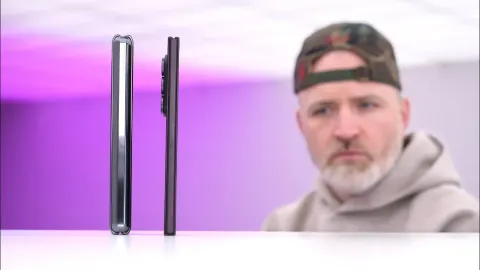
a bigger heat sink, and a larger screen than what you'd get with the Pro model. That doesn't make it a clear-cut winner, though. The Pro Max is way heavier, 38 g to be precise, and in hand it's noticeably bulkier. Many people would want to choose the Pro simply because it's more comfy to use. Besides that, the looks and build materials are the same between the two phones, and you get the same color options either way.
Both of these iPhones have hardware controls in the way of an Action key and a dedicated Camera Control key. There's also equivalent ingress protection, IP68-rated against dust and water submersion to a depth of 6 m. But let's compare these two phones' displays. It's actually one reason you might choose the Pro Max. The iPhone 18 Pro has a 6.3-inch OLED with a high resolution and high refresh rate. But the Pro Max is considerably larger at 6.9 inches. This means that the Pro Max has notably more screen real estate, so a bigger picture when watching things on the phone. And on the Pro Max, the cutout for the selfie cam takes up less of the total screen space.
At least either way, Apple has reduced the size of this cutout by moving the IR camera to under the screen. And Face ID works the same on either device, as responsive and snappy as ever. When we measure the maximum brightness, these two phones are neck and very bright. Both of these displays have an anti-reflective coating, too. So, the usability outdoors in the sun is just as great. Now, we'll move on to the speakers, and the Pro Max is louder, earning a score of Very Good on our charts versus Good on the 18 Pro. We'd say the Pro Max sounds better, too,
with more pronounced bass. You can listen for yourself through our comparison tool linked below. But an even bigger and arguably more important consideration between these two phones is the battery life. When comparing the SIM-enabled versions, the iPhone 18 Pro's battery capacity is a bit over 4,000 mAh, while the Pro Max's is nearly 5,400 mAh. That's a pretty sizable difference, but the Pro Max also has a bigger screen to power. So, let's see how it translates into battery life. In our suite of battery life tests, the iPhone 18 Pro Max came out ahead,
earning an overall active use score of over 19 hours, while the 18 Pro's was less than 17 hours. Not surprisingly, the Pro Max had its biggest lead in the 4G call test, where the screen stays off, but it was comfortably ahead in all other categories as well. Apple has also given the Pro Max faster charging. It's 54 W versus 45 W on the iPhone 18 Pro. In our charging test, the difference wasn't huge, but it was noticeable. The Pro Max charged a few percentage points more in a half hour, and a full charge was a few minutes faster as well. But both phones feature the same 25 W Qi2 MagSafe wireless charging. And Apple has equipped both of these iPhones with the same chipset, the new Apple A20 Pro.
It promises a considerable jump in performance across the board compared to the previous generation. And both phones run high-end games without breaking a sweat. In benchmarks, we indeed see a nice improvement compared to last year's iPhones. But between the Pro and Pro Max, the performance is equal. What isn't so equal, however, is the thermal management. As I said earlier, the Pro Max has a larger heat sink. In our prolonged stress test, the 18 Pro displayed notably more thermal throttling than the Pro Max. Not sure how much of an impact that would really make for your daily use, though.
Both devices offer the same storage tiers, starting from 256 gigs and going up to 2 terabytes. And there's the same software experience on both of these iPhones, as expected. It's iOS 27, with Apple's latest aesthetics and features on board. And now onto the cameras. Unlike what we saw a few generations back, Apple equipped both the new Pro and Pro Max with the same setup. On the back of either phone, you get a main cam, a 4x telephoto zoom, and an ultrawide, all at 48 megapixels. And these main cameras introduce something new when it comes to Apple, a variable aperture lens.
This lens allows you to manipulate the depth of field behind a close-up subject. Adjusting the aperture doesn't seem to otherwise affect the photo quality, though. Speaking of that quality, it's identical between these two iPhones, as you'd expect from two devices with the same hardware, software, and image processor. From the main cameras, you get output with conservative colors, great dynamic range, and very good detail. At 2x zoom, the main camera still delivers very good results. The 4x telephoto cameras capture good shots, but it's hardly exciting stuff if you compare them to proper top-tier camera phones in the Android world.
Similarly, the ultrawides will get you identical results whether you go Pro or Pro Max. There's hardly anything to separate the two phones. That parity naturally continues into the dark, with both phones capturing the same low-light photos. The main cameras produce slightly grainy but detailed shots, with good dynamic range and accurate colors from both models. The telephoto images are good for the most part, though some more aggressive low-light processing probably wouldn't hurt. It's the same on either phone. And both the iPhone 18 Pro and Pro Max will capture the same ultrawide photos,
with largely underwhelming quality. The selfies are yet another area where you'd expect the exact same output from both phones. And here are 4K selfie videos taken with either phone. Both iPhones have the same wide-ranging video recording capabilities, including shooting in ProRes and Apple Log, too. Video quality is, of course, the same between the two phones, with well-matched output from all three cameras, great global properties, and very good detail. In the dark, main camera clips are very good, and so are the ones from the telephoto camera. But you get the visible internal reflections usual for iPhones.
The ultrawide quality is just okay, but without those reflections, at least. So, there you have it, guys. The iPhone 18 Pro versus its bigger brother, the iPhone 18 Pro Max. Either way, you get a well-built iPhone with the same looks and premium materials. The displays are smooth, sharp, and bright with an anti-reflective coating. There's the same chipset and processing power on both phones. The Apple interface and software features are just the same. And the results from the cameras are identical, too.
The iPhone 18 Pro, however, is more compact and much lighter, so it's easier to wield. The overall user experience is nearly the same, and while the phone is far from cheap, it's a bit less expensive than the Pro Max. On the other hand, the Pro Max does have a few advantages, including its larger screen, louder and better-sounding speakers, better thermals, longer battery life, and slightly faster charging. When you add those all up, they do amount to a noticeable upgrade, and it could be worth it to pay the extra 100 bucks and get the Pro Max. But if you prefer the compact form factor, the Pro is also a great phone that should serve you well. And as a bonus, you'd save a bit of cash.
Thanks for watching, and I'll see you on the next one.