6:55



Hello, I'm Selina Downs and welcome to Inside America, the show that brings you insight and analysis of the biggest issues facing the United States right now. On this week's show, a war in limbo. President Trump says a deal is close, but continues to threaten Iran. Well, we want it open. We want it free. We don't want all I mean, where this all goes is unclear. I think all to the president's team, but my guess is also to the president. Trump's visit to China appeared to yield little, but what happened behind closed doors? Our panel will examine the relationship between the world's superpowers as Beijing flexes its diplomatic muscle.
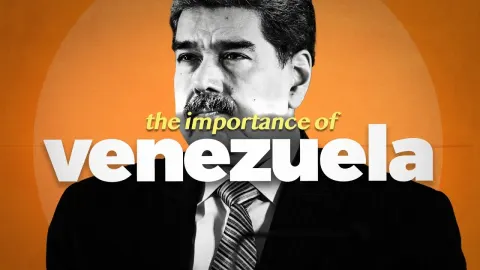
It seems to be a challenge to the America-dominated global order or the West-dominated international structure. But first, there's no real clarity over what comes next between the United States and Iran. As the world watches to see what the president does next, I'm joined by our North America correspondent John Brain, who's been following developments here at the White House. John, it's always difficult to second-guess the president. The messaging is often mixed. He's bounced between striking a deal and military threats. Is there a strategy here? Well, I think if there is a strategy or was a strategy, it could perhaps be boiled down to one word, and that word is Venezuela. Trump was so emboldened by
the Venezuela operation, not just the successful seizure of Maduro and his wife in that dramatic raid, but the fact that the Americans have been able to work with Maduro's basically his number two, Delcy Rodriguez, install her as the new leader, work with the old regime, and have this apparently successful collaboration between the two. Now, Trump seems to have thought he could replicate that in Iran, and of course Venezuela 2.0 Exactly. He keeps mentioning Venezuela. And of course, he was egged on by Benjamin Netanyahu, the Israeli leader, to do this. Netanyahu persuaded him that the regime would collapse once the Americans and Israelis started bombing. And of course, that it they haven't capitulated at all. And in
fact, although they took out those first tranche of leaders, those who replaced them seem to be more hardline than ever. That regime change has not happened. And I think Trump is often a very logical person. He thinks in terms, we often hear him say about who holds the cards. And I don't think he quite understands the fact that the Americans are bombing Iran, the leaders, the new leaders are at risk of being killed. He doesn't seem to realize that it's more ideological for the Iranians. They're not so concerned about personal survival and destruction in the country. And so, I think he's become more and more frustrated, and that's why we've seen him veer between talking about destroying Iran's
civilization one minute, and almost the next minute saying, "Oh, they're begging for a deal, and I think a deal is imminent" in his view. And of course, it's not as simple as that. The Iranians clearly are not have not been begging for a deal. They're willing to negotiate, but it has to be on their terms, it would appear. So, I think that's why we're seeing this almost floundering from the US president. I wonder if it's the mixed messaging that is making it so unpopular here at home, because a lot of Americans are wondering why they are bogged down again in a war in the Middle East, not least because also of spiking oil prices,
which is hitting them in their hip pockets here at home. Do you think any of that weighs on the president's judgment when he's making his next move? It's difficult to tell. I mean, he one mistake said he didn't care about the economy and he's often said, "Look, prices are going to come down once this conflict is over." The problem for Trump is that he's not facing re-election. So, he's he escapes the public's dissatisfaction in that sense. But of course his party is up for the midterm elections and if he if the Republicans lose control of Congress, that's going to leave a
hamstring president for the last 2 years of his term. They could even impeach him if the Democrats are in control. So, it's clearly a factor even though he's playing it down. And certainly for the American public, we've seen this is the number one concern for them even before the war. This war has not been popular from day one and the longer it goes on, it seems the bigger hit there are to Trump's poll ratings and to the Republican parties poll ratings. So, it's clearly got to be an issue for him. Yes, sure. Are the Democrats hoping to probably capitalize on public dissatisfaction going into the midterms? There John Brain, thanks so much. Always good to hear your analysis there. So, where do we go from here? I sat down
with John Altman, the global security analyst who worked at the State Department on Middle Eastern affairs and I asked him why it's so difficult for this administration to strike a deal with Iran. Look, you can certainly destroy targets in Iran and you can kill people in Iran. The question is how do you change the Iranian political calculus? How do you get the Iranians to make different political decisions? And it seems to me that the theory of the case at the beginning of this war was that was relatively easy to do. And arguably one of the things you learned in the first 40 days is changing the political calculus is much harder than coming up with target sets. Well,
it wouldn't be the first time that the United States has launched military intervention without a political calculus. I mean But I think it's it's different now because with advances in targeting with the use of artificial intelligence to come up with target sets, with the rise in use of precision munitions that really only hit the things you intend to hit. But it achieved an outcome. Now there's an expectation that it's very fast. It's very precise. You don't take any casualties. And you get the other side to casualties were in a school in Minab when the United States the US perspective, not taking any casualties.
Okay, but there has been collateral damage. No, there's been some collateral damage. I mean, when you're there have been casualties in the Middle East. When you're hitting 20,000 targets, uh it would be surprising to me if there weren't mistakes made. And I think that the Pentagon should be honest about exploring those and admitting those and paying compensation. you think they've been hiding some of the damage to US bases? Um hiding satellite imagery, disguising the risks to the US public. Well, I don't think you want to have the adversary understand exactly where everything's hitting for military reasons. So, what do you think the political strategy is of the administration? What
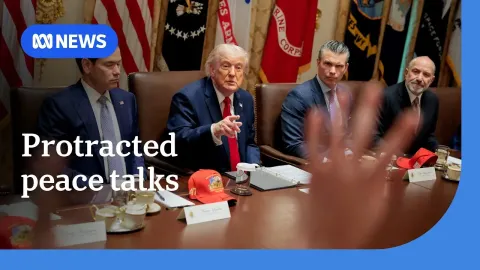
is the goal here with regards to Iran? And is that goal realistic? One of the words I keep hearing when I'm talking to people in the White House is the president's optionality. That the president retains as many possible alternative courses of action as long as is possible. I think that's different from the way most administrations have worked in the past where the goal is how do you prepare a series of options all of which have pluses and minuses, but have all been thought out. That's not the way this White House works. It's not the way this president works. Do you see a path back to diplomacy here? Is there an off-ramp for President Trump? I can see an off-ramp to negotiating with Iranians. I have a very hard time seeing a deal that can be
struck with Iranians that meets the US needs and the Iranian needs. From an American perspective, the president has talked incessantly that the Obama deal wasn't good enough. It was too narrow cuz it only focused on nuclear issues. It didn't deal with proxies. It didn't deal with missiles. From an Iranian perspective, they say we have to do much better than we did with Obama because the United States didn't adhere to the terms of the deal. We didn't get access to capital before President Trump withdrew from the deal, and then we were attacked. So, we need a much better deal than we got before.
I think you can create the parameters for a negotiation where you can work through smaller issues. But, I think that the prospect that each side feels it needs to get a much better deal from a deal that each side has said completely failed cuz we didn't get enough and the other side violated it. I think that makes a new deal under any terms very, very hard to imagine. And so, if those differences are irreconcilable, are we back in a forever war? No, you can be back in forever diplomacy. There's a long history of forever diplomacy between the US and Iran. I think we can get into that space. I think the Iranians are actually comfortable in being in forever diplomacy. They think that gives them an opportunity to make concessions when they need to, to apply pressure when
they want to. Um I think from an American perspective, that may be a better option than either striking a bad deal or [clears throat] prolonging a war that doesn't seem to be changing Iranian political decision-making. How do you think this has impacted um the US and its relations with the Gulf states? Do you think that the war has strengthened or weakened the US in terms of power and influence both within the Middle East and globally? You know, I think it's it's done both simultaneously. On the one hand, the Gulf states have come to understand that there are things the United States can do that no other country or collection of countries in the world can do. And therefore, it is ever more essential for
the Gulf states to have a close relationship with the United States. wasn't able to be that security But at the same time, that is not adequate for the security needs of the Gulf states. So, they will try to build stronger ties with China. I would guess stronger ties with Europe. I would bet investing both in connecting with the Iranians and deterring the Iranians. I think you're going to see them reach out in multiple directions, and they will both feel that the US relationship is essential, but also that as essential it is, it is also inadequate. I mean, this war has also had implications for China, has it not?
With regards not just economically with the Strait but also in terms of its relations with the Gulf states. Um if as reports suggest it is helping Iran with intelligence or providing weapons or components, how does that impact its relations if it's helping to Iran but then it also wants to maintain these strategic alliances that it has forged with some of those Gulf countries? I think, frankly, the Chinese relationships are transactional in the Middle East. China's been very clear. They see We often say that about President Trump. Yes. But the I think the Chinese view is Persian Gulf is kind of an American lake.
We don't want to send troops there. We don't certainly don't want to fight there. Let the Americans get dragged into the briar patch in the Gulf. To my mind, one of the things that's been clear is the Chinese really don't have much diplomatic ambition. They want to be present for prestige, but I think they're going to deal with everybody. And the fact is they're large enough that everybody wants to deal with them. John Alterman there speaking to me a little earlier. And John was right. Everyone, it seems, wants to deal with Beijing. So, is China positioning itself as the stabilizer to Washington's unpredictability? Craig Bow as well reports.
Just days after US President Donald Trump departed Beijing, Russian President Vladimir Putin flew in. It's a sign of China's growing importance on the international stage. Beijing's back-to-back diplomacy is dramatic. More than a dozen heads of state, including five leaders from some of the world's most advanced economies, have visited China in the past 6 months. Canadian Prime Minister Mark Carney met with Xi Jinping in January. British Prime Minister Keir Starmer arrived soon after. German Chancellor Friedrich Merz followed in February. Spain's Prime Minister and Abu Dhabi's Crown Prince visited in April.
But it was Trump and Putin who generated the most headlines. The White House hailed Trump's visit a success as both sides pledged to avoid another tariff war. And this has been an incredible visit. And think a lot of good has come of it. We've made some fantastic trade deals, great for both countries. He's a man I respect greatly. So far, we have established a new relationship between our two countries. A constructive and strategic relationship. This can be said to be a milestone visit. And we have reached many understandings on cooperative outcomes. But there was a stark warning. President Xi said the two countries could clash
over Taiwan if the US continues to send weapons to the island, which governs itself despite Beijing's claim it is a part of China. This political force of scheming for secession and provocation should now come to an end. China will achieve national reunification, and Taiwan will inevitably return to the embrace of the motherland. Trump's visit made no major breakthrough on Iran. China continues to support Iran in its war against the US, and Beijing continues to support Moscow in the war in Ukraine.
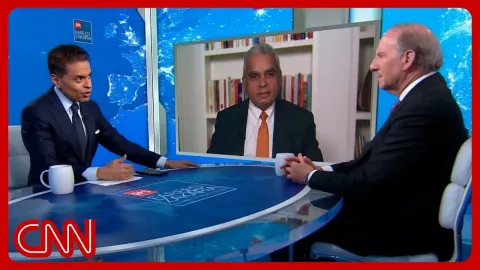
It's a diplomatic balancing act, showing China is positioning itself at the center of a new global order, no longer dominated by Western powers. Greg Boswell, Inside America. Skepticism of China has largely driven US foreign policy, but the two leaders now say it's all about strategic stability. So, what does that mean for these two superpowers and for the rest of the world? Joining me now to discuss the US-China relationship and their strategic calculations over the Iran war are Kelly Vlahos, a senior advisor at the Quincy Institute and editor-in-chief of its online magazine Responsible Statecraft, and Taisu associate professor of political science at the
Christopher Newport University. Welcome to you both. Tae, I want to start with you. Has the intensity of competition between the United States and China decreased? Have they reached a certain level of tacit understanding or is the distrust and the rivalry just too great to achieve this strategic stability they both speak of? Yeah, the intensity of competition may not necessarily have decreased, but I think both sides now have a basic understanding that escalation will not lead to the interest of both countries. There were escalations and economic warfare, tariffs added last year, leverage used. And so both sides now understand very clearly if you play any cards, if you escalate the situation, the type of retaliation you
will get that no side is willingly to move forward easily. And so we've now reached the state of mutually assured economic destruction. It's stability, it's constructive, but in the end this is not necessarily decreased level of competition or increased goodwill or trust. Kelly, is economic leverage the new warfare? I mean, I wouldn't call it warfare. I mean, I do think in all fairness that when Trump took office in his first term, he really didn't see China as a prospective military adversary. I think he has always been about the deal and economic competition with China was very clear to him and his administration. I think what you're seeing now is that more and the inclination to work with China while also being very
realistic about the economic potential threats that um China perceives or at least proposes rather than him amping up or escalating the military or potential military confrontation. And I think you saw that born out in their summit. I mean, the Iran war or the conflict in Iran is one of the areas where their strategic goals appear to be very different. I mean, is China deliberately trying to undermine or weaken US influence in the Middle East? I don't think that's the case and I don't think China is capable of undermining United States significantly. I think it's more of United States undermining its own capability.
We know that there are probably 10 aircraft carrier groups United States has, but only about three can be operational at the same time and all of them were sent to the Gulf, which means the Asia-Pacific, particularly the region close to China, is both mostly a power vacuum when the war in Iran is happening. I think the Chinese observers are also paying close attention that the speed of reduction of American ammunition and the cost and the speed to recover that ammunition is not going to keep the pace to be able to boast dealing with the war in Iran and also a potential conflict in the Asia-Pacific. mean, Kelly, that is one of the great ironies I find here, find difficult to understand is that President Trump when he returned to office for a second term said he was
going to take America out of wars in the Middle East and he was going to pivot back to the Americas and to Asia. And what the Iran war seems to have done is in fact had the reverse effect and enlarged China's footprint in that region. Yes, he has people that he brought into this second administration that are very much realists who were pushing for that, you know, pivot that you call it back to the Western Hemisphere. And not so much pivoting military um, uh, capabilities towards Indochina, but, you know, a renewed competition. And in that we were going to reindustrialize the United States. We were going to, um, redirect supply chains away from China and back to the United States. So, there was a real
plan to change. But, how realistic is that? Well, it's not realistic when you have people in your administration who want other things. And there are plenty of people who saw Iran as the primary focus of US foreign policy, um, preventing Iran, quote on quote, from getting a nuclear weapon, um, and that diverted Trump's attention. I mean, And so, I think there is a major, uh, lesson, uh, from Trump, uh, from the previous president that as long as American troops are not on the ground, it is easy to pull back. And so, uh, he decided that bombing, uh, Iran with Israel is just a one-time thing, that it can be easily done, uh, and terminated. But, uh, he did not realize the fact
that now we have multiple channels of, uh, influencing American public opinion, that, uh, Iran has leverage over the Strait of Hormuz, uh, that through that you can impact American gas price, American inflation. And so, through such economic changes, American voters can be impacted. And the dynamic is just as same as American troops on the ground and having casualties. And so, I think Trump probably did not expect that. And uh, kidnapping of, uh, Maduro probably emboldened him, uh, that this can be a quick and easy thing because of American military supremacy. Uh, but I his advisers and him probably got this wrong. Uh with US attention diverted from the Indo-Pacific, um does
this um essentially set up potential clash over Taiwan, uh clearly Taiwan's status with regards to American support or US support seems as ambiguous as ever. Right, and as you saw in the summit that Trump was being much more conciliatory um than Biden ever was than Biden ever uh basically conveying to Xi Jinping that he was going to put a hold on the 14 uh billion-dollar weapons package that had been going through Congress. And that's upset a number of people in uh the US capital uh who are much more hawkish and they want to get the those weapons over to Taiwan. He's walking a fine line. I think he felt that he had
to assure Xi Jinping um that he was not Biden um that he that hadn't been settled yet in terms of how much we would give Taiwan. And this has upset Taiwan greatly. Uh Tieh-Lieh, do you agree? Do you think both sides are trying to use Taiwan a little bit as leverage? Uh I actually think Trump's uh policy on Taiwan is practical uh even though he may not necessarily care too much about the geopolitical side of Taiwan. I think um uh Beijing's calculation on the unification with Taiwan is probably uh not too much related to the war in Iran and also uh the outside environment unless uh the United States provokes uh initially. Those who are involved in policy making on Taiwan would argue that the use of force, the use of coercion, and invading the island Taiwan are very
different things. Uh most of the time it's going to be coercion uh and maybe use of force to demonstrate credibility so that the provocation by uh the other side, the independent movement within Taiwan or American China hawks uh could back off. So, even if you see military exercises or coercive economic measures, it's not an indicator of Beijing ready to take over the island of Taiwan because it's too costly. What do you both make of President Xi hosting all of these world leaders, five of the G7 leaders of the world's most advanced economies, hosting President Trump, hosting President Putin? And sometimes you can read into the subtleties and the optics a little more than you can just from a one-page
readout from the White House or all the governments of the day. But what do you What is your main takeaway, Kelly, from the events we've seen? my main takeaway is that Xi Jinping perceives a new world order that's multipolar. And when he does bring in these world leaders, including Donald Trump, he's expressing that his acknowledgement that this is no longer a US-led world order. Yeah, so I think the situation is might be different. And so, a few days before Trump visited Beijing, a friend in Beijing who's probably involved in the planning of receiving Trump asked me, "Taiyi, why is Trump so determined to visit Beijing?" So, it sounded like that they would rather Trump not visit at the time because the American president was still making
decisions to bomb Iran potentially. And American president just took a head of the state from Venezuela. And so, a violator of international law should not be treated that way. And so, I think that's probably how the bureaucracy in Beijing was feeling. And so, it's it's a good thing that the United States and the China are touching bases to maintain the strategic stability. But I don't think Beijing at the moment was eager to receive Trump, but it on the other side Trump was probably eager uh to visit Beijing to uh declare uh victory uh diplomatically. So, some of the domestic uh crises can be uh less in the spotlight. Think about Epstein uh files. Think about the um uh inflation, the gas price uh
skyrocketing, as well as the Iranian situation, right? Um but I think Putin and uh Xi has this routine of uh getting on the same page, and they just announced uh in the joint statement saying that they would rather see a multipolar world. Um and so, uh even though uh it did not mention United States specifically, but it seems to be a challenge to the America-dominated global order or the West-dominated international structure. Um and so, I think strategically Beijing is probably trying to ally with uh Russia more than the United States, but it also understands that in a trilateral relationship, it's probably the best that the two of the other powers are fighting with each other that you can uh reap the benefits. We are running out of
time. We have to end it there. I want to thank both of my guests. We can talk about this uh all afternoon. It's glorious day in Washington. Tie soon and Kelly Blahos. Thanks so much for joining us on Inside America. And that is it for this show. Join us next time on Inside America.