15:07


If you're after a new Pixel phone, you might be wondering which is the better deal: the vanilla Google Pixel 11 or the higher-tier Pixel 11 Pro. Of course, the Pro model does come with a few extra features, but are the differences enough to be worth paying extra for? We've run both phones through our gauntlet of tests, and we have the answer. Both the Pixel 11 and Pixel 11 Pro are compact high-end phones that offer Google's signature software and camera experience. But as the vanilla model, the Pixel 11 is about 200 bucks cheaper. The trade-off is that the Pixel 11's cameras are a lower grade than the Pro's, and the display tech isn't as advanced either.
The design is about the same, though, with the signature bar-shaped camera island. However, the Pixel 11 has a glossy back, while the Pixel 11 Pro has a frosted back panel. The inverse is true for the frames, and the Pixel 11's matte frame is slightly grippier than the Pro's glossy one. And Google offers different color options for the Pixel 11 and the Pixel 11 Pro if those are important to you. I prefer the Pixel 11's matte look, but how about you? Let me know which design you like better down in the comments. Now, there is another difference worth mentioning. The Pixel 11 is the lighter of the two, though by less than 10 g, so it's hardly a deciding factor.
You also don't get a flashing LED on the back of the Pixel 11 like you do on the Pro models. But that's more of a gimmick than a useful feature, so I'm not even going to count it. Both phones have an IP68 rating with protection against dust and water submersion. But let's talk a bit about the displays here. That's one of the biggest differences between these phones, at least on paper. The Pixel 11 has a 6.3-inch OLED with a 1080p resolution and a 120 Hz refresh rate. The Pro model also has a 6.3-inch screen, but it has LTPO tech for a more adaptive refresh rate as well as a higher resolution. This means that the Pixel 11 Pro has
a higher pixel density of nearly 500 ppi, and the picture is technically sharper, but I don't think you're really able to notice this difference with the naked eye. Now, there is a difference we were able to measure, and that's the max brightness. It's higher on the Pro model, but both the Pixel 11 and Pixel 11 Pro were able to boost to well over 2,000 nits in automatic brightness mode. That's plenty for comfy use outdoors either way, but Google still hasn't added an anti-reflective coating like you see on the iPhones.
Under the display of either Pixel sits an ultrasonic fingerprint reader for biometrics, and they're just as snappy. But on the vanilla Pixel 11, the refresh rate isn't as adaptive as you don't have the LTPO tech. This means that while its high refresh rate can dial down when the phone idles to save energy, it can't go down below 60 Hz. The Pro model, on the other hand, can go down as low as 1 Hz, theoretically saving more energy. So, how did that affect the battery life here? The Pixel 11 is powered by a 4,985 mAh battery, while the Pro's is a bit smaller at 4,850 mAh. And both use the same chipset and software.
It turns out that despite the different battery capacities and screens, the Pixel 11 and Pixel 11 Pro earned identical battery life scores in our testing. That's for both the overall active use score and the individual tests. So, the LTPO screen efficiency and all that didn't make much of a difference in the end. And wired charging is rated the same between these two phones, 30 W max either way. In our charging test, the Pixels charged at exactly the same rate, reaching the same mark at 30 minutes and taking about 80 minutes for a full charge. And both phones support the same 25 W wireless charging. Either way, that's Qi2 magnetic wireless charging like the iPhone's MagSafe.
As I briefly mentioned earlier, the Pixel 11 and Pixel 11 Pro have the same chipset. It's Google's new Tensor G6 paired with 12 gigs of RAM. The Tensors aren't known for their high performance, but the G6 does promise better CPU and AI processing power than last year's models. It also includes a GPU architecture which doesn't support ray tracing. And at launch, it wasn't well supported by Android game developers. But despite earlier reports of glitching and incompatibility when gaming on the Pixel series, since then the problems have mostly been ironed out by Google.
As expected, in benchmarks, both of these phones earn the same scores. It's far from top flagship performance when it comes to graphics, but CPU-wise, it's still solid. There is no difference in the sustained performance either. Both Pixels did a decent job in our prolonged stress tests, displaying some throttling, but nothing drastic. But when it comes to onboard storage, the Pro model has the option to come with a terabyte on board. That's on top of the 256 or 512 GB options also available on the vanilla model. You'll get Google's software experience either way, a clean yet customized version of Android 17, and it runs perfectly smoothly here.
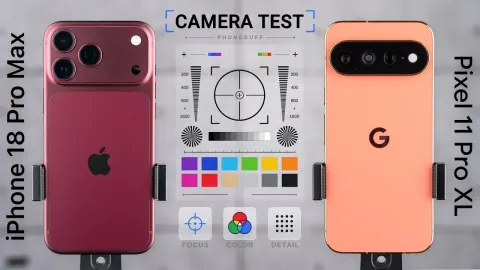
Let's touch upon something else, the speakers. Both phones are just as loud, achieving a score of Good on our charts, and the sound quality is about identical. Let's have a listen to compare. But what isn't identical is the camera setup. It's one of the other main differences between these phones. On the Pixel 11, you get three cameras on the back: a main cam, a 5x zoom, and a fixed-focus ultrawide. The Pro model's setup is similar, except that its rear cameras have larger, higher-res sensors, and the ultrawide has autofocus. So, we expect higher quality from the Pro model, but let's compare some photos and see the differences.
During the day, both phones' main cameras do a good job with similar processing typical of the Pixels. The 11 Pro does have the edge in sharpness. It's not a huge difference, but it's there and it's consistent. At 2x digital zoom, actually neither phone does a very impressive job. With the 5x telephoto cam, the Pixel 11 captures okay shots, but those from the 11 Pro are sharper and have better-rendered fine detail. A clear victory for the higher-tier model. Photos from the ultrawide cameras are actually quite comparable, at least when shooting faraway subjects. But only the Pro model is able to focus
up close. In those situations, it'll get you sharp results. When shooting photos in the dark, the Pixel 11 Pro's main camera will get you better detail than the Pixel 11. But the Pixel 11 did prove more reliable in its white balance. At 5x zoom, the 11 Pro again has the upper hand in terms of sharpness and detail. But yet again, it's a bit more inconsistent with its white balance for some reason. At night, the Pixel 11's ultrawide leaves a lot of noise unchecked, but its shots are still quite sharp, which isn't the case with the 11 Pro's images. So, surprisingly, the vanilla model is doing better here.
The Pixel 11's selfie cam is 10.5 megapixels, while the Pro's is 42 megapixels. Both have autofocus and take nice selfies. It's just that the Pro model has a wider field of view. And here's a look at 4K selfie videos taken with either phone. Both phones have the same video recording capabilities on board, except that the vanilla model's ultrawide maxes out at 4K at 30 fps, while the Pro model's ultrawide can do 4K at 60. In daytime scenarios, you'll end up with very similar video quality from the two phones. We give the edge to the Pixel 11 Pro. It has a slight sharpness advantage on all three cameras, but the Pixel 11 is doing just fine. And both phones are quite close in properties like the colors, contrast, and dynamic range.
At night, when shooting with the main camera and the telephoto, the Pro has a small advantage in sharpness. On the ultrawide, quality is more or less the same. So, there you have it, guys. Google's Pixel 11 versus the more premium Pixel 11 Pro. With either phone, you get a compact and well-built phone with ingress protection. The displays are smooth and very bright and look just as sharp when using them. There's the same chipset and equivalent gaming performance either way. The interface and software experience are just the same. And we got the same results in our speaker test, as well as our battery life test, surprisingly. And the charging is neck and neck as well. Plus,
the overall camera experience is very similar between the two. The Pixel 11 has some nice advantages in itself. Its matte frame is a bit grippier. And this phone provides much the same user experience as the Pro model at a lower price. The Pixel 11 Pro didn't seem to bring huge advantages over the vanilla model. Its display is higher-res and LTPO, but those didn't affect the user experience at all. The phone also offers an optional 1 TB storage tier if you need that. And the cameras have a slight edge overall, with autofocus on the ultrawide cam and sharper output in many scenarios.
In the end, the Pixel 11 can do basically everything the Pro model can for about 200 bucks cheaper. If having that bit of extra sharpness in your photos is what you're after, it could make sense to go for the Pro. But otherwise, the vanilla Pixel 11 is the better value. We'll have more iPhone and Pixel comparisons coming up, so make sure you hit that subscribe button and that bell icon so you don't miss out. Thanks for watching, and I'll see you on the next one.