48:46



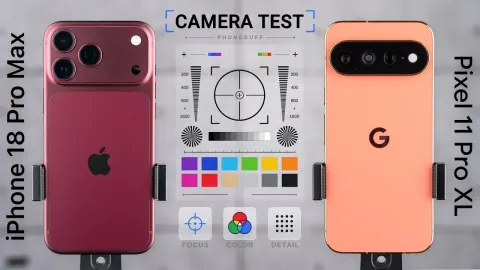
So this is the new iPhone 18 Pro Max, and this is the new Xiaomi. Pro Max. Do you remember this from last year? One of the most interesting and best phones from all of 2025, the Xiaomi 17 Pro Max, is a phone designed specifically to one-up the iPhone 17 Pro Max. And now they're back for more. So when I saw that they're doing this again, I had to check it out, of course, just to see if they're also doing an 'S' year update like Apple, or if they're taking it to the next level again somehow. So within a month of the iPhone 18 Pro Max coming out, sure enough, this is the Xiaomi 18 Pro Max. As expected, this phone still kind of looks like an iPhone, it's still shaped like an iPhone,
still has a lot of features that will be familiar to iPhone users. But it turns out there is a lot more going on here. So basically, if last year's phone was trying to one-up the iPhone, this year's update is trying to one-up the iPhone's update. So let's just start at the front here. Right, so you probably already know the iPhone's update was getting that slightly smaller Dynamic Island. Xiaomi already had just a hole punch cutout, so there's not really much more to shrink down here without going to an under-display camera, which would compromise quality pretty hard.
They also already have the under-display ultrasonic fingerprint reader, which is super fast. So what's their display upgrade? Well, they decided to borrow a feature you might remember from, from the Galaxy S26 Ultra, a whole privacy display. So this new screen can basically delete side-viewing angles with the press of a single button. And I think they've even improved on Samsung's feature. So, yes, you can turn it on for the whole screen or you can have it turn on like automatically just for certain apps or notifications, or only in certain places.
But they also added a feature called gaze detection. So if you're using your phone and, and the front-facing camera detects another person that's not you gazing at your screen, it'll notify you and tell you to turn on privacy display, which is kind of hilarious. So that's a real display upgrade over last year. Now, the iPhone also got a chip update, right? This went from the A19 Pro to the A20 Pro, which is its first 2-nanometer chip. And that did deliver huge gains. That's gonna be hard to beat. But of course, of course, this phone is up to that challenge because this phone also got a chip upgrade.
and it's also their first 2-nanometer chip, because this is one of the first phones in the world shipping with the new Snapdragon 8 Elite Extreme. Gen 6. Basically a flagship processor we're going to start seeing in a bunch of the highest-end phones for the next year. And yeah, on paper this chip is a beast. There are cores with 5 GHz clock speeds now, which is insane. And yeah, the benchmarks do not disappoint. It's the 15 to 20% improvement from the already great chips from, from last year. And so of course flipping through the phone and a ton of pre-installed apps 'cause this is the China version of the phone,
it absolutely cooks. That is no surprise. And I'm very curious to see how other phones perform when they do get this chip. By the way, the names, Qualcomm, the names are terrible. The Pro version of this phone gets the Snapdragon 8. Elite. Gen 6, but the Pro Max has the Snapdragon 8 Elite Extreme Gen 6. Terrible names. But yeah, the Extreme version is basically the one with slightly higher clock speeds for the absolute bleeding edge best phones. So yeah, 2-nanometer chip in this phone.
What a time to be alive. And they pair it with. 16 gigs of LPDDR5X RAM with UFS 4.1 storage with a huge vapor chamber. This is like a great performing phone. It could be a gaming phone, but it's not, it's just a regular flagship. Now the iPhone also got substantial. battery gains, mostly because of the new 2-nanometer chip, but also from a little bit of extra battery capacity. This phone also gets the 2-nanometer chip gains, but it also goes from a 7,500 milliamp-hour battery. to an 8,500 milliamp-hour battery on the Pro Max.
Thanks to this higher density of silicon. These numbers are just getting ridiculous now. I just saw a OnePlus 16 launched in China with a 9,000 milliamp-hour battery, which, we got phones cracking the 10,000 mark now, which is just nuts. And it almost kind of feels a little bit like the megapixel count, where this doesn't guarantee you have the best battery life. But it doesn't hurt. By the way, that's also without getting rid of the SIM card tray, and. without getting heavier than the Pro Max iPhone it's competing against. And it still comes with the 100-watt charger in the box, so it charges ridiculously quickly. And this is what I'm talking about, like 50, 50 watts on the new iPhone.
That's nice and all, but it's just, it's really hard to beat the crazy charging rates that silicon-carbon batteries are getting. I plugged this phone in for five minutes and it basically locked at 80 watts the whole time and it went from 12 to 25%. in five minutes. It's great. Plus 50-watt wireless charging with the right accessory. and. reverse wireless charging. So you can use this phone. as a battery bank for your iPhone, charge it from 0 to 100, and then still have battery leftover for yourself for the rest of the day. That's
kind of a crazy flex. So then, okay, the last big upgrade for the iPhone was their new. camera system. It's basically the same 48-megapixel cameras all the way around, but with a new variable aperture lens on the main camera. It's a cool feature. It's interesting. It's a more subtle thing. Like, if you've watched the full review, you can see the slight difference that it makes. The manual controls for it are pretty cool. The Xiaomi, though. Completely revamps their entire camera system. So instead of triple 50-megapixel cameras again this year, it's a new 200-megapixel main camera, a new 200-megapixel telephoto camera,
and this down here is a 50-megapixel ultrawide. So there is no variable aperture. No, but instead it's just kind of relying on having the better sensors across the board. The telephoto sensor in particular. It's absolutely massive. It's literally the same size as a lot of other phones' primary cameras. So it's a 3.2x zoom, but cropability factor is very high when you have 200 megapixels to play with. And then of course, the rest of the camera is full-featured too. You can shoot 200-megapixel mode, you can use different Leica color profiles, you can shoot 8K video.
It's not missing anything. And then all of this is not even mentioning the star feature of this phone, the display on the back, which you can use as a camera viewfinder to take the highest quality selfies the world has ever seen. And then a whole bunch of other things too. So this is not a full review. I can't daily this Chinese phone here. There are rumors of a global launch though, so that is exciting. But I was able to get Google Play on this one and I've been playing with it, and I do have some thoughts on what it's been like to use this for a bit. And you know, I think with these iPhone comparisons, a lot of what comes up usually is that. it's not always the numbers that make the big difference, it's the experience. Right?
So these Android phones. have amazing hardware, they. these massive numbers. But the experience and the optimization is what makes the iPhone great. I genuinely think if Xiaomi can work on a few things here, they can have both, like, they can have the smoothness and the optimization and the efficiency and the. huge numbers and raw horsepower. So this new privacy display, to start, it's interesting, you know, we know how Samsung does theirs with the half-normal pixels and half-narrow pixels.
Xiaomi is doing it a bit differently here with what they're calling HyperRGB. Basically, they have the complete red, green, and blue subpixel array for every pixel. So when they switch to privacy display, you don't get as big of a perceptible drop in resolution. But also the thing is it only obscures. left and right viewing angles, not above and below. So yeah, to me it's an interesting trade-off. Not as big of an overall hit to image quality as Samsung's, but it does still have some of the other downsides, like slightly worse overall viewing angles and this kind of a rainbowy sheen with off-axis viewing.
But Xiaomi's whole panel is also overall brighter to make up for it. It hits 4000 nits now. and honestly, I think it's all worth the trade-off. To me, this privacy display feature. is great. My only gripe, literally my only gripe is why is this not in display settings on this phone? Seems like that's where it should obviously be. Instead it's under privacy settings, which I guess that it's fine, but kind of odd. Doesn't matter though, because there's a new button here on the side. But in a bizarre move, Xiaomi has restricted the use of this button somehow.
more than Apple did with their own Action Button. So this button to Xiaomi is specifically an AI button. So a press of this button can either do nothing or add whatever you're doing to the Xiao AI memory, which I obviously don't use. I wish I could launch literally any other app I want with that button. But a long press can at least do a little bit more things. So you can have it launch a voice note or switch to silent or Do Not Disturb instantly turn on the privacy display for the whole screen. Maybe when you get that gaze notification when someone's looking over your shoulder. But also, Xiaomi, let us do other things with a single press of that button, obviously, please.
That back screen is still as useful as ever. Plus with a couple extra little things, like, I like that the camera rings are now flush with. with the glass here. It just makes it that much easier to kind of swipe across and open the camera. Maybe also makes it easier to smudge the camera glass, but yeah, otherwise, same idea, highly customizable. And if you look closely, there's also. now. speakers hidden back here under the screen. So one at the top and one at the bottom, which I thought may end up doing something funky with the sound quality, but it turns out to really not make a huge difference. If anything,
it just makes it sound like the speakers are facing away from you now. So you got to kind of cup your hand behind the back to get the full effect. But still, the whole back screen thing feels like something we'll probably never see on an iPhone. So whatever they choose to do with this back screen just continues to be unanswered. Sure, the shape of the camera island is the same as the iPhone's camera island, but is the iPhone doing a back screen desk calendar. or a step counter. or random fuzzy pet animals? Of course not. They're not doing that. Plus there's a whole bunch more you can download. And then these new cameras themselves are actually very welcome. You know, the primary camera last year was already huge and great.
It's huge and great again here. But the zoom camera's big upgrade. is something else. Like phones like this that have an amazing zoom camera just make me want to go take tons of zoom photos all the time. Pretty classy example of the tool shaping the behavior. I'm sure you can relate. Unfortunately, the ultrawide. is still kind of an afterthought, which you can kind of tell by looking at it on the back of the phone. But, you know, that's all right. It's better than not having one. There's also a bunch of AI stuff in this phone. Again, you can kind of take it or leave it.
I obviously don't use the assistant built in, but what I hear and what I've read is that it's very well integrated into the rest of the Xiaomi ecosystem. And for those who don't know, the Xiaomi ecosystem is. just as full-featured as anyone else. They make tablets, they, they make smart lights, they make appliances, they make. cars. But you know, the real plan when you see companies. make phones like this is to make it as comfortable as possible for iPhone users to switch. just by offering everything that they have on that other side of the fence. So, yes, that's including a lot of the aesthetics.
Like, a lot of the stock apps look and feel the same, so you never feel far from home. Like, oh, what's that? You like the Dynamic Island? Great! We've got a Dynamic Island here at home. Oh, you like the quick controls from the top right-hand corner? Of course you do. We've got that here, too. Oh, you like liquid glass? We've got liquid glass, too. We might not call it the exact same thing, but. we got that. And if it's the iPhone duo you're into.
Well, they also have a version. of that, too. Get subscribed to see that. very soon. It's Techtober. We're going to check all this stuff out either way. Thanks for watching. Catch you guys. Next one. Peace!