10:47


, the bear needed to regain its strength. The next day, the island is enveloped in sea fog. Walruses sense danger. Using the fog as cover, the bear approaches the herd. Adults close around their young, forming a wall of fat and skin. He checks the barrier, but it stands firm. It seems the world's largest land predator has met its equal. There must be a [__] in the armor somewhere. Not here. This female walrus is protecting her calf. If he can take it away, the bear's paws and teeth will not be able to penetrate its thick hide. When the herd retreats to the water, the bear must act quickly.
Having failed with one, he immediately moves on to another. The chance for his first meal in months is disappearing. He seems increasingly desperate. It's now or never. He must avoid the barbed tusks if he wants to win. The walrus's wing-flagging is extremely powerful and pulls the bear from shallow water to the safety of the herd. The bear slips out of his hands. Food is so hard to find this far north that a wolf pack must search hundreds of square kilometers if it wants to succeed. And success means educating the next generation. To do this, the wolves here must work together. So the young are raised not only by their parents, but also by their aunts and uncles. To achieve this, they try to make sure that each cub reaches a size close to an adult
before the snow returns. A growing cub needs more than just a few rabbits. Wolves need larger prey, and to catch it, they must hunt in packs. Adult hares are easy to spot, but they are not so easy to catch. They run at a speed of 60 km per hour. To catch one, wolves work as a team. One of them comes close enough to bite the hare by the tail. But a hare can change direction instantly. If he can keep taking steps sideways and laughing, he may eventually get through them. In the end, he runs away. The whole pack rushes in
pursuit of the next hare. Now the quantity is important. The wolves leading Others run on both sides so that the hare cannot change direction. A tiny portion for the whole flock. At this time of year, polar bears are successful on average only once in 20 hunts. If the hunter is as thin as this one, this may not be frequent enough. All she can do is keep trying. To prevent the scent from giving her away, she takes a wide swing to be downwind of the seal. It's coming. Now she is right behind the seal Incredibly, she caught a seal underwater. It's only small, but even so, its fat contains 100,000 calories, enough to feed this bear for a week. And during this time she may even catch another one. But this can't last forever. As
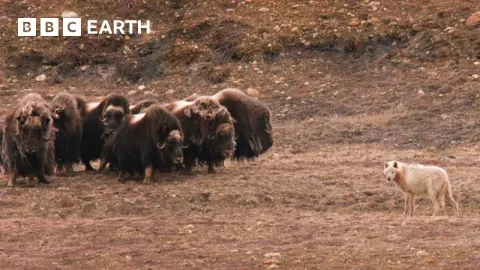
summer continues, the temperature rises. Each hunt requires more energy, depleting the bears of their reserves. They embark on the greatest overland journey ever undertaken by any animal. But wherever herbivores travel, predators lie in wait. Here they are. Arctic wolves. They must take their chance while the caribou pass through their territory. The wolf runs into the herd, trying to drive away the weak or slow. The cub is separated. At full speed, 60 km/h, the wolf is simply faster. But the calf has endurance. He is only a few weeks old, but this calf's will to survive is impressive. And it's necessary, because these young caribou have begun a journey that will last a lifetime. Forever chasing the seasonal growth of the grass they depend on. Like all
creatures on the steppes, they depend on these unpredictable but ultimately generous lands. Grass can survive in some of the harshest conditions on Earth. Floods, fires and frosts and still thrive. So, it is the steppes that provide the place for the largest concentrations of wildlife on planet Earth. I am in the Arctic. She is incredibly beautiful. Also incredibly cold. Winter temperatures here can drop to minus 50 degrees. However, some creatures, such as these magnificent wolves, call this place home. They live at the top of the world in one of the Earth's coldest places -beyond the Arctic Circle. I'm in the Polar Park in Norway, the northernmost wildlife park in the world. The wolves here grew up among people, so they are used to people. But I still
need to gain their trust and remain quiet and calm. Despite the cold, I had to take off my hat and gloves or these guys would have wanted to grab them. This magnificent beast treats me like another wolf and says hello. This is how they greet each other-mouths. Wolves often bite each other in the face. This may look aggressive, but it is a sign of affection. Paw size. You are beautiful. Just by stroking this wolf, you can lose your hand in its fur. And when I part my hair, you can see the bottom of it. You see these thin, very soft hairs. They provide insulation. And these longer outer hairs repel snow and
water. This wool is ideal for such conditions. But, like a domestic dog, a wolf's fingertips are completely bare. And they spend most of their lives with those bare pads of their fingers and paws, coming into contact with snow and ice, especially in the winter. So how do wolves prevent cold temperatures from the ground from reaching the rest of their bodies through their bare feet? Well, they have a very, very clever solution for that. Hot blood never reaches the paws of a wolf. As it flows down your leg, it cools down. Almost like being in a refrigerator.
Only cold blood remains in the paws. This way, all the warm blood can stay in the body. This clever adaptation means that any heat loss is reduced to an absolute minimum. On a thermal imaging camera, which shows body heat, the top of the wolf's legs are red. This shows that they are warmer than the feet. The wolf's fur looks blue. This is because its stunning thick fur prevents heat loss from its body. Another battle is looming in the Canadian tundra. And this is the final heavyweight battle of the winter. Female caribou are ready to mate.
This needs to be done now so that their young are born in early spring. So massive male caribou must compete with each other to father calves. The younger males watch from the sidelines as the heavyweights inspect each other. Serious fights are rare, but when they do happen, they can be very dangerous. But while this old bull was dealing with a rival, the young males were trying their luck with his female. He has to break up the fight and chase them away. Younger males may be lighter on their feet, but his massiveness allows him to burst past them with force. Another opponent challenges him. But the old bull easily deals with him. As the chase slows, he
can finally establish some order. Now that he's shown who's in charge, one look is enough. Only when he is sure that he has expressed his point of view can he claim his female. It's the height of summer in the goose colony, and the eggs are hatching. The young appear within a day or two, a miracle of time. The colony is now home to a million goslings. The fox is still collecting everything he can get. Sometimes one mouse just isn't enough. One will have to do. Not all food is stocked. Some are needed right now. She has seven hungry bear cubs that need to be fed. As their appetite grows, the mother must work tirelessly to raise her family.
Only fat, healthy bear cubs will survive the Arctic winter. The vast majority of goslings are still thriving. Their parents take them to safe water as soon as they are strong enough to embark on their journey. For foxes, the boom time is over. But the mother gave her cubs the best possible start in life. Geese will continue to graze in the tundra until summer ends and they are forced to head south for the winter. One of the most successful snow animals lives alone and spends most of its life in solitude. They can be found in the very north of the Arctic.
Polar bear. This male, like every polar bear, is almost completely covered in fur. But his secret to staying warm in this frozen land actually lies inside his large body. It has a huge layer of insulating fat, about 10 cm thick. It traps heat, keeping the heat inside. To maintain this fat, he relies on his good hunting skills. Its prey is hidden under thick ice. Fortunately, he has a secret weapon that helps him hunt. An extraordinary sense of smell, a hundred times stronger than ours. It can detect a seal carcass 30 km away and under a meter of snow. Success.
First, it will eat all the seal's fat, often leaving the actual meat. Such an extremely fatty diet would kill us, but for a polar bear it is necessary. Indeed, they are among the fattest mammals on Earth. Their incredible insulation and keen sense of smell make the polar bear a master of the snow. They are also designed to move easily in this snowy environment, unlike me. I am a perfect example of an animal that is not adapted to walking in such a snowy environment. I weigh 12 stone, 12 and a half stone, and all my weight is distributed on my size 12 feet. Big feet for a human, but not big enough to keep me from falling into the snow. What I need to do is increase the area of this surface. Put on snowshoes. I think the secret to moving through deep snow is to
it. Adapted for walking in the snow. This is much better. It's easy. I can walk in the forest. I don't fall down to my waist. I can walk fast. I can walk almost silently. As if I belong here. Polar bears have built-in snowshoes. Their paws are wide, about 30 cm in diameter. This helps them distribute their weight evenly on thin ice. There are small, soft bumps under their large paws to give them extra grip on the ice. So many animals choose to pair up because raising a family together has certain advantages, especially here in the Arctic, where the arctic fox lives and is one of the harshest places on Earth to try to raise a family. With temperatures as low as minus 50°C, winter
has forced this loyal pair of foxes to separate in search of food and a struggle for survival. As winter's grip loosens, the snow melts, and the foxes put on their new summer coats. The fox is back together. But life hasn't gotten any easier because they now have extra mouths to feed. These cubs are about 4 weeks old, and their parents take turns caring for them. The cubs should be fully independent by the time winter comes again. So this couple is working hard to share the hunt. Like all parents who work different shifts, they don't see each other often. That's why snatched minutes of family time are precious. But since the cubs' survival is directly tied to how much food mom and dad can put on the table, there is little time left for rest
Except for the bear cubs. Foxes timed the appearance of their offspring to an overabundance of food. Other animals also have young. And this mother fox found a nest full of eggs. But she may have underestimated how ferocious snow geese can be. One fox lays up to 1,500 eggs during the breeding season. These parents have only four months to raise their cubs before they must become independent. So, uniting is the only way to successfully raise cubs during the narrow summer period. A double effort helps many parents meet the challenge of raising their young during the short growing season before the rigors of winter set in.