12:44
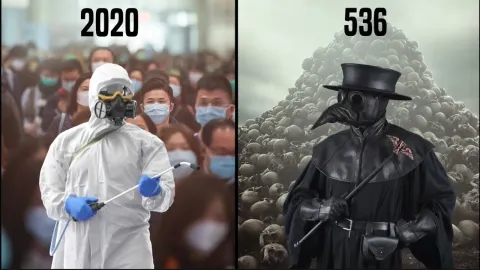


In the year 536, something went wrong with the sky itself. This is not a modern summary. It is close to what a contemporary witness wrote The historian Procopius, who lived at that time and wrote about the wars of Emperor Justinian, recorded that during that year a most fearsome omen occurred. The sun, he wrote, emitted its light without brilliance, like the moon throughout the year. He said it seemed extremely like the sun in eclipse, for the rays it cast were neither clear nor like those it usually emits. Read that slowly. Not a storm, not a single dark afternoon, but a sun that remained dim month after month for an entire year, described by a sober military historian who did not write poetry and who
had no reason to invent a dim sun in the middle of a war narrative. And Procopius was not alone. A second writer, working in a different language in a different part of the world, in a different tradition, reported something strikingly similar and for an even longer time. This video investigates the year 536 through three completely separate lines of evidence First, the written texts. Second, the rings inside ancient trees. Third, the chemistry trapped inside the polar ice. We'll keep those three lines separate for most of the video, the way investigators keep witnesses separate, and only combine them at the end. Because when three independent records, made by a
historian, by trees, and by falling snow, all point to the same year, that's no longer a story. That's one case. Let 's start with texts and what a text can and cannot do. Procopius of Caesarea was a legal advisor and historian attached to the Byzantine general Belisarius. His History of the Wars is our main narrative source on Justinian's wars against Persia, the Vandals, and the Goths. In Book 4, chapter 14, when describing events around the year 536, he pauses the war to record the omen of the darkened sun. Three features of his account are forensically important.
First, its duration. He says the darkening lasted throughout the year. That rules out an ordinary eclipse, which lasts for minutes, and he seems to know this because he compares the appearance of the sun to an eclipse while describing something that clearly was not one. Second, his character. The light lacked brightness and clarity. The sun looked like the moon. In modern terms, that is a description of sunlight being scattered and weakened before it reaches the ground, as if something tall and persistent stood between the sun and the observer. Third, its location. Procopius integrates the omen into a dated sequence of military events, allowing historians to link it to the year 536 rather than to a vague period of auguries.
Now, the limits are clearly established. Procopius does not give us a cause. It does not mention a volcano, an eruption, or dust. It gives us no measurements, no temperatures, and no geography beyond its own point of view. A text like this can prove that a cultured contemporary perceived a prolonged and abnormal darkening of the sun around 536. By itself, it cannot tell us what caused it, how far it extended, or how cold it became. For that, we need the second witness And then, we need to leave the texts behind completely.
The second textual witness wrote in Syriac, not Greek. John of Ephesus was a 6th-century ecclesiastical historian whose work preserves an account of the same darkened sun. In his story, the sun went dark and its darkness lasted 18 months. Each day, it shone for only about 4 hours, and even then its rays were weak The story connects the period with crops that did not ripen as they should have and with wine that tasted like sour grapes, fruit that never ripened properly under the weakened sun. Compare both witnesses carefully, because their value lies as much in their agreement as in their independence. John wrote in a different language, within a different literary and religious tradition, from a
more eastern perspective, in the Syriac-speaking world of Mesopotamia. He was not copying Procopius, and yet both men describe the same central phenomenon. The sunlight persisted not for hours, but for many months, with effects that reached all the way to the harvest. They also differ, and the differences are genuine. Procopius says a whole year. Juan says 18 months. Procopius emphasizes appearance. Juan emphasizes the shorter effective day and the lack of maturation.
Two observers of a real, long, and uneven event would be expected to differ on details like that. Perfectly identical accounts would be the suspicious result, not those that differ. So, let's rate the texts before we continue. Tested to the level that texts can be tested. Contemporaries of at least two independent traditions perceived a prolonged darkening of the sun beginning around 536. Supported. The darkening affected the growth and maturation of the plants. Not established by the texts at all. The cause, the global scale, or the size of any drop in temperature.
A chronicler can see a gray sun. He cannot see a stratosphere. It is worth pausing here because the year 536 has attracted far greater claims than two passages from chronicles can support. You may have heard it called the worst year in history or the year civilization almost collapsed. Those phrases do not come from Procopius or John. They are modern headlines. Our job in this video is to test the physical event first and then evaluate the consequences one by one, instead of letting a headline evaluate them for us. Consider what could, in principle, obscure a sun for a year or more. A passenger cloud system cannot do that.
The weather does not last for 18 months. A solar eclipse cannot do that. Eclipses are brief and local. Something would have to be placed high in the atmosphere, spread widely and remain there, scattering sunlight month after month as the Earth rotates below. That is a hypothesis about the physical world, and hypotheses about the physical world can be tested because the physical world keeps its own records. Fortunately, he keeps two excellent ones. Trees write one entry each year in their wood, and they cannot exaggerate, flatter an emperor, or copy another tree. And the snow that falls in Greenland and Antarctica captures a sample of the
atmosphere itself, layer by layer, including whatever was floating in it. None of the records were made for us. None of the records know what Procopius wrote. That independence is exactly what makes them powerful. So, we'll close the chronicles now. The next witness does not use words at all. Wear rings. A tree ring is a dated document, and dendrochronology, the science of reading tree rings, works because of one simple discipline: cross-dating. In a good year of growth, a tree creates a wide ring. In a tough year, a tight one. The pattern of wide and narrow years is shared by trees across a region, like a barcode. By matching those barcodes on many trees, both living and dead, researchers can assign each ring to an exact calendar year
, with no gaps or guesswork about which ring belongs to which year. If something slowed the growth of the trees in a particular year, the rings will accurately name that year The study at the center of this line of evidence was published in Nature Geoscience in 2016 by Ulf Büntgen and his colleagues. They constructed temperature reconstructions from tree rings at two high-elevation sites on opposite sides of Eurasia: the Altai roller coasters and the European Alps. Those two files matter because they are very far apart. A drought or a local storm could affect one of them. The same signal in the same years in both points to something much bigger.
The method also carries an honest limit, and the article's approach respects it. Tree rings at these sites primarily record summer temperatures, because summer cold is what limits growth near the forest edge. The rings are therefore specific witnesses to the cold during the growing season, not to everything that happened in those years. Keep that precision in mind, because what they report is dramatic enough without needing to exaggerate. This is what the Altai rings and the Alps show year after year.
Growth collapses in 536. It collapses again dramatically in 540. And there is a third major recession in 547. Büntgen's team interpreted this pattern as the imprint not of one eruption, but of three; A sequence of large volcanic eruptions that began in 536, was repeated in 540 and again in 547. Each one renewing the atmospheric charge before the climate could recover. The result was not just one cold summer. It was a cold era. The decade from 536 to 545 stands out in its reconstruction as one of the coldest of the last 2,000 years or more across the entire northern hemisphere. And the cooling did not completely relinquish its hold for generations.
The study gives a name to the entire episode. The Little Ice Age of Late Antiquity, which lasted from 536 to around 660. More than a century in which summers in much of the northern world were colder than in previous centuries. Notice what the rings add that the texts never could. Scale. Two mountain ranges, thousands of kilometers apart, freezing at the same time. Precision. The recession begins exactly in the year named by Procopius, not a decade earlier or later. And duration. Not a bad year, but a climate regime.
But the rings still cannot name the culprit. Cold is an effect, not a cause. To find the cause, we need the third line of evidence, the one that captured the atmosphere itself. The snow that falls in Greenland or Antarctica does not melt. Year after year, it compacts into ice, trapping bubbles of ancient air and, crucially, any particles or gas that were circulating in the atmosphere when it fell. Large-scale volcanic eruptions inject sulfur high into the stratosphere, above the climate There, it is converted into small sulfate particles that are then deposited, even in polar ice layers Therefore, a large eruption leaves a signature on the ice.
A pronounced spike in sulfate in a layer that can be accurately counted. Count the layers from the surface and you can date the peak. Measure the peaks in both the Greenland and Antarctic ice, and you can even determine whether the eruption cloud spread across one hemisphere or both. The key study here is that of Michael Sigl and his colleagues, published in Nature in 2015. Using ice cores from both poles, they reconstructed the dating of volcanic eruptions over the past 2,500 years and adjusted the chronology considerably.
That improved dating is crucial to our case, because the older timescales of the ice cores could vary by several years, enough to accidentally separate an ice spike from a chronicle. With the revised chronology, a significant sulfate spike falls exactly where the chronicles and tree rings say it should be: at 536. This is the point in the research that skeptics should pay attention to. The ice was extracted and measured by scientists testing a dating framework. The trees were measured by a different team that was solving a climate problem.
The chronicles were written 15 centuries ago by men who never imagined either of the other two. Three records, three methods, one year. The ice tells an even more specific story, and explains the strange double knock in the tree rings. The work of Matthew Toohey and his colleagues, also from 2016, examined the climate forcing of this period and supported the idea of twin eruptions. A first major eruption in 536 and a second, comparatively severe, eruption in 540. Remember the rings. Growth collapsed in 536, began under that burden, and then collapsed again in 540, before any recovery could be completed.
Two eruptions, four years apart, fit that pattern like a key in a lock. The drop in the 547 rings suggests that the sequence didn't even end there The sulfate evidence also speaks to the scale. A spike recorded in the ice at both poles points to one or more eruptions whose material was dispersed throughout the global stratosphere rather than remaining in one region. That global reach is what a veil needs. Sulfate particles in the stratosphere are not like the ash from a campfire. They are thin, they are reflective, and since there is no rain in the stratosphere to wash them away, they can surround the Earth and persist for years, scattering
sunlight back into space and cooling the surface. Thus, hypothesis after hypothesis, the mechanism assembles itself. A huge eruption or a sequence of eruptions loads the stratosphere with sulfate. The veil of sulfate obscures the sun, exactly as Procopius described it, like the moon without brightness. Diminished sunlight means cooler summers, exactly as recorded by tree rings. Colder summers mean failed and unripe harvests, exactly as John of Ephesus complained. Cause, appearance, and consequence, each attested by a different type of record.
Now, and only now, do we combine the lines and evaluate what followed. Evaluation of claims openly Three famous events are attributed to the year 536. They don't deserve the same trust, and this video won't give it to you. First, famine and crop failure. Rating: solid. The chain here is short and every link is attested to. The texts report fruits that did not ripen and grapes that never came to fruition. Our tree rings show severe cold during the growing season across the Northern Hemisphere precisely in those years, beginning in 536 and worsening after 540.
Cold summers at the limits of cultivation shorten growing seasons and reduce yields. That's basic agronomy, not speculation When independent writings and independent timber agree that crops suffered from a proven cold shock, famine and food stress in the affected regions is the best-supported consequence we have. Accuracy remains important. Just because something is strong doesn't mean it's universal. The evidence does not show that all fields on Earth failed, nor a single global famine with a single death toll. It shows a significant widespread climate shock with documented effects on crops in the sources we have That's a serious conclusion. This is
also as far as this evidence honestly goes. Second, the plague. In 541, 5 years after the darkening, the disease known as the Plague of Justinian appeared. First reported in Pelusium, Egypt, and spread throughout the Byzantine world and beyond. The moment is suggestive, and a proposed chain works like this. The cooling and crop failures weakened populations and changed rodent movements and trade, creating conditions in which the plague could ignite and spread.
Rating: correlation with causality not proven. Here we must quote a necessary critic. In a 2018 analysis, historian John Moreland challenged sweeping claims that climate change drove the era's transformations, arguing that links between cooling and specific social outcomes, including plague, are often asserted far beyond what the evidence can show. The dates match. A mechanism has been proposed, but no source, ring, or ice layer proves that the 536 veil caused the 541 outbreak. Honest history keeps those two facts in separate columns. The cooling occurred, the plague occurred, and the causal link between the two remains a hypothesis.
Third, the greatest claim of all: that 536 brought down empires and remade the world. Rating: the weakest of the three. The Little Ice Age of late antiquity was real, and a century of colder summers surely put pressure on agriculture, taxation, and armies on the margins. But empires in this period faced wars, succession struggles, religious conflicts, and fiscal tensions that had nothing to do with sulfate. The Byzantine Empire, whose chroniclers gave us our dim sun, did not fall. It lasted for centuries more. Attributing the fall of civilizations to a sequence of eruptions is confusing genuine stress with a complete explanation.
The evidence supports pressure, not puppet strings. One mystery remains, and this video will end up admitting it, rather than covering it up. We don't know where the volcano of 536 was No chronicle describes the eruption itself, suggesting that it occurred far from the literate world that recorded its effects. Two general candidates are being discussed in the investigation. An eruption in Iceland could load the northern stratosphere and coincide with the strong cooling of the northern hemisphere An eruption in North America has also been proposed based on the pattern of sulfate deposition between the two poles.
No identification has been resolved. There is no agreed-upon mountain, no named crater, and no confirmed ash layer linked to a specific volcano for the year 536. The biggest climatic event of its era has a proven effect, a proven date, and an unknown origin. So, the verdict, as promised, was proven. Something obscured the sun for a year or more starting in 536, attested by two independent textual traditions Tried. The coldest sustained recession in 2,000 years began that same year, as evidenced by tree rings on two sides of Eurasia.
Tried. A significant spike in sulfates, the signature of a major eruption, is found in the polar ice on that same date. Supported. Twin eruptions in 536 and 540, with a third in 547, fueled a late ancient Little Ice Age that lasted until around 660 , with real crop failures in its wake. Just a hypothesis. That this caused the plague of 541 or brought down empires. Three witnesses who never met, a historian, a forest and a layer of ice, agree on the year in which the sun went dark. If researchers announced tomorrow that they had finally identified the 536 volcano, what unique piece of evidence would you want them to show you first?
Ash, crater, or ice? Tell us