29:08
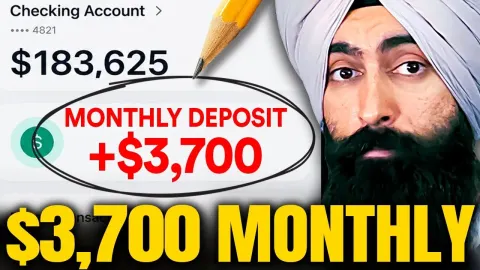


What's up, guys? This is Graham. So I'm going to take a huge risk in this video, because it goes against everything I've ever said. But, I'll be frank. After years of telling people not to pay off low-interest debt and to use arbitrage in the markets to make more money, I'm starting to think that maybe I was wrong. Mathematically, we all know that it makes sense not to pay a 3% mortgage because you can make much more money in the stock market. And below a certain point, it's almost like getting free money. But recently I did the unthinkable. I got rid of three mortgages with extremely low interest rates, which I never thought I would do. And as soon as they were gone, I felt as if a weight had been lifted from my shoulders that I had never
thought possible before. And I guess I'm not alone. I asked on Twitter if anyone had ever regretted paying off their low- interest mortgage. And believe it or not, out of almost 4 million views and 1,500 responses, almost no one said yes . That's why for the first time here on the channel, if you have a mortgage, car payment, student loan, or any debt at all, watch this video before deciding what to do with it. Because I'm going to show you the part about being debt-free that no one calculates on the calculator. And I promise that once you see this, you will never look at money the same way again. Also, a big thank you to Policy Genius for sponsoring this video. But more on that later. To start with, I know this sounds
a little strange, but growing up, I was taught that all forms of debt were bad. That credit cards are a trap. Loans are for people who can't afford things. And if you can't buy something immediately with cash, you shouldn't buy it. That was essentially my entire financial education before I turned 18. So, I've never had a credit card. I have never had any payments for anything. I had a regular debit card and a savings account, and I thought I was doing everything perfectly. That was until I turned 21. I had been working as a real estate agent for about four years, collecting all my commissions, and I wanted to start buying real estate because it was 2011 and houses were selling really cheap. I'm talking about
an amount of less than a hundred thousand dollars. So I thought, "Oh, great. If I have a hundred thousand dollars, I can either buy one house outright for cash, or use it as a down payment on three properties. And if this property yields 15% and my mortgage is 5%.Oh, that would be easy. I will be rich." You know, the funny thing is, at the time I thought I would be the perfect borrower because I never needed credit. I never needed payment. I just paid everything in cash right away, and I thought they would love me. So I went and applied, and I'll never forget how instantly I was rejected. It wasn't because of my tax returns, and I couldn't afford it, I did
n't have the money. This was solely because I had no credit history. I will never forget this. But it was on that day that my entire philosophy was turned upside down. Loans and debts should not be avoided. It was just a tool to be used like anything else. And if you play the system and use it to your advantage, this tool can eventually make you millions of dollars. For me, this meant that when I was 21, buying houses for $60,000 apiece, instead of buying three houses with cash, which is what I ended up doing, I could have bought 12 houses with a 25% down payment that would be worth about eight times what I spent today. For example, when it comes to debt, the only thing that
really matters is simply the spread. If I could borrow money at 5% and invest it in something that yields 12%, that's 7% I'm earning on money that was never mine. And once I realized this, my whole life changed. Without exaggeration, I spent the next few years opening as many credit cards as possible. I found every possible way to improve my credit score as quickly as possible. And pretty quickly after that, banks started giving me mortgages. The first was for a property in West Los Angeles worth $800,000, and I fixed it for 30 years at 3.375%. Then I bought a duplex a few miles away with an interest rate of 3.5%. After that, I bought another duplex for 3.6%. At the time, it was not clear to me
why anyone would want to get rid of this mortgage or pay it off early. For example, let's say I bought a duplex for $600,000 with a 20% down payment. The interest rate is fixed at 3.5%, but the property generated a net rental income of 8%. This meant that I would earn 4.5% for free from the very beginning. And then, if the value of that property increases by 5%, I will make an additional $30,000 on my initial investment of $120,000, which is a 25% profit. It's all just basic math, because if the value of the property goes up, I make money. If real estate makes money, I make money. On the contrary, it was logical to invest as little of
my own money as possible in the deal, because the more money I invest in the deal, the less money I have left to buy something else to make even more money with other people's money. Without exaggeration, this is the strategy I used to make millions of dollars over about ten years, simply because I had access to really cheap money from banks. Because I had a good credit rating. Plus, in my opinion, it was incredibly safe because the mortgage was fixed for 30 years. The stakes could never rise. My rent was really stable, and inflation was actively eating away at the debt. Because if my interest rate was 3%, but inflation
was also 3%, then it would kind of cancel each other out, and I would essentially just be getting free money. That's why when someone asks me, "Hey Graham, should I prepay my 3.5% mortgage?" I always say, "Absolutely not. Don't pay off this mortgage early. This is the cheapest money you will ever have access to in your life. Instead, just invest the difference in the S&P 500, and in the long run, over the next 20 years, you will have much more money than you would have invested in real estate. " A lot more than you'll have left over to pay off your mortgage in full, plus money to
do whatever you want." I've been saying this for about 10 years now, until I recently paid off three mortgages with extremely low interest rates starting at 2.875% with a 30-year fixed rate when I sold this property. And once I did, everything changed. So, in terms of what happened after the debt disappeared, and most surprisingly, why no one regrets paying off their low- interest mortgage, here's what you came for. Although, before we. Next, getting peace of mind goes way beyond just paying the mortgage, because at the end of the day, you can do everything right, but if you still have people who are financially dependent on you and something unexpected happens, the is knowing that
they will be taken care of. This is why having life insurance can be so important. It simply gives you the opportunity to plan for unforeseen events. And our sponsor, Policygenius, makes the whole process incredibly simple. For those who don't know, Policygenius is an online life insurance platform that allows you to search and compare quotes from some of America's leading insurers for free to find the policy that best suits your needs. In fact, with Policygenius you can find 20-year term life insurance policies starting at $276 per year for a million dollars in coverage. Plus, because life insurance isn't a one-size-fits-all product, Policygenius clearly lays out all your options, from coverage amounts to pricing and terms, so there's no
guesswork. Plus, their team of licensed, award-winning insurers.Agents can walk you through the entire process step by step, complete all the paperwork, answer any questions you may have, and help you make decisions with confidence. With thousands of five-star reviews on Google and Trustpilot, not to mention that, as I said, life insurance is one of those things that is very easy to put off because no one wants to think about needing it, but it is one of those things that you will be very glad you did when you do. So, if you want to finally cross life insurance off your to-do list, all you need to do is head over to policygenius.com/graham or click the link below in the description to compare free life insurance quotes from leading companies and see how much you
could save. Again, it's policygenius.com/graham with the link below. Thank you very much, and now let's get back to the video. Okay, so about what happened after I got rid of those low-interest mortgages, I never thought I'd say this, but for the first time I started thinking that maybe Dave Ramsey. makes sense. See, that's the thing. On paper, debt with a positive mathematical expectation is just a number. If the spread works and you make money, great. If not, then no. Mathematics is mathematics. There is nothing left to think about. And that's how I've calculated almost everything for the last 20 years. But your brain doesn't
treat it that way. For example, even though everything was on autopay, I never considered the fact that each mortgage had become its own mini- ecosystem of thinking. Where if the tenant moves out, I still have to pay the mortgage and I factor that into my net income. If I sell, I still need to factor in the mortgage payment in terms of what I will get back after the sale. The thing is, there's this big outstanding obligation that doesn't care if your income goes down, if you lose your job, if the tenant stops paying. It still exists. Honestly, I did n't even think it would be possible until I started selling my property. I'm talking about those who have.2.875% 30 year fixed rate mortgages. And when they were sold and I saw the debt category in
my Rocket Money account reduced by millions of dollars, it was like a strange sigh of relief. I wasn't worried about not being able to make my mortgage payments or anything, but just seeing my debt category go down was a really nice feeling of release for some reason. I think I'm really bad at describing what it was like, but it felt like something was occupying a mental space in my head that I didn't even know existed until it was gone. And then when it was gone, even though again mathematically it was the wrong choice to give up the low interest rate mortgage, it was a very nice feeling. Now, naturally, I started thinking that maybe it was just me, and I had a lot to do, and that was one less thing to think about in an exception. But when I started
researching this issue, there are many positive effects of paying off debt that I did n't even know existed. For example, one study found that after paying off debt, almost all people were.less anxious, made better decisions, and performed better on cognitive tests. And what's surprising is that it wasn't just related to low income. Even people with high incomes have shown improvements in cognitive abilities after paying off debt. And it wasn't just about the amount of debt. It was about the number of accounts, no matter how small, or the interest rate on the debt. That's why, when it comes to the final stage of loan repayment, it all comes down to freedom. Listen, to be absolutely clear, paying off 3% of your mortgage is not a
financial decision. This is emotional. As I've spent the last 10 years looking at this as an optimization problem. For example, when you look at a 3% loan and compare it to investing the difference in the stock market, the market wins, for sure, and it's not even close. But this is not the full picture, because what you are actually buying by repaying a loan is difficult to estimate, but it is simply peace of mind. Again, there is research on this. Even though a $2,000 payment is a that you can use in the market to make more than $2,000, in reality, that $2,000 payment is just another thing you have to mentally track. As evidence of this, one study found
that people's attitude toward their finances was as important to overall happiness as their job, health, and relationships combined. So, in a way, for over a decade, I traded simplicity and a little extra stress for a few extra percentage points in the market. And after a while, I began to realize that maximizing profit was no longer as important as trying to achieve as much mental clarity and peace as possible. However, I also recognize that there has to be a balance here, because in terms of being debt-free, one other study showed that cash on hand predicted life satisfaction better than income, better than investments, and better than net worth. Or, essentially, if you take all your money and pay off your mortgage with it, leaving
you with nothing, that's also not good because you're taking the most liquid thing you have, cash, and investing it in the least liquid thing you have, a house. And it's hard to get it back after you make that transfer. You can't call your mortgage company and say, "Hey, money's a little tight again." I need to get that $50,000 back." " They won't do it." This is all to say that from a mental clarity perspective, the best thing you can do is simply always maintain a cash buffer on the side no matter what, and then pay off the debt. There was a paper produced by the Journal of Public Economics that looked at households that voluntarily paid off their mortgages instead of maximizing their tax-advantaged retirement accounts. And it was found that
about 38% of them made the wrong choice, which cost them between 11 and 17 cents out of every dollar. All because they believed that a mortgage was a safer option. So, all of this means that if you have a 401k that you're not taking out, or a credit card with a 24% interest rate that you're not paying off, it's probably not the best idea to pay off a 3% mortgage. But if you want peace of mind after you've already sorted out the rest of your financial life, then perhaps paying off your mortgage starts to make sense if you value peace of mind. Although, in terms of what I think about all of this and then what I do for the future, that's what you came for.
Honestly, I think the answer is that everyone deals with it differently, and that's totally normal. I know some people with hundreds of millions of dollars in debt and they sleep great. Well, other people don't even want to have a car payment. None of them are right or wrong, but at least for me, as I get older, simply optimizing every bet, every dollar, every spread stops being so enjoyable and starts to become just another thing to think about and worry about. At some point you really need to ask yourself what this is all for in the end. Is it to get the biggest bank account possible, and in that case, engage in arbitrage as much as possible, never getting rid of that low-interest mortgage. But for me, it's just a shorter list of things to
think about and fewer files to send to the CPA at the end of the year. And if I ever moved in the future, I would seriously consider it as an early mortgage payment now. Because getting rid of other mortgages so far has been. simply incredible. Of course, as for my advice to everyone watching, because there is always some conclusion here. I think that practically, first of all, you should always set aside a reserve fund that you never touch. Then take your employer 401k contribution if you have one . Then pay off any high- interest debt or credit cards you have. And then, once you have the rest of your financial life in order, consider paying off your mortgage if that's important to you. And look if you're arbitrage-able, because again, it makes
no mathematical sense to pay off any debt at less than 4 or 4.5%, which would make your position bigger. I agree with you. I think logically it makes sense. But there is also a component of mental clarity that I think is hugely underrated. And that's something I never fully thought about until recently. Anyway, if you've made it this far in the video, I really appreciate it. Leave a comment below if you have ever paid off a low-interest debt early and regretted it. Tell me. Or if not, and you have a paid-off house, and you think, "This is the best decision of my life." I do n't care that I could make more money in the market. Let me know about it too below in the comments section. As always, don't forget to hit the Like button, subscribe, and if you want
early access to videos like this, as well as bonus content every week that I don't post publicly, feel free to join the channel as a member and you'll also get priority responses to comments. So, if you leave me a comment, I'm guaranteed to see it and do my best to respond. So, with that in mind, thank you very much, and see you next time.