50:01



It was like a stage play. Pools of light from torches held aloft, thousands of voices singing Nazi chants, and in the middle of it all, the chosen man, unable to hide his emotion behind pursed lips, cheered on enthusiastically by the crowd. On the day that Hitler came to power, I could count on my fingers the number of acquaintances who were capable of predicting the catastrophe that Germany was running towards. On January 30th, 1933, the aging President Hindenburg gives in to pressure and names Adolf Hitler Chancellor. The world's capitals are stunned and seek to find out as much as possible about this mysterious new head of state. In those days, the eyes and ears of the great nations are their ambassadors.
In Berlin, the most conspicuous of them is the unruffled French ambassador, Andre Francois Poncet, seen here with his wife, Jacqueline, in a rare personal archive. Francois Poncet, a cultivated man from the bourgeoisie and former minister, runs his embassy in lavish luxury in the heart of the capital. Being bilingual meant that he can converse in German with Hitler. He and his fellow ambassadors, the Italian Vittorio Cerruti and his wife, the American Dodd, or the British Sir Eric Phipps, are in the best place to observe Nazism.
At the beginning, the Nazis are happy to tolerate his high-class clique with their endless dinners and receptions, but it won't take long for the atmosphere to deteriorate. The ambassadors will turn into whistleblowers whose alerts fall on the deaf ears of their governments. Their secret dispatches and personal archives resonate today as the chronicle of a war foretold. When André François Poncet arrived in Berlin 2 years before, in September 1931, he was met at the station by the darling of diplomatic receptions, Bella Fromm.
She writes about the rich and famous for the well-known liberal daily newspaper, Vossische Zeitung. This is the Frau Bella as a young woman in a photo taken just after the First World War and before inflation has wiped out the fortune of her eminent Bavarian family. And also before the Nazis begin to pick on her for being Jewish. My columns immediately became popular. And through my position as friend and as columnist to the diplomats, I saw and heard more than most. Frau Bella knows everybody. The 200 people who make up the diplomatic corps, the old German nobility, and even quite a number of Nazis.
Especially as this group of people revolves around a small area just next to the Tiergarten, Berlin's central park, and the imposing Reichstag. From the French Embassy located next to the Brandenburg Gate at 5 Pariser Platz, it's just a stone's throw for Beller or the diplomats to the American Embassy across the road. The British Embassy is at 50 Wilhelmstrasse and a little further on the Soviet one. What better place to spy on the German Foreign Ministry and Hitler's Chancellery? February 7th, 1933. The diplomatic corps is buzzing.
They are about to meet with Hitler, the ex-World War I corporal, now head of the government. Last night at Hindenburg's formal dinner reception, Adolf Hitler made his debut in diplomatic society. The corporal seemed to be ill at ease, awkward and moody. His coattails embarrassed him. He crumpled his handkerchief, rolled it, just plain stage fright. The scene was a brilliant one. And in all the large company, there were but two Jewish women, Maria Chinchuk and Elizabeth Cerruti, the wives of the Russian and Italian ambassadors. And I was the third non-Aryan.
The dinner promised to be very interesting indeed. Two days before it was to be held, I received a tantalizing phone call from Frau von Meissner, wife of the head of the presidential chancellery. Her words quavered with excitement as she told me that it was I whom the Chancellor would take into dinner. My husband cautioned me to watch Hitler closely and not to miss a word he said. I would be the first to speak to him. Herr Hitler comes across as an unremarkable man of average size. He looks more like an out-of-place provincial than a refined laborer.
His face is somewhat swollen with blotchy skin. His vivid black eyes offer a fixed and dark stare. Occasionally, there's a glint in them, giving them a compelling and impassioned expression. He rolls his Rs. And his way of speaking is blunt and uncultured. Hitler is nothing more than a rustic Mussolini. The ambassadors have followed the rise of the Nazi troublemaker since the Weimar Republic. But now, everything starts getting out of hand. On the night of February 27th, 1933, André François-Poncet's children watch from their beds as the Reichstag, just behind the embassy, goes up in flames. Then, in a consciously orchestrated set of moves, the members of the Reichstag
vote to give full powers to Hitler, who is the Prussian sanctuary of Potsdam. Berlin, Ambassador's report, March the 30th, 1933. The morning after the day of Potsdam, the Reichstag divested itself of all power. It's important to highlight the flawless and ruthless strategy by which parliamentary legislation facilitated dictatorship. Dozens of stormtroopers were in the corridors, and many more massed outside the Reichstag, having received orders to shout at regular intervals, "We want full powers, otherwise we destroy everything."
The Nazis are not exaggerating when they boast about having carried out a revolution. The surge which has just burst through all the dams is a revolutionary surge. Its path is not mapped out. No one can predict where it will end, but it must be noted that as of today, the setting up of the dictatorship has brought forward neither hero nor martyr. German democracy has been able to save nothing, not even save face. Militant communists and social democrats, as well as a handful of Jews, are thrown into the first concentration camps, officially opened at Dachau near Munich,
in Oranienburg near Berlin. The word Gestapo, the secret state police, becomes synonymous with terror. On April 1st, 1933, the stormtroopers, the SA, turn their attention to Jewish shops, which are boycotted and attacked. Diplomats record that Jewish civil servants are being systematically dismissed. Mid-July 1933, Hitler has been in power for 6 months when Frau Bella entertains the recently appointed American ambassador William Dodd and his family. For want of more qualified candidates, US President Roosevelt appointed an historian with absolutely no diplomatic experience to this strategic post. As to high diplomacy, I am not the kind.
I simply am not the sly, two-faced type so necessary to lie abroad for the country. Who would care to live in Berlin the next 4 years? Although he isn't well off, the American ambassador rents a beautiful villa just opposite Tiergarten Park. By doing this, the Jewish owner hopes to save his property from the raids of the storm troopers. Dodd and his wife don't entertain much, but their children are more than happy to invite round their friends and foreign journalist introduced to them by Bella Fromm. And even a few Nazis such as the peculiar Ernst Hanfstaengl, known as Putzi. He's one of Hitler's old friends, and since he grew up in the US, Putzi is put in charge by the Nazis of entertaining and spying on the small diplomatic clique.
You will see his newest book. That's the He's happy to be part of the group and is a piano player. It's said that his playing can bring Hitler to tears. I was in close contact with Dodd, the American ambassador in Berlin. In those days, there ought to have been a robust millionaire occupying the post, capable of competing with the crazy extravagance of the Nazis. But instead, the US was represented in Berlin by a self-effacing minor civil servant who thought he was still on university campus. Dodd's trump card was his daughter, who was blonde and beautiful, and with whom I struck up a good relationship.
The youth are bright-faced and hopeful. They sing with shining eyes and unerring tongues. Wholesome and beautiful lads, these Germans. Good, sincere, healthy, mystic, brutal, fine, hopeful, capable of death and love, deep, rich, wondrous, and strange beings. These youths of modern swastika Germany. Martha is fascinated by the Nazi regime. During a reception, she falls in love with one of these fiery men, Rudolf Diels, the newly appointed head of the Gestapo. He had the most sinister scar-torn face I've ever seen. Cruel, broken beauty. He was often round visiting our house, for he was trying to appease the United States.
The cozy neighborhood of embassies is well protected. But in the rest of the country, the Nazi stranglehold is unrelenting. Brecht, the Nazi who was forced upon our newspapers, came into the office to have manuscript edited and put into principal shape. He asked me to give him a lift to the Grunewald. He spilled so much party and political gossip that he really interested me.
He spoke a great deal about the rate at which we were rearming. "Those fellows crash like flies," he said. "But there are plenty of them, and they get commissioned as soon as they finish school." Rearmament is supposed to be a state secret, but it doesn't go unnoticed by the ambassador's network of informers. Sir Eric Phipps, the British ambassador, who is highly critical of the Nazis, tells Hitler what he thinks about it. I was received for the first time by the Chancellor this morning. I remarked that, however materially Germany might have disarmed, it struck the foreign observer that spiritually she was very heavily armed.
Herr Hitler burst into an eloquent torrent of protestation. He declared that what foreign observers thought was military feeling was merely a well-disciplined attitude against communism. My several interpolations could only be made when the Führer paused to take a breath. November 12th, 1933, hundreds of packed polling stations. Hitler has called a referendum in order to approve Germany's withdrawal from the League of Nations. The result was a foregone conclusion.
The votes needn't have been counted. This poll was a farce. My ideas about Hitler were very clear, even before I was posted to Berlin. But I at least expected to find reasonable people around him. I was horrified to discover that the whole lot of them were just a gang of criminals and cowards. As was customary in New Year, Marshall Hindenburg, who was still nominally president, holds a reception for the diplomats in full uniform. The Nazis have been in power for a year. They announced spectacular drops in unemployment everywhere. Drops that were mainly due to the forced withdrawal of women from the job market. With just a few exceptions, German women
in the Third Reich have been relegated to the role of a basic reproductive machine. Their duty is to give birth to a child every year for the party. The New Year also brought bad news. The law on forced sterilization for the mentally ill came into force on January the 1st. Its aim is the prevention of unfit progeny. It is as inhumane a law as ever the minds of savages gave birth to. As for me, the editor-in-chief called me to his office this morning. Chin up, Bella, he began.
The Ullstein Press has received a verbal veto against articles signed by you. March the 7th. I was at the Chancellery to protest against the wave of Nazi propaganda which had recently swept through the US. This was the Führer's reaction. Oh, that is all Jewish lies. Damn the Jews. They have ruined Russia and they intend to ruin Germany. If they continue their activity, we shall make a complete end to all of them in this country. These words are ignored in Washington, more concerned with the Germans refusal to pay the reparations as stipulated in the Treaty of Versailles.
Meanwhile, the high life continues unabated with more down-to-earth problems. Hitler is a renowned vegetarian. There were to be 40 to dinner. There was some difficulty in choosing dishes for the Chancellor who never touched meat and disliked fish. I have always been very fond of new potatoes and was sure that everyone shared my taste. So, I placed before him an appetizing plate of them. My guest proved a good one for he exclaimed with delight, "Ah, what wonderful food you're serving me, Madame Ambassador." At one of these dinners, I met a young Frenchman, Armand Berard, a secretary in the embassy.
He was perfect to feature. He began calling on me, taking me out to movies. We drove long hours in the beautiful lake country outside Berlin. He began to explain militarism to me. He would point out military camps, airfields that were sprouting up all over the country. There began to appear before my romantic eyes a vast and complicated network of espionage, terror, sadism, and hate from which no one, official or private, could escape. In practice, the embassies are mistrustful of their German staff and their telephones.
To avoid any leaks, Dodd entrusts his most important dispatches to the captains of American ships bound for New York. André François-Poncet gives his most sensitive reports to family members of embassy staff so that they can deliver them in person to Quai d'Orsay, the French Foreign Ministry. Everyday dozens of encrypted telegrams. The ministry at Quai d'Orsay clearly disapproved that these dispatches ran to 20 or 30 pages contrary to standard practice. My excuse was that the Third Reich and its government were not subject to standard practice. They fully intended to overturn the moral and intellectual codes on which our civilized world has been based.
They claim to want to drive out Christianity for good and replace it with a new religion, racism. No area of public or private life was exempt from their onslaught. The law, the arts, the sciences, education, and the family all came under attack. There was plenty to write about. Summer 1934. Ambassadors François-Poncet, Phipps, Dodd, and Cerruti receive an unexpected invitation. Reichsminister and master of the German hunting forest, Hermann Göring, requests the pleasure of the company of His Excellency Sir Eric Phipps to the
hunting lodge on the afternoon of June the 10th. The party sets off for Carinhall, his huge property 100 km north of Berlin, where Field Marshal Göring likes to entertain, far away from the growing tension in Berlin. Our host, as usual, was late, but eventually arrived in a racing car driven by himself. He was clad with top boots and a large hunting knife stuck in his belt. General Göring opened the proceedings by a lecture delivered to us on the outskirts of the bison enclosure in a stentorian voice.
He celebrated the beauties of the primeval German forest. Göring began, "Ladies and gentlemen, in a few minutes you will witness a unique display of nature at work. In this cage is a powerful male bison, an animal almost unheard of on the continent. He will meet here before your very eyes the female of his species. Please be quiet and don't be afraid." No one was afraid, only very much interested. Göring addressed the bull, "Ivan the Terrible, I order you to leave the cage." Slowly the bull approached the cows, slowly lowered his huge head, and lumbered back into the cage. The bonds of restraint broke, and we all roared with laughter.
We then set out on a long drive through the forest. Göring had changed clothes. We finally arrived at the pièce de résistance, the building which was to house the remains of his first wife, Carin. The whole proceedings conveyed a feeling of unreality. The chief impression was that of the most pathetic naivete of General Goering who showed us his toys like a big fat spoiled child. And then I remembered that there were other toys, less innocent, though winged. And these might someday be launched on their murderous mission in the same childlike spirit and with the same childlike glee.
Danger is ever present. In Berlin, Heinrich Himmler has taken control of the SS and the Gestapo. Rudolf Diels, Martha's lover, begins to realize that he is expendable. Before fleeing for a while to Switzerland, he confides in Dodd. Most of this, you know, has been my work. I was the one who organized the most efficient spy network that Germany has ever known. But I know too much. We were more than happy to recruit men who could carry out the tasks at hand with such detachment. Unfortunately, we didn't realize that for some time our organization has attracted every sadist in Germany and Austria. Unbeknownst to us, as well as creating sadists.
Meanwhile, Martha has found herself a new lover. The Soviet advisor and spy, Boris Vinogradov, an extremely handsome and well-informed man. Saturday, June the 30th, was as beautiful and warm as we had yet had in Germany. I determined to spend the day on the beach, imitating the German habit of acquiring a sunburn as early as possible in the season. We drove to a lake near Wannsee. I baked in the sun the whole day. At 6:00 we drove slowly and quietly back to Berlin. Our heads giddy from the sun.
We were not thinking of yesterday or tomorrow or of the Nazis. Full of sympathy for the German people. When we drove into Berlin the atmosphere had changed. Soon we noticed there was an unusual number of police. We saw heavy army trucks, machine guns, soldiers, SS men and no SA men. The brown shirt was absent. June 30th, 1934 sees the night of the long knives. To counter an alleged coup, Hitler has hundreds of Nazi leaders killed including the head of the SA, Ernst Röhm, and dozens of establishment conservatives.
Rolf phoned. There is a wholesale butchery in full swing. Somehow I managed to get into my evening clothes and drove out to the gala soirée held at the Japanese Embassy at 3 Tiergartenstraße. As each German guest arrived they sighed with relief. Ah, you've survived. After this purge no one is safe anymore. André François-Poncet, whom Hitler suspected of being linked to Röhm, arranged to meet the US ambassador in the Tiergarten away from prying ears. It wouldn't surprise me if I was shot down at any time in the streets of Berlin. That's why my wife has stayed in Paris.
The Germans hate us so much and their leader is completely crazy. The elderly President Hindenburg passes away on August 2nd, 1934. Henceforth, Hitler combines all the functions. In spite of the assassinations and in spite of the alarmist dispatches, not a single country recalls their ambassador. 1935, for the first time, it's the Führer himself who receives the diplomats' New Year's wishes. The frenzy has died down. Berlin displays a superficial and often extravagant normality.
Reich Minister of Aviation, Hermann Göring, humbly informs you of his marriage to Madam Emmy Sonnemann, state actress, on Friday, the 12th of April. It was a symphony of spring, much too lovely for the stout middle-aged couple. Göring receives some sumptuous gifts, property, a yacht, and a sword with a golden hilt. André François Poncet records that Göring, the regime's number two, also received a squadron of 28 planes. On the whole, the regime is stable.
New ministries and housing are built in the recognizable architectural style of National Socialism. François Poncet's report from July the 24th, 1935. Summer camps of the Hitler Youth. During the school holidays, the coasts and the lakesides of Germany are sprawling with tents to accommodate more than 100,000 young people belonging to the Hitler Youth. The camps are basically a school for Hitlerism. There are no outside influences. No families are allowed in or any religion.
The prevailing racial ideas are taught here. The Aryan type, the hero, is being constructed in the camps in the open air and sunshine. The camps also resemble barracks in other ways. Germans have become soldiers even in peacetime. Came to this idyllic little village. Driving out was no fun. The German highways are a mess of repair and construction work. Detours everywhere. Everything for Hitler's army roads. To divert the eye from the torn and uneven roads, there were numerous and effectively painted posters and banners.
Hitler, work, bread. Thanks to our Führer. And entering the villages on the shop fronts, we don't serve Jews. September 1935. The Italian ambassador, Cerruti, and his Jewish wife are thrilled to hear that he's named ambassador in Paris, and they thus escape the Nazi world. They leave just before the proclamation of the Nuremberg race laws, which exclude Jews from virtually everything, including marrying and sexual relations with Aryans.
All the diplomats hear alarm bells The German provinces have returned to the Middle Ages when any carnal exchange between Jews and Christians was considered sacrilegious. Jews are terrified. They only have one thought in mind and that's to flee the country that considers and treats them as lepers.
The consulates have already reported the first signs of this latest exodus. While the diplomats are being met by Hitler, the French ambassador is taken on a young officer called Paul Stehlin as military adviser. Originally from Alsace and fluent in German, his job is to spy on the less and less covert expansion of Göring's Luftwaffe. I already knew many things about Berlin when I arrived at Friedrichstraße train station. Addresses of restaurants, nightclubs, country inns, and other discreet places more difficult to find than in France and probably a lot less pleasant.
I had to learn to watch and listen and to seek out information from the highest-ranking authorities in power. It was quite easy having attained this intelligence to realize that serious plans were being prepared and were ready to be unleashed. At the beginning of March, Hitler flexes his muscles by occupying the demilitarized zone of the Rhineland. This is a blatant violation of the Treaty of Versailles, but France refuses to retaliate as public opinion is heavily opposed to another war. In the eyes of the world, we've been beaten without a fight by the brand new young German army. The last chance of hitting back decisively at the National Socialist regime and of keeping the peace had disappeared.
During a dinner party, the young Stahlin makes friends with Goring's sister and finds himself part of the marshal's entourage. He is able to gather specific information about the power struggles within Hitler's inner circle between those who are calling for attacking the West and those who wanted only to invade Poland and the Soviet Union. Stahlin even manages to procure from Goring a liaison aircraft fly over Germany. The ease with which I was able to use the plane which had been made available to me on Goring's approval was astonishing. From Saturday to Monday, I flew to the
beach or to the mountains to watch artistic, tourist, or sporting events. Each trip gave me the chance to observe what we wanted to observe. The layout of the areas to the east and north of Berlin and how far advanced the road and rail networks were. Back in the Allied Embassies, social life has come to a halt. The Western diplomats feel more and more isolated and ostracized. During the summer, Andre Francois Poncet and his family take refuge in their country home outside Berlin. For girls, half a year's labor service has become obligatory.
My friend Margaret has tried to keep her daughter Hilda out of it as long as possible. All mothers dread this labor service. And the excursions of the Hitler maidens, for most of them are no longer maidens when they return. When Hilda came back, she was expecting a baby. Margaret was desperate. Hilda, however, said, "I am proud to be able to give the Führer a baby. I hope it will be a boy to die for him." Turning to me, she said, "I am one of the Führer's brides and do not care to talk to anti-National Socialists." Reich Minister of Propaganda, Dr.
Goebbels, and the National Youth Leader, Baldur von Schirach, kindly request your presence for the opening of the 11th Olympiad on August the 1st at midday. While Hitler is sending his air force to support Franco in Spain, the Olympic Games seem like an enchanted interlude. Report, August the 2nd, 1936, Berlin Olympics. The city has been a wash in a party atmosphere for the last week. Since the outset, Hitler and his chiefs have understood the advantages and benefits from hosting the Olympic Games. They brought the games under state control.
Chancellor Hitler was accompanied by his cortege of officers and members of the Olympic Committee, with their hats off, as he descended the monumental stadium steps to the applause of 120,000 people. He looked for all the world like a victorious emperor at the height of his glory. To culminate, a 1200 strong choir sang Ode to Joy from Beethoven's 9th Symphony. Those who were contemplating a fragile world peace couldn't help but listen with a heavy heart. The swastika is everywhere. And so are the black and brown uniforms.
The lack of sportsmanship of Germany's first man is disgusting and at the same time fascinating. Jumping from his seat when the swastika was hoisted or when the Japs or Finns won a victory. This is his show and his Germans are supermen. That the whole world must admit. In a month, all these foreigners will have returned to their countries. They'll be singing the praises of the Third Reich in each of their languages. They won't have seen the middle classes getting poorer nor the lowering of workers' standards of living. They'll know nothing of the concentration camps, of the tyranny of the Gestapo, of the systemic denunciation within government,
of the outrageous partiality of the justice system, of the stifling of opinions, and of the gradual paralysis of intelligent, critical thought. 1937, the Allied diplomats notice that Hitler has had frequent contact with diplomats from other nations. Japan, Romania, and of course Italy. Faced with this tension, some countries play the conciliation card by recalling their most critical diplomats. This was the case for the Russians, the Swiss, and above all the British, who sent Sir Neville Henderson to replace Sir Eric Phipps.
It was said that Henderson had been appointed to counteract the anger of the Nazis towards Phipps. In any case, he played the Nazi game not only subtly, but flagrantly. Everyone in the diplomatic corps gossiped about the facility with which Henderson was held tight and without protest to the Nazi beast. He even expressed at a party the view that Austria should be annexed to Germany long before the plan had been made. The result is that in the autumn of 1937, Henderson is the first Westerner to accept an invitation to the Nuremberg rally, which has previously always been boycotted by the allies. The rest of the diplomats followed suit, joining the grand Nazi congregation.
French Embassy report Nuremberg rally. Bombastic spectacle. An astonishing number of monumental choreographed parades. The apotheosis of the army merged with the deification of the Führer, a sort of Messiah of the German race. Thanks to whom the Reich would be able after a long period of humiliation rise up and proudly show its face. But what next? All this fanaticism cannot thrive on just hollow words. When the minotaur has devoured all its internal enemies, it will have nothing left to feed on. And so, how will it behave?
Mussolini is here. Friends of mine who have a house in the most convenient position to watch the road for miles ahead had asked me to come to see with them the spectacle. They have sent me a permit without which no mortal could approach the vicinity of the Boulevard. Shops and schools and factories were closed for the occasion. It was after 6:00 when the first cars began to roll by. Always a Nazi coupled with a fascist. Mussolini seemed bored, even annoyed. Probably, he's just fed up to find so many scenes in the Nazi picture book borrowed from his own displays.
At Christmas, it's the turn of the uncompromising Dodd to be recalled to the US. The Nazis had ostracized him. He'd been confined to his embassy, only serving to highlight his powerlessness. In March, as a sign of his peaceful intentions, Hitler decides, just before his 49th birthday, to annex Austria to the German Reich. The Anschluss is a seizure of power provoking no reaction from the Western democracies. The embassies sound the warning bells again. The military attaches are particularly alarmed by the effectiveness of the German bombers in Spain, notably in Guernica.
Some of them start wondering what it would be like if one day France is invaded. On April the 20th, 1938, for Hitler's birthday, our ambassador was awestruck by the parade of tanks and armored vehicles. In his inimitable style, he imagined a surge of German armored divisions across Belgium, deployed along the border with France from north to south. He imagined the chaos created in our own armies, which had been trained for a completely different type of combat, and the ensuing panic amongst the distraught population taken by surprise. The vast majority of German forces would follow on and occupy the whole of the country without any resistance.
François Poncet's prophetic telegram made Chief of Staff, General Gamelin, smile. He criticized the ambassador for playing war games. July the 20th. I have to leave Germany as quickly as possible. So far, I have gathered a collection of 23 of the necessary documents in 15 official bureaus. And I'm lucky. I have contacts and support. I simply can't imagine how other emigrants ever managed to overcome the abbys of deliberate difficulties. Frau Beller is under direct threat. She finally obtains her visa for the US. As she leaves the consulate, she sheds bitter tears on the Pariser Platz.
August 1938. The Nazis, feeling ever more sure of their strength, invite the French General Vuillemin, chief of the Air Force, to an ostensibly friendly visit. Their real aim is to destabilize the French. The program began with a set of routines carried out by a large number of fighter planes of all types. For the French officers, the most novel part was the dive bombing carried out by around 50 planes over fixed targets and on decommissioned moving vehicles pulled by cables. This came as a surprise to General Vuillemin, which would tend to prove that no one in Paris had taken much notice of anything that I'd written on the subject.
Vuillemin told our ambassador that he feared that our Air Force would disintegrate within a fortnight if it came up against the Luftwaffe, whose strength and training he just witnessed. Everyone now thinks that war is imminent, especially since Hitler has decided to invade Sudetenland, the German-speaking region of Czechoslovakia. In September 1938, the great powers organize a conference in Munich to try and save peace at the final hour. François Poncet rang me at 5:00 in the afternoon. I was to go with him to Munich. At the station, emotions were running high amongst those who saw us leave.
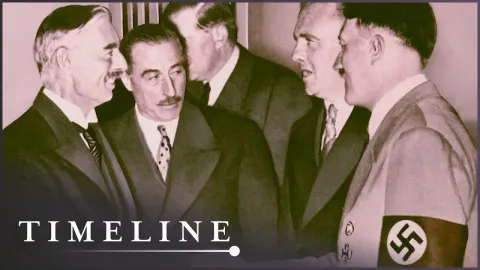
Madame Attolico, the wife of the Italian ambassador, rushed up to François Poncet and embraced him. "You have to save the peace. We Italians love France." These words came out in sobs. André François Poncet is one of the organizers of the conference. But what makes it special at the time is that the heads of state themselves make the journey to help solve the crisis. The conference also marks the beginning of the end of the embassy's eminence. Prime Minister Chamberlain and his Ambassador Henderson, as well as President Daladier and his team are ready for anything.
The discussions were exhausting. A final agreement is reached at 2:00 in the morning. The Czechs are locked out. The next morning, they find out that they've been betrayed by London and Paris. Hitler is allowed to annex Sudetenland with virtually no resistance. Adolf Hitler is nothing but an adventurer, always looking for new challenges and towards the next triumph, totally without restraint, as well as being hyper-sensitive and toxically proud. It would be dangerous for France to rest on the laurels of having achieved peace while this man is around. In Francois Poncet's view, the Munich conference only serves to gain time.
He reluctantly accepts being posted to Rome while the whole of Berlin is eager to be seen at his leaving party. He attempts to convince Mussolini not to follow Germany blindly into war. November 9th, 1938. The year ended with Kristallnacht, an unprecedented wave of terror organized by Goebbels' men. 267 synagogues are set alight and 60,000 Jews are sent to camps. Hitler's new Chancellery with 1,000 rooms, a stone's throw from the British Embassy, is now ready. As every year, the Papal Nuncio reads out each diplomat's declaration. Then it's Hitler's turn to salute the new lineup of ambassadors.
On the outside, the city of Berlin is both the same as and yet different from what it was in 1933. The soirées, the parties, and the receptions continue unabated. But now, it's the friends of the Axis whom Berlin entertains. In March, the inauguration of a Japanese cultural exhibition. In April, the visit of a Hungarian minister. In May, the signature of military pact between Berlin and Rome. And finally, in June, a triumphant welcome for the victors of the Spanish Civil War amidst an increasingly military backdrop. Summer 1939. Hitler carefully racked up the tension with Poland, claiming that Germans living there were being treated badly.
Emissaries were hurrying in and out of Budapest gotten to try to find a solution. On August 18th, I asked that a letter of conciliation be sent to the Führer. On August 21st, we learned that we had been preempted by the Soviets. In Moscow, at the end of August, the sworn enemies of Germany and the Soviet Union sign a non-aggression pact. In a secret clause, they share Poland. A week later, on the pretext that the Poles had attacked Germany, the Nazis invade Poland. This time, however, the Western powers refuse to turn a blind eye.
Great Britain evacuates its last remaining diplomats by boat, and France puts theirs on a special train to Switzerland. On September 4th, after years of backing away, France and Britain declare war on Germany. Dodd sends the following letter to President Roosevelt. The war could have been avoided if the democracies in Europe had simply acted together to stop Hitler. They would have succeeded. Now, it is too late. The outbreak of war is not the end of the story. In the US, William Dodd made every effort to warn of the Nazi danger up until his death in February 1940.
His daughter, Martha, married a millionaire from New York. Uncovered as a Soviet spy during the Cold War, she fled to Prague, where she died in 1990. In New York, Bella Fromm narrowly avoided being killed by Nazi spies, and managed to continue living the high life. Paul Stehlin made his way to North Africa in Free France. He became chief of the French Air Force in 1960. André François Poncet was kept hostage by the Nazis until the end of the war and returned to Germany as High Commissioner in 1945 and then as ambassador in Bonn until 1955. Later, copies of the numerous reports he sent to Quai d'Orsay, the French Foreign Ministry in Paris, were found in a hiding place under the ruins of Pariser Platz.