18:27
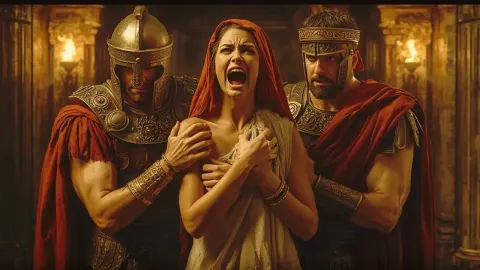



On the land of modern day Iran, two and a half thousand years ago, stood the Persian Empire, the realm of the Achaemenids, which ruled over half the population of the earth. You know it from the movie 300, a deranged king covered in piercings, mindless hordes, free Greeks defeating an eastern despotism. But what if I told you that in this story, the heroes and the barbarians were switched? In supposedly free Athens, they executed Socrates and kept their women locked away. And the man who masterminded the Greeks' greatest victory over Persia was driven out of his own country and lived out his days on the payroll of the Persian king. So, what was Persia really like?
The empire the whole world called barbaric for two and a half thousand years. And how did it make the Greeks destroy each other without sending a single soldier? Welcome back to Meditative History. The visuals here are AI, but every frame is reconstructed from real artifacts and sources, and I wrote the entire script myself based on scholarship on the Achaemenids. I hope you enjoy it. To understand how Persia worked, you have to start with one man, Cyrus the Great. In 559 BC, he became king of Anshan, a small mountain region in southern Iran that almost no one had heard of. He described himself modestly, "Great king
of Anshan, son of Cambyses, grandson of Cyrus. Not king of the world, not king of kings. Just the ruler of a patch of land up in the mountains." In 10 years, this man conquered the Medes, swallowed up ancient Elam, took wealthy Lydia, the very kingdom that invented coinage, and brought the Ionian Greek city-states on the coast of Asia Minor under his control. Historians call him a humanist. The conquered Greeks called him a just ruler. His own people called him father. And yet, Persians made up just one in 25 people in the empire. One in 25. The Assyrians, the previous great power of the region, had faced the same math and
bet everything on terror, cutting off ears, flaying skin, wiping out whole cities. It worked until the conquered peoples united and destroyed their hated master. That's exactly how Assyria ended. I've got a detailed video on that, by the way. Give it a watch sometime. Cyrus figured out how to rule an empire without drowning it in blood. In 539 BC, he came to the walls of Babylon, the oldest, richest, most powerful city on Earth. A city with a thousand years of written history. You could take it by force, but holding it at one to 25 was impossible. And Cyrus did something no conqueror before him had done. He didn't storm the city. He made a deal with the men who controlled it. The Babylonian king Nabonidus had spent years sitting
in a distant oasis in Arabia, neglecting his capital, and insulting the priests of Marduk, the chief god of Babylon. He pushed their cult aside and removed the god's statues from the temples. The priests hated him. Cyrus offered them a deal. "You open the gates for me and I'll restore Marduk to first place and rebuild the temples." The priests opened the gates and then they themselves wrote that Marduk had invited Cyrus in because the old king had angered the heavens. A coup dressed up as the will of God. Babylon barely noticed the change of power. The priests, the merchants, the officials all stayed in place, the temples untouched. Only the figure at the very top had changed. When Cyrus's
son Cambyses conquered Egypt, he took the throne by the will of Isis, Osiris and Anubis. The Persian king became a mirror. Every people saw its own ruler in him. Deported peoples, including the Jews, were given the right to go home. Cyrus entered the Bible as a righteous liberator and that text would be read for thousands of years. Cyrus died on the step battle against the Massagetae, a nomadic people related to the Persians themselves. For three decades, no one could stand against him and he fell to the same kind of nomads the Persians had been a generation earlier. They buried him at Pasargadae in a simple stone tomb with no ornamentation at all. The creator of the largest empire in history had no
taste for splendor even in death. Cambyses expanded the borders by taking Egypt and died without an heir. Cyrus knew how to walk into other people's cities, but empires aren't built only on conquered cities. They're built on the roads, the canals, and the money that tie those cities together. Persia didn't have any of that yet. One man would change that. In 522 BC, after several months of chaos and a struggle for the throne, a distant relative of Cyrus named Darius came to power. He and six Persian nobles killed the usurper who had seized the throne after Cambyses died. That left the question of which of the seven would become king. According to Herodotus, they agreed on this. Whichever man's horse neighed first at dawn would be king. The night
before, Darius's groom led his stallion to a mare. At dawn, his horse neighed first. And so, the largest empire on earth went to the man whose servant knew one trick with a horse. In any case, Cyrus conquered the empire and Darius built it, literally. He started with water. The Persians had been nomads on a scorched plateau where water sources turned up once every few dozen miles. Their engineers came up with something neither the Egyptians nor the Babylonians had thought of, underground channels called qanats. A vertical shaft sunk down to the water table in the mountains, and from it a tunnel with a perfectly calculated slope, so the water ran by gravity alone for 1225, sometimes nearly 40 miles underground
with no loss to evaporation in a climate where an open canal would dry up in a week. No water, no food. No food, no empire. The qanats gave the Persians both. Next came the roads. The Royal Road stretched about 1500 miles from Egypt to India. 111 stations, roughly every 20 miles, where you could change horses and restock supplies. On horseback, switching mounts at the relay stations, you could get from western Turkey to central Iran in a week. The road was laid on a bed of packed gravel that drained off the water and kept the surface from turning to mud. And the nomads on the eastern borders, Darius hired them to guard these very roads. In one move, he
removed the threat of their raids and got himself a free border patrol. Everyone's heard of the Suez Canal, but who's heard of the Canal of Darius? About 125 miles from the Nile to the Red Sea. Seven years of construction, dug by Egyptian laborers and stonemasons. Over the high ground, ships were hauled on rollers. In the low stretches, they were floated again. 2400 years before the Suez Canal, Darius connected the Nile to the Red Sea and through it to the Mediterranean and proudly carved into stone, "Ships went from my canal." He divided the empire into more than 20 satrapies, introduced the gold daric and the silver shekel, and created a state postal system. But, the greatest thing Darius built was Persepolis. Persepolis
stood on a colossal stone platform spanning some 30 acres. You could see it from miles away. Beneath the platform ran the first sewer system in the ancient world. First, they laid the pipes, then they raised the city on top. Darius's great hall held 10,000 people. Its seat and ceiling carried by columns 65 ft tall, perfectly vertical, and all of it cut with bronze chisels. The walls were covered with reliefs showing the rulers of every conquered people in their national dress bringing gifts to the Persian king. From the surviving pay records, we know exactly who built it. Egyptians, Ionian Greeks, Elamites, Babylonians. Stone masons and architects drew a wage. Women worked there, too. There were no Persians among the builders at all. The
city where Egyptian forms stood beside Babylonian carving and Greek columns was built by the hands of every people in the empire for pay, not under the whip. The Persians laid out gardens everywhere. Pairidaeza, from which by way of Greek comes our word paradise. They ran channels to dead oases and brought parched soil back to life. A Persian city without a garden was no city at all, and the paradise of the Bible is described as a garden. Written down by the very people a Persian king had freed from slavery. Women in the empire owned property and ran palaces, and a palace was not just a residence, but an economic center with fields, storehouses, and workers. A woman named Mania was a satrap in Asia Minor, a governor and a military
commander who planned operations and led troops into battle. The Greeks who wrote about this couldn't believe it was even possible. This is what the movie 300 shows you as a horde of savages. Underground waterways running nearly 40 miles, a canal between two seas, paid craftsmen, cities with sewers, women generals. And at that very moment, on the other side of the Aegean Sea, there was a civilization that called all of this barbaric. So, what did it look like from the inside? While Persian women ran palaces and commanded armies, on the other side of the Aegean, an Athenian woman couldn't own property, couldn't take part in the assembly, and barely left her house. At the Olympic Games, women weren't even allowed to attend. When the Greeks learned that women at
the Persian court owned property and appeared in public, they were horrified. To a Greek, that was a symptom of weakness. To a Persian, it was simply everyday life. The Athenian democracy they were all so proud of worked for 10 to 15% of the population. Only free adult men born to citizen parents. Everyone else, women, slaves, immigrants, was completely shut out. The Parthenon, the great symbol of that civilization, was built with money collected across all of Greece to defend against Persia. Athens simply moved the common treasury into its own city and spent it on decorating itself. And Socrates, the greatest thinker of the age, was sentenced to death by a vote of those very same free citizens. In Persia,
where every people prayed to its own gods, that would have been unthinkable. And these were the people who drew the Persians on their vases in humiliating poses. A frightened bearded man in a cap running from a naked Greek athlete. When war broke out between them, only one side wrote the history. It's time to hear the other. Now, picture the scale. An empire that had just built a canal between two seas, laid a road from Egypt to India, and raised a city with a sewer system looks to the west and sees a cluster of tiny towns of 20 or 30,000 people with no single ruler, no single army, no single currency, forever squabbling among themselves. To a Persian king whose territory ran from Libya to
Pakistan, this wasn't even an enemy, just a nuisance on the western edge. But, the nuisance began to grate. The Ionian Greeks, city-states on the coast of Asia Minor, long under Persian rule, rose up in revolt. And the Athenians backed them. They sent ships, and together they stormed Sardis, the seat of the local satrapy, and burned down the temple of the local goddess Cybele. The Persians crushed the revolt in 2 years, but Athens went unpunished. Darius sent envoys to them with an offer. Share your earth and water. Not surrender it, share it. The Athenians threw the envoys down a well with the words, "Go look for earth and water down there." Think about that. The Scythians,
who drank from human skulls, never touched a Persian envoy. Persia sent envoys deep into the Indus Valley. They came back alive. But free, civilized, democratic Athens killed them. Remember who's supposed to be the barbarian in this story? In 490 BC, Darius sent an expeditionary force, professional veterans who had just put down the Ionian revolt. They landed at Marathon. But at the very moment the Persians began loading their cavalry back onto the ships to outflank Athens by sea, the Athenian general Miltiades threw his citizen militia into a head-on charge. Ordinary townsmen, not professional soldiers, struck exactly when the army was split in two. There was butchery right at the ships, the Greeks hacking off hands as
men tried to climb aboard. And seven ships were captured all the same. The Persians pulled out. For Greece, Marathon became a myth. Proof that free citizens could beat an empire. For Persia, it was the loss of a single core. Athens hadn't been the only target of the campaign. Along the way, the Persians had already punished the island of Naxos and the city of Eretria, which had also backed the Ionian revolt. Two of three objectives done. Only Athens got away. Well, we'll come back with a bigger force.
Darius died before he could return. His son Xerxes decided to close the matter once and for all. He gathered an army of up to 100,000 men. Across the strait of the Hellespont, his engineers threw a pontoon bridge made of 674 ships, and the whole army crossed it, heavy cavalry and all. The Greeks tried to stop this avalanche in the one place where numbers don't matter, the narrow pass of Thermopylae, so tight that two chariots couldn't pass side by side. A force of a few thousand Greeks led by the Spartan king Leonidas held the pass for 3 days, the very 300 Spartans everyone knows from the movie. In the end, the Persians found a path around the mountains, surrounded the defenders, and killed them all. From the
Persian point of view, a 3-day delay, annoying, but no more than that. Xerxes walked into an empty Athens and burned the city to the ground, revenge for the temple at Sardis. But while Xerxes celebrated in the ashes, the general Themistocles was setting a trap. He understood that on land, the Greeks couldn't beat the Persians. There were simply too many of them. But at sea, the Persians had an unwieldy fleet of hundreds of ships, and in open water, that was an advantage, while in tight quarters, it was a death sentence. Themistocles pulled the Greek fleet back to the island of Salamis and sent Xerxes a deserter with a false message. The Greeks were supposedly in a panic and about to flee in the night.
Xerxes took the bait and drove his entire fleet into the narrow strait of Salamis to catch the fugitives. In the cramped space, the Persian ships piled up, fouled one another, couldn't turn. The heavy Greek triremes rammed the lighter Phoenician ships at full speed, one after another. The defeat was total. With no fleet, the 100,000 strong army was left with no supplies and no reinforcements. At Plataea, the Greeks finished off what remained. Three major defeats in half a century. You'd think Persia was broken. But after all those routs, the empire stood for another 150 years because Persia had discovered something.
The Greeks' greatest pride, democracy, was also their greatest weakness. How did Athenian democracy work? Citizens gathered in the square and decisions came down to who spoke best. In a monarchy, buying off the king means a coup and a deadly risk. But in a democracy, all you have to do is find three or four eloquent men and pay them. They step out into the square, give a speech, and the city votes the way you want. All perfectly legal, no coup required. The Persians understood this and started sending not armies, but gold. Buying orators in Athens, politicians in Sparta, turning
the city-states against one another, and it [clears throat] worked. When the Peloponnesian War broke out between Athens and Sparta, Persian gold flowed to Sparta. Think about it. Sparta, the very 300 Spartans, the symbol of resistance to Eastern despotism, won that war on the money of that very despotism. And Themistocles, the mastermind of Salamis, the savior of Greece, the Athenians accused him of taking bribes and drove him out of the city. And then, the Persian king Artaxerxes wrote him a letter. "You are a worthy adversary. I have cities for you." Themistocles accepted, took charge of several cities in Asia Minor, and died in honor and comfort on Persian service. Democracy threw away its savior. The despotism took him in.
Meanwhile, in Greece itself, a quiet surrender was underway. The Greeks who had laughed at Persian sleeves and parasols began to wear them, to drink from Persian cups, to furnish their homes the Persian way. For half a century, the Greek elite copied the culture of the very people they called barbarians. Persia played both sides. First, it paid for Sparta's victory over Athens. Then, it paid for a coalition of Greek cities against Sparta itself. When everyone was spent, in 387 BC, the Persian king dictated the terms of peace. What Persia couldn't take with the armies of Xerxes, it bought with gold and patience. For a whole century after that, Persia controlled Greece without a single soldier on its soil.
A hundred years later came the Macedonian king Alexander. He took Babylon, Susa, and Ecbatana, and burned Persepolis to the ground. A century and a half of written records went up in flames in a single night, which is why everything we know about Persia was written by its enemies. But, the deeper Alexander pushed into the barbarian empire, the royal roads, the cities with sewers, the canals between seas, palaces of a kind that didn't exist in Greece, the more clearly he understood he had conquered a civilization greater than his own. He put on Persian clothes, married his generals to Persian princesses, declared himself the heir of the Achaemenids, the very dynasty he had come to destroy, and ordered his hardened veterans to fall to
the ground before him in the Persian bow. The boy who came to kill the barbarians died more Persian than Macedonian. The movie 300 ends with freedom triumphing over despotism. In reality, the despotism survived every defeat, bought off every victor, and waited for freedom to devour itself. Alexander burned the capital and cut off the dynasty, but he didn't kill Persia. He only stunned it for a while. His own empire fell apart the moment he died. And from that same region of Pars, a few centuries later, the Parthians would rise, and then the Sassanians, Persians again, a great power again. But, that's a whole other story. For now, remember just one thing. The only man who ever managed to defeat Persia made himself
its heir the first chance he got. No civilization has ever paid another a greater compliment. If this take on Persia surprises you, drop a like. It genuinely helps videos like this reach people who care about real history.