3:43




Picture this: it's 2002. You're a particle physicist. And you've grabbed your snack of choice to relax with the latest issue of the Journal of High Energy Physics. I've actually been published in that one. But my paper's not the one that we're gonna talk about. I was a child in 2002. Sandwiched between papers about black holes and supersymmetry, you might find an article that's even weirder, about something even more fundamental.
The paper had three authors…all esteemed particle physicists… debating each other about an almost philosophical question they'd been arguing since the early 1990s: How many numbers do we need to describe reality? You may think, what with reality being so big and all, that it would be a pretty huge number. But the debate was about whether the number was three, or two, or…zero? As weird as that is, fast-forward to now, and that debate still hasn't been settled. In fact, a new argument has been made that the answer is…one. So, can we really describe the whole universe with a single number?
[♪ INTRO] If you've ever driven between the US and Canada, you'll have noticed that the speed limits change units as you cross the border, between miles per hour and kilometers per hour. I promise, this is relevant. Like, a 50 mile an hour road would become an 80 kilometer an hour road. But despite the numbers being different, the speeds they represent are the same. Because miles and kilometers represent the same physical quantity: distance. ~ So even though there are countless units out there… seconds and years for time, calories and electron volts for energy, Celsius and Kelvin for temperature… we don't strictly need most of them.
We have more options just for convenience, or historical reasons. In fact, some whole types of measurement are redundant. Like, all temperature units can be converted into energy ones, since temperature is just a form of energy. Or kilograms and pounds and stone. What the heck is up with stone? So, the question that the particle physicists were debating in the 90s was "how low can you go?"
How many units can you plausibly get rid of? This may seem like a strange thing for particle physicists to be debating, but it was actually directly relevant to their work studying the fundamental constants: the baseline numbers at the heart of reality. If you ever took a physics class, you'll have seen a bunch of numbers listed on a page in your textbook. These numbers are the constants. They describe basic properties of reality as we know it, like the speed of light, the strength of gravity, the mass of the electron, and so on.
Right now, the best theory of physics predicts 30 fundamental constants of nature…which is quite a lot more than three. So what's going on? Well, these 30 constants mostly come from particle physics, giving us things like the masses of the fundamental particles and the strengths of the fundamental forces. As far as we know, the 30 constants are fundamental, in that our theories can't predict their values. We can only measure them. And we think they're all the exact same value everywhere in the universe.
Always have been, always will be. But importantly, 27 of those constants can be written so that they don't have units. They're what's known as dimensionless. In physics jargon, a dimension is basically just a unit. Think distance, time, energy, charge… basically anything we can imagine physically measuring. To get why this is important, consider the number 1.07. Sounds completely random, but it's not. It's the mass of the iPhone 15 Plus, divided by the mass of the iPhone 15 Pro. To work that number out, you could have weighed the two iPhones in pounds, or grams, or any other unit you liked.
It wouldn't matter, because after you divide one mass by the other, the units disappear. In some fictional Apple universe, the ratio 1.07 could be a dimensionless constant dictating the relative masses of the Plus and the Pro models for all of eternity. In the real universe, this isn't true at all. For example, the ratio for the 16 Plus and Pro isn't 1.07, it's exactly 1. But it's easier for me to explain the concept using smartphones than anything from our list of 30 fundamental constants. But of those 30 constants, a whopping 27 are like our example 1.07: a number with no units, where it doesn't matter if you're using imperial units or metric or some other system to measure things. And the thing is, there's a lot we still don't
understand about this list of 27 constants. Especially whether 27 is the actual final amount on this list. It's fully possible that there are fundamental, dimensionless numbers missing from the list, hidden in the consistently murky areas of physics like dark matter or cosmic inflation. Meanwhile, physicists might find a way to explain some constants in terms of others. That would reduce how many numbers we truly need to put on sheets for students to memorize or not memorize depending upon how good of a student you are. But no matter whether the final theory of everything has more or fewer than 27 dimensionless constants, we still need units to actually do physics with them.
Like, if you're doing an experiment in the lab, you eventually need to measure some length scale, be it in meters or feet or fathoms. By nature of having units, the last three constants in our list of 30 should establish the fundamental units for physics as we know it. But do they? Before I can answer that, I have to show you this ad… which was not paid for by Apple. Attention, SciShow viewers! Yes, I'm talking to you, the curious, engaged, folks with a learning mindset. This video's sponsor is for you.
Brilliant is an online learning platform made for everyone from age 10 to 110. And they offer courses that strengthen your math skills, improve your confidence in coding, and excel in data, science, logic, and all sorts of useful stuff. Like their Quadratics course, which has step-by-step interactive lessons and personalized practice opportunities built in. So you can learn by doing. To learn for free on Brilliant for a full 30 days, go to brilliant.org/scishow, scan the QR code onscreen, or click on the link in the description. Brilliant's also given our viewers 20% off an annual Premium subscription, which gives you unlimited daily access to everything on Brilliant.
The debate published in 2002…or the "trialogue" as its authors called it… framed everything in terms of a minimum number of constants. But after reading the whole thing, our writer walked away feeling it was really a debate over the minimum number of units. So let's try and unpack all of their arguments. And we'll start with the most popular position, that you need three constants with units. For this episode, we'll call them Team Three. Feel free to assign them a mascot, like a triceratops or something. Team Three's argument starts like this: we know most constants with dimensions can be derived from other constants. For example, you may have heard of the "SI" standard of units,
which defines seven units. Some people call them fundamental units, even though everyone agrees they aren't. They're really just a matter of convenience. Like remember this guy from chemistry class? The mole counts the number of particles in a specific amount of carbon. So really, it's just a conversion factor between big and small scales. Meanwhile, Einstein's famous relation E equals m c squared tells us mass is just energy wearing a different hat, so we don't need separate fundamental units for both energy and mass. In fact, in particle physics, scientists write particle masses
using a unit of energy: the electron volt. Team Three argues this trick can work for most constants with units, but you'll always need at least one unit for space, one unit for time, and one unit for the stuff going on within spacetime: an energy unit. If you have fewer units than that, there are some measurements in physics you won't be able to do. Like, if you don't have a unit of time, you can't measure any speeds. What's extra appealing here is, there's a very natural choice for which three physical constants are the fundamental ones you can derive all the others from, and which ones get put on that list of 30 necessary constants:
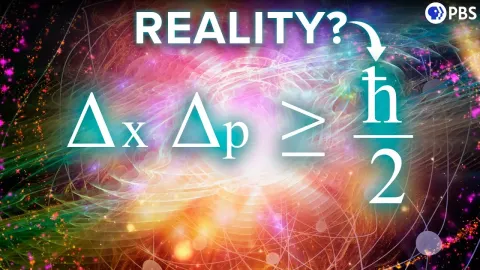
The speed of light, c, the universal gravity constant, G, and the Planck constant, h, which pops up in a lot of quantum mechanics stuff. Each of these constants is made by combining dimensions of length, time, and energy…or in G's case, energy wearing a mass hat. That means you can reverse the process, and combine the constants together to get three special units. Physicists named them the Planck length, the Planck time, and the Planck energy, after the guy who first proposed them: German theoretical physicist Max Planck.
They're special because they each represent a fundamental physical limit in reality: the shortest span of length or time the universe allows you to measure, and the most energy you can possibly cram into one single particle. So our constants c, G, and h have a solid case for being a fundamental component of reality as we know it. But the trialogue paper makes clear, not everyone agrees this is as simple as it gets. Team Two Constants chose their answer after redefining the laws of physics. More specifically, they assumed the weird and entirely hypothetical world of string theory was true.
String theory is just one avenue scientists have explored to try and explain all of physics in one go. To unite the tiny world of quantum particles with the massive world of gravity. Because our current laws of physics cannot do that. According to string theory, reality is filled with fundamental, one-dimensional, vibrating strings. The way these strings vibrate corresponds to different kinds of particles and forces. So, for instance, a particle of light is just a string vibrating one way, and an electron is a string vibrating a different way. Behind this simple idea is a vast library of complicated mathematical theories. But I'm not a string theorist, and there's a good chance you aren't either, so this is all we need right now.
Over at Camp Triceratops, Team Three needs a separate unit of energy to describe all the stuff going on in spacetime. But if everything is just vibrating strings, then the energy of each string is fixed by its length. Energy no longer needs a separate unit; it's just length wearing a different hat. That means we can get rid of energy and express everything in terms of just two constants: the speed of light, and a special length scale. Unfortunately, while lots of people work in and believe in string theory, there's no direct evidence backing it up, yet. And as far as science can tell, there's little hope of that changing any time soon.
So we'll have to wait a while longer to find out if Team Two was just stringing us along. Next, let's look at the newest argument, from Team One Constant, which instead of turning to a new version of reality, tried to redefine the original question that was being debated. And remember, Team One Constant is the new team that came about decades after the original trialogue. Instead of answering how many constants we need to describe reality, they said the question is really: what is the minimum number of instruments you need to make any possible measurement? Because if you can do any possible measurement using just one device,
then the units of that measurement would be all you need. Everything else would just boil down to that. According to this paper's authors, all you need are clocks. Every measurement a physicist could ever want to make can be done using some form of timing information. Take mass, for instance. In 2010, a team of astrophysicists used timing information from a kind of dead star called a pulsar to calculate the masses of planets in our solar system. In other words, a measurement of mass was derived from a measurement of time. If you can measure everything just using timing, that would mean c, G,
and h would all be expressed in terms of some timing unit, bringing us from three down to one fundamental constant. But what about that guy from the original trialogue who went even simpler than that? How the heck can he justify zero fundamental units? Well, he basically went super existential with it all: what if I redefine what even matters? To Team Zero, any constant that depends on arbitrary things like units can't possibly be something real and fundamental. It must be a human convention. Remember how some of the SI units can be explained away?
Well here, the same logic applies to all units. Any constant with units is just a conversion factor between two different, related concepts. Like, going back to E equals m c squared, imagine defining c to be equal to 1. And in fact, in some areas of physics, they really do set C equal to 1! So the equation is now just E equals m. It tells us mass is energy. They're equivalent. And that revelation is the real physics behind the equation. Everything else is just arbitrary labelling.
We lose nothing physical by ignoring c. Team Zero says every constant with units is like this. None of them are meaningful constants that represent something fundamental about the world. Instead, we're just left with the dimensionless constants. Which I will remind you currently stands at 27. And 27 is not, you may have noticed, equal to zero. In fact, that one author admits that we may need a few dimensionless constants by the time we figure out which are truly fundamental. This is why our writer came out convinced that this was ultimately an argument about units, not constants. ~
But whether you're thinking in terms of constants, or in terms of units, one thing is clear. And that is that nothing is clear. The arguments over this topic range from practical questions about how we measure things, to speculative questions about future theories of physics, to philosophical questions about the nature of reality. But that's okay, because these questions all get to the heart of why we even do science. And why we keep doing it. In fact, you could even say our search for a better understanding of the universe is, itself, a constant.
[♪ OUTRO]