16:26




well this is our first deep sky videos since we finished the messia catalog it's your first my first our first together it's collaboration yeah and since the messia catalog is a catalog of things that aren't comets and we're now allowed to talk about whatever we like I thought I'd choose an object that is actually a comet oh M would be turning in his grave yeah well no he'd be excited he wanted the Comets right actually good point all right yeah so the comet I've chosen is com hail Bop because it's the one I have an actual personal connection to I actually remember seeing it in the sky when I was a kid growing up really interested in astronomy and Comet hle came around once
as it does once every 76 years and I remember being bitterly disappointed because we couldn't see anything um it was just kind of a non-event so I was this disappointed little astronomy kid but then unexpectedly a new Comet was discovered and it was discovered while it was still out past the orbit of Jupiter which made it quite unusual indicated it was probably quite large better yet it was going to pass sort of quite near Earth so we were going to get a really good view as this cold frozen nucleus came close to the Sun started warming up out gassing and doing its whole Comet thing and it didn't disappoint so what I remember is the winter of 19969 1997 I was in my final year at University I was living in a place where
the skies were actually quite naturally dark it was a very small town in the middle of nowhere so very unlike Nottingham here where we have a lot of um artificial light um lot of light pollution it's very difficult to get a nice dark view of the sky from the city but out in Saville New Brunswick the skies were dark and this was an object that just hung around in the sky for months I remember walking home one night and just sort of turning the corner and looking down the street and it was just hanging there in the sky and we got an even better look at it so I was really lucky to have this fantastic astronomy Professor uh Dr Bob Hawks who was a real influence on me and my
career and he took a bunch of us out in his car we drove out into the marshes into the countryside um and just went for a viewing party out there so it was yeah it was really spectacular why was this Comet so spectacular when some other ones haven't been so part of it is down to the sheer size of the thing so observations um you know and it was continually monitored as it came into the inner solar system so this is an absolutely massive thing and as it got close to the Sun heated up that results in outgassing so Jets were coming off different parts of the Comet it had a lot of very f fine dust which made this beautiful big display um and it was just a very close and very active Comet um and very visible it was well placed
in the sky for us in the northern hemisphere um I think when you Brady and the southern hemisphere wouldn't have had such a great view of it by the time it passed around the Sun and then dipped down to your part of the world um but we got a beautiful show up in the northern hemisphere for several months it's a long period Comet um so we're not going to see it again for another 2,400 years so it really goes a long way out into the outer solar system before it Loops back and like many long period comets it does this on a very highly elliptical orbit and it's interesting to think of a mental picture of it because we tend to think of the solar system being in a plane like your table like my table with
the planets orbiting around the Sun more or less all um with the same angle but of course Space is really three-dimensional and comets like hail Bop often come in from very oblique angles it was coming in from the south crossing the plane of the ecliptic going over the top as it rounded the corner near the Sun and then plunging back down again it's way down south now where is it now so now it's about 40 astronomical units away now the astronomical unit is the unit that we use for solar system scale distances because it's the distance between the Earth and the Sun it's 40 times that away right now just to give you some perspective the orbit of Neptune goes out to about 30 Au so
it's further away than Neptune from the Sun but in a completely different direction and we can actually show you this because we've got a live solar system emulator which you can actually look up different objects including hail Bop right so I've set the date here to August 1996 and if I rotate this you can see what I was saying about the angle so the planets are all in a plane but then you see I hope that this plunging orbit from hail Bop comes up and over and if I animate this with 1 second being one week you don't see much so I'll choose that I'll change that to 1 second being one month and you start seeing it come around it's now February 1997 if I pause it and zoom in you can see just
how close it came to us in the inner solar system not in any way that it was going to collide had it collided it would have been absolutely catastrophic the size of this thing was way bigger than the size of the asteroid that wiped out the dinosaurs um but the chances of that happening very small so instead we just got this beautiful um light show if I change the date here we can now see that it's started to leave us on its orbit and head back into the outer solar system presumably it hasn't got a tail and doesn't look spectacular anymore no not at all so the tail really only or the Tails I should say so here's here's the typical image that you think of when you see you know spectacular Comet you've got this bright Ion gas tape and that's
pointing directly away from the Sun so that's particles being pushed out by the solar wind and then you've got this more visible dust tail that's often off at a trailing angle this icy Dusty body is being melted essentially as it gets near the Sun the gases are pushing the material out and then the solar wind is trailing it off behind as it continues in its orbit so you know this is an astronomer's view of a comet but again I just went through and found some images on the web but this is what I remember this is the view from the everyday person on the street who and it's not very often that you know someone will just walk down the street and look up and say even with no interest in astronomy oh my God what is
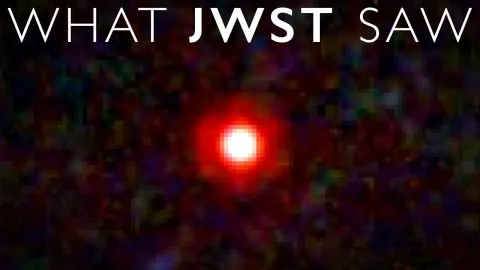
that thing up there and that's what we had for months and months with this so that's that's what I remember about hail Bop um but you asked about what it's like now and um we're still observing it and so I was really curious to see that um in cycle one for the James web Space Telescope there was a proposal that got time to go and observe Comet hail Bop and so at that time it at the time of observation it was far in the outer reach as the solar system and it wasn't this spectacular looking thing with a tail it's back to being a Frozen um icy body but one that with the right instruments we can still look learn lots about its composition about what kind of water is in there what kind of organic materials are in there
and that helps us understand the conditions in the early solar system when objects like these were formed and potentially whether water and organic materials were brought to Earth in the early part of the this the solar system formation has it been imaged yet has it happened it has yes it has can we see it yet not yet no oh there's there's a all I could find was uh a conference proceeding U talking about uh the observations I think the images probably wouldn't be very spectacular but as with most things with jwst a lot of the really um meaty science is going to come out of the spectroscopy because that's where we find out what it's made of is this what most comets are or is this
just a Remnant from that cloud of icy objects that are far away that just got knocked down towards us what would be the origin of this most likely yeah that's right so like most long period comments we think that they probably originated in the OR Cloud which is this cloud of primordial icy material you know in the very far reaches of the solar system and every once in a while some gravitational perturbation from a passing star or something might just nudge something out of that um equilibrium State and it starts plunging down into the gravitational well of the solar system and that's why these orbits tend to be very long period um comets very different from something like Comet hle or some of the other comets that have been in the news that tend to just hang
around essentially the inner solar system and come back every few years or in the case of Hal's com every 76 years so how come H's comet has such a short period by comparison is it just a gravitational fluke or yeah I mean it's all once you enter into the inner solar system you know you're the complex gravitational interactions of the planets particularly Jupiter um really can change a comet's orbit uh doesn't they don't necessarily stay on the same orbit all the time uh something can be perturbed captured disrupted um by something like Jupiter indeed we've even seen uh comets uh shoa the famous shoeer Levy Comet uh it was torn apart and then actually impacted into Jupiter um so you know this solar system
is a gravitationally busy place um and things can get messed around and disrupted very easily when you think about this Comet that was here thousands of years ago it was here during your lifetime and it won't be back for thousands more years does that make you feel insignificant um this is something that astronomers grapple with all the time um I don't think makes me feel insignificant I actually feel like it gives me a little bit of perspective that's what I enjoy about all of these big numbers and these large distances uh it doesn't make me feel insignificant it makes me actually feel like I want to treasure what we have here um because it is so unusual and so fleeting that's very philosophical but you asked have a look at the video
description for more of us at Deep sky videos of course we've got our 110 videos about the messier objects and if you'd like to learn one-on-one from people like Professor gray of course you could study Physics or astronom at the University of Nottingham I'll put a link to that also in the video