4:57



We appreciate Halley's Comet for its punctuality. We know its orbit and are waiting like clockwork for its return in 61. But there are also so-called large comets. They don't live by a calendar, they just emerge from the cloud belt, which, if you didn't know, is a giant icy dump at the very edge of the solar system and covers half the sky. These large comets are so massive and eject so much dust and gas that their tails stretch for millions of kilometers. Sometimes the comet itself becomes so bright that it can be seen in broad daylight. This is exactly what happened with Comet Hale-Bopp in 1997 or Comet McNaught in 2007. But there's a problem. Astronomers cannot predict their appearance in advance. These
objects arrive in extremely elongated orbits from absolute darkness. We are physically unable to track them in the early stages. For example, we will notice the next such giant iceberg only a few months before it flashes in our sky. And that's at best. This means that right now a piece of dirty ice the size of a metropolis could be racing towards us. Oh, that's scary. We have no idea where he is, and we don't have the exact date, but the statistics are inconclusive. Large comets appear on average once every few decades, so the chances of seeing at least one in your lifetime are quite high. Just don't forget to look up.
You won't need binoculars for the next event on our list. In fact, you won't see it at all. You will feel it as silence. The Voyager 1 and Voyager 2 probes are currently the most distant human-made objects from Earth. They have been flying through the void for almost 50 years. They left the heliosphere and entered the interstellar medium. becoming our only eyes in interstellar space. But these eyes are slowly closing. To transmit data over billions of kilometers, energy is needed. Solar panels are useless at such a distance. To the Voyagers, the sun appears as just another bright star, and its light would not be able to power even a flashlight.
The only thing keeping the onboard systems running is the heat from the decay of plutonium in their nuclear batteries. The problem is that physics is unforgiving and ruthless. Plutonium decays on its own and every year the batteries produce less and less electricity. Unfortunately, the energy supply is slowly running out. NASA engineers spent years saving every possible watt, alternately turning off scientific instruments and heaters to save enough power to power the antenna. But around the late 2020s or early 2030s, the connection may cease completely. The energy level will fall below the critical minimum required for radio transmission. There won't be anything dramatic like an
explosion or collision, although, to be honest, it would be spectacular. Instead, receiving stations on the ground will simply catch the last final data packet, and then the signal will disappear forever. The most distant messengers of humanity will become silent pieces of metal, continuing their endless flight through the Milky Way in complete silence. Usually astronomical events require patience. You go out of town and stare at the night sky for a couple of hours, only to catch one faint meteor trail. But in November 2032 or 203, by some estimates, you won't have to squint. The Earth will fly straight
through a dense patch of dust trail left by a comet with the charming name of Tempel. Here. And this will not be an ordinary meteor shower. A huge surge in Leonid activity is expected, which could reach storm levels. In essence, our planet will crash at full speed into a wall of cosmic dust. At such moments, the number of meteors jumps from a modest 10 per hour to thousands. The sky will literally look like it's falling. During peak minutes, hundreds of objects will burn up in the atmosphere, densely crossing the sky with all sorts of glowing lines. This phenomenon looks so large-scale and scary that in the 10th century, during a similar storm, people ran out into the streets,
convinced that stars were falling to the ground and that the time of the apocalypse had finally come. It won't be there this time, but we'll see with our own eyes what it looks like when a planet rams a wall of space debris. Saturn is a true icon of the solar system. We know it almost exclusively because of its massive rings. But in October 2039, orbital mechanics will create a huge optical illusion. Despite the gigantic width of the ice structure of the rings, their average thickness is quite small, only a dozen meters. In 2039, the planet will tilt towards Earth in such a way that the rings will be perfectly edge-on to our line of sight.
At a distance of 1.2 billion kilometers, such a thin edge simply wouldn't be able to reflect enough light into our telescopes. The rings will visually disappear on a black background. For a few weeks, the gas giant with its complex orbital system of ice will turn into a completely ordinary yellow ball. It's a flawless magic trick on a planetary scale that will have amateur astronomers around the world wiping their lenses, trying to figure out where the main decoration of the solar system has gone.
We are used to seeing planets randomly scattered across the night sky. You will even see two of them side by side. Good luck already. But in September 2040, orbital mechanics will line everything up with frightening precision. Mercury, Venus, Mars, Jupiter, Saturn, and the thin Serbian Moon will come together in an incredibly tight group. To an observer on Earth, it would look as if someone had artificially shrunk the solar system to fit all of its major worlds into the field of view of a pair of binoculars. It is not actually a straight line and not a true physical alignment in space.
This is just a rare beautiful projection of the planets onto one area of the sky. A millennium ago, such a cluster would have been guaranteed to cause panic, as people would have perceived it as some kind of harbinger of the collapse of civilization. Today we know that it's just gravity and orbital cycles, right? But given what we move on to next, the premonition of disaster does not seem entirely unfounded. Low Earth orbit is crowded. Tens of thousands of satellites race on it at a speed of 28,000 km per hour. And every month there are more and more of them.
Back in 1978, NASA consultant Donald Kessler calculated and predicted this very scenario. He proved that if the density of objects in orbit exceeds a critical mass, collisions will trigger an irreversible process. Today, this scenario is named in his honor, Kessler syndrome. One large collision will create thousands of small fragments. These pieces of metal, flying 10 times faster than a bullet, will begin to tear apart nearby satellites. Those will explode with new fragments. Their number will multiply exponentially and the space around the Earth will turn into an orbital meat grinder. From the ground, it will look like a beautiful artificial meteor shower. The night sky
will regularly flare up with burning debris, but in reality this will mean a global system failure. Navigation, communication, network synchronization, a huge part of the global economy will suffer a serious blow. And worst of all, the dense cloud of debris hurtling at enormous speed will make it very difficult to launch new rockets for decades to come. We can build a deadly barrier around the Earth ourselves. And to dramatically accelerate this cascade, all it takes is one large collision in a crowded orbital zone. But even if we save our satellites from debris, the sun could simply disable them, and at the same time turn off several continents.
We're used to thinking of our Sun as a stable source of light, but it periodically spews billions of tons of magnetized plasma into space. This is called a coronal mass ejection. In 1859, one of these plasma clouds hit the ground directly. This event went down in history as the Carrington Incident. The sky was shining so brightly that you could imagine reading a newspaper at night, and the telegraph stations were sparkling and lighting up by themselves In the 10th century, electricity was just a funny novelty. Today, our civilization is completely dependent on energy grids and the digital web. And experts consider a repeat of an event of Carrington's magnitude a matter not of if, but of when.
Statistical cycles of solar activity indicate a high probability that we will see such a storm within the year. Good news. There will be no Hollywood-style global apocalypse. We have surveillance satellites that will give us anywhere from 15 hours to several days to prepare. Energy workers will have time to proactively disconnect vulnerable sections of the network. Bad news. This definitely won't save everything. A few hours before impact, we will see blood-red auroras stretching all the way to the equator. And then a magnetic storm can knock out our power grids over vast areas. And here's the catch. Spare
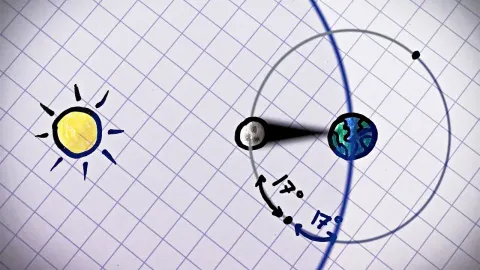
transformers are not kept ready in warehouses. They are made to order and production takes six months. Oh, we won't go back to the Stone Age forever, but entire megacities could be left without stable electricity, communications, or even water supply for months. And all this simply because our star just burped a little. If the sun doesn't destroy our power grids by 2093, it will at least put on one last visual show for us. We previously mentioned the total solar eclipse of 2027 , when the moon will perfectly cover our star. But on July 23, 2093, the orbital geometry will unfold somewhat differently.
The Moon will be near its farthest point from Earth. Its disk simply won't be large enough to completely block the sun. So instead of the usual darkness, a completely black sphere will hang in the sky, framed by a blindingly bright plasma halo, a ring of fire. And it will hang there for an awfully long time. This event will be one of the longest annular solar eclipses of the 20th century. It's the perfect cinematic and somewhat ominous shot to end the century. Just don't look at it without filters, because that fiery rim is still capable of permanently damaging your vision.
All the previous events on our list had at least some reference points: orbital mechanics, cycles, dates. But Betelgeuse has no schedule. Look at the constellation Orion. A massive red supergiant shines on his left shoulder By stellar standards, this star is in the final stages of its life. Its core is running out of fuel and it is literally hanging on by a thread. When gravity finally wins, the core collapses and a supernova explosion occurs. It won't just be some bright flash in a telescope in our sky. It will be able to match the brightness of the moon or the brightest objects in the night sky.
Just imagine, for a few months, the Betalis will be so bright that it will cast soft shadows even at night. Moreover, it will be perfectly visible in broad daylight. At this point, it would be logical to panic and think: will the radiation from this exploding star system fry us? Spoiler: no. Belgeuse is located approximately 600 light-years away from us. By cosmic standards, these are perfectly safe seats in the front row. The deadly radiation will simply dissipate into the void, never reaching our beautiful planet Earth. In fact, the only noticeable effect may be on the behavior of animals sensitive to light cycles, such as migratory birds or insects. And for humanity, it will be a completely safe VIP viewing of an event of cosmic proportions.
But the main catch is something else. We don't have a timer. Astronomers say an explosion is expected within the next 100,000 years on the scale of the life of the universe. This means at any second. By the way, remember, due to the delay in light, the star could have exploded back in the Middle Ages. And the light from this explosion is flying towards us all this time. So the greatest astronomical show of the millennium could begin in a few centuries. Or it could flare up right now while you're scrolling through the comments under this video. So don't forget to subscribe to the channel and click the bell. Do it quickly before Kessler Syndrome leaves you without internet and Betelgeuse
cancels the night.