19:06


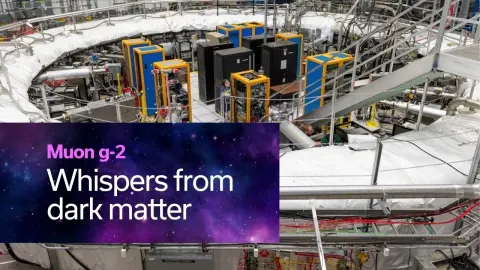
SLAC National Accelerator Laboratory in Northern California. To my left is the world's most powerful X-ray laser. Work is currently underway here that will make it twice as powerful. In this video, I'll show you how they do it and what it means for science. The Linac Coherent Light Source, or LCLS, is a two-mile linear particle accelerator. It emits the brightest X-ray pulses on Earth. Each one lasts only a quadrillionth of a second. Scientists use these flashes to make movies of the movement of atoms in real time. This is something no microscope can do. And a new update is about to make LCLS exponentially more powerful. This means a deeper understanding of how matter works, and it could lead to discoveries in chemistry, medicine, and even extend the life of
your phone's batteries. The new update increases or creates a path from 100 pulses per second to a million per second. So depending on the specifics of the experiment, we can run them 10,000 times faster. At 100 pulses per second, some experiments take too long to complete. If you think about the basis of many of the important technologies that we have, we need to understand them at the atomic level, at the level of atomic resolution. This is where X-rays come in handy. So, how do you make a superconducting accelerator twice as powerful? By adding cryomodules, which are the building blocks of the accelerator. Their task is to accelerate electrons to almost the speed of light.
Now, they're adding 23 new cryomodules to the existing 37, bringing the total to 60. The goal is to increase the energy of the beam so we can create photons with shorter wavelengths, harder X- rays, er, higher energy, if you will. So this is one of the cryomodules from LCLS. It 's usually impossible to see what's inside, but we were very lucky because this one was taken down for renovations, so we can see everything that's inside. Here, below, the beam itself is passing through. Everything else you see is mostly for cooling the system. When I say "cold," I mean extremely cold. To prevent the beam from losing energy through heating, the cavities operate at almost absolute
zero. At this temperature, the cavities lose any electrical resistance. This is what allows the accelerator to fire a million shots per second instead of a hundred. This in itself requires an entire building We are now in their huge cryogenic center. Because a superconducting laser gets very hot, they have to keep it cool. They do this by processing thousands of tons of liquid helium at minus 456 degrees Fahrenheit right in this facility. Helium is the only substance on Earth that remains liquid at such temperatures. It is compressed, cooled with liquid nitrogen, and then passed through a series of turbines spinning at 3,000 revolutions per second until it reaches 2 Kelvin. It's colder than outer space. At any given time,
the facility processes 6 tons of helium. If we filled balloons with helium, we would need 3 million balloons to get the volume of helium circulating in the system. Since helium is a non-renewable resource, the cryogenic unit is a closed system, so not a single gram is wasted. Before scientists can use this electron beam to observe atoms, it must be converted into X-rays. This happens in the undulator hall. Here, a series of magnets causes electrons to move in a zigzag pattern, creating X- rays. These beams are directed to various scientific stations along the accelerator.
Each station is designed for a different type of experiment: from studying new materials to observing the progress of chemical reactions. So, now we are in XPP. This is one of the stations that will be able to take advantage of these new powerful X-rays. The beam enters from the undulator hall into a device called a monochromator. Think of a monochromator as a radio receiver setup. The beam comes in with a mixture of wavelengths, and the monochromator is tuned to just one-the one that the scientists need for a particular experiment.
This is where the beam hits this plate. This is where the material that scientists are researching is placed. X-rays hit the material on the plate, but just before that, scientists irradiate it with another laser from above. This laser puts the material into an excited state of motion, depending on what the scientists are studying. This is how LCLS creates what scientists call a "molecular movie." Each pulse is a separate frame We have a very brief flash of light, like at a disco, that "freezes" the person's movement. After all, a person moves slowly. A flash lasting a second is enough for her, and everything will be fine.
Atoms and molecules are tiny, the distances you are interested in are extremely small. It takes very little time for atoms to cover this distance. This means that the flash of light must last what are called femtoseconds. A femtosecond is a millionth of a billionth of a second, roughly the time it takes to break a single chemical bond. SLAC scientists say such fast pulses will allow them to observe things they could previously only indirectly recreate: chemical reactions as they occur, conditions inside a fusion experiment, and even the wear and tear of your batteries. The battery life is limited.
Therefore, the frequency with which you have to charge your phone is increasing. Perhaps if you have an electric car, the distance it can travel depends on the characteristics of the batteries. We make them more durable. So, can we better understand the processes that lead to battery degradation in order to design a better battery? SLAC now expects to receive the first radiation from the upgraded accelerator in October 2027, and shortly thereafter to conduct the first scientific experiments using these hard X-rays. If you enjoyed this video, don't forget to give it a like. Stay tuned to CNET for more, and we'll see you in the future.