22:02


Right now we are disembarking in Icy Strait Point. So we are learning all about salmon. How it was processed, how it was canned. Look at the size of that. It looks like we're walking through Jurassic Park. Seems like these one they grow forever. The views were simply phenomenal. As soon as you get to the top, you get off and there's this viewpoint of Glacier Bay and you're like, "This is the Alaska I came here to see." Just nature at its finest. Raw, rugged beauty. This has been a lot of fun. I'm enjoying cruising. First cruise and I'm sold on the concept. All righty,
friends. Good morning. This is our second port of the trip of the cruise to Alaska. And right now, we are disembarking in Icy Strait Point. This place is spectacular. We are in the middle of the forest. And first thing we're seeing as we get off the cruise ship, two bald eagles right in front of us. Pretty amazing. So, yeah, we're just going to try and get a little bit closer and show you the wildlife here. It's amazing. Again, really great weather today. It's a little bit overcast, but it's nice and pleasant. So, today is going to be all about enjoying nature, wildlife, walking,
just running up ahead to get a shot of a bald eagle. I mean, we haven't even got off of the platform yet. And already we're we're being treated to spectacular wildlife. So excited to be here. This is definitely a more tranquil destination. A really small place. I think we're just going to wander around, do some hiking. There's the opportunity to go to the gondola. Just so happy to be here. It's so beautiful. So, as soon as you get off the dock, you've got kind of like this welcome area with an information center. You can book different tours. And the first thing
you spot, of course, is the gondola. That's one of the main activities here. And then also, they have one of the biggest zip lines in the world. All righty. We have two options, guys. Yes. And we're going to do both of them. Yes, we are. But we'll talk about both. So, first off, we've got we're going to be taking the Transporter Gondola, this beautiful gondola system. It's free. It's free for anybody. And then we're going to come back on the nature trail. It's only a 15-minute walk. FYI, there's bear activity. Yeah, there's bear activity. It says so there's a sign.
So yeah, be careful and be aware of the bears, obviously. But uh yeah, let's go check it out. Okay, we made it. We made it in Germany. What a smart idea for them to do this. Oh yeah. All righty. So, I'm going to show you here on the map. That is where we started. That's where our cruise ship is docked. We took the gondola over to this area. And next there's a nice
little boardwalk. We can walk up to there to that section where we've got the Huna Caneries. So I think that is our plan. Oh, people are zip-lining behind us. I don't know if you can see them going past. That's a little too scary for me. Um yeah, but the ride was really nice. You just go through the middle of the forest and it is like so thick and dense and lush. You can tell they get a lot of rain over here. And yeah, it's just a beautiful ride. The scenery is spectacular. We're planning to walk back when once we're done with our day of sightseeing so that we can actually
enjoy being in the woods, being in the thick of it. Um but yeah, here we've got a nice little stop with some restaurants. There's a smokehouse, washroom facilities, that sort of thing. And yes, just having a lot of fun. This is a really cool spot that I had never even heard of before. So very excited to be here in Icy Strait Point, Alaska. I just want action. Things to do. Heat. Here we are walking along the beach with Aurelia in arms with grandpa. And you noticed something. Something caught your attention. Do tell. What caught my attention was the size of
this log. I'm going to show you here. Look at this behemoth. It runs all the way like down there. That's a tree passing that little tree there. And also all of these ones, they have the uh chain system. Yes. Okay. This one has the chain and this one has the uh clip. That means that these logs were the ones that were used on the uh perimeter. You know when they float the trees and the logs down the water by the lake or the river, it looks like a huge raft. Yeah. But the logs in the middle are just loose. And the ones all around the edges, they have these chains. Yeah.
They're tied up together. Yeah. They tied up together and then the tug pulls from them. So, uh, this is to avoid that the log that are floating in the middle and they're not tied to anything. They just wander off with the current and they disappear. So, it's basically like a ring made out with this and that's how they transport because around here, you know, you have no roads and you have no means of transporting anything other than by water and uh that's how they do it. They bring it to the mills floating and then they just process them for whatever it
is that they need like uh boards or post and beams and whatever. Right. But this is the way that uh it is done here in these parts of the world. And another thing that you were mentioning these are cedar trees. Yeah. And the other day we learned that they use red cedar to carve the totem poles that we've been seeing. Yeah. Because the cedar is uh one of the trees that has the most uh it's like durability, would you say? Yeah, durability at the uh to the elements with the element to the weather. It doesn't rot. So a cedar tree once it's been cut, it can stand for years, decades,
and maybe hundreds of years without getting rotten. And this is also a tree that has a natural repellent for all these insects that like to chew and eat and carve and bore uh in the wood. So the cedar is also a natural repellent. The smell of the cedar is there's got to be something there that uh it's like a moth bowl, a giant moth bowl, right? It's a cedar tree. Amazing. Stop. Heat.
The different kinds of salmon. Who knew there were so many? My gosh. Wo. Apparently, the king salmon is running right now. And the bears love to eat that one. It's the biggest. So, we are learning all about salmon. How it was processed, how it was canned. Yeah, it's amazing. And this is the Henry. And uh they have like a actually they have the original machines. Yeah. That they were using for uh to process the salmon. Uh the fish is not real of course. It's make believe, you know. But uh they have different stations and they show over there on that side how the fish was gutted and the
head and the fin were removed over here. And then on the other side we have the actual uh canning process. It's uh super interesting because uh this is not the stuff that was made just for the museum. It's the actual machine that these people were using back in the day. And you know you wonder how did they manage with so little. When you get to be my age, these are the type of thing that makes you wonder how many generations of people worked in a place like this, in a factory, in a cannery like this, how many mothers and fathers they have to put in the days to feed
the family and to bring up the kids. And uh I must have been a real hard life because back in the day here I don't think there was much other than the cannery or going to the bush and with an axe and fell trees you know like uh there was no other means or possibilities of uh making a dollar if you will. So this was kind of a maybe for a lot of people a forced situation to get into and having to work in a place like this just because survival dictated it. Okay, since we've been since we've been talking about salmon, salmon, salmon, let's actually talk about the life cycle of the salmon,
which we can see here in the diagram, but my dad Daniel is going to give us a quick lesson. Is this a biology lesson here? Yeah, salmon is so good to eat, but a lot of people ignore completely what uh what's the salmon life like, you know? Yeah. Uh we're not going to talk about the farm salmon because those they live in a cage basically. We're going to talk about wild salmon. The salmon is born in a very uh shallow and small creek, usually up in the mountain with a very crystal clear water. And the bottom has to be pebbled. Okay, that's where the salmon is born. Uh
that's where the female lay the eggs and that's where the males they uh fertilize the egg. What happened the first uh the first month of life they live there where they're born. They get strong and then slowly they start swimming out of that little creek. They go into a bigger river and a bigger river and they always swim towards the uh here we're in the west coast. So they swim toward the Pacific Ocean. Once they reach the ocean they go and they spend depending on the different species of salmon the time could vary but usually around 4 years they spend swimming
around the Pacific Ocean getting big I mean getting nicely and fat. And then the time comes when they have to reproduce again. And slowly from that huge ocean water, slowly they make their way to the same place where they were born. Exactly the same spot. They come into the ocean through the bigger rivers and they swim upstream always because the river flows towards the ocean. So the salmon is fighting always the current and sometimes they have to go over some falls and slowly they get to the same area where they were born and that's where the female will lay the
eggs again and the male will fertilize and that's the cycle of life is over. The salmon dies there. Now it's over for the fish, but it's not over for nature because out of that you have all kinds of wild animal that they feed and they survive thanks to the salmon because they eat it. You have a lot of the um natural uh trees and vegetation that can drive because of the nutrient they get from the salmon. Usually the bears or the wolves or the foxes or the eagles will take them into the forest consume part of it and the rest will be there left to rot. So once is rotten that goes
into the ground and it gives a lot of nutrient to the trees and the plants. And as you can see, it's a cycle of life that not only feeds a human being that they fish the salmon and then they, you know, eat it, but it also serves to feed a whole variety of wildlife and even the uh plant life. Okay, this is one of the biggest mysteries of uh life. No one knows exactly for sure. There are some theories, but no one knows exactly for sure. How does the salmon manages to after swimming four years in the Pacific Ocean make his way back to the same spot little mountain creek where he was born?
What kind of GPS is the earth magnetic field that guides them? We don't know for sure. But the thing is that this fish can find his way back to the origins and uh that's the story of the cycle of life cycle of the salmon that a lot of people don't know. It's a marvel of uh nature, right? Thank you. Thank you for that lesson. I hope I didn't bore you with it. No, that was fascinating. Okay. So, I really enjoyed visiting the Canary area and so appreciated the history tour you did with your father. That was fascinating. Yes, there's a gift shop. Yes,
there's also places to eat. But they have a fascinating museum inside so you can learn about the history of this place and also about the history of Alaska and the different industries they've had over the years. So, I found this a really fascinating place to go. Very laid-back, very chill, and we spent probably almost 2 hours here. So, we had a really good time. Okay, so we are now walking back to the cruise ship and you saw us come on over via the gondola. Now we are going back on foot. There's a nice hike. It's a 15minute hike and it's a trail that
winds through the forest and all around us. We can also see the treetop trekking. That's one of the things to do and activities that you can do here in Icy Strait Point. So, if you're feeling adventurous and you don't have a problem with heights, they have all sorts of obstacle courses. You can also see them behind me. And I wanted to share one piece of advice. If you are traveling as a young family with babies or little kids, it's good to have an all-terrain stroller with big wheels. Especially if you're planning to do the hiking cuz here we are on like a dirt
trail with a bit of gravel. I mean, if you do have the simpler, smaller umbrella style stroller, you'll probably want to come and go via the gondola because you're going to struggle. You you'll probably lose a wheel. But we have my dad pushing Aurelia, who fell asleep finally. This here, Alaska, the last frontier, is not for flimsy equipment or Mickey Mouse things. here you need, you know, equipment that can take it. And the stroller is uh is a good uh example of that. If you come with a little umbrella, folding stroller, uh $29.99 kind of thing that you use in the city
here, you're going to destroy it and you end up carrying the baby in one hand and the stroller in the other one. So, get yourself an a 4x4 stroller and then you won't have any problem. There you go. Believe me, it's a good piece of advice. He's had three kids, so he knows. Despite the abundance of forest wildlife, ranging from deer, bear, and moose, there are snake Despite the abundance of forest wildlife ranging from deer, bear, and moose. There are no snakes to be found in Alaska. Look at the size of the leaves. Like, I need to put my hand here just for scale. Look
at the size of that. It looks like we're walking through Jurassic Park. The size of some of these uh plants, it's just out of this world. Especially under a canopy of a pine tree like this. You know, it seems like really we are in some even I don't know subtropical or even it looks in some area look like a tropical forest. The this one we call the lettuce. Look at that. The lettuce, you know. Look at this. And also the uh when you touch under the uh the tree trunks, it seems like it is a sponge, you know. Yeah. Like a cushion of leaves, like some sort of a
cushion of uh moss and uh all kinds of debris. And that's a good indication of the amount of water that must fall over here in the way of rain. You know, otherwise you couldn't have, you know, this type of vegetation. this only, you know, this these are all species that require a lot of water and I mean not just a couple of days of rain a month. I mean heavy stuff and the height of these trees. It seems like these one they grow forever and that's also probably due to the good excess of water that they receive. So water, water, water. Amazing. Rain, rain, rain. Yeah.
Heat. Friends, I just completed an epic ride up on the Sky Peak Gondelola. Check it out on my wrist here. Everyone else was basically hanging out and chilling back on the cruise ship. We had a very busy day kind of just wandering around, but I thought I had one more activity still in me, so I decided to do this. It was $49. I've got to tell you, I used up all of my courage points
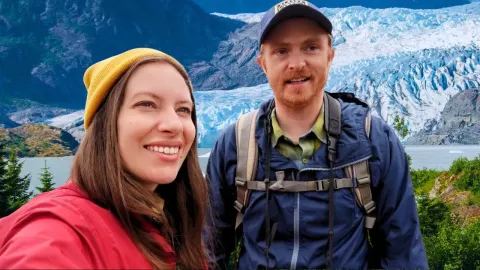
for the day. That was one of the steepest gondola rides I've ever been on. There's an area where it just feels like there's just pure vertical ascent. Anyways, the views were simply phenomenal. As soon as you get to the top, you get off and there's this viewpoint of Glacier Bay and you're like, "This is the Alaska I came here to see." The raw wilderness, the ice cap mountains, the pristine water. I mean, just nature at its finest. Raw, rugged beauty here in Alaska, and it was so worth it. Upon finishing that, I just went on the little nature hike that they have on
offer. It wasn't spectacular, just an easy little walk. You have a little bit of a lookout point, but that's not the highlight. The reason to go up there is for the epic views and it was definitely worth it. 49 bucks and uh that covers your return trip. So, I'm really glad I went up there. And that is it for me today. I'm gonna partake in the siesta just like everyone else. Alrighty, it's windy. So, we are now leaving Icy Strait Point. We spent the day here. It was beautiful. Enjoyed it so much more than I thought I would. I mean, when I heard we weren't actually visiting a
real town, that this is just a stop for cruising. Um, I wasn't sure what it would be like because everything we visit today has been built for tourists. But honestly, it was really fun. We got to visit a museum and learn about salmon canning. And the trail through the forest was just gorgeous. Sam ended up taking the gondola. Well, we also took one of the gondilas, but like not the epic one that goes up the mountains. And yeah, it was just a lot of fun. Now we are continuing onwards to Juno. And the captain just came on the speakers and announced
that there's a very good chance we'll be able to do some whale watching on the way to Juno. The water is super calm right now. Like we have really lucked out with the weather. So, we've just grabbed the table here on the outer deck with the whole family. And we're going to see maybe we get lucky and we see some humpback whales or some killer whales. We already saw whales in Ketchikan. So, I mean, we've ticked that box, but it'd be great to see some more. And yeah, we're just going to enjoy the journey. We've got really long summer days at the moment. So,
yeah, perfect for just enjoying the scenery here in Alaska. This has been a lot of fun. I'm enjoying cruising. First cruise and I'm sold on the concept. So, it'll be the first of many. Heat.