6:56


How can something infinitely large turn out to be smaller than an atom without even colliding? To answer this question, we need to try to get around Einstein's ultimate nightmare, the singularity. Welcome to time zero. I remember what we were taught in school. 13.8 billion years ago, space and time emerged from absolute nothingness, the big bang. But maybe it wasn't like that at all. Over the past few years, scientists have managed to discover three very strange clues, objects and phenomena in deep space that are difficult to fit into the standard model of the universe. We saw ancient galaxies evolving suspiciously fast, as if they were on cosmic steroids.
We have found structures of such colossal size that they may challenge one of the basic principles of cosmology. And most disturbingly, we now have new data that suggests that dark energy may not be constant, but rather changing over time. By themselves, these anomalies don't disprove the big bang, but together they force us to ask a much deeper question. What if the big bang wasn't the beginning of everything from absolute nothing? What if this wasn't the beginning at all? Imagine a dark, completely empty room. There's a grenade in the middle of it, the check has already been pulled out. 5 4 3 2 1.
This is how pop culture portrays the big bang. And that's exactly how she lies to us. Real physics is actually much crazier. The thing is, it wasn't the fragments flying around inside the room. The room itself began to expand. A room that perhaps didn't exist at all until then. The Big Bang is not an explosion. This is a period when the entire observable universe was incredibly hot, extremely dense, and expanding at a breakneck speed. How do we know this? We saw it. When you look at the Sun, you see it as it was 8 minutes ago. If you point a telescope at Sirius, you will see light that left the star back in 2017, when Donald Trump first moved into the White House. The further
into space our telescopes peer, the greater the delay and the deeper into the past they look. And we have looked almost to the very edge of the observed past. We have captured the oldest light in the universe, which has been stretched into invisible microwaves over billions of years of travel. The cosmic microwave background radiation, or cosmic microwave background, is the cooled glow of the same hot primordial fog left over from the Big Bang. Essentially, we got a snapshot of the universe when it was only about 380,000 years old. Physicists have calculated the nuclear reactions of the early universe. If space was indeed ultra-hot and dense, then
it should have left a chemical imprint in the first few minutes. About 3/4 hydrogen, almost a quarter helium, and tiny traces of other light elements. When astronomers pointed telescopes at the oldest, purest gas clouds in deep space and spread their light out into a spectrum, they saw these exact numbers. This proportion became one of the key pieces of evidence that the big bang was not just a poetic metaphor, but a real hot phase in the history of the universe. But if we mathematically rewind this expansion to the very beginning, Einstein's general theory of relativity leads us to a dead end.
The equation formally leads us to a state where the entire observable universe contracts to almost zero volume, and density and temperature go to infinity. Division by zero appears in calculations, while gravity and temperature soar to infinity. This state is called a singularity. And, by the way, if there's one thing you want to know about physicists, they hate infinities. Not because infinity is impossible in mathematics. And mathematics works with it constantly. Because in the real world, we don't have a single confirmed example of something physical becoming truly infinite. So when an equation shows that density or temperature
goes to infinity, physicists don't usually say, "Cool, we found infinity." They say, "Oh, we got infinity. It looks like our theory breaks down here." However, this is where new observations begin to pose problems for the Standard Model. This is where the anomalies begin. In 2024, the James Webb Space Telescope confirmed the existence of extremely early galaxies. The most talked about is JADES GS-z14-0. We see it as it was about 300 million years after the Big Bang. According to previous ideas, the cosmos during this era should have been mostly filled with dim, small embryos of the first star systems that were just beginning to form. But JADES GS-z14-0
turned out to be too bright, too fast growing, and was already too chemically advanced for its young age. Further analysis of its light revealed traces of heavy elements, including oxygen, and such elements do not appear in empty space by themselves. They must first form inside stars and then be ejected into the interstellar gas by stellar winds and supernova explosions. This means that in just the first 300 million years, the Universe has already managed to form stars, burn their nuclear fuel, enrich the gas with heavy elements, and assemble a bright galaxy from this material. This doesn't disprove the Big Bang, but it shows that the early universe could have evolved much faster and more aggressively than we expected.
JADES GS-z14-0, what a complicated name. It looks like she was pumped with banned steroids. The second anomaly concerns the very scale of the universe. The Standard Model assumes that on sufficiently large scales, matter is distributed approximately evenly. Imagine a well-blended puree soup. Up close, it still has some texture, but if you scoop a large portion from one end of the pan and the same amount from the other, on average they will look the same. The same goes for space. If you take an imaginary cube of space
1 billion light years in size, it should contain roughly the same number of galaxies wherever you look. But recently, astronomers discovered the so-called large ring. A colossal pattern in the distribution of galaxies and intergalactic gas with a diameter of about 1.3 billion light years. And just next to it, they found a giant arc that stretches for over 3 billion light years. For comparison, the Milky Way is about 100,000 light years across. These structures are tens of times larger than our galaxy. Finding such a structure is like suddenly discovering a whole huge potato in your perfectly mashed soup. Important note. It is not necessarily a single continuous object like a giant galactic chain, but rather a large-scale
pattern in the distribution of matter. But if it is not random, the problem becomes quite serious. The universe can remain lumpy even on scales where, according to our models, it should already be homogeneous. And the most intriguing anomaly appeared very recently, when the DESI project published new results on dark energy. OK. To understand why physicists were so excited about this, we need to make an honest observation right away. No one has ever actually seen either dark matter or dark energy. These are working names for two invisible components that we have added to our picture of the universe. Because without them, the observable Universe simply does not converge in equations.
Galaxies rotate as if they contain additional hidden mass. We call this dark matter. And the expansion of the Universe is accelerating as if space itself contains some unknown factor pushing the cosmos apart. We call this dark energy. Since the late 1990s, cosmology has largely viewed dark energy as an unchanging constant, a force that pushes the cosmos apart with exactly the same density everywhere and always. But DESI has created a super-precise 3D map of millions of galaxies at various distances from us. Physicists use these galaxies as mileposts on a giant cosmic highway. Imagine you are driving a car and the gas supply is fixed in one position. You can confidently predict where you will be in a minute or an hour.
In exactly the same way, scientists calculated where ancient galaxies should have been located if dark energy were constant. But when these data were compared with other cosmological observations, an intriguing picture emerged. A model in which dark energy changes slightly over time fits the results better than a perfectly stable cosmological constant. At certain times in history, the cosmos expanded a little slower, and at others faster, than the formulas required. In essence, a car that should have been moving at a constant speed was actually speeding up and slowing down. DESI data hint that dark energy may not be constant, but rather change over time.
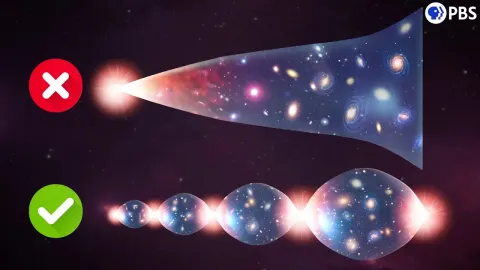
This is not yet a definitive discovery, but if the results are confirmed, the standard cosmological model will have to be significantly expanded or even completely rewritten. And this is so confusing. Individually, these three anomalies are just oddities, but together they sound like a sentence. They indicate that the beginning of the universe had a much more complex structure, and to understand what it might have been like, modern physicists offer five radical ways out of this mathematical impasse. The first hypothesis states that the big bang was not a unique event at all. In this model, the basis of the cosmos is an eternally expanding cosmic vacuum with enormous energy density. This energy
causes space itself to expand so rapidly that the distance between distant regions can grow faster than the speed of light. By the way, this does not violate the prohibition against moving through space faster than light. At the same time, the inflationary field remains in an extremely unstable, high-energy state. Imagine an incredibly stretched rubber band that starts to tear in random places. At these points, the field abruptly releases its energy, transforming it into a hot, dense plasma of matter and radiation. And a local event occurs, similar to a big explosion.
Our universe in this model is just one bubble universe among countless others. A region where inflation locally ended, and galaxies, stars, planets, and us were later formed from the energy of the field. This elegantly explains many properties of the early universe. But there is a pitfall. The space inflating between these bubble universes, all the rest of the rubber, can expand faster than the speed of light. This means we are locked here forever. In our own bubble. We will likely never be able to directly see neighboring bubbles. Light from those regions will simply never reach us.
Scientists are trying to find indirect traces of this in the cosmic microwave background, the cosmic microwave background radiation. But there is no convincing signal yet. Perhaps eternal inflation will remain a beautiful, but extremely difficult, if not impossible, idea to test. And that makes us move on. How Einstein's equations come to a standstill near zero-time simply because space and gravity are not what they seem. To understand this idea, think about VR headsets.
You have flat displays in front of you, but the code renders the images in a way that your brain perceives depth, distance, and volume. You are standing on the edge of a virtual cliff. Your palms get sweaty, your heart beats faster. You physically react as if the world is real, but in reality, all you see are flat screens, behind which are calculations on a chip. The holographic principle offers a similar, but much more radical, idea. Perhaps our three-dimensional reality can be described through information encoded on the boundary with fewer dimensions. By the way, if all this talk about extra dimensions is
making your head spin, check out my previous video about spatial dimensions. What we call space, depth, and gravity may not be the foundation of the universe. The main problem is that we don't know if this idea can be applied specifically to our universe. It works surprisingly well in some mathematical models, but we don't yet know how to test it with direct observations. Holography gives a good clue. Perhaps space and gravity are simply the effect of a deeper information layer. If so, the singularity may not be a true endpoint, but simply a place where our method of describing the universe breaks down. But for now, this is not a solution to the big bang problem. It's more of a signpost to physics we don't yet understand. The next idea sounds even more radical.
Richard Lew proposes a model in which dark matter and dark energy may not be separate invisible substances, but rather echoes of brief flashes in the very fabric of space. Time singularities of energy density and pressure. Imagine how an internal combustion engine in a car works. I will explain separately for Tesla drivers. A car moves not by one giant explosion of all the fuel in the tank, but by thousands of tiny, controlled explosions inside the cylinders. And the pump takes literally a drop of gasoline, mixes it with air, and injects it into a sealed chamber. There, the spark plug ignites the mixture, creating an isolated micro-explosion that pushes the piston and makes the car go. The exhaust
gases are immediately expelled and the next microdose enters the cylinder. This is a strictly controlled process. Thousands of tiny explosions per minute instead of one catastrophic detonation of the entire tank at once. Although that would be cool. Not very useful, but cool. Who doesn't love a good explosion? In any case, Liu proposes a similar logic for the universe. Perhaps the cosmos evolved not smoothly, but in jerks through a chain of ultrashort energetic bursts, the remnants of which may appear to us today as dark matter and dark energy. It sounds bold, but this is where the problem lies. This is not yet proven new physics, but a very unconventional mathematical hypothesis. It has not yet been able to explain the
entire set of observations as successfully as the Lambda-CDM model, the CMB, gravitational lensing, structure formation, baryonic acoustic oscillations, and galaxy dynamics. Therefore, Liu's model is interesting as a radical workaround. What if the dark sector is not matter or energy at all, but a trace of a series of events that have already disappeared from our observable history. But I personally have another question: where is our gas tank in this scenario? The next idea sounds almost like a cosmic reboot. Instead of an absolute beginning, it suggests that there may have been a contraction phase before our expansion.
The universe didn't just emerge from nothing, it contracted, became denser and hotter, but didn't collapse into a state of infinite density at the last moment. This is where different versions of rebounding come into play. In Steinhardt's cyclical models, the universe goes through phases of expansion, slow contraction, and new expansion, while in loop quantum cosmology, the very geometry of space at the smallest scales becomes quantum. Space behaves as if it were fundamentally made up of tiny pixels, quantum cells of geometry. Imagine a digital photograph. From a distance it looks perfectly smooth, but zoom in to the maximum and pixels appear. And you can't squeeze a pixel into anything
smaller than a pixel. Same here. When the universe contracts to extreme density, the quantum structure of space can reach its absolute limit. Classical gravity can no longer simply crush everything to nothing and the compression turns into a rebound. Is it a rebound? Bounce. This transition is exactly what we could have mistaken for the big bang. And that's why this idea is so tempting. It offers a completely new perspective on our three anomalies. Then the galaxies discovered by the James Webb Telescope wouldn't necessarily have to start from a completely clean slate if some fluctuations or initial conditions survived the bounce. These early galaxies could have gotten a slight cosmic head start.
Similar logic applies to the large ring and the giant arc. Such gigantic structures can be imagined as relics of an ancient cosmic prehistory. Not the galaxies themselves from the previous cycle, but the imprints of the conditions from which the matter of our cycle eventually grew. And even the DESI data stands out as particularly intriguing here. If dark energy really changes over time, that doesn't prove rebound, but it makes cyclical scenarios much more interesting. In them, the fate of the universe may depend not on an eternal constant, but on a dynamic field that changes the course of cosmic history.
But that's still not proof. Rebound models remain theoretical. They need to explain not just one elegant idea, but a whole array of observations. So far, the standard lambda-CDM model does a better job of this. But if the big bang really had a flip side, then the beginning might not have been the birth of the universe, but simply the moment when contraction turned into expansion. The fifth and most interesting model was proposed by Nobel Prize winner Roger Penrose. Unlike Steinhardt's approach, in his model the universe does not have to contract at all, but rather expands eternally. Over time, the last stars will fade away and black holes will evaporate due to Hawking radiation. And if in the ultra-distant future
massive particles decay or cease to play a significant role, space will increasingly resemble a void filled mostly with radiation, photons. And this is where pure physics comes into play. Remember Einstein. For particles moving at the speed of light, time actually does not pass. If there were no particles with mass left in space, there would be no one to count time and measure distances. Penrose proposes a model in which, in such an extremely empty future, the universe loses its absolute scale. Imagine a vector image on a computer screen. A single black dot on a white background If there are no rulers nearby, you will not be able to
determine its true size. You can zoom in forever, you will still only see a white field and a dot. You can zoom out forever, and the picture will hardly change. Although, wait. And right now, you can still determine the scale because you can see the edges of your monitor. Now imagine there are no edges, no screen, no ruler, nothing to compare it to. Only a dot remains. And it can be simultaneously infinitely large and microscopic not because it has been physically compressed, but because the very meaning of the word size has disappeared. In physics, this logic is associated with conformal geometry. It preserves the shape of the light paths, but erases absolute
distances. This is why, in the so-called CCS, the infinitely distant cold future of one eon can mathematically resemble the hot beginning of the next. It's as if the cosmos is resetting its scale. But where then does the heat of a new big bang come from? In the Penrose model, the energy of the old aeon does not just disappear. Stellar radiation, gravitational waves, and the eventual evaporation of black holes remain part of this final picture. When the scale is no longer absolute, the infinitely rarefied future can be described on a different scale so that for the new eon it will look like an ultrahot, ultradense beginning. Not as a simple compression of the universe into an atom, but as a change in the very ruler by which the universe
measures itself. Penrose calls one such cycle an eon. If we apply this idea to our anomalies, it becomes incredibly attractive. Early galaxies, giant structures, and strange traces in the cosmic microwave background radiation can be imagined as faint imprints of events from previous eons, such as the final evaporation of supermassive black holes. But this is not proof yet. Penrose and his colleagues were indeed looking for such traces, so- called Hawking points, in the cosmic microwave background. However, independent studies have not yet provided grounds to recognize the CCS as a generally accepted model.
Standard cosmology, all that remains, is much more thoroughly tested. Therefore, the CCS is not the final solution to the big bang problem. This is just one of the most beautiful and bold attempts to say: perhaps the beginning was not the birth of time, but a transition between two different ways of measuring the same deep physics. All of these ideas sound very different. Eternal inflation, holography, temporal singularities, large bounces, Penrose aeons, which personally look and seem the most elegant to me. But at the heart of all of them lies one and the same question. What if the big bang was not a starting point, but rather a veil, a boundary, hiding physics that lies deeper than space, time, and the gravity we are familiar with?
Today we still do not know which of these models is correct. Maybe none. Perhaps the correct theory will turn out to be even stranger. But that's the beauty of science. Each new anomaly pushes the boundaries of what we are able to understand. We have long searched for the beginning of time, and now it is becoming increasingly difficult to rule out the possibility that time may not have had a beginning at all, at least in the sense in which we are accustomed to imagining it. Write in the comments which model seems most logical to you.