9:01
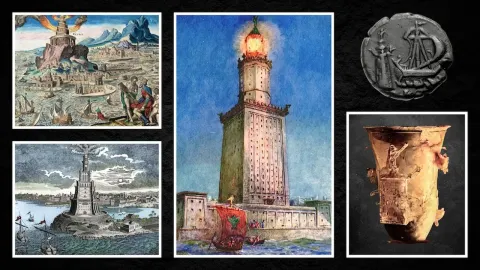



It was the most famous tomb in history. So iconic that its name, the mausoleum, is still used forerary monuments today. Taller than any temple, it was decorated with hundreds of sculptures by the greatest Greek masters of the age. But with the exception of a few tantalizing fragments, this wonder of the ancient world has vanished. The mausoleum was built in the mid 4th century BC, a generation before the conquests of Alexander. At the time of its construction, Helicarnasses and the rest of Asia Minor were part of the Persian Empire, which stretched from the Aian to India. The sat trap Persian governor of the region around Helicarnaces was Mousilus, a local dynast married to his sister Armisia. When Mouselus died, Armisia, so
distraught, it was said, that she mixed a pinch of her brother husband's ashes into her wine, presided over the completion of his tomb. The mausoleum was a rectangular structure that rose in tears to a colonade and a stepped roof. The architects drew inspiration from the neighboring region of Lissia, where dynasts had long been buried in monumental tombs influenced by Greek architecture. The so-called Nariad monument, the most famous example, has been reconstructed in the British Museum. The Egyptian pyramids seem to have inspired the shape of the roof, but the overriding artistic influence was Greek.
Four famous Greek sculptor worked on the project, each decorating one side. Although the scale of the tomb, 140 ft tall from its base to the colossal quadriga that crowned it was impressive, it was the quality and sheer abundance of its sculpture that ensured the mausoleium's place among the wonders of the ancient world. The mausoleum was instantly and lastingly famous. Elements of its design were imitated in Roman victory monuments. Both the trophy of Augustus at La Turbby and the trophy of Trajan at Adamissy are thought to have been inspired by it. So more distantly with the mausoleiums of Augustus and Hadrien. The closest replica, a second century tomb known as Gumos Kessan, the
silver purse, still features a colonade and a parameal roof. The Muslim's own roof and cowade were shattered by medieval earthquakes. By the 12th century, when Ustavius of Thessalonica described it as still marvelous, the tomb was probably a shapeless mass of marble carpeted with vegetation. These remains were destroyed by the Knights of St. John, a military religious order that established a stronghold at Helicarnaces at the beginning of the 15th century. Between 1494 and 1522, as part of a sustained effort to reinforce their castle, the knights cried the mausoleum down to ground level. Thousands of green lava blocks from the tomb's masonry core were built into the castle walls. Most of the marble statues and reliefs were burned
for lime. Only a few slabs showing battles against Amazon and centaurs were preserved along with a scattering of monumental lions and leopards. In 1522, while dismantling the mausoleum's foundations, the knights stumbled upon a marble staircase. They dug all around it, prying up course after course of heavy stone blocks. After four or 5 days, an opening appeared among the stones. A few men squeezed through the crack and found themselves in a room walled with marble in many colors. By candlelight they could see a beautifully sculpted freeze with scenes from a longforgotten battle. Beyond through a low door was a room that contained an alabaster sarcophagus. Before they could open it, the evening retreat was sounded.
When they returned the following day, the sarcophagus was empty. The only traces of treasure were golden spangles fallen from an ancient burial shroud. The knights supposeded that pirates had come in the night and robbed the tomb. Shortly after they discovered the tomb chamber, the knights were driven from their castle. Helicarnaces, now known as Bodum, became a sleepy Turkish village. Houses were built over the rubble of the moselum, and its sight faded from memory. We'll discuss the remarkable rediscovery of the mausoleum after a brief word about this video's sponsor.
Over the centuries, dozens of artists have reconstructed the mausoleum at Helicarnaces on paper. Now with Portal, reconstruction happens in 3D. Portal is a groundbreaking app that transports you into the ancient world using historically accurate reconstructions and photorealistic CGI. It creates immersive XR experiences that allow you to walk through history. In Rome's Circus Maximus, for example, Portal transforms what is now a nondescript valley into a stadium with tens of thousands of spectators all cheering as chariots race around the
track. Scan the QR code on screen with your mobile device and you'll receive five free tickets with the app. Enough to watch some of history's greatest monuments come to life. Returning to our topic. In 1856, Charles Newton, an employee of the British Museum, set out to rediscover the mausoleum. He knew approximately where it had been located thanks to a description of Helicarnaces by the Roman architect Vuvius. Walking among the lanes and gardens of Bodrum, he fixated on a neighborhood where almost every house had fragments of fine marble in its walls. Here in a field that contained the fragments of a colossal stone lion, Newton started digging.
Almost at once, his workmen uncovered a platform made of large greenish blocks, many still clamped together with iron. The rubble above glistened with splinters of white and colored marble. Newton had discovered the foundations of the mausoleum. Since he could not afford to buy every house in the neighborhood, Newton spent several months tunneling along the tomb's buried base, trying to determine its exact footprint. Then after lengthy negotiations with local homeowners, work started in earnest. Initially Newton was disappointed. The knights had stripped the mausoleum to its base. When he turned to the area just north of the tomb, however, he found a spectacular trove of sculptures
and decorative elements from the top of the mausoleum. toppled by a medieval earthquake. They had fallen beyond the precinct wall and been buried by sediment washing down from an adjacent hill. The knights had missed them in their search for stone. Newton recovered parts of at least 20 sculptures, all over life, colossal statues he identified as Mouselus and Armisia, fragments of the quadria that crowned the tomb, and several majestic lions. The finds now fill a room in the British Museum. A century after Newton's discoveries, the site of the mausoleum was revisited by a Danish team under Christian Yeperson. For the first time, the tomb chamber was fully uncovered, revealing both the huge stone block that sealed
its entrance and a ritual deposit of food probably made during Mousiss's funeral that included the butchered carcasses of 21 sheep, five cattle, and 14 chickens. Through careful analysis of the extent remains, the Danish archaeologists have clarified the dazzling opulence of the mausoleum's sculptural program. A continuous rank of colossal freestanding statues lined the base. Hundreds of life-sized freestanding statues were poised along the top of the first tier. Above was the Amazon Freeze partially preserved in the British Museum. Higher still beneath the
colonade were colossal portraits of Mouselus, Artemisia, and their predecessors. Dozens of lions guarded the roof and the great quadrea at its pinnacle. Though conjectural in some details, this reconstruction captures the richness of a monument that overshadowed even the parthonon and the ambition of a ruler who combined Greek, Egyptian, and local architectural elements into a synthesis that defied time. Follow the link on screen and in the description for a tour of the mausoleum's site today, hosted on my travel channel, Scenic Roots to the Past.
The design of the mausoleum appears to have been partially inspired by the Egyptian pyramids. If like Mausalus and Artemisia, you're intrigued by ancient Egyptian religion, you might be interested in the course on the Coptic language, the language of the pharaohs, taught by Dr. Lydia Bremer McCllum on the religion department, an online learning platform associated with the religion for Breakfast channel. Follow the link in the description to learn more. In case the last two promotions didn't catch your fancy, I urge you to continue scrolling through the video description to the links for my spring 2026 group tours. One tour will explore Spain's most impressive Roman monuments. The
other will follow the path of Alexander the Great through what is now Western Turkey. The Tolenstone Patreon also awaits your pleasure. So do my scrappy secondary channels. Tolden Stone Footnotes and Scenic Roots to the Past. Thanks for watching.