16:39
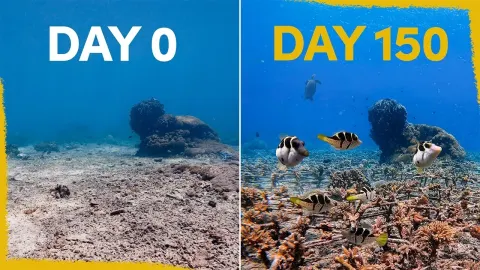



I can think of No Place More Alive than a coral reef this ecosystem is just bursting with life it is the frenzy of nature put on display in a show that dazzles and mesmerizes you with its beauty with its intricate complexity and sheer abundance from the wide reefscapes buzzing with activity to all the creatures discreetly Sheltering in the holes and crevasses this place feels to me like it is truly alive there are corals of unimaginable diversity there are fish of every shape and size there are Rays eels octopuses and even snakes among many other wonderful and mysterious creatures that depend on this place to live and even though these ecosystems have endured for millions of
years they're also fragile and in our greed we as humans can be very destructive and this of course is where we come in we started up a team in Indonesia with the sole task of bringing back these areas that have been destroyed and to do so at scale and since then we've been hard at work getting everything set up and in this video today I want to explain why we think this work is so important and to introduce you to our action plan so many of you have been asking us when we were going to do something about coral reefs and I agree it's about time that we try to help this absolutely mindblowing ecosystem which is why I'm super excited to introduce you to our project here in NSA panita I think that with a few years
we can do a lot of work and we can achieve a lot so I'm really excited about the potential impact of this project but before we get into all of that I want to start by introducing you to Coral explaining what Coral is and also delving into why coral reefs are so important and the best way to do that is of course to go underwater every image in this video was filmed by me and Julia either at our project area or nearby and that is because we want to show you exactly what we are working to restore and what you would be helping restore as a most Earth member so while we go down and explore this mesmerizing ecosystem please remember that all our work to bring back this exact magical ecosystem
you are seeing on your screen right now is funded by our Mossy Earth members and if you would like to join our efforts then you can learn more at moss. Earth let's start by looking at the corals they are animals with a very simple body structure comprising a central mouth surrounded by stinging tentacles that they use for defense and feeding and to survive they also rely on a symbiotic relationship with zanth algae which live inside their bodies and help them with some of their daily energy requirements by giving them sugars glycerol and amino acids through photosynthesis in turn the algae receives the carbon dioxide phosphates and nitrogen that it needs and also the protection offered by the
stability of the coral and the special proteins that the corals have developed to protect their algae from excessive UV light and those proteins are actually something that we can visual because they create fluorescence when we dive down at night shine a blue light and use a yellow filter we are able to see these proteins in action absorbing the harsher shorter wavelength blue light and re-emitting it at longer wavelengths in Greens yellows oranges and reds and this trick not only helps them protect their algae but it also allows them to photosynthesize better at dawn and Dusk and also in deeper and more shaded areas so it's essentially the corals creating the best conditions possible for the algae to thrive at this stage you might be
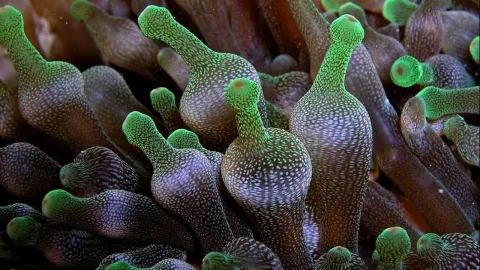
wondering whether this is a scene from Avatar but I can promise you it's very much on this planet of ours now each individual animal here is called a polyp and when a polyp clones itself thousands of times we get a colony of polyps that stays connected through a thin layer of living tissue that allows them to share nutrients and energy and while they CL BL themselves and grow they secrete a limestone skeleton underneath their bodies which is how they build the impressive structures that you might recognize as a coral such as these bush-like acropora that grow fast these colorful brain corals that prefer to grow slow but steady or these ainop corals that look more like a brown rigid
cabbage and all of these corals are then complemented by other animals such as sponges large seaf fans giant clams and feather stars which filter the water and keep it clear allowing the bright equatorial sunlights to penetrate deeper and keep this whole ecosystem going and all of this put together forms an underwater habitat where marine life can find shelter where it can find food and even a place to get cleaned it's the perfect home for all kinds of life forms which is why this beautiful mess of a place is the most biodiverse marine e system on Earth home to 25% of all marine species despite covering only 1% of the ocean floor and for as humans there's also a lot of benefits this
place is full of fish which many people rely on and it also plays a big role in protecting the shoreline from storms and of course they store carbon so I hope that uh this has uh made it clear why we think coral reefs are so magical and so important but unfortunately it isn't all sunshine and vibrant corals there are also problems very obvious problems that these ecosystems are facing we have climate change which is changing the water temperature and acidity and can lead to the bleaching of corals which means that the corals get too stressed and expel their algae and then die we have water pollution which can increase theut nutrient loads in the water and reduce water Clarity and thus light penetration that of course is very important for corals there is the
smothering love of Tourism that both protects it but can also destroy often depending on how well it is managed and finally there are the fishing practices which can often be disastrous such as blast fishing which is fishing with underwater explosions and I'm not making this up this is actually a thing and of course it shattered this habitat to bits now a lot of these problems require government level Solutions but we still wanted to find a way to help this really important ecosystem and that is where yudi comes in I met him while doing my Dive Master training in Indonesia many years ago and since then we've kept in touch so we had an idea about Mossy Earth and the kind of work that we do
which is why last year he reached out to see if we could do something about the coral reef that he loves it's a beautiful dive size like in the shallow Parts it's very beautiful corals and also in the slope there's very beautiful corals but also in this dive side we have some patches of rubbles which over like over the years they're not recovering so they're only getting bigger to find the solution to this problem we took yudon full time and paired him with Ellie one of our biologists from the UK and they got cracken they created an Indonesian yayasan or foundation and found a good location for our first project this is NSA penita an island near Bali it is in a part of Indonesia where the currents are cooler and the likelihood of
bleaching is lower and it also has a marine protected area now which surrounds the island and helps keep the coral reefs safe from the threats we mentioned earlier so all of these conditions give us a really good opportunity to try to fix the areas that have been damaged in the past and the first step in any Mossy Earth Project is of course to get a Baseline and this is where CHA comes in she is yudi's girlfriend and besides bringing a lot of laughs to the project she also brings expertise as a marine biologist focused primarily on Indonesia's coral reef ecosystems and with her on board the core team was complete and we could start with the surveys but the cost of renting a local boat for each day of
serving was really starting to add up which is why we decided to look for a more permanent solution and that is why we bought a boat yeah we have our very own Indonesian boat now which is uh which is never something I thought would happen very cool to have and uh the boat needs a name and we actually intend to honor what you guys vote as the top comment this is of course a bit of a liability there's a bad uh record of this online but uh I believe in you so the top voted comment on this video is what we are going to name this boat we're going to paint it and everything so we're committing to that and hoping that you are members have some good judgment now it's very useful to buess
your boat especially when allowing YouTube viewers to name it but better than that is having a great Captain which is why the team was lucky to strike a partnership with pakade an experienced Helmsman that knows these Waters really well and with all of this in place they got to work and after some weeks of surveying they identified six Rubble areas in need of restoration which they carefully mapped using photos and surface GPS this allowed us to estimate the area we want to restore and it came up to about 2,200 square m for this initial site to fix these areas we had a browse at what other people are doing around the world and here in Indonesia as well and based on this and the scientific literature the concept we
ended up using is to bring back the substrate the coral is missing that essentially means bringing back something stable for it to hold on to and also to give the coral a helping hand in attaching we will be doing this work at scale by producing these metal structures coating them in Coral sand deploying them on top of the rubble areas attaching them together foraging the nearby healthy Reef for naturally broken fragments tying them to these structures and taking care of them until they attach with our plan clear we started working on getting a permit from the Indonesian government but while going through the paperwork we also wanted to test out our methods so we got permission from the Marine protected
area to deploy a small trial of a few structures this is going to be our first trial um so we're testing around with how we're attaching the coral fragments uh what species mix are we ideally looking for obviously we're limited by what fragments are available um and also just to see how logistically it works how are we going to get the structures from the boat into the water how many can we carry um so there's lots for us to test out they started by preparing seven metal structures for deployment as that will be enough to test things out as you can see our boats the red one over there looks like we've still got a little while until we're going anywhere but eventually the tide came
and they got underway and Midway through the work in this first deployment of ours they were lucky to have some special guests visiting our trial site um everything went really well um we managed to get all three of them installed and colonized with 15 fragments of coral each um all on the first dive which is really good because we're going to need to be doing around 50 a day um once things really start ramping up the next day they deployed the remaining four structures and the trial site was complete so then it was time to gather some last bits of data finish writing our application and prepare to scale up our efforts me and Julie arrived in Indonesia 4 months later to be here for the kickoff of this project but it was
quite stressful because our permit was still in limo the wor is the waiting here once we have the go then we can actually start but Judy hasn't been sitting around waiting he used this time to put together our capacity to produce structures at scale so we decided to start by checking out the progress he made on the first component of are little Coral Factor okay so when the metal bar come it comes with this long 12 M and we cut it out and bend it into this sizes so the structure requires three of these and put together in the mold once in the mold the structure can get welded together and reinforced with some extra metal bars and there you have it that is a completed structure we will need to
produce thousands of these so we contracted this shop to do it for us and they were quite happy to have this business as it steady work for them over a long period of time so once the reef stars are made we need to store them somewhere so we have a little Shack on the beach where we can leave them and I just wanted to show you what it all looks like because uh yeah it's um starting to look like a lot of progress it's uh yeah really cool to see all of these reefs are stacked up ready to be coated and go in the water the coating process is simple it involves using some epoxy resin to cover the structures in Coral sand waiting for them to dry and then adding a second layer this was
actually the slowest part of this whole production but bit by bit we got quite a few of them ready for deployment but we were still missing our permit to be able to start so we decided to go and check out the small trial site now that 4 months had passed it was great to dive down into this beautiful ecosystem once more I truly cannot think of a more exciting bit of nature than this we passed hawkville Turtles busy forging for sponges we saw parrot fish nipping at The Reef to clean it of algae and morels curiously peeking out to take a look at us it was just wonderful to be back here but on our way to the trial site we also passed many of the rubble areas as well as the rubble landslides covering the healthy Reef further down and this
really drove home the point that there is work to be done here and then we arrived at our trial site where we could see that so far all of the corals were alive and starting to attach with many of them growing so fast that they had already covered the zip TI used to keep them in place and yeah this was great to see and gave us even more confidence in our plan to do this at scale and it was then that we spotted something very cool there was this beautiful tiny black Domino damsel fish which had moved into one of the corals this is its new home and when we checked on it over the next few days we always found our little Domino friend living in the makeshift house that we built for it really
makes you think what we can achieve after deploying tens of thousands of these it's an amazing dream I'm so excited for this work and please remember that we can only afford to build teams like this one that can bring back wildy ecosystems because of the continued support of our Mossy Earth members people like you watching this video that decide to join us with a monthly subscription to help pay for the costs of building Domino fish houses among all the other ambitious and serious Rew Wilding projects that we have so I hope you'll consider joining us at moss. Earth and I'm confident that our little Domino friend won't have to wait too long to have neighbors because a few days later we had it okay thank you Ministry of the marine and fishery of
Indonesia we are ready to go on the offensive and in the next video in this series we will show you the first big deployment as well as all the progress we've made since then because this was filmed in April and we've put in a whole lot of work since then until next time cheers