7:31



That telescope behind me is the largest telescope on the planet, but it has a problem. It's a problem that we'll probably never be able to solve, and it's also the exact reason why you just can't keep zooming with your iPhone. When the Apollo 11 left the moon, the flag that the astronauts planted there fell on its side. So, if this telescope can spot galaxies that are billions of light-years away, why can't it get a photo of that flag? The ESO has spent billions of dollars to try and overcome this impossible problem with optics, a problem that could mean the answer to so many of the questions that we have about the universe, not to mention to shut up flat-earthers once and for all.
So, I came all the way here to the Atacama Desert, got access inside the Very Large Telescope to understand why we'll never be able to see the flags that we left on the moon. Okay, so check it out. This is the photo that we shot of the Milky Way using my iPhone. Put it on a tripod, iPhone 15 Pro. And this is the photo that we shot using my DSLR. Why is one so different from the other? The first simple answer is light. This photo on the iPhone was a 9-second exposure versus this photo on the DSLR was a 30-second exposure. But check out what happens when you zoom in. Both of these cameras are 48 megapixels, so why does one look much better than
the other? Megapixels are just part of it, but this isn't a sensor problem. It's a much more complicated physics problem. But a problem for tomorrow. Anytime you see photos of the Earth and the moon, they kind of look like this. But you've been fooled all your life. When looking at the moon, there's a big problem that we need to overcome, and that's how far the moon is. Now, imagine that the moon is about this size. At this scale, the flags that we left on the moon would still be microscopic. But we still haven't accounted for distance. So, at this scale, the moon would have to be under the drone.
Go. All right, you're good. About this far apart. Those are the Earth and the moon to scale with the actual right distance. In our field of view of the sky, the moon is about half a degree, or about 1,800 arc seconds. For comparison, the Andromeda galaxy, despite being millions of light-years away, is huge. Now, this explainer is supposed to come with my own photo of the Andromeda galaxy that I hope I can get today, but uh I have to wait till I get home to see. Okay. Ha. That did work. So, this is the Andromeda galaxy on my camera. In our sky, Andromeda is over 3° wide, or about 11,000 arc seconds. Again, that's about six moons wide. The challenge to be able to see it is a problem of light, of
getting enough light into the sensor. But we already know how to solve that. It's easy. You just have to point the camera at it for longer. Now, the moon, on the contrary, is very bright. But the point that we're trying to focus on, 1 m on the surface of the moon, would be 0.00054 arc seconds wide. So, bright, but we would need to zoom in a lot. So, why can't we keep zooming? That's in essence what telescopes are for, zooming into objects that are too far, or in other words, too few arc seconds wide for us to be able to see. Kind of like a giant camera, except this telescope has one key difference with cameras. A usual camera or telescope, what it usually does is it takes light and tries to focus that light in a
spot that would be the sensor. So, in a nutshell, if I make a hole in this cardboard, I can focus light from the sun onto the floor. And what's actually happening here is there's a cone of light that is formed from the hole, and I need to find the exact distance so that this hole focuses on the spot that I want. So, that hole is called aperture, and it's going to be really important in a moment. So, don't forget it's called aperture. Now, because we don't want to build these giant black boxes that have to have this distance between the hole and the sensor, we use lenses. And what the glass in a lens does essentially is focus that light but in a shorter distance thanks to the curved glass. That's why you can have three very different cameras in your
phone where the distance between the hole, the aperture, and the sensor is the same, but a wider or narrower batch of light gets focused on the sensor. But there's a real big problem with the glass in those lenses. Check out what happens with this photo of the moon. Um if you zoom in, you'll see that there's this kind of discoloring here. So, this is a very bright object in the sky, but notice that there's this kind of blue discoloration on one side and this kind of red discoloration on the other side. This is called aberration. Aberration happens because light is made up of waves of different colors, right? So, as those waves hit the glass and get curved and get distorted, some light, some colors get distorted at
different speeds than other colors. So, we get this difference. This amateur telescope that I own back home has the exact same problem. It's a problem of glass over glass. That's where we are, here to the Very Large Telescope in the middle of nowhere in the Atacama Desert with like a UV index of 11 and like 30° C, but I really hope this shot works when we get back. English or at least let's go. Looks like it's four of them, though. Why are there four? And that is the main telescope mirror.
The mirror in each of the four telescopes up here is 8.2 m wide, which is effectively the aperture of the telescope, just like the size of the hole in our little paper experiment outside. A mirror is also the solution to our problem with lenses cuz the fact that lenses are transparent is actually a problem cuz as light passes through a lens, it gets distorted. But in a mirror telescope, no transparency is needed. We're dealing with reflections. Now, light comes in through that huge hole up in the roof. It gets reflected into this large mirror at the bottom, and then all the way up to another mirror at the top, and then down one last time to that mirror in the middle. And that mirror then reflects it back to each of the different instruments that the telescope has.
Is this. Just bigger. Eventually, after all of these reflections, light hits a sensor, just like the sensor in your phone, but, you know, better. Now, there are a bunch of sensors that catch light inside the VLT, but fun fact, the largest sensor in the VLT is about the size of this paper sheet I've been using. It's mad. I never thought I'd see one of these on the inside. Crazy. Another interesting fact is that astronomers don't operate the telescope. Most astronomers don't even have to fly to the VLT. What they do is they submit a request of what they want to see, and then there are these operators,
who are usually Chilean, that actually move the telescope and take the photos or the measurements of what they need. But if you don't want your software product to require a trained engineer to use it, you should look into Mavin. Think of Mavin as the repository for UI and UX design inspiration with over 2 million product designers that use it to search for references for their design problems. They have over 5,000 screens, over 250,000 user flows that you can bookmark, reference, share, and of course draw inspiration from by creating your own mood boards. These are all real-world designs that you can search with natural language keywords. They're
organized in flows, too, which lets you test all these UX approaches without having to download each one of those apps. Signing up is completely free if you use the link in the description or this QR code here, not to mention that you support our channel in the process. Thanks so much to Mavin for pitching into the production of today's video. So, back to those flag photos, why can't we see them? Well, Earth has other problems. Some of those have to do with the atmosphere. While useful to keep us alive, it distorts light as well. Now, check out how those city lights flicker in the distance. It's the same reason why stars twinkle.
It's our atmosphere's fault. It's the same reason why we get mirages. The guys at the ESO, they struggle with the exact same problem, which is atmospheric distortion. Now, that's even worse in sunsets, for example, cuz the sun has to go through all this atmosphere before it reaches us, so it distorts the light even more, which gives us some great cinematics, but some really bad astronomy. So, what the VLT guys did is they put the telescope on top of this hill, so they have less atmospheric distortion, which is as good as it gets before having to put the telescope as in outer space. That's great. So, that should solve the atmosphere problem. So, why can't we still see the flags? There's another much bigger challenge to be able to see the flags.
And to solve that, the ESO has been working on a new project that's on the other side of the desert. We're going to cross it, and we're going to go to their newest conundrum, the Extremely Large Telescope. Maybe we're not supposed to be on this road, but promise I'll be good. I'll behave and won't disturb the operations. We just want to get a closer look. So, the ELT is trying to solve the very last, the impossible problem with cameras. It has nothing to do with megapixels. It has nothing to do with the quality of the glass or the quality of the mirror. It's a physics limitation
of how good a camera can be. And it all has to do with aperture. When light goes through any aperture to try and get focused on a sensor, it gets blurred. It's not a problem with the glass. It's not a problem with the mirrors cuz it happens with mirrors, too. It's not a problem with the megapixels. It's simply the fact that we're putting all this light through a hole, and that creates this blurriness. Now, in a perfect world, a single photon of light travels through space or wherever and lands on the sensor and makes just this tiny little point of detail. The problem is that when light travels through any aperture, it's going to get distorted. So, that little dot is not going to be a dot anymore. It's going to be more of a smudge.
That, by the way is the main reason why my pro camera shoots a much better photo than my iPhone camera despite both having about 48 megapixels. The difference is my pro camera has a much larger aperture. Aperture is a physics problem and no amount of science is going to help us solve that problem because we're trying to do with this flag on the moon is focus on a point that's 0.00054 arc seconds. So this smudge is on this 8.2 m mirror on the VLT are too large. Too large to be able to tell the detail of that flag. The resolution of this aperture of 8.2 m is not enough to see a point that small. Now the ELT is trying to solve this problem by making a mirror that's not just 8 m wide but 39 m wide. A 1.5
billion dollar engineering marvel and yet not enough. So this is the residence inside ESO where the astronomers actually live. This is kind of like the hotel in that James Bond movie. That circle dome here is like this greenhouse situation they have so they have some humidity for better living conditions. And that thing is 35 m wide which means that the mirror on the ELT is 5 m larger than that. That doesn't even fit in a single shot. It's crazy. Now when going through the 39 m aperture on the ELT, we also get a smudge and that smudge is about 0.0032 arc seconds wide. That resolution would allow us to see objects of about 6 m wide on the moon. Because remember we're trying to see an object that's 0.00054
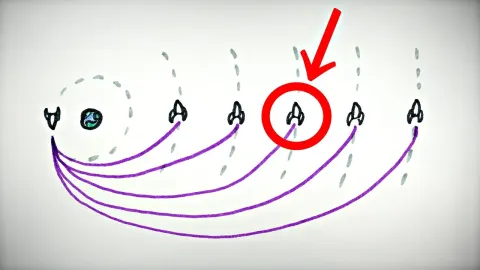
arc seconds wide. So we need this smudges that our aperture produces to be smaller than that. We would need an aperture or in this case a mirror that's 230 m wide. Building that mirror wouldn't only be unaffordable but also really impractical and essentially impossible with the technology that we have today. But these guys have another trick up their sleeves. Now the VLT actually tried a really elegant solution to that. Now the reason why there are four telescopes up here and that weird layout on the floor [clears throat] is that all of these telescopes can act as one. This is called an interferometer and when aligned properly, these telescopes can simulate a larger aperture of about 200 m.
It can't capture as much light but the distance simulates this giant mirror. However, they still came up tad short for the size that you would need for that mirror. Not to mention that the interferometer works with infrared light not visible light which makes it really hard to pick up objects that will have a lot of contrast like a flag sitting in a really bright moon. The other solution is actually a lot simpler. Just put the camera closer to the object. We actually have a bunch of satellites flying around the moon that have taken photos of these landing sites. I guess that's just not enough for flat earthers though. By the way, geeking on lenses and telescopes is not the only reason why we're here. The most valuable plot of land in the Americas is
just a few miles south of here. We made a whole video about that so make sure to check it out. Catch you on the next one.