7:31
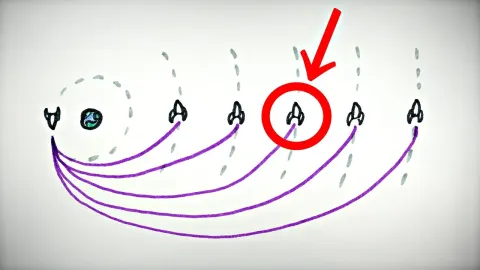



what if everything we call the universe was actually inside a giant black hole. Sounds crazy, right? But if you take the approximate mass of the observable universe and plug it into the Schwarzschild radius formula, the result comes out frighteningly close to the scale of our cosmos. Stay with me until the end. The answer lies at the seventh level. Level one. Primary black holes. Forget about imagining them as giant craters in space. Some hypothetical primordial black holes could be smaller than a single atom. But inside this subatomic crumb, which cannot be seen even with the most powerful
microscope. The compressed mass of an entire mountain or a large asteroid is tens of billions of tons. If such a black hole were to fly through the Earth at great speed, we would most likely not see the Hollywood apocalypse. It would simply pierce the planet almost through, like an invisible bullet. The planet would barely register its passage, leaving behind only a very faint, barely perceptible seismic and gravitational trail. Where do these monsters come from? Smaller than an atom. Well, they weren't born from dead stars. Stars simply did not exist then. In the very first split second after the big bang, our universe was an incredibly dense, seething, and red-hot quantum soup. Space
was expanding at an incomprehensible rate, but matter was distributed somewhat unevenly. And if in some random microscopic region the energy density exceeded a critical threshold, that matter could collapse under its own gravity. Even before the cosmos cooled, in some scenarios, the early universe could have been seeded with a huge number of such invisible gravitational traps. But physics is inexorable. Nothing lasts forever, not even black holes. Stephen Hawking showed us this back when he discovered that black holes will eventually evaporate, very, very slowly, radiating energy back into space. The rule is brutally simple: the smaller the black hole, the faster it disappears. So the tiniest of them dissolved into the
void at the dawn of time. But those whose initial mass was equal to the mass of a small asteroid evaporated over billions of years. And right now they may be nearing the end of their lives. The final moments of such a black hole are not a quiet extinction. It would be an incredibly powerful, but extremely short burst of high-energy gamma rays. The final flare, during which the residual mass is converted into pure radiation. The Fermi Gamma-ray Space Telescope has been searching for such signals in the depths of space for 15 years. The result: so far, scientists have not found a single convincing candidate. But this does not prove that primordial black holes do not
exist. This only places strict limits on their numbers near us. Either there are very few of them, or their mass, distribution, and evaporation rate lie beyond our current observational capabilities. Level two. Stellar mass black holes. We leave the hypothetical microworld and move on to objects whose existence we can prove. These are the same black holes you've heard about. Billions of years. An ordinary star lives in a state of perfect but fragile equilibrium. This is a grand cosmic tug-of-war. Thermonuclear reactions are constantly occurring in the core of a star, releasing enormous amounts of energy that presses on the star from the inside out. Meanwhile, its own terrible
gravity is trying to open it from the outside. But she lives in a balance between these two forces. As long as there is fuel, the star holds its shape. But one day this chain of thermonuclear combustion reaches its limit. Iron accumulates in the core, from which energy can no longer be obtained through fusion. The pressure that was pushing the star outward disappears and gravity wins. If the remaining core of a dying star has a mass two to three times that of our sun, the pressure of matter itself can no longer stop the collapse. The substance of the core rushes inward at tremendous speed. In a split second, the star loses its support. The outer layers of a star are ejected into the universe in a blinding supernova explosion. While
the core falls into darkness forever, it contracts into a sphere from which light will never escape again. It becomes a black hole. The typical mass of such objects ranges from a few to tens of solar masses. According to current estimates, there may be tens of millions of them in the Milky Way alone. Most of them are completely invisible. We only notice them when, for example, they strip plasma from nearby stars, spinning it into a glowing disk, or when they collide with each other. In 2015, the LGO observatory first recorded this merger. It was an absolute triumph of astrophysics. Far beyond our galaxy, two black holes circled in a deadly dance until they eventually
merged with each other. In a matter of fractions of a second, energy equivalent to about three solar masses, three of our suns, was completely transformed into gravitational waves, distortions of space-time itself, that rolled all the way to us here on Earth. The remainder was incredibly compact. A mass of dozens of dreams was compressed into the area. Only a few hundred kilometers across. Level three. Intermediate mass black holes. For decades, astrophysicists have looked at the universe and seen a frightening void. We knew about stellar black holes. And we have long known about galactic giants with masses of millions of suns. But between
them lay an incomprehensible chasm. Black holes with masses of hundreds or thousands of solar masses seemed to be absent from the universe. The problem wasn't that physics forbade their existence. Basically, the problem was that the standard death of a single massive star could not easily explain this range. The area around a hundred solar masses was particularly problematic. The theory of stellar evolution predicts the effect of pair instability. If a star is too massive, the temperature in its core becomes so extreme that photons begin to transform into pairs of particles and antiparticles. The pressure
drops, the star contracts sharply, and then an uncontrolled thermonuclear explosion occurs. Such an extremely massive star can completely destroy itself in an explosion, scattering its matter into space and leaving no compact remnant behind. Because of this, for a long time we had only controversial candidates. Scientists have been searching for this missing link in evolution for almost 40 years. And only in May 2019 did gravitational wave detectors catch one of the most convincing signals, the event GW190521. Very exciting name, isn't it? Okay, they need a better name. Well, whatever, two black holes with masses of approximately 85 and 66 solar masses merged. Simple
arithmetic would give you about 150 solar masses, but the final black hole had a mass of only about 142 solar masses, which was not enough mass. Mass equivalent to about eight suns was released in the form of gravitational wave energy. Steeply. Egesh. So how did they come about if individual stars didn't create them? One of the most likely explanations is repeated mergers in extremely dense environments. In a close star cluster, ordinary stellar-mass black holes can eventually collide and consume each other. This is a long process of cannibalism, where they gradually gain mass, crossing the forbidden zone step by step. But no matter how massive they become in such clusters, their scale pales
in comparison to the objects that await us further ahead. Level four. Supermassive black holes. We move on to the real masters of space. Such a giant lurks at the center of almost every large galaxy. Their masses start in the millions and can reach well beyond billions of solar masses. In our home galaxy, the Milky Way, this gravitational anchor is called Sagittarius A. Its mass is about 4 million suns. If you placed it where our star is, its event horizon would be far inside the orbit of Mercury. Not so gigantic, right? But don't let the seemingly small size of its shadow fool you. Its gravity would completely rewrite and eventually destroy the entire architecture of our solar system. How do
we know it's there if the center of the galaxy is hidden from us by a cloud of dust? Well, the stars themselves give it away. For years, telescopes have tracked stars near the very center of our Milky Way, racing around an invisible object at breakneck speeds of up to 24 million km/h. Such fast orbits at such a short distance are possible in only one case. A colossal mass is hidden in the center. And in 2019, the Event Horizon Telescope project achieved the almost impossible. By connecting radio telescopes across the globe into a single network the size of Earth, humanity for the first time saw not the black hole itself, but its shadow at the center of the galaxy M87.
This is a famous image, a blurry asymmetrical ring of fiery superheated plasma enveloping a completely dark, impenetrable void. But there is a much deeper secret here. Scientists have discovered a striking pattern. The mass of a supermassive black hole is often related to the mass of the central bulge, that is, the thickening of the host galaxy. In other words, the monster at the center and the galaxy around it seem to be growing and evolving together. However, this relationship is not perfect, and astrophysicists still argue about who sets the rules in this partnership: the galaxy itself or the black hole at its center?
Level five. Ultramassive black holes. We are approaching the limit of the observable world with you. One of the most massive black hole candidates known to science is the monster powering the quasar Ton 618. Popular and scientific literature estimates its mass at tens of billions of solar masses, often around 40 billion and higher, although the exact mass depends heavily on the model used. The light from this Leviathan has been traveling to us for over 10 billion years. We see it as it was when the universe was only a few billion years old. Around it rotates a giant accretion disk, a vortex where gas accelerates, compresses, and heats to extreme temperatures, gradually losing energy and falling closer and
closer to the black hole. This process releases so much energy that the quasar shines hundreds of trillions of times brighter than the sun. Think about this. Could you even imagine something that shines hundreds of trillions of times brighter than our sun? I honestly can't even fathom such brightness. I didn't even think there was anything in our universe that could be this bright, but apparently it can. Well, behind this almost incredibly bright light, it's almost impossible to see the host galaxy . But the main problem with such giants is not only their size. That's how quickly they appeared. In physics, there is such a thing as the Eddington limit. A black hole cannot absorb matter infinitely quickly. If it eats too quickly, the radiation from the
superheated gas becomes so intense that it repels matter flowing toward the black hole. This is how space traffic jam occurs. If the black hole in TON 618 had grown only in the standard way, starting with the mass of a normal star and obeying this physical limit, it would have been extremely difficult for it to grow to such a size. for the time available in the early universe. Therefore, scientists suggest that such objects were either originally born from giant embryos, when entire clouds of pure gas collapsed directly past the star stage, or they grew through extremely rapid superdynastic feeding in the chaos of the young universe. Surprisingly.
Level six. stunningly large black holes. In astrophysics, these hypothetical monsters are sometimes called slaps. Steppend large black holes. I love this name. This is a completely hypothetical class of objects whose mass starts at 100 billion solar masses and only increases further. Humanity has not yet discovered any such object. So why do physicists even waste time discussing them? Because science often finds answers on the verge of the impossible. If such incredibly huge giants really existed somewhere in deep space, their presence would be impossible to ignore. Their gravity would be powerful enough to influence the motion of entire clusters of galaxies.
Let me repeat: not just galaxies, but entire clusters of galaxies. In some bold theoretical models, scientists suggest that such colossal objects, hidden from us, could explain some of the dark matter in the universe. You know, that invisible substance that seems to make up most of the matter in our universe, but whose nature remains a mystery. However, it is important to remember that this is not a fact derived from observations. This is a speculative mathematical hypothesis with very strict limitations. If they do exist, their number must be very limited. Overly massive or numerous objects have left noticeable traces in cosmological observations, particularly in the CNB's cosmic microwave background radiation. So,
we continue to peer into the darkness. But we may never see this final seventh level. Well, at least from the outside. Level seven. Class Space Horizon. To understand this ending, we have to change our understanding of what a black hole is. We are used to thinking of it as an object whose density supposedly tends to infinity. Remember the first level. The mass of a mountain in the volume of a proton. But the mathematics of the event horizon hides a paradox: the more massive an object becomes, the lower its average density. For sufficiently massive, supermassive black holes, the average density can be comparable to that of ordinary water, and a black hole the size of the solar system would have a density no greater than the
density of the air in the room you are sitting in right now. The more mass you add, the more sparse the average density of such an object becomes. Now imagine the most grandiose thought experiment possible. Take the approximate mass of our entire observable universe, all those trillions of galaxies, stars, planets, gas, and dark matter. If you simply plug it into the formula for the Schwarzschild radius, the size of the event horizon, the result will be times or close to the scale of our real cosmos. And the average density of such a hypothetical object would be an order of magnitude the same as the current density of our universe right now. Hmm, very interesting. This is where strict observational
astrophysics ends and the territory of bold cosmological hypotheses begins. There are mathematical models in which our universe could have originated inside a black hole located in some larger four-dimensional parent space. The equations of general relativity do indeed show an intriguing, almost frightening mathematical similarity between the geometry of gravitational collapse and the metric of our expanding cosmos. But you have to be careful here. This does not mean that science has proven that our universe is inside or is indeed an ordinary black hole in some external superspace. This is a highly speculative idea, not a conclusion of the standard cosmological model. However, this very coincidence of formulas and scales keeps
physicists awake at night. This is an occasion to ask the most uncomfortable questions about the nature of our reality. We began this journey with microscopic objects hidden in quantum foam. And we end with the thought that the most grandiose structure in the universe may not be an object somewhere in space, but the very edge of the universe, from the middle of which we try to understand reality. Write what you think about it in the comments. Always happy when you visit and comment. See you next time.