18:27



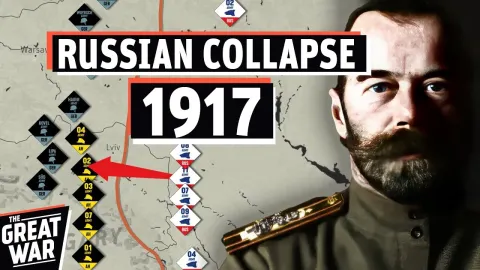
Early 1917 - the Russian Empire was in chaos. The Tsar's political opponents launched a revolution in Petrograd, and the 300-year Romanov dynasty came to an end. Some Russians were optimistic, and looked forward to the country's first-ever elections, and perhaps even peace. But for others, like Bolshevik leader Vladimir Lenin, the year of revolution wasn't over yet. At the end of the 19th century, the Russian Empire was a great power, but was less developed than its European rivals. It had modernized more slowly than Britain, France or Germany: serfs were only freed from their feudal-style bondage in 1860, there were fewer railways and factories, and political parties were banned.
But opposition was growing. When the economy started to modernize, it happened very fast and unevenly, causing instability and inequality. At the same time, there was little social or political modernization, which angered intellectuals and nobles who wanted progress. Peasants were also upset, because the economic changes disrupted their way of life without improving it, so their local governing bodies resented central authority. Socialism and liberalism were two of the ideologies championed by political opponents of the Tsar. In 1881, The People's Will - a populist socialist organization opposed to industrialization, assassinated Tsar Alexander II. Other socialist groups, though,
approved of industrialization, disowned violence, and/or wanted a constitutional monarchy. Liberals wanted a free-market economy but also civic and political freedom for everyone. Marxism emerged in the 1880s and rejected liberal idealism, terrorism, and the traditional focus on peasants. Marx had argued only proletarian industrial workers could move society beyond capitalism to the inevitable triumph of socialism and communism. Marxists therefore wanted capitalist development as a necessary pre-requisite to a socialist revolution.
The vast majority of the population was peasants, though there were more and more industrial workers. In 1897, 92 of the Empire's 126 million people lived in European Russi and Ukraine, concentrated around the industrial centres of St. Petersburg, Moscow, and the Donbass. Many peasants from these areas did seasonal industrial work, and the authorities noted growing political activity: "Within the last three or four years, the easygoing Russian young man has been transformed into a special type of semi-literate 'intelligent', who feels obliged to spurn family
and religion, to disregard the law, and to deny and scoff at constituted authority. Fortunately, such young men are not numerous in the factories, but this negligible handful terrorizes the inert majority into following it." (Fitzpatrick 29) [1901 Police Report] Matters came to a head in January 1905. Defeat in the Russo-Japanese War sparked revolution against Tsar Nicholas II, and in October, he bowed to the pressure and created an elected parliament, the Duma, and legalized political parties. Previously illegal movements now formed a
party system. The Constitutional Democratic Party, also known as The Cadets, was the main liberal party and favored a constitutional monarchy. The Socialist Revolutionaries, or SRs, blended populist and Marxist ideas, and were popular among peasants. The Russian Social-Democratic Labor Party was more Marxist, but soon split into two factions, the Mensheviks - who favored a gradual, legalist approach to revolution - and the Bolsheviks, who wanted a more direct revolution with workers as the vanguard. Many Social Democrats hoped the two factions would reconcile, but the Mensheviks worried about Bolshevik leader Vladimir Lenin's
preference for tight, central control. However, the following years saw little direct improvement for the people of the empire, and the police suppressed political rivals amidst riots and strikes. Many leaders, including Lenin, remained abroad to avoid arrest. Even in 1908, a relatively quiet year, political violence killed 1,800 state officials, and by 1910 major strikes were common. A general strike in 1914 almost hindered mobilization in the leadup to First World War. The declaration of war saw some patriotic fervor and most moderate socialist parties supported the war effort, but they often rejected aggressive war goals. Lenin wanted Russia
to lose the war to trigger revolution - which caused the authorities to arrest many Bolsheviks. But battlefield defeats like Tannenberg in 1914 and Gorlice-Tarnow in 1915, and economic hardship and shortages resulting from the abrupt transition to a war economy led to disillusionment. When Tsar Nicholas II appointed himself Supreme Commander in 1915, critics focused on the monarchy and his absence from the newly renamed capital of Petrograd. Tsarina Alexandra took on more responsibility in government, and her German heritage and
controversial relationship with mystic Grigorii Rasputin caused a political stir. Cadet Pavel Milyukov wondered in 1916: "Is this stupidity or is it treason?" (Fitzpatrick) [Pavel Milyukov\} Despite later Soviet claims, the Russian army was not yet on the edge of collapse. Morale was poor, but it varied. In Galicia, the southern armies managed to inflict a damaging defeat on Austria-Hungary in 1916. The northern armies, facing tougher German units and closer to political events in Petrograd, were unhappier. In fact, morale was lowest behind the front. Garrison units, especially in Petrograd,
suffered from poor discipline, made worse by a lack of competent officers and NCOs. In early 1917, 65% of the garrisons' men were new recruits, or veterans recuperating from wounds - both groups reluctant to go to the front. Garrison troops were also more exposed to political rumors and agitation: "At this time, a regular soldier - in fact, any soldier from the ages of twenty-two to twenty-five - was a rarity. The [Petrograd] soldier of those days was either a dissatisfied peasant or a dissatisfied city-dweller. In essence, the barracks became simply brick pens to which more and more red and green draft notices drove ever-increasing herds of raw humanity." (Badcock 89)
The war had destabilized society and the army, but in early 1917, it would be many soldiers' wives who would trigger a new revolution. In February, Petrograd was a hive of political activity as food shortages wracked the city. Many Russian provinces produced enough grain, but a wartime lack of transport capacity and poor weather prevented distribution. In 1917, Petrograd received by rail only 44% of the grain it had in 1913. These concerns, combined with increased industrial discontent, led to mass demonstrations on International Women's Day - March 8 - or February 23 in the Old Style calendar used in Russia at the time. Crowds, including revolutionaries, took control of railway stations and arsenals and descended
on the Duma. The authorities ordered the Petrograd garrison to put down the uprising, but it refused. Few military commanders or Duma members were willing to support the Tsar. Instead, they encouraged him to abdicate to save the country. He agreed to hand his throne to his brother, Grand Duke Mikhail, who refused in favor of forming an elected Constituent Assembly, essentially ending the 300-year Romanov dynasty. Nicholas was shocked: "It turns out Misha renounced the throne. His manifesto ends with a flourish about elections to the Constituent Assembly within six months. Lord knows who gave him the idea to sign such a
disgusting thing!" (Badcock 86) [Tsar Nicholas II] Following the February Revolution, a Provisional Government made up of politicians, notables, and intellectuals was formed in the capital, but it wasn't the only governing body. During the revolution, workers and soldiers formed the Petrograd Soviet - a council of representatives promoting socialist policy. Although moderate Mensheviks and SRs dominated its leadership, the rank-and-file were more radical workers, including Bolsheviks. The Soviet and Provisional Government agreed to work together, with the
Soviet monitoring the Provisional Government until a new Constituent Assembly could be elected. It was a dysfunctional system in which radical Soviet members had significant influence: "The Provisional Government does not possess any real power, and its directives are carried out only to the extent that it is permitted by the Soviet of Workers' and Soldier's Deputies, which enjoys all the essential elements of real power, since the troops, the railroads, the post and telegraph are all in its hands. One can say flatly that the Provisional Government
exists only so long as it is permitted by the Soviet." (Fitzpatrick 48) [Alexander Guchkov] The Soviet even unilaterally announced Prikaz Nomer 1, or Order Number 1, drastically reforming military discipline and giving the Soviet authority over the armed forces. The Soviet also forced the Provisional Government to abandon offensive war goals for more defensive ones, known as defensism. Meanwhile, peasants in the countryside started appropriating land from nobles and establishing their own committees. The Provisional Government delayed land reform until the formation of the Constituent Assembly, a decision which fed rural disorder. As a result, some peasant soldiers on the front deserted to
return home and get their share of the land. In April, Lenin returned to Russia and released a manifesto predicting the inevitable collapse of the bourgeoise Provisional Government. This caused alarm within the Menshevik Soviet leadership, who wanted to let the bourgeoise revolution peacefully run its course. Another problem was Bolshevik infiltration of their defeatist ideology into frontline forces. Although some units became heavily Bolshevized, the failure of the July 1917 Kerensky Offensive wasn't just because of Bolshevik agitation.
While some soldiers refused to continue the attack, most remained willing to defend, and did not necessarily want to abandon the war entirely. Even so, the Provisional Government was suspicious of Lenin, and promoted theories he was a German-sponsored agent. Germany had facilitated Lenin's return to Russia and provided some money. But, although they were pleased with the instability in Russia, it's unlikely Berlin directed Lenin's actions. The political situation in Petrograd got worse over the summer. Soon demonstrators,
including workers and soldiers, were calling for "All power to the Soviets". In mid-July, the capital was shaken by another near revolution. On July 16 demonstrators took to the streets of Petrograd yet again. At their head was the First Machine Gun Regiment, a heavily Bolshevised garrison unit. The crowd descended on the Taurida Palace - home to the Provisional Government and Soviet - and clashed with loyalist Cossack troops on the way, resulting in 6 killed. But when the roughly 10,000-strong crowd reached the Palace, even the demonstrators weren't sure what to do. Lenin belatedly arrived in the city,
but refused to even address the crowd. Although more militant Bolsheviks pushed for revolution, many leaders felt the time was not right and it would only invite retaliation. As debate raged, Menshevik-turned-Bolshevik Leon Trotsky helped calm the crowd and dispersed them. The so-called July Days was a confused affair, as once again, radical grassroot movements outpaced revolutionary leadership. But the Provisional Government response was definitive. Police arrested leading Bolsheviks, and suppressed Bolshevik organizations, although Lenin escaped
to Finland. The Provisional Government enjoyed a boost in support as they framed the event as a German-sponsored Bolshevik plot to hijack the February Revolution. At a Bolshevik demonstration soon after, teenager Edward Dune recalled: "The demonstration turned out to be most unimpressive. Afterwards propagandists remained on the square, surrounded by groups of glaring, inquisitive onlookers, obviously inclined to be hostile. Similar knots of unfriendly citizens had gathered around the numerous orators along Tverskaia boulevard and were heckling them
fiercely: 'German agent', "Where's your German money?' 'Adventurers', 'Did you happen to come to Moscow via Germany?'" (Badcock 81) [Edward Dune] By August, socialist lawyer Alekandr Kerensky headed the Provisional Government. He continued to suppress the Bolsheviks and denied further reforms for workers. He also dismantled elements of Order Number 1 and reimposed the death penalty in military courts. By now the army was on the edge of collapse. Although it held in the south, the more radical northern armies were unreliable. On September 1, German forces launched the Riga offensive, capturing the city and opening up a route to the
Russian capital, spreading panic in Petrograd. On September 10, General Lavr Kornilov, commander-in-chief of the Russian Army, withdrew troops from the front and sent them to Petrograd, supposedly to restore order. There is considerable debate about his intentions. Some claim he wanted to establish a right-wing military dictatorship, others that he believed he was acting with Kerensky's blessing. Kornilov put it this way to the public: "I, General Kornilov, son of a Cossack peasant, declare to all and sundry that I want nothing more for myself except the preservation of a Great Russia, and I vow to bring the people by means of victory over the enemy to the Constituent
Assembly." (McMeekin 189) [Lavr Kornilov] However, there was no mass disorder at the time, and Kerensky had given no such permission. Kornilov's confused forces stopped outside Petrograd, as workers blocked trains and persuaded the troops to halt. Factory workers, including Bolsheviks, quickly formed Red Guard militia units, but there was no major combat. Kerensky dismissed Kornilov and had him arrested. The Soviet leadership saw grassroot workers' resistance as instrumental in preventing a coup, and although the Bolsheviks played no special
part in organizing it, they benefitted afterwards. Kerensky stopped police repression of Bolsheviks and allowed them to gather 40,000 rifles for their Bolshevik Military Organisation. After months on the political periphery, the Bolsheviks also achieved an electoral success, gaining a majority in the Soviet's workers' section. Lenin, still in hiding in Finland, told his followers to prepare for armed insurrection, although not all Bolsheviks agreed. Having gained some political legitimacy, they preferred to wait for the Constituent Assembly elections.
But Lenin and his supporters argued the Bolsheviks were unlikely to gain a majority and the German threat to Petrograd required action. Trotsky supported Lenin's argument, which won out, and they made plans to strike before the 2nd Congress of the Soviets in early November 1917. News of another potential revolution soon spread across Petrograd but only around 6,000 of the garrison's 160,000 men were staunch Bolsheviks. Belatedly, Kerensky orders the garrison to remove Bolshevik-appointed figures and surround the Bolshevik headquarters in the Smolny Institute.
However, Kerensky has even less support in the garrison, and although troops cut off strategically important bridges, they take no decisive action against the Bolsheviks. On November 7 - October 24 in the Old Style calendar - Bolshevik Red Guards sprang into action and often simply took over from garrison troops at key buildings and locations. There is almost no armed resistance and Petrograd remained relatively calm. Only at the Winter Palace, headquarters of the Provisional Government, was there a small-scale battle. Bolshevik revolutionaries fired artillery from the Peter and Paul Fortress and brought up
the battle cruiser Aurora to support an attack, even though the ship could only fire blanks. After a confused assault against remaining officer cadets and female soldiers of the pro-government Women's Death Battalion, the Provisional Government surrendered, and Kerensky escaped. Minister of Justice Pavel Maliantovich recalled the Bolshevik advance through the building: "[The noise] grew all the time, intensified, and swiftly, with a broad wave, rolled toward us. it penetrated and seized us with an unbearable fear, like the onslaught of poisoned
air." (McMeekin 208/209) [Pavel Malyantovich] As few as five people died in Petrograd, but in Moscow, there's more violence. The Bolsheviks had less support there, and there were more government troops. 15,000 armed workers seized important buildings and junctions before heading to the Kremlin. Fighting caused 700 casualties before the Provisional Government forces surrendered on November 13. During the chaos, the army did nearly nothing. Kerensky only gathered 700 Cossacks to try to retake Petrograd, and the Red Guards defeated them at Pulkovo Heights. While many rank-and-file soldiers sided with the government,
Kerensky's handling of the July Offensive and Kornilov affair tanked his popularity. Many officers sided with Kornilov, whom they saw as one of the few competent commanders remaining. It was also unclear who was in charge of this latest revolution. The Bolsheviks carried out the revolution under the guise of the Petrograd Soviet's Military Revolutionary Committee, which suggested wider support for their action within the Soviet. However, Mensheviks and SRs were not involved in the revolutionary violence. Many soldiers supported the Soviet and adopted a wait-and-see attitude. It soon became clear this was a Bolshevik
takeover - some have defined it as a coup rather than a revolution. They transferred all power to the Soviet, and the Mensheviks and SRs quit in protest. Instead of electing a new Executive Committee as expected, Lenin created an all-Bolshevik Council of People's Commissars. The elections for the Constituent Assembly went ahead in January 1918: the SRs got the most votes overall, even though the Bolsheviks won the urban vote. So, the Bolsheviks disbanded the Assembly after 13 hours of its existence. So, as Russia entered 1918, it was becoming a single-party state. There is still debate about whether this was Lenin's intention from the start, or a reaction to the chaos of 1917.
The Bolsheviks promised to take decisive action and deliver peace, land, bread, and freedom. Their first priority was ending the war. Some Bolsheviks, considering the new threat to Petrograd, now wanted a revolutionary war against Germany, but Lenin and Trotsky developed the "no war, no peace" approach. They would not continue the war, but they would not sign a peace that gave up their new empire. Negotiations with Germany broke down in January, and some German leaders now changed their opinion of the Bolsheviks. They were happy to see Russia's
revolutionary government at the peace table, but the Bolsheviks now represented a threat: "No other way out is possible, otherwise these brutes [the Bolsheviks] will wipe up the Ukrainians, the Finns, and the Balts, and then quietly get together a new revolutionary army and turn the whole of Europe into a pig-sty. The whole of Russia is not more than a vast heap of maggots - a squalid, swarming mass." (Fitzpatrick 74) [Max Hoffmann] The Central Powers then advanced against the passive Russian forces, which forced
the Bolsheviks to sign the Treaty of Brest-Litovsk in March. Russia gave up Ukraine, Poland, Belarus, Lithuania, Latvia, and Estonia, as well Caucasian territories - around 34% of the old Russian Empire population. It was hugely controversial with many groups in Russia, although most affected areas were already under German occupation. The Bolsheviks also acted on the home front. The Decree on Workers' Control endorsed worker demands to take over the management of industry, although stopped short of total control, while the Land Socialization Law incorporated peasant demands for land reform. But all this did little to stabilize
post-revolution Russia. Hunger and food distribution was still a problem, so the Bolsheviks requisitioned grain by force, damaging relations with peasants: "We are told: 'I am requisitioning [food] from you.' It would be better if they said: 'I am robbing you.'" (Kowalski 146) [Kaluga Province Peasant] Meanwhile, worker control decreased productivity, as factory managers left or simply closed their factories. As factories closed, thousands of workers moved to the countryside in search of food. By 1920, two-thirds of Petrograd residents would leave. To maintain productivity the Bolsheviks reintroduced labor discipline, stopped reforms,
and eventually nationalized industry. Workers too now complained about Bolshevik actions: "We were promised a speedy peace, a democratic peace, concluded by the people above the heads of their governments. In fact we were given a shameful capitulation before German imperialism. We were given a peace which deals the severest blow to the entire Workers' International and strikes to death the Russian workers' movement." (Kowalski 159) [Petrograd Assembly of Factory Representatives] Lenin argued, as the head of a dictatorship of the proletariat, he was entitled to such harsh actions: "The dictatorship of the proletariat does not fear any resort to compulsion and to the most severe, decisive and ruthless forms of coercion by the state. The advanced class,
the class most oppressed by capitalism, is entitled to use compulsion." (Engelstein) [Vladimir Lenin] Lenin is confident, but Bolshevik control is concentrated in industrial cities and along major railways. Many regions were outside their firm control, and some regions developed new political regimes of their own. In the Urals, Mensheviks and SRs predominated, while on the edges of the Empire, anti-Bolshevik forces were organizing. In Ukraine and other regions, local nationalism was emerging as a potent force, while some former Tsarist officers rallied troops as the anti-revolutionary 'Whites'.
Much of the middle and upper classes supported them, as did Allied powers like France and Britain - who were considering sending troops. The Russian Revolutions of 1917 had definitively toppled the old empire, but in 1918 it was now making way for the Russian Civil War. And the Russian Revolution would shape Russian and European history well beyond that. Roughly 30 years after the events of Fall 1917, the Red Army was standing at the gates of Berlin, ready to take the German capital and Adolf Hitler hiding in his bunker in the city center.
With uranium captured in Berlin and East Germany during the last stages of the Second World War, the USSR would also kickstart their nuclear program and Stalin's vision of nuclear-powered communism. If the end of the Second World War in Berlin and the Soviet Nuclear program interest you, I can highly recommend two documentary series we produced: 16 Days in Berlin and Red Atoms. The former chronicles the battle of Berlin day by day and is the most detailed documentary about this often overlooked battle. In Red Atoms we explore the Soviet nuclear program from its roots in the Soviet interwar period all the way to the
Chernobyl disaster and beyond. And where can you watch 16 Days in Berlin and Red Atoms? On Nebula, a streaming service we're building together with other creators. On Nebula you can watch original documentaries from us and from other creators like Real Life Lore's War Room series which explains and analyzes current military conflicts around the world so you can make sense of them. If you go to nebula.tv/thegreatwar you can sign up for just $30 for an entire year and enjoy all our content ad-free, in 4K and earlier than on YouTube. Again, that's nebula.tv/thegreatwar for a great deal that also supports our work here directly.
As usual you can find all the sources for this episode in the video description below. If you are watching this video on Nebula or Patreon, thank you so much for the support, we couldn't do it without you. I am Jesse Alexander, and this is a production of Real Time History, the only history channel riding the fine line between stupidity and treason.