34:08




Antarctica is home to more than you might think. Harsh winters, waddling penguins, research stations, blubbery seals, and, um. oh yeah, the Doomsday Glacier. This glacier is enormous, and making sure it stays that way is crucial for preventing irreversible sea level rise. It probably won't surprise you to hear that it's shrinking. But the reasons it's shrinking are a lot more complicated than the one you're imagining. So complicated that we've only recently begun to understand all of them.
The good news is that, with these findings, there's a real chance we can slow down the melting. Which is desirable for something with "doomsday" in the name. [♪ INTRO] While "Doomsday Glacier" is super catchy, scientists much prefer to call it by its proper name: Thwaites Glacier. It's named after Fredrik Thwaites, a glacial geologist and geomorphologist. He never actually visited the glacier, but he was so influential in the field of glacial geology that they named it in his honor.
It was discovered in 1947, and it's the single widest glacier in the world, with an area of 192 thousand square kilometers. Or, to put it another way, larger than the entire American state of Florida. A lot colder than Florida, too. And I am manifesting that it is gonna stay that way! Thwaites Glacier is also very tall. The ice is 800 meters deep at its thinnest, and almost 4000 meters at its thickest! For comparison, the world's tallest building, the Burj Khalifa, is only 828 meters high, so parts of the glacier would bury it in ice several times over, with room to spare.
The glacier is so big that when a big chunk breaks off, the tremors from the falling ice can be detected by seismometers as far as 1600 kilometers away. And it picked up its ominous nickname, the Doomsday Glacier, because if it ever melts or breaks apart, all the water locked up in there could cause dramatic sea level rise. But let's go back a bit to review what a glacier is, in case you slept through your 8am section of Glaciers 101. Glaciers come in two different flavors. If you hike, the type you might be familiar with are alpine glaciers. They form in chilly mountain regions and most of them flow down into valleys like a river of ice.
And then there are ice sheets, like the Thwaites Glacier. Instead of flowing in one direction, they form domes that flow in all directions, emptying out into the sea. This distinction is important because Antarctic glaciers rest partially on land, and float partially on the sea. That land vs sea ratio is critical for understanding a glacier's potential impact on sea level rise. See, if ice is already floating in the ocean, like an iceberg, and then it melts, that doesn't really affect the overall sea level.
Think about it like a glass of ice water. No matter how full your glass is, it won't overflow when the ice eventually melts. But if you add more ice cubes, eventually the glass would overflow. As long as glacier ice is locked up on land, their extra water isn't overflowing our oceans. But as the world warms, glaciers like Thwaites are flowing faster and faster toward the sea, transporting all that ice to the ocean. To be specific, estimates say that if the Thwaites Glacier melts, it alone could raise global sea levels by as much as 65 centimeters. That's more than double the amount that sea levels have already risen since we started keeping track. Which is pretty bleak.
But believe it or not, that's not the most "doomsday" thing about the Doomsday Glacier. What scientists are really worried about is that losing the Thwaites Glacier might also destabilize the West Antarctic Ice Sheet. This ice sheet contains enough ice to raise sea levels by several meters, which would be enough to flood almost all of Florida's coastal cities. Orlando would nearly be beachfront property! The Thwaites Glacier is one of the only things holding the West Antarctic Ice Sheet in place. So losing the Thwaites could make the West Antarctic Ice Sheet fall into the sea too.
Despite this very real danger, many scientists don't like the 'Doomsday' nickname because it makes it seem like we're already doomed and there's nothing we can do to stop it. Which is absolutely not what scientists are saying. There's still a lot we could do to slow down climate change if we could just get our collective act together! The glacier is shrinking, but panicking about it isn't useful. Scientists still don't know enough to predict a time of death for Thwaites Glacier. Because this whole thing is a little more complicated than a cooler full of ice cubes melting during your backyard cookout.
Thwaites Glacier is a complicated system. It has a lot of different forces acting on it, and we don't fully understand how all those forces affect each other. So it's hard to predict exactly how much the glacier is melting, or how it will react to future temperature changes. But before we tell you what we do know about this glacier, we've gotta run a quick ad. Thanks to Henson Shaving for supporting this SciShow video! Nobody likes razor burn. But it might not have to be a part of shaving. That's the problem Henson Shaving was trying to solve when they designed their razors.
Henson's designers approached shaving differently because they came from aerospace machining. The AL13 razor holds the blade to within a thousandth of an inch of the shave plane. The blade doesn't deflect. It cuts the same way every time. Instead of tugging on your hair, it's designed to cut cleanly and avoid the burn. The goal is a more consistent shave. Because at the end of the day, consistency might have been what your skin was missing.
Henson Shaving will send you 100 blades for free - that's more than two years' worth of blades for most people - when you go to hensonshaving.com and use the code SCISHOW. Just make sure all products are in the cart for the code to apply. To start with, Thwaites is always moving. That's the nature of a glacier, but Thwaites likes to keep us on our toes. A research paper from 2022 showed that rather than sliding smoothly towards the ocean, Thwaites tends to retreat in spurts.
Glacial retreat happens when a glacier shrinks faster than it gains new snow and ice. Its terminus, the edge point, ends up moving uphill. And researchers were able to track Thwaites Glacier's retreat by looking at sedimentary ridge deposits. As glaciers flow, they scrape up a layer of rock and dirt and add that to their ice river. All that stuff gets transported to the edge of the glacier and forms a small hill of sediment. A sedimentary ridge deposit, if you will. That means these ridges mark the end of the sediment conveyor belt. AKA the point where the glacier broke off from the sea floor and started to float, called the grounding line.
As the glacier retreats, its grounding line retreats, too, stepping closer to the shore. Researchers found Thwaites' grounding lines by swimming around under the glacier with an autonomous underwater vehicle, basically a robot with a sediment-seeking mission. They found a pattern of rapidly retreating spurts, occurring over the past two centuries. And, probably unsurprisingly, they found that these spurts have been getting closer and closer together over time. This isn't just because the ocean is getting warmer though. It also has to do with the glacier's geography. On one end, Thwaites is pinned in place by the Thwaites Ice Shelf, the floating section of the glacier that's attached to the grounding line.
But on the other end, the glacier is unprotected. It used to be shielded by the Thwaites Glacier Tongue, a narrow, floating extension of the glacier that extended far beyond the land. But over the past couple decades, the tongue has broken off into several icebergs, leaving the rest of the glacier more vulnerable and less stable. One of the largest icebergs, B-22, broke off in 2002. B-22 is approximately the size of Rhode Island. But that's only like one fiftieth of the size of Florida.
Just in case you were wondering. After B-22 detached, its largest portion, B-22A, broke off and got grounded about 100 kilometers offshore from the Tongue. This turned out to be a good thing, because like ice in your drink at that backyard cookout, the iceberg managed to keep the surrounding water cooler than it would have been otherwise. B-22A was stuck there for a really long time. Like weirdly long for an iceberg. It started to move again in 2022. Since then, the tongue has split into several more icebergs.
The latest iceberg, B-22J, was spotted in September 2025. So those are the big changes to the Thwaites, but there have also been smaller, less visible changes beneath the surface. When glaciers melt, they release cold, fresh water into the sea. This can have a few strange effects, because it changes the water's density. It's tempting to imagine the ocean as one uniform blob of water. But if you had special goggles that could see density, you'd find the ocean is actually made of many different small blobs with differing density. The denser water sinks below the less dense bits, like the wax in your lava lamp that sinks as it cools. When it comes to seawater,
there are two main factors that affect its density: temperature and salinity. Cold water is denser than warm water, but salty water is denser than freshwater. While Antarctic seawater isn't exactly warm, it is warmer than glacial melt. But it's also saltier than glacial melt. So when cold, fresh water enters the warmer, salty water, strange things happen. If you were looking at it with your density goggles, you'd see some really weird lava lamp shenanigans going on. For example, in 2013 a network of subglacial lakes drained out from underneath Thwaites Glacier. The sudden influx of all that fresh lake water started mixing with the seawater,
creating pockets of warm saltwater suspended in the flow of cold freshwater from the glacier. And some scientists think that when these pockets of warm water are held up against the glacier's surface, they can trigger faster melting at those spots. But that's only one possibility. While we know a subglacial lake drained, and we know that it caused some mixing, we can't actually quantify the full effect of that mixing. There's also evidence that hurricane-like underwater storms could accelerate melting. When water masses of different densities smash into one another, they create storms of swirling water.
The vortices can be up to 10 kilometers wide, and like hurricanes, they carry a lot of power and momentum. When they reach an ice sheet floating on top of the water, like the free edge of the Thwaites Glacier, they can slide under the ice. When the storm gets trapped under an ice shelf, its whirling pulls cold water away from the glacier, and draws warm water up towards the ice from the deep ocean, effectively melting the ice shelf from the bottom up. And since these storms are caused by the collision of water masses of differing temperatures, that meltwater can flood out into the ocean and spin off even more vortices.
Scarily similar to how surface melting can trigger a feedback loop, the underwater melting can build stronger storms that lead to even more melting. Since 2025, storms like these have been responsible for a fifth of the underwater melting events at Thwaites Glacier. And, like regular hurricanes, these processes are expected to get worse with increasing ocean temperatures. These effects are like the tip of an iceberg when it comes to everything that's been going on with this glacier. Simply adding up calving icebergs and underwater melting and rising ocean temperatures doesn't quite equal the glacier loss that we see.
So measuring how fast Thwaites Glacier is shrinking is complicated. And understanding exactly why it's shrinking is even more complicated. To predict what's going to happen to it in the future, and how those changes will affect sea level rise, there's a lot left we need to understand. This all matters because there's a real chance we could stop the shrinking. Scientists have been brainstorming ways to prevent Thwaites Glacier from melting entirely. And some of them are pretty surprising.
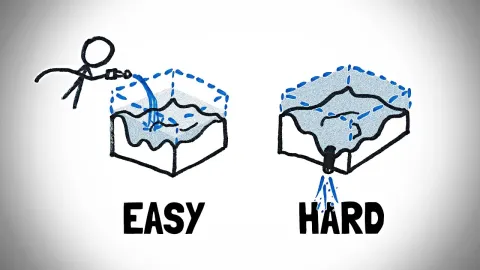
Like, researchers have thought of placing reflective material over portions of the glacier, or building fences to retain snow that would otherwise blow into the ocean, or drying the seabed beneath the glacier so it doesn't slide toward the ocean as easily. But there have also been discussions of building berms or artificial islands out of material dredged up from the seafloor or shipped in from elsewhere. Placing these structures around or beneath glaciers could protect against the warmer ocean water that stirs up vortices and accelerates melting.
One particularly interesting idea is to build flexible sheets that keep cold water close to the glacier and direct warm water away. These curtains could keep the glacier frostier, like a coat to keep the cold in. But they'd come with a hefty price tag. One of those curtains would cost about 50 billion dollars. As you can imagine, a lot of these ideas have been controversial. And it isn't just price that has scientists worried.
Some scientists think that direct interventions distract from a much more important goal: lowering global CO2 emissions. That's the number one thing that we can do to stop climate change, and all that it comes with it. Including melting glaciers. But that said, even if we stopped emitting CO2 tomorrow, the ocean wouldn't stop warming right away. So maybe it's a good idea to have some other solutions up our sleeve so we can keep Thwaites Glacier from living up to its other, more ominous name. [♪ OUTRO]