18:55



Say what you want about modern Iran, but one thing is beyond doubt. The moment it lays a finger on the world's main oil artery, everyone gets nervous. From Washington to Beijing, this is a land you have to reckon with. And it was the same 1500 years ago. Except back then, the power forced to reckon with it was the greatest empire of its age, Rome. Here stood the Cassanian Empire, the last great kingdom of Persia before the coming of Islam, and its kings took Roman emperors prisoner and made Rome pay tribute. So, how did this empire, one the West still calls barbarian, bring the unconquerable might of Rome to its knees for four centuries straight? And if it was really that strong, what
in the end put it in the grave. To understand where the Cissanians came from, we have to go back 4 and a half centuries to the moment when Alexander the Great burned Pipilus and the Persia of the Akimmonids ceased to exist. After Alexander, the Iranian plateau was ruled by outsiders. First the Seucids, the Greek dynasty of his successors. Then the Paththeians, a people who came out of the steps of Central Asia. The Paththeians were warlike and lasted almost five centuries, fighting Rome along the Euphrates River the whole time. But they were not Persians. Strictly speaking, they weren't even true Paththeians. They were a tribe called the Parni who settled in the region of Paththeia and took its name to
the native people of Par, the same land in southern Iran that once gave the world Cyrus and Darius. The throne of their ancestors was occupied by foreigners. By the start of the 3rd century after Christ, the Paththean kingdom had run out of steam. Endless wars with Rome and constant infighting over the throne had turned it into a patchwork. Regional rulers obeyed the king in words only, while in practice they ran their own affairs. And it was at this moment in pass near the ruins of ancient Pipilus that a man named Ardashir rose, the ruler of a small territory around the city of Istaka. First he absorbed the lands around him. Then he stopped recognizing the authority of the Paththean king. The Paththean ruler Artabonus marched
against him and died in the decisive battle. And then came something that explains a great deal. The noble houses of Paththeia, sensing where the power now lay, went over to Ardashir one after another. Even the house of Surin, the same family that a century earlier had made its name by crushing the Romans at Karai, kept both its wealth and its place beside the throne under the new dynasty. That is exactly why Ardashir took over all of former Paththeia so quickly. The old nobility simply changed masters. And so in the year 224 a new empire was born with its capital at Cessophen on the Euphrates and Ardashir immediately proclaimed what would become the guiding idea of the whole dynasty. We are not just new
kings. We are the heirs of the Aminids and we are reviving the great Persia that Alexander destroyed. After 550 years, the real Persia had returned to the throne of its ancestors. Zoroastrianism, the ancient Iranian faith built on the struggle between light and darkness, became the state religion. Society was organized into strict classes, priests, warriors, officials, and common people. And the army was rebuilt from the ground up. From the Paththeians, the Cissanians took the emphasis on heavy cavalry, but they improved on it. Instead of separate light archers and heavily armored lancers, they created a single all-purpose horsemen in lighter armor
able both to charge with the lance and to shoot on the move. From the very beginning, the reborn Persia looked west. And in the west sat an empire that treated its eastern border as a permanent headache and had long since learned not to underestimate the people beyond the Euphrates. Ever since the days of Cassus, whose legions the Persians had once cut to pieces there, these two were bound to collide. The only question was who would break whom? Adashier struck almost immediately when his cavalry moved on Roman Syria. The emperor Alexander Seis came against him in person, not to fight but to negotiate. He even reminded the Persians that Rome had taken their capital
three times, hinting that history could repeat itself. Arashir ignored the hint. Alexander Severis's campaign ended in nothing. One part of the Roman army did well in Armenia. Another was beaten by the Persians in Mesopotamia. And the emperor himself sat in Syria with the main force losing men to disease. Officially, he celebrated a triumph back in Rome. In reality, it was a draw at best. Soon afterward, Alexander Seis was killed by his own soldiers, and Rome sank into what historians would call the crisis of the 3rd century. Emperors changed almost every year and civil wars never stopped. For the reborn Persia, you could not ask for a better neighbor.
Adashier's son was named Shapor and it was under him that Rome realized it now faced in the east not a bandit on the border, but an equal and maybe a superior. Shapur gave himself a breathtaking title, King of Iran and nonIran. By non-Iran, he meant Syria. all of Asia Minor, Armenia, the Caucusesus. In short, everything that had once belonged to the Akeminids and that he intended to take back. What followed looked to Rome like a nightmare that kept repeating. Over 20 years, Shapor waged three wars against Rome, and the Roman defeats only got worse. The first emperor, Gordian III, marched against the Persians in person and never came back. According to the Persian version, he fell in battle against Shapur himself. His successor, Philip
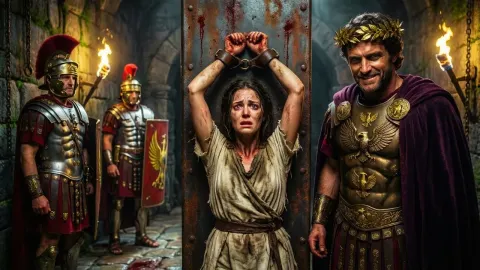
the Arab, wanted nothing more than to secure his hold on Rome as fast as possible. So he simply bought his way out. He paid Shapur an enormous ransom and handed over the disputed lands. For a Roman emperor, that was as good as a public surrender. But the real shock came with the third. The emperor Valyrian gathered an army to finally stop the Persians. And in the decisive battle at Adessa, he was defeated and taken prisoner alive. Think about what that meant for Rome. All kinds of things happened to Roman emperors. They were murdered, overthrown, killed in battle. But for an emperor to end up alive in the hands of the enemy, that had never happened once in all of Roman history.
Not before Valyrian and not after him. Shapur did what no one else ever managed. The old emperor was kept at the Persian court as a living trophy. And according to Roman accounts, Shapur even used him as a human stool, stepping on his back to mount his horse. Whether that is true or an invention of humiliated Romans, we will never know. But the very fact that such a thing was told about an emperor says everything about the scale of the disgrace. And Shapor made sure it would be remembered forever. On the cliffs in the very heart of Persia, he ordered a giant relief to be carved. The king on horseback and before him the Roman emperors. One bows low, the other kneels, hands stretched
out in pleading. stone on which the Lord of the West humbles himself before the Lord of the East. You can still see that relief today, 1,500 years later, it is still there in the cliffs of Iran, still telling a story the West would rather forget. You might think this was the final victory. Rome laid low, its emperor a prisoner. But this is exactly where the real riddle of these wars hides. Why? Despite triumphs like these, could neither Persia nor Rome ever finish the other off. The border between the two superpowers had run along the Euphrates River since Paththeon times, and it stayed there for centuries. It shifted one way, then the other, but never for long. The same border cities, Nissibis, Adessa, Karay,
Hatra, changed hands 10 times over, and neither side could hold the advantage. The reason was simple and merciless. Both powers were too large and too strong for either one to swallow the other. The Persians could smash a Roman army, take a city, carry off plunder, but they could not occupy and hold everything beyond the Euphrates because Rome had bottomless reserves of men and money. And it was the same for Rome. The legions reached the Persian capital, Cesifon, and took it three times, but they could not hold the east. The moment one side decided victory was in hand, the other found the strength to strike back. Shapur's own fate showed this best. After the capture of Valyrian, the
Persians seemed unbeatable. But then an unexpected avenger for Rome stepped onto the stage. On the wreckage of the eastern provinces which the empire in its chaos no longer controlled, the kingdom of Palmyra rose under a ruler named Odinathus. And this Odinathus not only took back the endlessly disputed border cities from the Persians. In the old Roman tradition, he pushed all the way to Cessopon itself. The man who had beaten emperors suddenly found himself on the defensive. And when Palmyra was later swallowed by its own intrigues and Rome took it back, the balance in the east simply restored itself as it always did. And the Persians kept taking their due. A century later, the emperor
Julian, called the apostate, a gifted commander who dreamed of restoring Rome's old power, led a huge army deep into Persia. He never came back. Julian died on the Persian campaign and Rome was forced into a humiliating peace, handing the Cisanians lands and fortresses. Another emperor, another defeat in the east. Beneath these wars lay something deeper, two world views that could not coexist. Zoroastrian Persia saw the universe as a battlefield of light and darkness and itself as the soldiers of light.
Everything outside Iran it called nonIran. a land that had to be brought back under the rule of true order. Rome, for its part, saw the Persians as Eastern barbarians, soft, treacherous, unworthy of the luxury they wallowed in. And the Persians paid them back in kind, looking at the Romans as crude upstarts with no antiquity and no greatness. Two civilizations stared at each other across the Euphrates with equal contempt, and neither understood that a war no one could win was slowly killing them both. But before that exhaustion took its toll, the Casanians would live to see their peak. A king who did not just beat Rome, but turned its humiliation into an art form.
By the sixth century, Rome's heir in the east was called Bzantium, and it was ruled by Justinian, an emperor who dreamed of restoring the old greatness and was winning back lands all around the Mediterranean. On the Persian throne sat Kosro I under whom the Cassanian Empire reached the height of its power. These two signed an eternal peace and it lasted exactly 8 years. Kosro watched with growing alarm as Justinian's generals reconquered North Africa and Italy and he understood if Rome gathered its strength in the west, the east would be next. So in the year 540, he struck first. What he did next was not just war. It was a cold, calculated humiliation of his enemy. His army moved
along the Euphrates and cities paid him off just to make him pass them by. Hierropolis handed over nearly a ton of silver. Others paid in gold. The city of Surah he took by storm. The city of Bowarea he burned. And then he came to Antioch, the second city of the whole empire, the capital of the Roman East, one of the greatest cities in the world at that time. Antioch fell. Corso burned it to the ground, took its people into slavery, and resettled them in Persia, where an entire new city was built for them. And then came gestures that made the Bzantine see red. Having seized the Syrian coast, Kosro rode down to the Mediterranean and ceremonially bathed in it, a Persian king in the waters. Rome
had called its own for centuries. Then, in one of the captured cities, he staged chariot races and rigged them so that the team Justinian himself supported lost in humiliating fashion. It was pure mockery. I rule in your lands. I bathe in your sea. and I beat you in your own arena. And Justinian, ruler of the eternal empire, the man building the Haga Sophia, paid almost 22 tons of gold up front and nearly £500 of gold every year after that just to make Kosro leave. A contemporary called it the greatest military humiliation of the Eastern Empire in 300 years. The Persian king went home richer than any conqueror, and on the way he extracted several more payments simply because he
could. There was, however, one moment when the Romans managed to save face and only by a trick. When Cosro set out to plunder once again, this time Palestine and Jerusalem, Justinian sent his best general, Belisarius, to meet him. Belisarius had almost no army. The real troops were bogged down in the west. So he bluffed. He met the Persian envoy far out in open country, surrounded by handpicked tall soldiers, Goths, Vandals, Libyans, all deliberately relaxed, as if the Persians arrival did not worry them in the slightest. The envoy went back to Cosro and reported that the Romans were numerous, formidable, and calm, and that their general was dangerous. The Persian king,
unwilling to take the risk, turned back, although there is a simpler version. Cosro turned back, not out of fear of Belisarius, but because he had learned that the empire was already in the grip of the plague. Because while the two powers were busy humiliating and robbing each other, an enemy came to the lands of both that could not be stopped by gold or by cavalry. Out of the Nile, Delta spread the plague. The first plague pandemic in human history. The historian Proopius, who saw it with his own eyes, wrote that the human race came close to being wiped out entirely. The disease mowed down whole cities. In Constantinople, on the worst days, as many as 10,000 people died in a single
day, and the population of the capital was cut in half. The infection did not tell Romans and Persians apart. It ate away at both empires from within while they kept on fighting. And in this lay a bitter irony that no one could see at the time. Persia and Rome were so absorbed in their struggle with each other that they failed to notice they were growing weak together in the face of a future that would spare neither of them. The wars between the Cisanians and Bzantium went on for another century and toward the end they grew almost insane in scale. At the start of the 7th century, King Kosro II achieved the impossible. Persian armies marched across all of Asia Minor, took Jerusalem
and carried off the greatest relic of Christianity, the true cross seized Egypt. the bread basket of Bzantium and stood beneath the walls of Constantinople itself. For one brief moment, it looked as if Shapor's dream had come true and Rome's air was about to fall. But Bzantium struck back for the last time and with the last of its strength. The emperor Heraclus made a desperate dash around the Persian armies into the very heart of the Cassanian Empire and crushed them where no one expected it. Everything Cosro II had conquered over 20 years fell apart as fast as it had been taken. Both empires came out of this last war as winners only on paper. In reality, they were drained dry. Four centuries of unbroken
hostility, the plague ruined provinces, empty treasuries. Two exhausted giants stood facing each other, unable to lift a hand for another blow. And at exactly this moment, out of the deserts of Arabia came a force that cared nothing for the Euphrates, nor for the Roman border, nor for old scores. Arab armies under the banner of a new religion, Islam, struck both empires at once. Bzantium, losing Syria, Egypt, and Jerusalem, held on in the West and shrank to a fragment of its former self. Persia could not hold on. Bled white by centuries of war, it lost a 20-year war against the Arabs. In the year 651, the
last Cassanian king, Yazdur III, fled east. Having already lost everything, his army, his capital, his country, he tried to hide in a mill, promising the miller payment. And in the night, the miller cut his throat for the royal jewels and threw his body into a ditch. And so in a roadside ditch, a 400-year-old empire and the entire pre-Islamic history of Persia came to an end. Think about how it ended. An empire that took Roman emperors prisoner. A power whose king bathed in the Roman sea and made Bzantium pay in gold. A civilization that for 400 years brought the greatest force of the West to its knees and that outlived pagan Rome itself, watching it fall in the west
under the blows of barbarians. And in the end, it was not Rome that destroyed her. Rome never managed to defeat her in all four centuries, no matter how many emperors and legions it sent. What destroyed her was that she and Bzantium spent each other completely, clearing the way for a third power that both had failed to notice. The Cisanians vanished from the map. Yet, they are the ones Rome and Bzantium never managed to defeat in 400 years of war. Their kings are the only ones in history to hold a Roman emperor alive in captivity. And every time we casually call Rome the summit of the ancient world, it is worth remembering that this summit had a neighbor in the east before whom it
bowed its head, an empire carved forever into the cliffs of Iran, where the lords of Rome still kneel before the King of Kings.