14:56




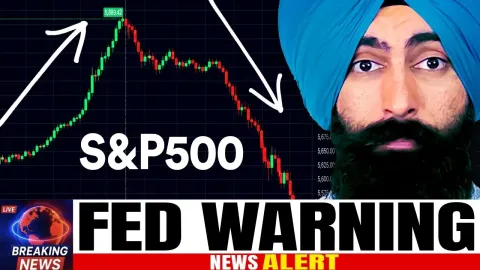
Every percentage point is $600 billion. Just think about it. But we continue to push it. Trump panicked yesterday and they intervened in the bond market. What we saw yesterday was a sign of desperation. This is the most expensive market in American history. And the bursting of the bubble happens when How are you guys? Graham is with you, and you better prepare yourself for what just happened. Breaking news: believe it or not, the US is suddenly preparing an economic rescue worth up to a trillion dollars. And the craziest thing is, this is happening at a
time when stocks are as expensive as they were at the peak of the dot-com boom in 2001. Interest rates are rising out of control, and now people are again drawing parallels with 1999, just before everything went awry. Okay, seriously, we are about to witness one of the biggest economic interventions since 2020. And so we need to discuss what exactly is happening, why we are about to get another bond market bailout unlike anything before, and a danger that almost no one is prepared for. Because once you see what's really going on beneath the surface, you'll realize that the market is sending a completely different signal than most people think. But before we begin, as always: if you value such urgent news, I would really
appreciate it if you would hit the like button and subscribe if you haven't already. I know it sounds silly to ask for something like this. I'm not a fan of constantly reminding myself of this either, but it helps, and as a thank you for it, here's a photo of the mouse. So thank you very much, and also a big thank you to SoFi for sponsoring this video, but more on that later. So, to start, we need to talk about something that almost none of us were prepared for, namely yield control. You see, most people forget that what really drives markets isn't necessarily profits, expansion, or attractive valuations. Instead, it's interest rates, and recently those rates have skyrocketed. Why?
Well, to put it simply, investors are concerned that long-term inflation will continue to rise. And as a result, they demand a higher return on their money to compensate for the additional risk. Think about it this way: if you think long-term inflation will be 4%, why would you borrow money at 3% or 2%? Instead, you would want 5.5% to make at least some profit. Well, obviously, this is putting a strain on the national debt, mortgage rates, and the economy, which has caused Treasury yields to hit their highest levels in nearly 20 years, which coincidentally also happened right before the Great Financial Crisis. So, what did we do? That's right. The United States stepped in to buy back its own
long-term Treasury bonds, essentially rescuing the market by massively printing money to lower interest rates. And believe it or not, this is not the first time they have done this to save the market. In fact, the United States implemented 1940s to finance the war with cheap money. After that, the stock market rose by 187%. Then, again, we saw various forms of quantitative easing from 2008 to 2014. And more recently, we all remember what happened in 2020 before the market went crazy. Essentially, in all of these cases, yield controls were implemented to prevent a market crash or catastrophic situation. And that means the fact that they're implementing this today makes us ask, "What do they know that the rest of the market hasn't already
considered?" And that, of course, brings us to stock prices. First, it's no surprise that the stock market loves "free" money. We've grown about 20% in the last year, and even since the beginning of the year, we've grown almost 12%. But now people are starting to worry. Are we entering a stock bubble to such an extent that everything could soon fall back? Well, to answer that, we need to talk about whether this rally is actually sustainable, because there are five concerns that many people are starting to realize. And the first of them: the market is extremely expensive.
Look, I'll just point out that the CAPE ratio is almost at the same level we saw during the peak of the dot-com bubble in the 2000s. Buffett's indicator has reached an all-time high above 230%, signaling that the market is twice as high as it should actually be. And a small number of AI stocks are almost entirely responsible for a disproportionate share of these recent gains. In fact, legendary investor Jeremy Grantham recently called it the largest investment bubble in American history. In addition to that, we have number two-weak monetization.
The reality is that hyperscalers are on track to reach $850 billion in spending by 2026. Great, right? Well, it would be great if they would refund their money. And so far, MIT has found that about 95% of AI pilots have no measurable impact on profits. Moreover, other firms are calling it the largest capital expenditure bubble in history, comparable to railroads or fiber optics, where infrastructure is being built far ahead of proven cash flows. This also leads to three, cyclical funding. To put it simply, we've all probably seen this graph where big tech companies invest in each other, buy and guarantee each other's capabilities, boosting each other's revenues. It's like I give $10 to Tom, he gives $10 to John, who gives $10 back
to me, and now we're all showing $10 in income, even though it's just a rollover of our own money. This is point number four, similar to other tech bubbles. Usually people get ahead of themselves, pricing in huge growth, and then everything collapses when expectations don't match reality, which is especially true for point five- overconcentration. It is now estimated that 87% of venture capital is invested in AI. And even Sam Altman asked: are we at a point where investors are generally excited about AI? In my opinion, yes. When bubbles arise, smart people get caught up in the grain of truth that is flagged as a potential sign of a bubble. However, others strongly disagree and believe that now could be one of the best opportunities of your life to
invest in the markets, especially at a time when the government is starting to print and pour a lot of money back into the market. So, as for what's really going on, if this is one of the last chances to buy before prices go even higher, and what to do when the market finally crashes-this is what you came for. Because there is one last piece of data that will determine whether this could be the best investment opportunity of a lifetime or a huge mistake. Before we get to that, though, I want to be clear that wealth creation is not just about maximizing profits. It's also about diversification and being prepared for where the financial system takes us next For example, cryptocurrencies are becoming extremely difficult to ignore as tokenization increases
and more assets move to digital networks. This doesn't mean it's right for everyone, but having a safe and comfortable place to study and explore can make a huge difference. And this is where, of course, our sponsor, SoFi, is ready to help . What sets them apart is that SoFi is the first nationally licensed bank where you can buy, sell, and store cryptocurrency within one simple app. This means you get all the security guarantees of a bank on a federally regulated platform, which is very important. Plus, they allow you to buy and sell cryptocurrency in the same SoFi app as the rest of your finances. This means you can manage your cryptocurrency alongside your SoFi checking, savings, and investment accounts without having to switch between
platforms. Not to mention, if you don't know where to start, their in-app tips will help you learn as you go so you have a better understanding of what you're doing before making a decision. Of course, cryptocurrency is inherently risky, so before investing, you should make sure it suits your financial situation. But if you're ready to explore cryptocurrency with SoFi, just visit sofi.com/graham or click the link in the description below to get started. And from now until August 27, you can earn up to $1,000 in your chosen cryptocurrency. You can find all the details in the description below or on the website sofi.com/graham. Thank you very much, and now let's get back to the video. OK. So, in terms of what's happening now, whether the market could
sell off soon according to the data, and whether this is a good time to continue buying, we need to discuss the market bubble. I know I may be exaggerating a bit, but I see a lot of people comparing what is happening today to what was happening during the Great Depression of the 1920s. Coincidentally, this happens almost exactly 100 years later. Actually, you know what's scary? Even when you compare the graphs, they look eerily similar, almost like confirmation that we have entered the final stages of a great upswing before everything collapses into the abyss. However, critics say these people are wrong. In fact, the market
will continue to grow even longer than expected for five main reasons. The first of them is that companies make a lot of money. It's no wonder that Nvidia, Amazon, Alphabet, Microsoft-you name it. They are all very profitable. In addition, their AI projects were financed through their own funds, not through debt or equity issuance. Revenues also beat expectations, suggesting real sustainable growth driving these valuations. And the smaller companies have actually started to catch up, which theoretically should provide a more balanced rally, especially when compared to number two.
There is rapid growth. For example, just look at the profitability metrics of cloud AI. They are growing at triple-digit percentage rates. By mid-2026, Anthropic had achieved 30x growth. Usage rates are rising, and all of this suggests that we could see trillions of dollars in profits and growth over the next few years. In addition, there is a third point: the estimates are still not as extreme as in 2000. Sure, the forward price-to- earnings ratio is similar, but it's significantly lower than the 80X multiple that was much more common for loss-making companies 30 years ago. Furthermore, a significant portion of these market gains are driven by real gains, not just speculation, which brings us to point four: low IPO activity.
Typically, at the peak of a " bubble," there is a wave of IPOs and takeovers of companies that are not profitable enough. And while SpaceX became the largest IPO in history, a single offering of shares is not necessarily a threat to the entire economy, especially when many companies are already using AI and making money from it. And finally, this brings us to point five. Rallies don't end just because the price is too high. The reality is that an unforeseen catalyst is bound to occur that will trigger a wave of sell-offs. And now, despite rising oil prices, international conflicts, and yen-carry operations, nothing has yet stopped innovation. Of course, this doesn't mean we're definitely not in a " bubble," but according to Fidelity, there are some
red flags to watch for, and if they start to appear, we should be on our guard. These red flags are: companies are burning cash by spending more than they earn; businesses own shares of each other so much that the collapse of one leads to the collapse of all; debt levels are growing disproportionately to profits; AI is reaching a limit in energy consumption, which literally limits growth; and higher borrowing costs, which reduce profits. In fact, Fidelity believes this is just the beginning, and markets will continue to grow thanks to AI. They believe that professional services companies, industrial firms, healthcare, and utilities will be able to use it to scale. But even with all of that, in terms of what the data says about the most likely
outcome, here's what's quite surprising. And it's all about future profitability. Personally, I am a big fan of data analysis, as statistically it is probably the most accurate method. And if you look at the numbers, yes, we are at a historically high level. But Ben Carlson points out that the last 30 years are much more important to us than the previous 150 before the advent of the Internet. And if you look at it this way, our average is not as crazy as some people try to make it out to be. For this reason, Ben Carlson supplemented his research by stating that returns are still extremely high and the stock market is surprisingly efficient. He doesn't care what happens today. He only believes in what can happen in the future. As one
researcher put it, "The job of the stock market is to make you say, ' This doesn't make any sense.'" In addition, another analyst believes that if companies meet earnings expectations and political tensions stabilize at least somewhat, there remains a real path for stocks to rise. So, if you were an investor from 1928 to 1949, there would have been almost two decades when the market didn't go up, but only fell or stood still. But even then, if you invested at the very peak and did nothing, with dividends reinvested, you would still have made about 100% profit over that period. Again, that's assuming you didn't buy the dip, which is impossible in reality, as you'll be investing steadily throughout. So as to whether we are in a bubble, here is the
reality. If the US were to repeat the Japanese scenario, where prices fell for decades, it would mean that our profits would have to stop and the S&P 500 would have to trade at 14,000 to match what Japan did in the 70s and 80s. Or, more simply: if profits start to fall and our market doubles in price, then yes, there are good reasons to worry, and we can well compare ourselves to Japan. But from a bubble perspective, yes, the stock market is expensive, but that doesn't mean it can't continue to grow. Not to mention that the very fact that there is talk of a market bubble means that perhaps some of this is already priced in.
Additionally, history shows that buying at historical highs has little impact on your overall returns, as the market naturally reaches record highs as inflation increases and companies develop. So, in terms of what I'm doing personally, my thoughts on what's going on, and what you can do today to win-that's what you came here for. In general, I am a big fan of the phrase: "The market can remain irrational longer than you can remain solvent." This means that no matter how smart you try to predict the future, the market constantly defies the odds, so choosing one side or the other is usually a losing proposition.
You could be absolutely right that the market is overvalued and needs to correct by 30%, but suddenly Scott Bessant says he's printing money to lower yields. Bam, and your thesis suddenly becomes worthless, and you are wrong. Or you might think that the markets will continue to rise because they are printing a lot of money. And then, bam, out of nowhere, Trump imposes a 50% tariff on Canada. Suddenly you are wrong again, even though on paper you should be right. That's why I just try to diversify all my investments as much as possible.
I have the US, international markets, somewhere around 20-25% in Treasury bonds, which are currently yielding 3.5% to 3.8%. I own a small amount of real estate. I have a little bit in a Bitcoin ETF and maintain the income at such a level that if the market falls, I can continue to buy, regardless of the price. I firmly believe that it is impossible to predict the future, but you can control your patience, your buying frequency, and whether you panic sell on the bottom. And if you stay consistent, you'll be fine. Especially if you click the " like" button and subscribe if you haven't already So, thank you very much for watching, and as always, if you want to see bonus videos, including early access to such content and exclusives for members,
join the channel sponsors. You will receive an additional video from me every week, early access, and priority responses to all comments. I would be glad to see you among them. Also, I do audits for subscribers where you can send your finances, and if it's interesting, I'll take it all apart and "tear you to pieces." So if this sounds interesting, feel free to join. Thank you very much for watching, see you next time.