24:28



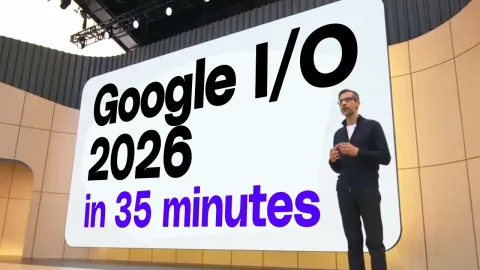
Google IO is in full swing and there's been so much that's announced, it can be a little bit difficult to know where to start. And if you manage to get past the 15-minute infinite scroller game, there was a lot announced and it can be a little bit difficult to keep track. It's no surprise really that Gemini and AI were very much the focus for Google and that is kind of what IO is all about. We saw a few things that Gemini can do and will be able to do in the next few weeks. from ask YouTube. There will be a new search option where you can ask in plain English what you want help with and YouTube will take you to exactly the timestamp in the video to save you watching it all, which I'm not sure I'm
that keen on. Android Halo is something else that's coming to monitor agents in real time. And then you have daily briefs with the Gemini Spark. And I'm sure you're in the same boat as me at this point where AI is just becoming a little bit tiring because it's so difficult now to be able to tell what is real, like what's a real image, video, and audio because you can make all of this at the click of a button. And I think Google has to take some of the blame for this. So, let me play a game. I'm going to show you two pictures and videos and a bit of voice over made with 11 Labs. And I want to tell whether you can pick out what is real and what isn't. So, let's start with the
pictures. This is just a picture from my desk showing my MXM 3. So, I'll give you a couple of seconds to see whether you can spot which one is real and which isn't. Now, the video. So, one of these is something that I took in a tube station on my Pixel and the other is something that I told Google Flow to make. And then let's see whether you can spot which voiceover is real and which isn't. There is so much AI. Google might have a problem. There is so much AI. Google might have a problem. So, let me know in the comments whether you got this right or you got it wrong. So the picture of the mouse, the picture on the right was the one that was made by Gemini. For the video, it was the video
on the left that was made by Gemini. And for the voice over, it was voice over a there is so much AI. Google might have a problem that I made with 11 Labs. And I just think that this at a quick scroll is very hard to tell what is real and what isn't. And Google has made that problem. But luckily, it's also got a solution. Over the next couple of weeks, Google is adding a few new tools to Gemini Search and Chrome to make it a little easier to detect AI. A big part of that is something called Synth ID. And you might have heard about it before because it's been around for a while, but essentially what this is it's a watermark. So, this is a watermark inside of images, videos, and songs that
makes Google be able to detect AI. The way this works is that synth ID embeds itself into pixels and then it isn't lost through cropping, filters, adding noise or compression of those images. For video, it's baked into every frame. And for audio, it's converted into a specttogram, which is where the watermark is placed. This means that images made through Gemini, videos made through VO, and then audio made through LRA, the moment they are made, they have that synth ID baked straight into them. And I didn't know this existed, but you can already use Circle to search to find out whether something is real or fake. And apparently it's been used over 50 million times to check that already
according to Google. When you ask, is this real or is this AI? Google comes back with no, this image is not real. It's completely AI generated. It then goes into why it's not real. So that would be that it has synth ID attached. And then it breaks down the inaccuracies in that picture. So for example, the cat's holding a steering wheel here and Gemini calls it out. And over the next few weeks, Google is adding this to Chrome with that new Gemini integration. This should work in a fairly similar way to how it works with Circle to Search or asking Gemini if the picture is AI made.
There is a problem with this though. Not everyone is using that synth ID yet. So, if you were to go outside of any of Gemini's AI creative tools, it might not necessarily have that ID baked into it, which means that Gemini can't tell you with 100% accuracy whether it is AI or whether it is real. It was announced though at IO that people like Nvidia said it's working with Google to add this into videos created with Cosmos. Open AAI is adding it and so's 11 Labs. They're all working with Google to add this synth ID. And that's what we need. We need more people to be adopting synth ID. But the problem is here that it's not a standard yet. So not everybody who
creates AI content is going to add this in because there's no reason to do it yet. But Google has open- source synth ID for text watermarking. But for images, video, and audio, why the support depends on companies actually wanting to adopt this. I'm so here being able to ask Gemini whether something is real or not real because it can be a little confusing even to me. But synth ID is only part of what Google are doing to try and combat this problem. The other part of this is C2PA. C2PA works a little differently. The easiest way to think about synth ID is that it helps identify AI content while C2PA helps prove the history of real or edited content. This is more of like a
digital receipt. So when you take photos and videos on your phone, it basically gives it that C2PA certification. This then means it can read and show information about how the photo was captured, including the device or camera that actually created it, if that information is included. It can also tell you if the image was edited or even what tools were used to edit that photo. This isn't new, though. You've probably heard of C2PA before because back in the summer when the Pixel 10's launched, this was something that was introduced on those devices. So, if you take a picture with your Google Pixel 10, it
has that C2PA digital receipt already attached to it. What was interesting though, I saw Google mention this was coming to video for the Pixel 8s, 9, and the Pixel 10s. And Google have a plan. They don't want to just tell you whether something is AI or not AI. What they want to do is kind of tell you that an image is real. And I think that's more important. They want to give you a paper trail saying, "Okay, this creator, for example, took this photo on a Google Pixel 10." So, I think that's a little bit more important than just telling you whether it's AI or it's not AI. you kind of want to have a little bit of peace of mind that what you're looking at was
made by an actual person. And this is something that you might be seeing on Instagram pretty soon because Meta is working with Google to implement this across Instagram. So, when you upload a picture from your pixel, then you might start seeing a tag of some sort to show you where that photo actually came from. From what I've read, it looks like that soon, I'm not exactly sure when, but soon, if you upload a picture from your Pixel to Instagram, it's going to start being able to label it and tell you what device this came from. And this is not going to be like one of those big labels like shot with Pixel or made by Pixel.
It might be something that's going to be a tag on the image, or it could be in the description of some sort, but I don't really know how exactly Instagram is going to show this yet. But I'm all here for being able to be told that pictures that I'm looking at are real. I think this is massive for creators though because I've seen graphics being made by Gemini or Chat GPT that would take someone hours and it can easily be passed off as something that you've created. Same for a photo. People have entire Instagram accounts with just AI photos that look so real it's hard to tell that they're not. And that sounds great if you create that AI piece of art using Gemini or something else or you
take a picture with C2PA. You can post it and then you know that it came from you. However, there is an issue that Google probably needs to fix here because if you were to screenshot that image or something similar, then you lose that metadata. So that synth ID and CTPA that are attached to the image, they don't exist anymore. And I have no idea how Google or anyone is going to be able to combat that. But just because something doesn't have a label, it doesn't automatically mean it's fake. It just means that there isn't like a verified trail attached to it. And I said it before, it doesn't mean that every picture that's ever taken now is going to have C2PA attached to it or a
synth ID. But I suppose it's a step in the right direction because we are going to be flooded with AI in the next couple of years. I feel like even now Twitter and threads and Instagram is already flooded with AI rubbish. So being able to tell where something came from, how it was made, and if it's real is going to be a really big deal in the next couple of years. So, there are loads of other announcements at Google IO, but that's one that I think might have gone under the radar a little bit. And at the moment, I am so sick of AI. So, anything that can help me detect AI and kind of figure out what's real and what isn't, I am all here for. But, you know, let me know your thoughts about this in the
comments below because it's something that I think is not going to get the big headlines at Google IO, but I think it's important. So, let me know before you head off. If you can subscribe to the channel, I would massively appreciate it. And if you do that, then I'll see you in the next one.