9:44
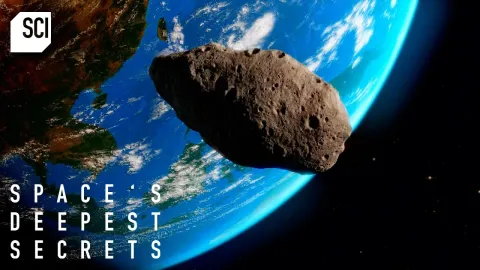



Imagine you wake up tomorrow, step outside, and see this. A massive, luminous arc sprawling across the sky. Brighter than the moon, it stretches from one horizon to the other, visible day and night, impossible to ignore. Where in the universe are you? Believe it or not, scientists are starting to think that half a billion years ago this may have been the view from not some distant alien civilization, but from Earth. New analysis of ancient impact craters suggest our planet once had rings, just like Saturn's, that may have persisted for as long as 40 million years. And those rings may even explain some of the most dramatic climate shifts and
extinction events in our planet's history. So, what were these rings? Where did they come from? And could Earth ever see skies like this again? I'm Alex Mack Holgan and you're watching Astrum. Join me today as we ponder what an Earth with rings would actually look like, evaluate the evidence for their existence, and uncover how they could have shaped the history of our planet more than you might imagine. We Earthlings have got used to looking up to an empty, inky expanse of night sky, adorned only by the familiar spattering of the brightest stars, the subtle smudge of the Milky Way, and of course, our lone moon.
But what if our night sky didn't always look like this? If Earth once had rings, how would it have looked then? To really paint a picture for you, let's imagine we're standing on the surface of this ancient, ringed Earth. For starters, the rings aren't shiny and bright like Saturn's, because we're too close to the sun for ice to persist. Instead, Earth's rings are made of rock, rich in silicates and low in iron. Rocks don't reflect light, at least not efficiently. They absorb it. So, the traces you see overhead are pale and dusty. But, this doesn't make them any less dramatic. And what you see from the surface varies wildly depending on where you're standing.
At the equator, you don't see a ring at all, just a thin line from one horizon to the other. As you move 20° from the equator in either direction, the rings appear in their full majesty, taking up a significant portion of the sky. 40° away, they appear like an elongated rainbow stretching across entire cities. Here, the bottom of the rings are blocked by the curvature of the Earth. And 90° away, at the poles, the ring is barely visible at all, hiding just beyond the horizon like a permanent twilight. At night, things get really surreal. At the equator and poles, not much changes, but in the mid-latitudes, night takes on a whole new meaning.
Dust in the rings scatters daylight from the day side of the planet onto the night side, a phenomenon known as ringshine. The rings glow brighter than the moon, which fades into obscurity. At these latitudes, darkness becomes a thing of the past. However, you never see the full ring. As much as the sun traces an arc across the sky in the day, so the Earth's shadow traces an arc across the rings in the night.
It sounds like a world from a science-fiction novel, except it's not. Researchers have actually found evidence that Earth may have had skies like this millions of years ago. Imagine what standing in a ring's shadow would have been like. A strange twilight would sweep across the earth, bringing darkness where there should have been daylight. The thought of it evokes the similarly unforgettable moments when our moon blocks out the sun in a solar eclipse. If you need a reminder of that particular sight, one is coming on August 12th this year to Europe and will even be partially visible in parts of America. It promises to be an unforgettable moment, one I don't intend
to miss. Though, to do so safely, I'll need the right equipment. The VisiSolar Solar Eclipse Viewing Kit has partnered with us on this video and can keep your eyes safe as you witness a sight that's not been seen in Europe since 1999. Choosing the right glasses is important as not all eclipse glasses are created equal. If you buy a cheap knockoff, looking at the sun could seriously damage your eyes. VisiSolar's kit is approved by the American Astronomical Society, so you'll be safe to witness the eclipse and make some memories. The kit even comes with a filter for your phone, helping you capture the moment forever. Get yours today by scanning my QR code or following the link in the
description below. If you use my code Astro 2026 at checkout, you can get 10% off your purchase. But, back to the Earth's rings. What is the evidence these sun-obscuring objects once appeared in our skies? If you look into the geological record, you'll notice something strange around the 466 million year mark. All across the globe, limestone formations from the Ordovician period show a sudden 100 to 1,000-fold spike in key elements associated with meteorites, specifically L-chondrites. For decades, the prevailing theory stated that these L-chondrite deposits all originated from one apparent body. That body broke apart somewhere in the asteroid belt, scattering debris throughout the inner solar system. Some
of these fragments collided with Earth, leaving impact craters dotted all over the planet. But in 2024, Andy Tomkins and his team at Monash University, Australia, noticed something unusual. They analyzed 21 craters using tectonic plate reconstruction models to determine where each impact site would have been 466 million years ago. Accounting for continental drift and plate movement, the data points started falling into place. If these impacts had come from random asteroid belt debris, we would expect to see a global distribution of impact sites strewn across our planet. But
Tomkins' analysis revealed something else entirely. All 21 impact sites fell within 30° of where the equator would have been back then. It seemed too unlikely to just be a coincidence. So, Tomkins and his team ran the numbers. The odds that 21 impacts would all land within that narrow equatorial zone was 1 in 25 million. As I said, very unlikely. Still, there could be a non-obvious reason for this pattern. To be sure, the researchers compared the spatial clustering of these impacts to more recent impact events on Earth. They found that the modern impact craters from the last 40 million years didn't
really form clustered groups on Earth's surface. They followed the pattern you'd expect for a shower of random space debris. But the Ordovician impacts were a different story. They were all clustered together, almost as though something had guided them there. So, how does a rock shower from the asteroid belt explain this crater pattern on Earth? To answer this, scientists turned their attention to our next-door neighbors. If this was truly an asteroid belt breakup, we would find evidence all over the moon and Mars, too. Mars sits closer to the asteroid belt than we do. Any fragments flying through space should have collided with the red planet harder and more frequently than
they did with us. And the surface of the moon, without an atmosphere to protect it, is essentially a permanent record of everything that's ever hit it. So, did this mysterious asteroid leave any clues behind? That's exactly what Anthony Lagain and his team wanted to find out in 2022. The researchers examined 49 large craters on Mars, 45 on Earth, and 91 on the moon to determine if there were any spikes in impact frequency over the last 600 million years. Earth, as we already saw, showed a jump in impacts about 460 million years ago. But Mars and the moon did not. Lagain thought this spike on Earth could be due to preservation bias.
The craters in question formed in tropical regions with favorable preservation conditions, and that created an apparent cluster around Earth's equator. He argued that our planet wasn't pelted in a thin belt, rather that only those impacts have survived until now. But Tompkins had a different idea. What if the asteroid that caused the Ordovician meteor shower didn't break up in the asteroid belt, but right here in Earth's orbital space?
What if a massive asteroid passed close enough to Earth that our planet's gravity tore it apart? And what if those fragments didn't scatter across the inner solar system, but stayed right here in orbit? What if 460 million years ago Earth had rings? When you think of rings, your mind jumps to Saturn, the iconic illuminated arcs circling the queen of the solar system. And though not as epic, all four gas giants have rings of their own. But, as it turns out, rocky planets can have rings, too. They just don't last as long for various reasons we'll discuss later. Before we get to all that, we need to work out how an asteroid could spontaneously fracture above Earth 466 million years ago.
As an asteroid gets closer to our planet, the side facing the planet experiences a stronger gravitational pull than the side facing away from it. This difference is called the tidal force, the same phenomenon that causes the moon to raise ocean tides on our shore. For most objects, their internal gravity is strong enough to hold them together. But, the closer to the planet they get, the stronger the tidal forces grow. If the orbiting object gets too close, there comes a point when the tidal forces of the planet eventually rip it apart. The distance at which this happens is called the Roche limit. It isn't a hard and fast distance, since it varies depending on a few things, namely the planet's mass and radius, and the
object's density and composition. For example, the Earth's Roche limit for a rigid body made of solid rock, like the Ordovician L chondrite asteroid we've been talking about, is about 3,100 km above the surface of the planet. For a pile of rubble loosely held together by gravity, it is about 15,800 km above the surface. So, fairly possible. Next, we need to know what happens to the fragments once this near-Earth asteroid breaks up. How do they end up in a neat circular orbit around the equator? Well, when the asteroid breaks apart, its total momentum is conserved among its fragments. Most remain trapped within Earth's Hill sphere, the region of space where Earth's gravity dominates over the sun's, keeping them in orbit around our planet.
At first, these fragments follow chaotic elliptical paths. Some swing close to Earth, others arc further out. But over time, they collide with each other. Each collision transfers momentum, and gradually these wild elliptical orbits become more circular, a process known as collisional damping. The circulating debris eventually settles into a flat disk around the equator for a specific reason. You see, the Earth is not a perfect sphere. It has a bulge in the middle, making its equatorial diameter about 43 km wider than its polar diameter.
This creates an asymmetric gravitational field and generates torque, or rotational pull, on nearby debris. Gradually, this torque draws the material orbiting at an angle into alignment with the equatorial orbital plane. Kind of like a spinning top that wobbles, but eventually settles into a stable spin. And this process wouldn't be unique to Earth. In fact, modeling from a 2017 study suggests that once upon a time, Mars had rings, too. Not from the breakup of a nearby asteroid, but from its very own moon. Researchers Andrew Hesselbrock and David Minton predicted that Phobos's orbit will bring it within the Roche limit in about 70 million years. At this point, it will break up and form a ring around the planet, which will eventually deposit about 80%
of its debris onto the Martian surface. The remaining 20% will coalesce to form a new generation of satellites around the red planet. Extrapolating backward, the pair suggested this cycle has been going on since Mars's birth. According to them, Mars has gone through three to seven ring satellite cycles, and they postulate Phobos and Deimos themselves might be the result of such a process, accreted from ring dust of a previous bigger moon. Could a similar process be responsible for our own moon? Well, possibly.
We think our moon could be the result of a violent collision of two protoplanets some 4.5 billion years ago. One was a newborn Earth, and the other was a Mars-sized rock called Theia. This impact sent debris flying into the planet's orbit, where, thanks to collision damping and the equatorial bulge, it would have eventually settled into rings. Over time, these fragments would have accreted to form bigger and bigger moonlets until they eventually coalesced into the moon we see today. So, if Earth already went through one ringed phase, what's to say it didn't go through another 466 million years ago?
Rings could certainly explain the Ordovician impacts. Over time, dust and rocky material from Earth's rings would have slowly rained down onto the surface of the planet, dotting impacts all along the equator, which is exactly what we see. But, the rings would have had consequences beyond the impacts themselves. Tonkin speculates that they could explain the Hirnantian Ice house, a 8 to 10° global cooling event that took place to 444 million years ago. The rings would have blocked sunlight, potentially triggering the cooling despite high atmospheric CO2. This period of glaciation is largely accepted as the leading cause of the late Ordovician mass extinction, which killed off 85% of marine life.
Still, even if Earth did have rings back then, how come it doesn't anymore? Where did they go? And will they ever come back? As glorious as they are to behold, no planet's rings last forever. Even Saturn's spectacular rings are only predicted to last another 100 million years. And Earth's rings would have disappeared far more rapidly. The main culprit is orbital decay. Any material orbiting closer than 35,800 km altitude is considered to be below Earth's synchronous orbit.
We aren't sure exactly how far from Earth's surface its rings would have been, but they almost certainly would have been closer than that. In this case, the rings would orbit around Earth faster than the Earth rotates about its own axis. With every swing past our planet, the rings would transfer some of that orbital motion energy to make the Earth spin a tiny bit faster. The Earth's slower rotation would act like a brake, sapping energy from the rings, causing their orbital radius, period, and altitude to decrease until they fell into the planet.
Atmospheric drag from Earth's exosphere would only accelerate this process. Extending from 700 to 10,000 km above the surface, this part of our atmosphere is incredibly tenuous. Although it's still dense enough to create friction on orbiting particles. Each pass through the exosphere would slow the material down slightly. Over thousands of orbits, this would pull fragments into lower and lower trajectories until they burn up in the atmosphere or impact the planet below. From the surface of the Ordovician Earth, it would seem as though the sky were literally falling. Not always dramatically, the majority of the ring material would tumble down as dust. But occasionally, when a larger fragment deorbits, a brilliant fireball would streak across the sky.
As it fell into Earth, it would grow bigger and bigger until it slammed into the ground somewhere along the equator. Along with gravity, our rings would also have the sun to contend with. Charged particles from our sun would constantly bombard the ring material, stripping off electrons. The resulting positive particles would then become trapped in Earth's magnetic field lines and get funneled down toward the poles and the equator. Eventually, they'd slam into the upper atmosphere, giving off a dull glow before disappearing forever. Looking up from an ancient Earth, you'd see a dim curtain of light in the high-altitude sky, kind of like a faint localized aurora.
But this light show can't go on forever. Every glowing speck represents material lost from the rings. We also can't forget the effects of the moon's gravity. Every time it passes overhead, the moon's gravity would tug on nearby ring particles. For particles at certain orbital distances, this would happen repeatedly at the same point in their orbit, a phenomenon called orbital resonance. The repeated gravitational kicks would destabilize the rings' paths, ejecting some particles outward into space and nudging others inward, in this case toward Earth.
Over millions of years, these resonances would carve gaps through the rings, accelerating their collapse. We think Earth's rings disappeared after about 40 million years because this is when the L chondrite spike in the geological record ends, no more asteroid bombardment. But Tompkins is confident we haven't seen the last of our rocky companions, saying, "This wasn't the first time Earth had a ring, and it won't be the last, most likely." But, if Earth had rings today, how would it affect us? Would its satellites survive? How would we get into space? Or, would we just end up pulverized by a brutal impact from infalling debris?
Let's assume Earth's hypothetical ring sit somewhere between the thermosphere and geostationary orbit, between 700 to 35,800 km up. Commercial airplanes don't fly high enough, so they wouldn't have to worry about navigating the ring itself. But, they still face danger from infalling ring debris, burning up as meteors on their way down. Flight paths near the equator would need constant monitoring for incoming fragments. A much bigger challenge is what to do with satellites. In low Earth's orbit, satellites travel at 28,000 km/h. At this speed, even the tiniest particles can wreak havoc.
Satellites would need precise launch windows to thread through the gaps in the ring, or heavy shielding, which would increase payload weight and lead to higher fuel costs. Maintenance would also be more challenging. Failure rates would increase, and the whole thing would become much less reliable. Back home on Earth, this would spell disaster for our modern way of life. We personally rely on satellites every day for high-speed internet, telecommunications, and GPS. But, we also benefit from them in more indirect ways. Aviation and shipping industries
need accurate GPS to keep operations smooth and efficient, keeping the global economy running. Weather predictions let farmers manage their crops better, keeping yields high and prices low. Speaking of climate, a dense ring of rocks surrounding the planet is bound to affect it. The exact impact of rings on Earth's weather patterns is hard to pinpoint, but there are a few things we are fairly sure of. At the equator, the rings would block some of the incoming light, casting a shadow on equatorial regions like this. As the Earth rotates through the seasons, different equatorial regions experience this shadow.
It hits the southern tropics in June, July, and August, and the northern tropics in December, January, and February, making winters on both sides much colder. During equinoxes, when the Earth's axis tilts neither towards or away from the Sun, the shadow would fall in a thin line directly on the equator. The cooling effect might only be a degree or two, but that's enough to shift weather patterns, alter growing seasons, and stress ecosystems that depend on consistent sunlight, just as it might have done during the late Ordovician mass extinction I mentioned
earlier. At the middle latitudes, the equinox looks completely different. The planet silhouette stretches across the rings, casting the largest shadow of the year, the smallest then arriving at the solstice. Imagine the kind of folklore that would arise from witnessing such phenomena year after year. But perhaps the most imminent threat to civilization on a ringed Earth would be the infall from the rings themselves. Most would burn up as meteors, setting the sky ablaze for those near enough the equator to see it. But every now and then, a larger fragment would get past our atmospheric defense and collide with the planet.
Now, we can't know how big the debris in our ring system would have been, but a fragment only has to be 50 m wide to destroy an entire city. That doesn't mean that those living closer to the poles are safe from catastrophe. A rock just 1 km wide can spell global devastation. But perhaps my favorite difference in this ringed world would be how we study and understand our own cosmic backyard. Mission launches would face the same challenges as satellites. And even if we could successfully pull it off, the ring would interfere with radio communication, scattering transmissions, and creating dead zones.
Any probe we send to far-flung destinations would ping back distorted signals. Radio astronomy, critical for studying black holes, pulsars, and distant galaxies, would get muddled with interference, especially around the equator. Ground-based astronomy would also take a hit. The light scattering off the rings would make faint objects even harder to detect. Our view outward into the universe would be compromised. The sky would be more awe-inspiring, yes, but it would be much harder to study. Just because Earth doesn't currently have rings, doesn't mean it never will again.
Tompkins believes it's only a matter of time before they return. But when they do, humans will adapt, as we always do. You and I won't be there to see it. But maybe that's what makes science so powerful. It lets us witness the wonders of the universe across time, painting pictures of worlds we'll never touch, but can still imagine and understand. Astrum isn't just made possible with sponsors and ads. It thrives because of our patrons. Please join us so we can keep creating more and better videos and making space accessible for everyone. Patreon is where viewers become part of what keeps Astrum running. The place where people who love space gather to make sure these videos keep coming.
You'll get ad-free viewing, early access, and a closer connection to how the channel grows. We're building something steady and long-term, and every new member makes it stronger.