10:16


Look at the letters you are reading now. The Romans gave them to you. Look at the numbers on the clock face. The Romans again. Half of Europe speaks languages that originated from Latin, and it all started with a tiny village in a swamp populated by shepherds, runaway slaves, and bandits. How did this village become the ruler of the world? Let's walk through 12 centuries in 20 minutes with our very own Virgil as our guide. Around 1000 BC, several villages stood on the hills near the Tiber River. Not a very good place. The swamp below, clouds of mosquitoes, but it had one advantage.
Trade routes intersected here. In the north, the Etruscans, a mysterious people whose language has still not been deciphered, traded. In the south were the Greeks, who had so many colonies in Italy that the region was called Magna Graecia, Greater Greece. The villages between them grew thanks to this trade and gradually merged into one city. Thus Rome was born. From the very beginning, Rome was a strange city. He accepted everyone. Runaway slaves, murderers, outcasts, anyone who wanted to start over, and this gave them a chance to become full members of the community. Other cities did not do this. For example, among the Greeks, you could only be a citizen if
your parents were citizens. Rome welcomed all who came. That is why it became the largest city in the ancient world with a population of one million, while Athens never had more than 100,000. This is the first secret of Rome. He was always open to outsiders. The Romans told a beautiful legend about themselves. The twins Romulus and Remus were thrown into a river and were rescued and raised by a she-wolf. The brothers grew up, decided to found a city, and argued about where to place it. Romulus killed Remus and named the city in his honor. After that, as the legend says, seven kings ruled, and each gave the people something useful.
Calendar, sewerage, temple of Jupiter, the main god. Whether any of this is true, no one knows. The historian Varro even calculated the exact date of the founding of Rome - April 21, 753 BC. But this date is about as reliable as a wolf. What we know for sure is something else. Rome was originally ruled by the Etruscans, and almost everything for which Rome later became famous was borrowed from them. Arches, bridges, sewers, gladiatorial combat, even the alphabet - everything is Etruscan. The last three kings of Rome were Etruscans, and it was from them that Rome learned how to build, fight, and govern. And here is the second secret of Rome.
The Romans were never shy about taking someone else's idea and making it better. In 509 BC, a The son of King Tarquin the Proud raped a noblewoman named Lucretia. The Romans rose up, expelled the king, and decided that there would never be kings again. Instead of one ruler, they invented a system where everyone controls everyone. Above are two consuls, and they serve for exactly 1 year. Two, so they can watch each other. 1 year, so no one settles, and there is no re-election the following year The consuls are vetted by the Senate, a council of 300 elders. In fathers" are patres, from which the word "patrician" comes, and laws are passed by
popular assemblies, where ordinary artisans, merchants, and soldiers vote. Butchers, cooks, fishermen, carpenters, shoemakers, potters, the nobility looked down on them, but without their votes, it was impossible to pass a law or declare war, because it was they who waged the wars. So you get three elements at once. Consuls as kings, the senate as an aristocracy, the people as a democracy. The Greek historian Polybius believed that this was why Rome became invincible. Everyone has a vote, and no one can take all the power. This is the third secret of Rome. But first they had to fight for her. The patricians, ancient noble families, did not want to allow the plebeians, that is, everyone else, to power.
Even a rich plebeian could not hold office. So the plebeians found a brilliant move. They formed the bulk of the army, and whenever the patricians dug in, the plebeians would simply march out of the city to the next hill, the whole army. The frightened patricians made concessions. Thus, the people's tribunes appeared, defenders of the plebs, who could overturn any decision of the consuls with one word - veto. Thus the first written laws appeared. Before this, the law was oral, and the patricians interpreted it as they pleased. After 200 years of struggle, the plebeians achieved complete equality. The unity of Rome was reflected in four letters: SPQR (
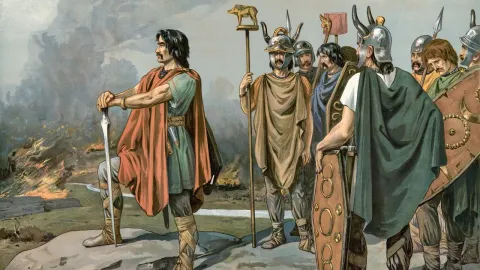
Senate) and the people of Rome. Those letters are still there, even on the manhole covers of Rome. In 390 BC, Rome almost ceased to exist. The Gauls, wild tribes from the north, captured the city out of nowhere. The guard dogs did not bark, and for this the Romans later crucified the dogs every year. The last fortress on Capitol Hill was saved by geese. They began to sound the horns when the Gauls climbed the wall at night and woke the defenders. After this humiliation, the Romans rebuilt their army. The legion was divided into small units, manipuli, which could move independently. This army was much more flexible, and for the next 100 years Rome fought non- stop until it united all of Italy. And here is the fourth secret.
Having defeated their neighbors, the Romans did not simply collect tribute. They formed alliances. The defeated became allies, received self-government, and sent soldiers in return. Gradually, their leaders became Roman citizens. So Rome had an endless supply of recruits, and the defeated did not want to rebel. Staying with Rome paid off better. This became a test when Pyrrhus, the best commander of the time, a relative of Alexander the Great, arrived in Italy. He was hired by the Greeks of Taranto, the last free city in Italy. Pyrrhus won several battles, but the Romans kept returning with fresh legions. The allies did not betray them. Pyrrhus sailed away with nothing. Having reached Sicily, Rome faced Carthage, the richest trading city in the world and the
ruler of the Mediterranean. The Carthaginians were descendants of the Phoenicians, and the Romans called them Punic, hence the Punic Wars. Three wars lasted for over a century. The problem was that Rome had no navy. Carthage was a maritime power, but one day a storm washed a Carthaginian ship onto the Roman shore. The Romans dismantled it, copied it, and added one invention - a gangway with a hook. Now a Roman ship could capture an enemy vessel and land soldiers on it . The naval battle turned into a land battle, and on land the Romans were stronger than anyone. The same secret again. Take someone else's idea and improve it. In the second war, Carthage took revenge. The general Hannibal led 40,000 soldiers,
9,000 cavalry, and 37 war elephants across the Alps. 16 days through snow and ice. Almost all the elephants died in the Italian winter. One survived. But Hannibal was a genius and destroyed Roman armies in battle after battle. Tens of thousands of legionnaires fell. Hannibal understood something. To defeat Rome, he needed Rome's allies to come over to his side. So for 10 years he marched through Italy, trying to convince cities to come over to his side.
Almost none of them did. Firstly, because the Romans took cruel revenge on the traitors. Secondly, because the allies were better off with Rome. The fourth secret worked. Any other nation would have surrendered. The Romans didn't do that. They raised new armies, sent them to Spain, then to Africa, and forced Hannibal to return home and defend Carthage. There the general Scipio finished him off. The fifth secret of Rome is stubbornness. The Romans were losing battles. They never lost a war. Carthage recovered from each defeat, and Senator Cato the Elder ended every speech, on any topic, with the same phrase. Carthage must be destroyed. In 146 BC, they did just that. The city was wiped off the face of the earth.
The population was sold into slavery, and the land was sown with salt so that same year, the Romans destroyed the Greek city of Corinth. Greece became a Roman province. And then something strange happened. Rome conquered Greece, and Greek culture conquered Rome. The Roman elite rushed to study Greek, read Greek philosophers, and imitate Greek orators. The famous orator Cicero studied the speeches of the Greek Demosthenes. Greek became the second language of the empire. The winner turned out to be the disciple of the losers, but there was one injustice. In this vast territory, only the Romans themselves had full rights. Even the rest of Italy, the very allies who made up the majority of the army, were not
citizens. They endured it and endured it. And then they declared war on Rome, and won. Rome granted citizenship to all of Italy. This changed everything. Greece remained a bunch of cities that were at war with each other. Rome learned to turn the defeated into its own people and built an empire on this. Having conquered half the world, Rome became a victim of its own victory. Cheap grain and free slaves poured in from the new provinces. Small farmers could not compete. While they were fighting in distant lands. Their fields were going wild, and with them their debts were growing. For the rich, this was not a problem.
They bought slaves, and the slaves worked the fields. But the poor man, returning from the war, discovered that he owed money that he did not have. He had to sell his land to the same rich man. So one by one, farmers disappeared and flocked to the cities. A new class appeared there - the proletarians. In Latin, it means those who only have children, nothing more. And the rich became a hundred times richer. They bought up all the land of the destroyed and worked it with slaves. Rome was once stable because the rich and poor always found a way to come to terms with each other. Now this connection has been broken. The Senate and people of Rome were divided into two hostile camps. The tribunes Tiberius and Gaius Gracchus tried to
fix this. They proposed taking surplus land from the rich and giving it to the poor, as well as distributing free grain. The senators responded simply. They killed the older brother, Tiberius, in the street, and the younger, Gaius, having lost his support, ordered a slave to stab him. Several thousand of their supporters died with them. Rome descended into civil war. The commander Gaius Marius found a way out for the poor. He began recruiting them into the army, promising them land after their service. Before that, the Roman army
was a militia. Farmers would show up with their own weapons and return home after the war, but there were fewer and fewer farmers left, and there was no one left to fight. Now the army has become professional. The state clothed and fed the soldiers, and the poor volunteered, but there was one trick. The soldiers now depended on their general, not the senate. He gave them land to have their loyalty. This is how the legions turned into private armies. The next to take advantage of this was Sulla. Having defeated the enemies of Rome, he led his legions into Rome itself, declared himself dictator, and compiled lists of enemies.
Everyone who killed a person on the list received a reward. More than 4,000 citizens died. This is how Rome first learned that it was possible to seize power with its own army. In 49 BC, two of the greatest generals clashed for power. Gnaeus Pompey conquered the East, cleared the sea of pirates, suppressed the Spartacus rebellion, and called himself the Great. Gaius Julius Caesar conquered Gaul. Today we would call it genocide. A million Gauls killed, a million enslaved. Then he invaded Britain. By law, a general had to disband his army before returning to Rome.
Instead, he received a triumph, a ceremonial entrance into the city through a roaring crowd. Caesar refused to disband his legions. He crossed the Rubicon River, the border of Italy, and marched on Rome. "The draw is made," he said. Roman legions fought Roman legions. Caesar defeated Pompey, then everyone else. Along the way, he placed Cleopatra on the Egyptian throne and began an affair with her. She bore him a son and named him Caesarion, little Caesar. Returning to Rome, Caesar gathered all the positions in his hands: consul, tribune, dictator.
Rumors spread that he wanted to be king, and the Romans remembered, " We have no kings here." A conspiracy developed in the Senate, and Caesar was murdered right in the meeting. But this did not save the Republic. Caesar unexpectedly appointed his great-nephew , 18-year-old Octavian, as his heir. He turned out to be smarter than all of them. For 17 years, he defeated all rivals, including Mark Antony, who at that time had an affair with the same Cleopatra. Antony and Cleopatra killed themselves. Octavian was left alone. Caesar ruled for four years. Octavian ruled in 43. He took the title of Augustus, the revered one, and came up with a ruse.
He never abolished the Republic. All the positions remained, the Senate remained, the elections remained. He simply held all the positions himself, and called himself somewhat modestly, princeps, first senator. The Pax Romana, the Roman Peace, began. 200 years without major wars within the empire. They fought with barbarians on the borders, but inside there was peace and order. 200,000 Romans received free grain. In the center of the city, they dug a huge artificial lake where 3,000 gladiators fought on real ships. Concrete apartment buildings were being built. Augustus had to ban the construction of buildings above six stories. Citizens complained about traffic jams and high rents.
Familiar? The golden age of poetry has arrived. A friend of Augustus named Maecenas gave money to poets to glorify Rome, and his name became the name of a patron of the arts in half the languages of Europe. Temples were built in honor of Augustus, and the August was named in his honor. Emperors began to be revered as gods on a par with Jupiter and Mars. And after Augustus, power was inherited for the first time. This turned out to be a problem. The first heirs of Augustus went down in history as a gallery of lunatics. Tiberius introduced terror. Failure to praise the government could result in execution.
Caligula wanted to make his horse consul. Claudius was so engrossed in feasts and alphabet reform that he did not notice how his wife poisoned him with mushrooms to put his son from another marriage on the throne. This son was Nero. He considered himself an actor, not an emperor. He killed his own mother. He killed the apostles Peter and Paul. He allegedly set fire to Rome to recite verses about the fall of Troy against the flames, and then accused the early Christians of starting the arson. Ultimately, he committed suicide. We know all these stories from the historian Tacitus, who hated emperors and loved the Republic.
He may have been exaggerating, but one thing is certain. Real power passed from the Senate to the Praetorians, the emperor's personal guard. They were the ones who strangled Tiberius, stabbed Caligula, and appointed Claudius. Then came the better emperors. Vespasian, the grandson of a peasant, introduced a tax on public toilets. And when his son asked if it was shameful to take money from urine, he replied: "Money doesn't stink." Note that this same Vespasian so thoroughly suppressed the uprising in Judea that only one wall remained of the temple in Jerusalem - the Western Wall.
His son Titus opened the Colosseum, and people called it the love and delight of the human race. The second century was called the age of good emperors. Trajan expanded the empire as far as possible from Britain to the Persian Gulf and connected it with a network of paved roads. This network still defines the map of European motorways. Where the Roman road used to run, there is a highway today. Hadrian moved to the defensive, building the wall in Britain and the Pantheon in Rome. The first temple in the world with a huge dome dedicated to all gods at the same time. Marcus Aurelius, the philosopher on the throne, spent most of his life on
campaigns, and between battles he wrote a book on how to live with dignity. People still read it. And then his son Commodus decided that being a gladiator was more interesting than being an emperor. He entered the arena to fight men and beasts while the state crumbled around him. His wrestling partner strangled him in the bathtub. The Roman peace ended. The next hundred years were chaos. The army put anyone on the throne. A free-spirited man, an adventurer who bought a throne at auction, a Syrian sun priest, a former shepherd. But within this chaos, the most important event in the history of Rome occurred. In 212 AD, Emperor Caracalla, half African, half Syrian, granted Roman citizenship to every free inhabitant of the empire. To everyone in
Africa, in Judea, in Britain, in Gaul. It no longer mattered where you were born or what language your mother spoke. You were a Roman. The idea that you could be a Roman anywhere in the world is perhaps the greatest achievement that Rome left behind. Order was restored by Diocletian, the son of a free man who began his career as a simple soldier and ended it as an absolute monarch. He divided the empire into four parts with four rulers so that each could monitor its own section of the border. Rome itself ceased to be the capital. The Senate turned into a city council.
The emperor went from being the first senator to the master. The word " slave" was used to refer to the owner. The citizen became a subject. The warrior became a soldier. The farmer became a serf. The ancient world, built around the free citizen , is over. After 20 years, Diocletian voluntarily retired to grow cabbages on his estate. When asked to return, he replied, "If you could see the cabbage I grew, you would n't be asking." His successor Constantine, before the decisive battle, saw a cross in the sky and the words "By this sign you will conquer. " He won, legalized Christianity, and founded a new capital, Constantinople.
Theodosius made Christianity the state religion and became the last emperor of a united Rome. His sons divided the empire in half. The eastern half lived for another thousand years. We know it as Byzantium. The western half fell into the hands of the barbarians. Ironically, the last emperor of Rome was named Romulus. In the center of Rome, a little closer to the Colosseum, there is a tomb. Not imperial, not senatorial, but a baker, a man named Eurysaces. He was born a slave into a family of Greek migrants. He gained freedom. He signed a contract to supply bread to the city and became rich enough to build a monument to himself that has stood for 2,000 years. In Egypt before Rome, people died as they were born. In the Middle Ages after
Rome, it was the same. But in Rome, a slave could become a citizen. A citizen could become a senator. And a peasant's son could become emperor. Here is the answer to the question of how a village in a swamp became the mistress of the world. It accepted everyone, brought out the best in everyone, and gave everyone a chance to rise.