20:08
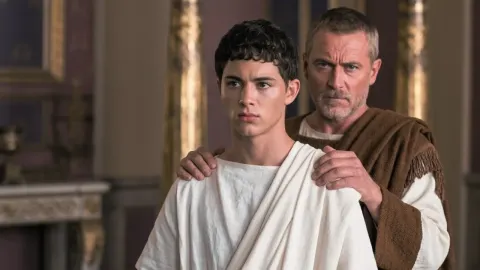



On the 25th of July 306 AD, Constantius I, ruler of the western provinces of the Roman Empire, died at York in northern England. The legions there immediately proclaimed his son as the new emperor, Constantine I. Little could they have known that summer day in 306 AD that the man to whom they had just sworn their allegiance would change the course of history. How did Constantine go from York in 306 AD to converting the Roman Empire to Christianity and building one of the greatest cities in the world? This is the story of Constantine the Great, the ruler who converted the Roman Empire to Christianity.
The man known to history as Emperor Constantine I or Constantine the Great is believed to have been born on the 27th of February in the year 272 AD. While the day on which he was born, the 27th of February, is known with near certainty from ancient sources, there is more of a debate about the year. He could have been born in 273 AD or 274 AD, although some historians place his year of birth as late as 280 AD. The strongest evidence supports the year 272 AD, as several fourth-century writers claimed he was 65 years old when he died in May 337 AD. His full
Roman name was Flavius Constantinus, to which was later added the name Valerius as well. Although the year of his birth is disputed, there is agreement that he was born in the city of Naissus in the Roman province of Moesia Superior. This is the modern-day city of Niš in Serbia. Constantine's father was Flavius Constantius, a Roman military commander who was born in the Balkans. around Moesia, where Serbia and Kosovo lie today. He was, though, said to be either an Illyrian or Thracian, the tribal groups who in ancient times had dominated the regions around modern-day Croatia, Albania and Bulgaria. When Constantine was born,
Constantius was a young soldier. He would rise to a position of major power within the Roman Empire as Constantine was growing up. Constantius entered into a relationship with a Greek woman named Helena around 270 AD. Constantine was their first and only child. Helena came from a humble background. She was an important figure in the history of the era, for while Constantius was an adherent of the old polytheistic religion of Rome and Greece, Helena was a Christian. As such, she seemingly exposed her son to the Christian faith at an early age.
It is unclear if Constantius and Helena were in a legally binding union of any kind. He later left her and married a woman named Theodora with whom he had numerous further children. Constantine's life is unusually well documented for a later Roman Emperor. While the emperors of the first century AD were written about extensively by ancient historians like Suetonius, Tacitus and Cassius Dio, there are far fewer biographies for later emperors. That changed completely for Constantine. His role in converting the Roman Empire to Christianity
meant that dozens of Christian historians in the fourth and fifth centuries wrote about him. Several of these accounts were written by contemporaries of Constantine who lived through the events of his reign. The most notable is the Vita Constantini or Life of Constantine written by Eusebius, the greatest early historian of the Christian church. He was born a few years before Constantine and died two years after him, so their lives overlapped. Subsequent Christian historians, such as Sozomen added further details. Lactantius, a slightly earlier Christian historian, knew Constantine in the first half of his reign and wrote a work entitled On the Deaths of the Persecutors which shed a lot of light
on Constantine's earlier years. However, while Constantine's life and reign are unusually well documented, the nature of these sources creates a problem in and of itself. They were nearly all written by Christian scholars who wrote about Constantine in hagiographical terms, highlighting his successes in converting the empire to Christianity. As such, they are clearly biased accounts that exaggerated Constantine's accomplishments. When Constantine was born in the early 270s AD the Roman Empire had been in the midst of a crisis for nearly forty years. The Severan Dynasty which had ruled the empire between 193 AD and 235 AD
had been succeeded by decades of civil war. There were dozens of emperors between 235 AD and 284 AD. On top of this, the northern and eastern borders of the empire were assailed by a combination of Germanic tribes. These included the Franks and Sarmatians in Europe and the Sassanid Persians and Palmyrans in the Middle East. Alongside these assaults from outsiders, hyperinflation and pandemics impacted on the empire economically and socially. The Third Century Crisis only came to an end in 284 AD when the Emperor Diocletian rose to the throne. Constantine's father had decided
to support Diocletian's claim to the throne. As a result, Constantius benefited accordingly after Diocletian's 21-year long reign began. In 293 AD, in order to ensure a peaceful transfer of power in the future, Diocletian established a college of emperors known as the Tetrarchy. This structure outlined a new format for Roman rule. There would be two senior emperors, known as the augusti, and two junior emperors, known as the caesares. He appointed Constantius as one of the caesares. As such, while Constantine was growing up, his father's support for Diocletian promoted the
family to become part of the ruling elite. If all went well, the idea was that Constantius would subsequently succeed to become one of the more senior augusti. Accordingly, this could open a place for Constantine to enter the Tetrarchy at that point. These shifting political events meant that Constantine did not spend much time around his father when he was young. When he was an infant, for instance, Constantius was serving as a commander of the personal guard of Aurelian, the Emperor between 270 AD and 275 AD. He moved around constantly in the years that followed and it is likely that Constantine was primarily raised
by his mother, Helena. Eusebius stated in his Life of Constantine that the future emperor had "reaped the advantages of a liberal education." This involved learning subjects like history, philosophy and rhetoric that the Romans prized greatly. He was taught in Latin and this became his primary language despite his mother's Greek heritage. Later in life Constantine required translators to aid him in some official duties in the Greek-speaking east. Constantine's teenage years were spent at Diocletian's court in the city of Nicomedia, modern-day Ízmit in
western Turkey. Historians remain divided on how directly exposed he was to Christianity here during his youth. For instance, one of the learned preachers in Nicomedia during this time of Constantine's childhood was the Christian scholar Lactantius. As we have seen, Lactantius later became a key source on events in the Roman Empire during Constantine's rise to power. Diocletian was certainly not a supporter of Christians of any kind. Christianity had grown massively in the third century to become part of the politics of the Roman Empire.
The new religion had started out as a radical sect of Judaism in the Levant in the middle of the first century AD. It spread thereafter through the Greek-speaking Eastern Mediterranean, yet it remained a minor faith with small, isolated communities of Christians in places like Antioch, Corinth, Alexandria and the coastal cities of what is now Turkey. It continued to grow slowly, albeit steadily in the second century AD. From the 160s AD onwards there were a growing number of Pagan Greco-Roman writers in the Eastern Mediterranean, pointing out that the values
of the Christians fundamentally conflicted with those of mainstream Roman society. Nevertheless, despite the claims made by later Christian writers, there was no sustained policy of persecuting Christians in the Roman Empire until the reign of the Emperor Decius between 249 AD and 251 AD. The shift in attitude was occasioned by the massive growth of the Christian movement in the third century. Historians, theologians and even sociologists still debate why this occurred. The most likely explanation is that the Third Century Crisis created such a volatile political
and social environment across the Roman Empire that this radical religion, with its emphasis on salvation in the afterlife, became attractive to a growing number of people. Even Decius' campaign of persecution was brief. Instead, the most substantial attack on the Christians came during the later years of the reign of Diocletian, by which time there were several million Christians across the empire. In 303 AD he launched the Great Persecution. In this the rights of Christians across the empire were restricted and they were ordered to make the standard sacrifices to the
emperor on pain of punishment. As a member of the Tetrarchy, Constantine's father was responsible for overseeing the Great Persecution in some of the western provinces of the empire. Could you use "DESS-eee-us here was one of the last major acts of his eventful reign. Two years later, on the 1st of May 305 AD, he made the unusual decision to retire and hand over the office of augustus. This was all seemingly in the interest of ensuring that the Tetrarchy system functioned as it was supposed to and there was a smooth transfer of power. In the western provinces, Constantius
was elevated to become one of the augusti. In the east, Constantine had hoped that when Diocletian stepped down that he might be appointed as one of the caesares, the junior emperors in the Tetrarchy system. However, this did not happen. Instead, the new senior emperor in the east, Galerius, appointed his nephew, Maximinus Daza, as the new caesar in the east. Fearing that he might now be killed by Galerius, who was effectively holding him hostage at his court, Constantine fled westwards and joined his father in Gaul near modern-day Boulogne in northern France. When he
reached Gaul, his father was preparing to lead an army over the English Channel to campaign in Britain. This was against the Picts of Caledonia who were pressing south from what is now Scotland into northern England. Constantius was seemingly already ill and he died at Eboracum, the name of the Roman city of York, on the 25th of July 306 AD. The legions there immediately proclaimed his son as his successor, a move which was a breach of the Tetrarchy system, as Constantine had never been established as one of the caesares. Hence, civil war beckoned yet again within months of
Diocletian's abdication. For his part, Constantine later made it part of his official propaganda that he had not requested the legions to proclaim him as emperor at York. Constantine argued that they had done so anyway, in the process creating the notion that he was a figure of such popularity that he had the imperial title thrust upon him. The Civil Wars of the Tetrarchy that now began in 306 AD, and which would last down to 324 AD, would change the course of history. MAX-imin-us If the Tetrarchy system had functioned in the way that it was supposed to, a commander named Severus, who had become
the caesar in the western provinces in 305 AD when Constantius became one of the augusti, should have become the undisputed augusti in the west when Constantius died. Constantine could then have been promoted to become the new caesar if Severus had agreed that he should enter the imperial college. Instead, though, Constantine claimed his father's senior position, opening up a civil war between himself and Severus. The picture was further complicated by Maxentius. He was a son of Maximian, who had ruled alongside Diocletian down to 305 AD. Like Constantine,
Maxentius had been passed over for earlier promotion. In October 306 AD, when news arrived to Italy where Maxentius was based at the time of Constantius' death, the legions under his control proclaimed him as the new emperor. Severus was not far away in Milan and headed south to confront Maxentius. He was defeated, captured and died not long afterwards in 307 AD. This meant that the struggle for power in the west of the empire was now broadly between Constantine and Maxentius. While Maxentius had control over Italy and secured the provinces of North Africa, Constantine
secured control over Gaul and Hispania. Constantine and Maxentius had something in common; neither of them were able to gain acceptance as a legitimate ruler in the west from the senior augustus in the east, Emperor Galerius. Instead, at an imperial conference held at Carnuntum on the 11th of November 308 AD in what is now Austria, it was decided that Licinius, an ally of Galerius, would become the new augustus of the western half of the empire. The conference at Carnuntum was given added gravitas by the presence of the retired Emperor Diocletian. Although an effort
was made to conciliate Constantine by making him caesar in the west, he was unsatisfied with this. Instead he briefly drew closer to Maxentius. Constantine had entered into a marriage alliance with his rival in the west the previous year by marrying Maxentius' sister, Fausta. Their father, Maximian, who had abdicated his position as augustus in 305 AD at the same time as Diocletian, but who had re-entered the political fray in 306 AD, was also involved in these complex political manoeuvres. Fausta was probably Constantine's second wife. Years earlier he had entered
into a relationship with a woman named Minervina while he was residing at the court of Diocletian. They had a son together named Crispus. It is unclear if Minervina was Constantine's wife or a concubine. In any event, he put her aside in 307 AD in order to marry Fausta and form an alliance with Maxentius. Constantine and Fausta would remain married for many years and they had five children together, three sons and two daughters, Constantina, Constantine, Constantius, Constans and Helena. However, the alliance between Maxentius and Constantine disintegrated
long before most of these children were born. In 310 AD, Maxentius and Fausta's father, Maximian, tried to overthrow Constantine in Gaul. He was defeated, and his actions led to a spiral of events which led to Constantine and Maxentius entering into direct war with one another for control over the western provinces. By then Maxentius had become extremely unpopular and was facing local rebellions in Italy. And so it was that Constantine campaigned towards Rome in 312 AD. The resulting clash between his and Maxentius' forces at the Milvian Bridge outside Rome on the
28th of October 312 AD has become one of the most famous military clashes in history. On the surface, the story of the Battle of the Milvian Bridge was quite routine. Two rival claimants for the Roman imperial title clashed in battle. Constantine's forces won the battle after Maxentius drowned in the River Tiber, and Constantine became the unrivalled ruler of the western provinces. However, the significance of the Battle of the Milvian Bridge lies in Constantine's alleged conversion to Christianity as a result of
the battle. There are actually two completely different versions of what happened. Lactantius claimed in On the Deaths of the Persecutors that Constantine had a dream vision the night before the battle in which he was instructed to have his men adorn their shields with a Chi-Rho, an early Christian symbol of Christ. As a result of doing so, his men won the battle and Constantine was inspired thereafter to become a Christian ruler. The other version of the story of Constantine's conversion was related by Eusebius. He claimed that during the battle Constantine and
his soldiers saw a shining Christian cross in the sky. Constantine interpreted this as a divine sign of the providence of the Christian god. Eusebius' version became more popular over time with its epic appearance of a shining cross in the sky as the battle raged around the emperor. KAI-ROW Constantine claimed that he was inspired enough by his vision at the Battle of the Milvian Bridge that he proceeded in the immediate aftermath of it to end the persecution of the Christians. In February 313 AD, the Edict of Milan was issued to that effect. Here it was proclaimed that "we have given to those Christians free and unrestricted
opportunity of religious worship." Several things are usually overlooked with the Edict of Milan however. Firstly, the Edict went on to declare that "we have also conceded to other religions the right of open and free observance of their worship for the sake of the peace of our times." Secondly, the preamble of the Edict states very clearly that it was being issued after Constantine had met with his major remaining rival for power. This was the ruler of the eastern provinces, Licinius, and at Milan both had agreed on the measure together. Thus, the Edict of Milan was not
a declaration by Constantine that Christianity was to be tolerated henceforth. It was a joint declaration by Constantine and Licinius that all religions were to be tolerated across the empire in order to end religious tensions among the Roman people. The question of what motivated Constantine has absorbed the attention of historians for centuries. In all likelihood, he and Licinius had decided that it was pointless to try to curb the seemingly unstoppable rise of Christianity. They decided to tolerate the Christians as a means of stabilising the empire
after the crises of the third century. Indeed, one of the last acts of Galerius, the senior emperor in the east, prior to his death in 311 AD, had been to issue the Edict of Serdica. This proclamation ended Diocletian's Great Persecution in the eastern provinces and established the same idea of tolerance that Constantine and Licinius guaranteed at Milan two years later. The popular view is that Constantine firmly committed to Christianity owing to his experiences at the Battle of the Milvian Bridge. According to this version of events, by the later stages of his
reign the Roman Empire had become a Christian state and steps were already being taken to eradicate Pagan superstition. That at least is the myth of Constantine, who is venerated as a Christian saint. The only problem is this is not what happened at all. While Constantine did end the persecution of the Christians through the Edict of Milan and would move to establish a Christian church throughout the empire as his reign went on, he continued to worship the old gods and did not view Christianity as being an exclusive religion. For instance, long after the Milvian Bridge, coins were issued with Constantine's image on one side
and images of Jupiter, the old Roman king of the gods on the other. He also connected his reign to Sol Invictus, a Sun deity that had become extremely popular in the third century AD. There is evidence to indicate that Constantine viewed the Christian god as being a Sun deity as well. Overall, his religious outlook was one in which he viewed Christianity as a new component of the broad tapestry of religious life across the empire. He did not reject the older religion or other cults like that of Sol Invictus. The meeting between Constantine and Licinius at Milan in 313 AD was important for multiple reasons. The Edict was issued there and a marriage alliance was also entered into as Licinius
married Constantine's half-sister, Flavia Julia Constantia. The alliance was a temporary one, but Licinius needed it to secure his power. He faced a rival claimant for power in the east, Maximinus Daza, the nephew of Galerius who had been made a caesar back in 305 AD. Indeed, Licinius might well have been the driving force behind the Edict of Milan to a greater extent than we realise. Maximinus Daza was a persecutor of the Christians in the lands he controlled in Egypt and the Levant, which were provinces where Christianity had flourished since
the second century AD. Licinius may have been trying to undermine Daza's position by appealing to the Christians of those lands. Shortly after the meeting at Milan, Licinius defeated Daza at the Battle of Tzirallum on the 30th of April 313 AD. He was killed soon after and Constantine and Licinius briefly ruled the western and eastern halves of the empire in relative peace. Renewed conflict broke out between them, though, in 316 AD. Constantine won an initial victory at the Battle of Mardis that winter, but the tensions between them continued to simmer and they returned
to war at the start of the 320s AD. Constantine's twin victories at sea and on land, at the Battles of the Hellespont and Chrysopolis respectively, in the summer and autumn of 324 AD brought these civil wars to an end. This saw a conclusion to the conflict that had followed the abdication of Diocletian and left Constantine as the sole ruler of the Roman Empire, seventeen and a half years after he was first proclaimed as emperor. MAX-imin-us One of Constantine's first acts as ruler of a consolidated Roman Empire was to initiate plans for a new capital. Nova Roma or 'New Rome', as it was initially named,
was to be located where Europe met Asia. The new capital would be strategically located to allow an emperor residing there to respond to attacks against both the northern and eastern borders. The location that he chose was on the European side of the Bosporus, the waterway separating the Balkans from Turkey and the Mediterranean Sea from the Black Sea. The symbolic foundation of the city of Constantinople, as it eventually became known, here on the 24th of November 326 AD was not a revolutionary break with the past. There had been a settlement at this location,
known as Byzantium, going back centuries to when the Greeks had colonised this part of the world. Furthermore, Diocletian had recognised the need for a capital in this part of the empire to respond to issues as they arose in the east. He had therefore kept his court at Nicomedia, where Constantine had spent a large part of his youth and early adult years. Constantinople was closely modelled after Rome in many ways. For instance, a claim was made that the new capital was being built on seven hills, like Rome had been, while the city centre was laid
out to mimic Rome. What made Constantinople as distinctive was its Christian character. Christian churches were located prominently here, albeit the grand church of Hagia Sophia was not built until much later. Eusebius' extremely extensive Life of Constantine contains limited details on the emperor's early life. Conversely, it is immensely detailed about Constantine's actions after he secured full control of the empire in 324 AD. It is also highly informative about the reforms that he initiated to establish a hierarchical Christian Church that was interconnected with the Roman state.
Constantine did so at an unprecedented ecumenical council which he convened at the city of Nicaea on the Turkish side of the Bosporus in the summer of 325 AD. This was presided over by Constantine and attended by around 250 bishops drawn from across the empire, and even from the lands of the Scythians and Persians beyond Rome's borders. The Council of Nicaea was a defining event in the early history of Christianity. The Council saw the Christian church organised more effectively and adjudication over a number of theological disputes. These included the dating of Easter,
the establishment of what became known as the Nicene Creed as a statement of Christian faith and, most importantly of all, the deliberations on the nature of the Holy Trinity. The issue of the Trinity had become controversial owing to the teachings of a North African bishop named Arius who claimed that Jesus was not co-eternal with God, but was instead a more junior celestial that had been created by God. Throughout his Life, Eusebius tried to make clear that Constantine aimed for a church that was unified politically and theologically.
He stated that Constantine uttered the following in his address to the assembled bishops: "I feel that my desires will be most completely fulfilled when I can see you all united in one judgment, and that common spirit of peace and concord prevailing among you all." On the disunity of the Christian community, Constantine commented specifically: "Begin from this moment to discard the causes of that disunion which has existed among you, and remove the perplexities of controversy by embracing the principles of peace." Yet what Eusebius depicted as an emperor bent on
establishing peace, could just as easily be interpreted as a power grab. Constantine, the dual Pagan-Christian ruler, wanted a unified church without divisions. Such a Church, unified and bound to the state, would be much easier for him to dominate as Emperor. While the nature of Constantine's Christianity is clearly open to debate, there is no denying that his actions were incredibly successful. Estimates are that there were perhaps only around a quarter of a million Christians throughout the Roman Empire in 200 AD, out of a total population of as many as 50 or 60 million people. Undoubtedly that number had increased to a few million Christians
by the time Constantine was proclaimed as emperor in York in 306 AD. But Christians were still very much in the minority across the empire. That all changed because of Constantine's reign. He was not unique in deciding to tolerate Christianity at the start of the 310s AD. Both Licinius and Galerius had decided on the same course of action. He was also a peculiar Christian, one who was able to integrate worship of the Christian god into his own polytheism that included strong veneration of the Sun deity, Sol Invictus. However, he laid the groundwork for the
establishment of a strong Christian church and his reign was long enough that, by the end of it, the triumph of Christianity as a state religion was assured to a large extent. In the decades that followed, millions of people began converting to Christianity across the empire. Constantine's reign is understandably the focus for the creation of the Christian church and the building of Constantinople. However, there were numerous other issues which Constantine was concerned with. The fiscal crisis that had gripped the empire in the third century had not gone away.
While the Romans were brilliant engineers and administrators, they had a limited grasp of economics. The crisis of the third century had forced them to consider monetary policy. Diocletian had issued an Edict on Maximum Prices in 301 AD to try to curb inflation, setting upper limits to both prices and wages. Numerous emperors had tried other methods, engaging in recoinage whereby new coins were issued with higher silver and gold purity to create fresh confidence in the coins that were circulating. Diocletian also tried this, issuing a new silver coin that was said to
be pure silver. However, it wasn't long before versions of the coin began to circulate where the silver was mixed with other metals. Constantine's innovation was that he began issuing 'billon' coins that were a mix of silver and alloy metals. He did mint and distribute a new gold coin as a kind of premier piece of coinage, but in issuing the 'billon' he was getting rid of the pretence that the silver coins in circulation were pure. He also ordered the melting down of statues made of gold, silver and bronze from Pagan temples and used the metal to have new coins minted.
Christian writers subsequently cheered on this activity, interpreting it as a sign of Constantine's animosity towards the old Pagan religion. In reality it could be interpreted as a practical measure, allowing the state to acquire precious metals, rather than any indication of his antagonism towards the old polytheistic religious cults. Constantine's reign, like that of any Roman emperor, witnessed the construction of monuments and statues. What marked Constantine's time in power as distinct was that his reign lasted over three decades, so he simply built more than others. What is unusual is that, despite creating
his own capital city at Constantinople, the two pieces of art and architecture which Constantine is most famous for were both constructed in old Rome in Italy, not the New Rome on the Bosporus. These are the Arch of Constantine and the Colossus of Constantine. The Arch of Constantine lies between the Colosseum and the Palatine Hill in Rome and is still standing to this day. It is a classic Roman commemorative arch, celebrating Constantine's victory over Maxentius at the Battle of the Milvian Bridge. What is remarkable about the Arch of Constantine is its sheer size. It is
the largest triumphal arch in the city, standing 21 metres tall. By comparison, the Arch of Titus, built to commemorate Roman victory in the First Roman-Jewish War between 66 AD and 73 AD, is 15 metres tall. This being said, Constantine was magpie-like in the methods he allowed his architects to employ. Many of the reliefs decorating the outside of his arch were literally ripped out of the triumphal arches of other emperors and recycled for his monument. The Colossus of Constantine was erected in the Basilica of Maxentius in the Roman
Forum. It would have stood 15 metres high when first built in ancient times. However, it was destroyed in its original format in ancient times and was possibly broken up for looting when the Goths sacked the city in 410 AD. The head, which alone is two and a half metres tall, has survived, along with some other fragments. A full replica of the enormous statue was installed in the Capitoline Museum in Rome in 2024. Constantine's later reign was not entirely devoid of controversy. In the summer of 326 AD, as work accelerated to establish the New Rome on the
Bosporus, Constantine appears to have ordered the killing of both his wife, Fausta, and his eldest child, Crispus, the son from his earlier relationship with Minervina. His motives for doing so are not entirely clear. Eusebius conveniently avoided mentioning the pair and their murders. The general consensus amongst later writers was that Crispus was killed first and then Fausta was murdered a few weeks later in a bathhouse. Zosimus, a historian writing at the very end of the fifth century AD stated that Constantine acted when he learned that the pair
had become engaged in a sexual relationship with each other. He stated that Constantine "killed Crispus … when he incurred suspicion of him having sexual relations with his stepmother Fausta, without taking any notice of the laws of nature." Zosimus expands on the story to account for the pair's death in detail, writing that "Constantine then tried to remedy the evil with a greater evil: having ordered baths to be heated above the normal level, he deposited Fausta in them and brought her out when she was dead." An alternate theory is that Constantine was trying to stamp his authority
over the imperial family. He had witnessed Maxentius overpower his own father, Maximian, in the western provinces nearly two decades earlier. As a result, Constantine may have been concerned that something similar could happen as his sons grew up and their mother schemed on their behalf. Thus, the murders of Fausta and Crispus may have been a strategic initiative to indicate that Constantine would not tolerate any effort to dilute his power as he grew older. Constantine certainly did not betray any signs that he was aging poorly through his fifties and
into his sixties. He continued to campaign militarily throughout the remainder of his reign. The empire was more secure in the early fourth century AD than it had been half a century earlier when the Franks, Alemanni and Sarmatians had penetrated deep into Gaul and the Balkans. However, even at this later point in Constantine's lifetime, the borders were still in a precarious state. Constantine had been able to secure the frontier in Germania early on in his reign through the location of his capital being established at Trier, near the River Rhine,
in the years prior to the Battle of the Milvian Bridge. During these years, while an unstable peace existed between him, Maxentius and Maximian in the west, Constantine had campaigned against various Germanic tribes such as the Bructeri, as well as the Franks and Alemanni. Constantine also left behind reinforced border defences along the Rhine when he went eastwards to confront Licinius. Thereafter, Constantine's focus when it came to Rome's borders was in campaigning against the Sarmatians and other groups in the Balkans. These tribes had been in control of large parts of Dacia in modern-day Romania for half a century. This had
come after the Emperor Aurelian had strategically withdrawn from the lands north of the River Danube back when Constantine was an infant. With the border along the Rhine reinforced, the empire secure internally, and the Romans enjoying an extended period of peace with Persia in the east, Constantine developed his ambition to try to reconquer Dacia. Crispus campaigned against the Alemanni and secured the gap between the Rhine and Danube Rivers in the mid-320s. Perhaps it was this military success which cost Crispus his life not long afterwards, as his father became wary of
his ambitions. Thereafter, with the western flank secure, Constantine campaigned into Dacia. Between 328 AD and 332 AD he was active almost every year along the frontier in what we now call Serbia and Romania. Here, Constantine won several victories, establishing a series of new defensive structures, although his claims that he fully reconquered Dacia were exaggerated. Constantine was active until late in his life. He was preparing a large offensive against the Persians in 336 AD and was said to have developed a plan to be baptised like Jesus in the waters of
the River Jordan on his way through the Levant. However, the plan was never implemented. In the late winter or early spring of 337 AD, Constantine became ill. He never fully recovered. Instead, he withdrew to Nicomedia, where he had spent so much of his life in his youth and early adult years. There, the man who had begun converting the Roman Empire to Christianity, was finally baptised on his deathbed. Strangely, the cleric who carried out the ceremony was Eusebius of Nicomedia, not to be confused with his biographer of the same name. This other Eusebius was an adherent of the Arian
heresy that the Council of Nicaea had tried to eradicate. Not long afterwards, Constantine died on the 22nd of May 337 AD. He was probably around 65 years of age, though we cannot be sure. He was laid to rest in a sarcophagus in the Church of the Holy Apostles in Constantinople. His remains were destroyed at some stage in the thirteenth century during the chaos that had enveloped the city following its conquest by the Christians of the Fourth Crusade. Constantine was succeeded upon his death by three of his sons, Constantine II, Constantius II and Constans I. However, while the Constantinian Dynasty managed to hang on to imperial power,
there was internal conflict. The brothers quickly became rivals. Constantine II was killed while campaigning into Italy. Constantius II and Constans I then ruled together down to 350 AD when Constans was usurped and killed in the western provinces by a rebel general named Magnentius. Constantius was the longest-lived of these sons of Constantine the Great. When he died in 361 AD, he was succeeded by his first cousin, Constantine the Great's nephew, Julian. This young emperor was clearly a man of ability, though he broke completely with the religious tradition
established by his uncle. In direct contrast to Constantine's apparent embrace of Christianity, Julian began trying to convert the empire back to Paganism and re-orientate it towards Hellenic philosophy. Julian could well have changed the history of the ancient world if he had ruled for three decades like his uncle and been able pursue his goals for more than 30 years. However, he died less than two years after he assumed the imperial purple while campaigning against the Persians in the east. His premature passing in the summer of 363 AD brought the Constantinian Dynasty
to an end. Thereafter the empire reverted to a less linear form of succession. All of Julian's successors were Christians. Many of them, like the Emperor Theodosius, introduced laws which specifically aimed to persecute non-Christians in ways that would have been unthinkable in Constantine's time. The shift towards Christianity becoming a religion of persecution thus happened in the second half of the fourth century, not during the reign of Constantine. Constantine I was probably the second most important ruler of the Roman Empire in the 500 years between the establishment of the imperial system in 27 BC and the fall
of the Western Roman Empire in 476 AD. His importance within the history of the Roman Empire was eclipsed only by Caesar Augustus, the man who created the empire and returned the Roman world to stability after decades of civil war and anarchy. Constantine's reign was also the third longest in that time period. His ascent was both unexpected and typical of the time he lived in. On the one hand, a stable system of succession via a college of emperors had been set up by Diocletian when Constantine was a young man. If this had operated properly, Constantine would not have become the ruler of the empire. Conversely,
if looked at from the perspective of the wider third century in which Constantine was born, his rise to power via civil wars and rivalries with other would-be emperors was completely normal. What was altogether different about Constantine was what he did when he became emperor. After securing control over the western half of the empire, he issued an official edict of toleration for Christian worship which was followed by the organisation of the Christian Church into a mass political institution. After becoming the undisputed ruler of the entire empire in 324 AD,
he then built a great new capital in the east. The conversion of the Roman Empire to Christianity, and the construction of what would become one of the greatest cities of the world throughout the medieval era and down to the present day, are the two great achievements of Constantine's reign. is still no certainty today, 1700 years later, as to what Constantine's real religious beliefs were. It remains a matter of debate as to whether the conversion of the empire was facilitated by Constantine's personal beliefs, or whether it came from his tactical political manoeuvre to increase
imperial stability through greater tolerance of rival religions. In the end, his motives really do not matter. Constantine stands at the very centre of a religious and political revolution in the Late Roman Empire which changed the history of the world. For that reason, he surely deserves to be called Constantine the Great. What do you think of Constantine the Great? Was he a genuine Christian believer? Or was he an opportunist who saw the Christian Church as something which he could utilise to cement his control over the Roman Empire? Please
let us know in the comment section, and in the meantime, thank you very much for watching.