4:28


Ocean. Alpine ridges. Rainforests. All in one park. Hi, I'm Ranger Kathryn, and we're at a rainforest in Olympic National Park. I'm here to help answer some top-trending questions about national parks and the great outdoors. Let's hit the trail. The oldest national park is Yellowstone National Park, which was designated in 1872. However, the trees in forests of Olympic National Park can be several hundred years old, and even upwards of 500 years old,
which is older than the creation of the Park Service and even older than the United States. Something that's really unique about old growth forests in the Pacific Northwest is that decay happens really slowly out here. So because that decay happens slowly, that is providing a slow release of nutrients, which allows our forest floors to be covered in vegetation. Here we have found a ghost pipe plant. It's parasitic, so it's not photosynthesizing. It's actually leaching materials and nutrients from other plants surrounding it.
A really awesome find in the forest. In the temperate rainforest of Olympic National Park, moss can really grow anywhere. If it has the right environment and has what it needs, it's going to be able to climb and grow all over our trees, just like the big leaf maple here. Tidepooling is when you're going out to explore all of those rocks and pools that are left behind when the tide goes out.
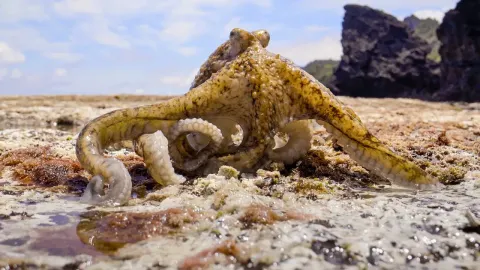
Hopefully you get a chance to see some of these amazing animals that we see here today, like sea stars, sea anemones, barnacles, mussels, and maybe, if you're lucky, even an octopus. The best time to see animals in the low tide is anywhere below a one-foot tide. When you come across a negative tide, that's going to be extremely good tidepooling opportunities. There's a bunch of sea stars kind of huddled up on this rock. They are predators of the tide zone. One of their favorite things to eat is mussels. So if we look up higher on the rock here, right about there, we see a little tinge of blue.
Those are blue mussels or California mussels. And that is a favorite food of our sea star. Now, it's a really cool thing how sea stars eat these mussels too. They will climb up onto a mussel, pry open that mussel and eject their stomach into the mussel, actually dissolves the insides of the mussels into, like, a soup, and then they slurp it back into their body and go about their day. Behind me you see these snow-capped mountains, and more importantly, you're seeing these glaciers. A glacier simply is a river of ice.
They form when snow accumulates more than it melts each year. Once that snow accumulates and compacts on top of itself, it eventually creates that solid block of ice that we know as a glacier. Waterfalls are fed usually by mountain streams, starting at a much higher elevation, traveling down the mountain. As it's going, it's eroding rocks at different rates based on what those rocks are made of. So, if you have a rock that's harder and a rock that's softer, one of those is going to fall off, create this ledge that's gonna ultimately create that water cascading over the rocks.
Our parks are so diverse across the country that you can see a wide variety of different species, depending on where you are. Whether that's elk, bears, or even our tiny critters like squirrels and marmots. Personally, one of my favorite things to bring backpacking are binoculars. They allow me to see things up close without having to approach any wildlife. Let's see what we can find. Hurricane Ridge is a great place to spot marmots.
What is a marmot? Well, a marmot is in the squirrel family, so it looks kind of like a big rodent. When trying to spot an Olympic marmot, the best thing to do is to find a nice open meadow and search for piles of dirt. Those are their dens and their mounds where they're often hanging out around the opening. If you encounter a black bear, or really any wildlife, you want to use what we call the rule of thumb. And that means you extend your arm, put out your thumb, and if you can cover that animal with your entire thumb, you are a good distance away. Create distance by backing away slowly; make yourself look nice and big, and make noise.
In the National Park System, there are 63 national parks like the Great Smoky Mountains, Everglades, the Grand Canyon, and even Olympic National Park. However, what you might not know is that there are over 400 national park sites, including monuments, historic sites, battlefields that cover every state. Our national parks are great in every season. So whether you're hiking or swimming or snowshoeing, our parks have it all. So, get yourselves out into your local national park, and let's hit the trail.