20:11



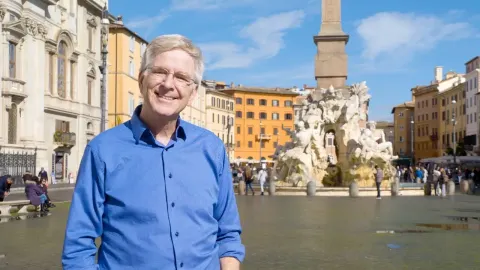
Hey, I'm Rick Steves back with more of the best of Europe and always learning. What's good day? Gintore. What's Thank you. Jinua. What's this? Nastro. We're in Poland in its most visited city, Kkow. Thanks for joining us. Poland's political capital may have moved to Warsaw. centuries ago, but Krakow remains the historic, cultural, and intellectual capital, a proud symbol of the Polish national identity. Krakow is ideally set on the Vistella River.
We'll explore one of Europe's most crowd-pleasing squares, marvel at medieval glory, visit Vaval Hill, a site sacred to Poles since the 11th century, learn how to make a classic Polish dish, or at least try, and then eat what we cook. We'll remember the Holocaust at a concentration camp memorial. And with a guide, we'll take a nostalgic communist era joy ride. Finally, we'll cap our visit with a twilight stroll. Medieval Poland was prominent on Europe's map. In the late 1700s, it disappeared, partitioned by its powerful neighbors, and it didn't reappear until after World War I. Then, after World War II, it was part of communist Eastern
Europe. And today, with the Iron Curtain long gone, it's a leading country in central Europe. We're visiting Poland's historic and cultural capital, Krakow, and sidpping to Awitz. Krakow, or as locals say, Kraku, was a crossroads, a trading center that boomed back in the 11th century. Today, it's a sprawling city of a million with a delightful old town. And everything converges on the majestic and massive Main Market Square. It's hard not to be drawn to this square. It bustles with life. Enticing cafes, families out for a stroll, fairy tale carriages, a youthful energy, and it seems half the tourists in Poland.
St. Mary's church stands tall over it all. Its spire doubles as the town watchtowwer. At the top of each hour, literally 24/7, a fireman with a trumpet comes to the window and plays a tune to announce all is well. A tune that suddenly dies. Recalling a legend in which a watchman's throat was pierced by an enemy arrow. Inside St. Mary's each midday is a medieval moment. A nun swings open the door's much adored alterpiece. This exquisite Gothic tptic with hinged panels was carved in the late 1400s by Vitto.
One of the most impressive medieval wood carvings in Europe. It depicts the Virgin Mary's ascent to heaven with a motion rare in Gothic art. The square's centerpiece is the cloth hall. Once a marketplace for cloth merchants, today it's home to souvenir stalls. Vendors sell gifty crafts from all over Poland. like painted wooden plates from mountain forests, colorful embroidery delicately handstitched, hand painted pottery from Cissia, and amber jewelry from the Baltic Coast for your favorite travel partner.
Krakow's old town is compact and easy to navigate. The vibe is relaxed as modern and medieval mix it up. In the 13th century, after their city was destroyed by invaders from the east, Kovians rebuilt it with a near-perfect grid plant. Today, it's pedestrian friendly and thriving. They also encircled their city with a wall featuring classic ramparts and towers. The big round freestanding fort is a barbacon, which provided extra protection at the main gate. Later, the wall was mostly torn down, leaving just a few evocative remnants.
The moat was filled in and a fine park was created in its place. This circular green belt called the Planty is popular with today's Crackovians. And if you need a break from all the tourists, you can bike or hike around the Planty and along the riverbank. It's a charming local scene. fun-loving boers, lazy picnics, but beware the dragon. Oh, and if you think you're good at chess, challenge one of these guys. The Riverside Path is inviting, and so is the playful rigging on its delightful pedestrian bridge.
Krakow has been called little Rome. That's because of its many churches. There are 23 in the old town alone. The country is devoutly Catholic. Almost 2/3 of Poles attend weekly mass. So churches here aren't just tourist attractions. They're alive with worshippers. Catholicism is central to Polish identity.
Squeezed for centuries between Protestant Germans and Orthodox Russia, Poles were united and strengthened by their Catholic faith. And after World War II, when Poland was ruled by anti-church communists, going to mass was more than worship. It was a political statement, a chance to express both dissent and a desire for freedom. It was during these challenging times that a charismatic KKow priest named Carol Voitwa led his flock in defiance of communist authorities. Throughout the 1950s,60s and 70s, he fought for the right to worship inside the communist state. The church hierarchy was impressed and in 1978 that humble Polish priest was elected Pope John Paul II.
The first nonItalian pope in centuries was made a saint in 2014. Although he's a controversial figure to some, many locals consider him the greatest pope. Krakow's Franciscan church was special to John Paul. He'd come here all alone to pray. This was his favorite pew way in the back. To people across the eastern block and to Catholics worldwide, Pope John Paul II embodied the resistance fighting Soviet rule. And he inspired the Polish people with his soothing refrain, have no fear. The church is also a fine introduction to art nuvo Polish style. With its stained glass weaving together images of the favorite Franciscan saints, it employs the movement's
characteristic organic swoops and floral motifs. Another window shows God in the act of creation, turning natural light into spiritual energy. The art nuvo style flourished across Europe in the early 20th century. While Climpmpt was painting in Vienna and Muka was busy in Prague, Poland's art nouvo movement was led by Stanislav Vispensky. At the museum dedicated to the artist, you see how the movement was playful, lyrical, and inspired by folklore. Vispensky and his fellow artists mixed gloom and mysticism into beauty that came with a message.
The spirit of Poland will live on. To learn more about Polish culture, I'm joined by my friend and fellow tour guide, Tomas Click. Every time I travel in Poland, it seems vodka is quite important. What does vodka mean to Poland? Vodka is definitely our national drink. We take it very seriously. We're very proud of it. Polish Vodka is a brand that is renown all over the world and we do take our vodka very seriously. So Polish vodka, does that mean Polish ingredients?
Polish vodka has to be not only made in Poland but made from Polish local ingredients and those could be either potatoes. So we have potatoes vodka or grain. So which is this potatoes or grain? This one is grain vodka. Which do you like better? I like grain better. That's my favorite. So is there a ritual for drinking it? in a pub or a bar? Yes, there is. When we celebrate, we drink it with our friends and we do mainly the shots and we don't sip it like this. We just do the bottoms up.
Is that right? No sipping. What if I sip? What do people think? Well, if you want to be really local, you better do the bottoms up. Okay. Okay. So, really, you just throw it right down. Exactly. Mhm. And how do you say toast? Nazia. Nastro and bottoms up. Yes. For dinner, Tomas has promised to teach me how to make a classic Polish dish at his house. A dish that all Polish grandmas make. I'm learning how to cook perogi. First, you need the potato dough to just the right texture. Like a play-doh. Very relaxing. It's like going to a spa for your body and soul.
Is grandma looking down? I hope she is. Then you roll it out flat as a Polish crepe. We want it as thin as possible because our dough is generally flavorless. What gives the flavor to our dish is the filling and the topping and cut out small discs. Beautiful. Mhm. Circle. Making cute little pockets. You tuck in the cheese, onion, and meat filling. Then you seal it watertight around the edges. Pinch it firmly. has to be wet. Your first pureogi. Congratulations. And we just wait for them to float. After a short boiling bath, they're ready to eat. In true family style, we enjoy a little sunshine in the backyard and a classic
Polish meal, just like grandma or babcha used to make. Babcha. Yes. I hope she's proud. From Kkow's old town, a ramp leads up to the most hallowed ground in all of Poland. Vavvel Hill is sacred to the Polish people, a castle and royal residence since the 11th century. The park-like scene entices Poles to drop by and celebrate their nation's epic story. Everything is layered in history, including the venerable Vaval Cathedral. Architecturally, it's a hodgepodge, a riot of towers and chapels. This national church with its many tombs is a who's who of the nation's most beloved figures. From saints to generals to kings and queens. And if you're going to remember only one name,
make it Kazime the Great. He ruled Poland from Kkow in the 14th century. The larger than-l life Kazimek was a great warrior, diplomat, and patron of the arts. His scribes bragged that Kazimesh found Poland made of wood and left it made of stone and brick. In fact, he even made it on the 50s ladi note. Kazimesh provided refuge for Jews expelled from other lands. And he established the tradition that Poland would provide safe refuge for Europe's Jews. In fact, for centuries, an estimated onethird of the world's Jews lived right here in a land known as the Jewish paradise. While they still faced some persecution,
Jews carved out a relatively vital niche in Polish society as Poland became home to an estimated 1th3 of the world's Jews. Krakco's historic Jewish district is named for Kazimish. Until the 20th century, Jews made up a quarter of Krakco's population. Of the neighborhood's many historic synagogues, some are still places of worship. But today, the economy is mostly tourism, and touristy restaurants feature klesmer, a Jewish traditional folk music that stokes a nostalgia for their poignant story. Hey.
The old cemetery of Kazmirisk also honors the Jewish past. This grave remembers a beloved 16th century rabbi. Prayers are lovingly tucked into the cracks and crevices of his tombstone. And rocks stacked at top tombs, also representing prayers, recall the ancient Jewish tradition of covering sandy graves with stones to prevent them from being disturbed. Jewish cemeteries like the community of Kazmir itself were nearly destroyed after Nazi Germany invaded Poland in 1939. Gravestones crushed under Nazi tank treads were later assembled into memorial mosaic walls.
During the Holocaust, the vast majority of KKow's Jews ended up in concentration camps, and fewer than 1 in 10 survived World War II. About an hour away is perhaps the most powerful Holocaust memorial in all of Europe, the concentration camp at Awitz Bear Canal. This was the biggest and most notorious concentration camp in the vast Nazi system. After invading and occupying Poland in 1939, Nazi Germany built many such camps here, far from mainstream German society. Ultimately, they murdered an estimated 6 million people, mostly Jews, and about half of those came from Poland. The Nazis turned this army base into a death camp. Over a million people, the vast majority of them Jews, were systematically exterminated here at Awitz.
The notorious gate welcomed inmates with a cruel lie. Arbite mocked fry. Work will set you free. The former cellb blocks now display powerful museum exhibits that, while difficult to see, must, out of respect to its victims, be seen. People were told they'd be starting new lives and to bring luggage clearly labeled with their names. After they were killed, everything of value was seized and sorted. Crutches and prosthetic limbs remind us that the first people exterminated were the mentally and physically ill. Piles of glasses, a seemingly endless mountain of shoes.
It's hard to comprehend the numbers, even children. The Nazis spared no one. Halls are lined with photographs of victims. Men and women, each marked with the date of arrival and the date of death. Inmates rarely survived more than a couple months. The gas chamber and crematorium is marked by its chimney. Up to 700 people at a time could be gassed, but it required 2 days to burn that many bodies.
The Nazis wanted an even higher death toll. So they built a far bigger camp nearby. That camp called Burkanau was an efficient factory for the mass production of death. Designed to implement the Nazis final solution, genocide, the murder of all Jews. It could hold about a 100,000 prisoners at a time. People from all over Europe were loaded like animals into train cars like this. They'd pass under the infamous gate house into the camp into the dividing platform.
A Nazi doctor stood here and evaluated each prisoner as they stepped off the train. If he pointed one way, that prisoner marched unknowingly directly to the gas chamber. If he pointed the other, that person was judged fit to work and would live a little while longer. It was here that countless families from across Europe were torn apart forever. The gas chambers, where the mass killing was done, were disguised as showers. At Burkanau, the Nazis gassed and cremated thousands of people per day. The camp monument represents gravestones in the chimney of a crematorium. Plaques in each of the languages spoken by camp victims explain the mission of this memorial.
Back in Kkow, tourists can learn about the next chapter of Poland's story becoming a Soviet satellite after World War II. one entertaining yet informative way to get a peek at that is by looking through the windows hello of tiny communist era cars hop in and we'll do the same visiting the communistplanned workers town of Novah Huta. Oh, I love this little car. Don't get too comfortable. And our guide is Cornelia. This is such a treat. Tell me about this little car. So, we are driving a famous Trabant from East Germany. very popular family car in Poland. Also one of few to choose from. So people had no choice and they were happy what they got. So tell me about this neighborhood. What is this?
We are in Nova district. It's a communist model city from the 50s. The only place like that in Poland actually. So it's supposed to be a showcase kind of proving that communism works. People get jobs, apartments, and they're happy. Novah Huta was designed around a new enormous steel mill, the largest in Poland, called the Lenin Steel Works. It employed nearly 40,000 workers who worked in three shifts 24 hours a day. It was intended as a high production factory to show off the Soviet block's industrial might. How many people lived in Novah?
Design was for 100,000 people, but it was like a worker's paradise. So most men had a job in the in one factory over here still works and families women you had jobs like services hospitals. So it was self-sufficient town. So why did Stalin want to give that plan to Krakco? Well, one of the main reasons for sure were to punish the intelligencia to kind of contrabalance this society in Krakco with a lot of churches, universities with workers which before were farmers and had quite simple life. So punish Krakco for having culture, education and churches. Yeah. What was it like to actually live here in the ' 50s? So after the war this was very attractive place for people to come. So
they had job, they had apartments for free and shops were even better than the center. They wanted to show people in Kov that it's working. So after the war that was a good place to live. What about now? What do people think of Doah Huta now to live in? It's getting way more popular uh than in the past. Now within 30 years time, this is pretty nice place to live in. People are happy. People have beautiful space to live in and they definitely prefer it more than being in the busy center. Probably one of the best districts to live in Kraov. And the central plaza reflecting the transition from communism to democracy and capitalism is called Ronald Reagan Square.
Let's enjoy one last slice of Krakco with an evening walk. The Jewish quarter Kazimir has transformed into a thriving night spot with trendy pubs and restaurants and an inviting energy. The round market hall is now a food circus popular with families and locals out on a cheap date. Many munching zabi, the local pizza. And back at the main market square, locals and visitors alike make the scene. Cafes are full. The horse carriages add to the gental atmosphere. And it's all about another great travel tip, savoring the moment. As the sun sets and the lights come on, KKO takes on a timeless and romantic aura.
Surrounded by the flood llit wonders of Kkow. And having learned so much in this jewel of a city, I'm reminded how travel connects us with the past, with rich cultures, and with inspiring people. I'm Rick Steves. Until next time, keep on traveling. It was also the nickname of her lover. I guess it's up to the viewer to decide what's really going on. Like painted wooden plates from mountain forests. That was good. Like painted wooden plates from mountain forests.