6:16



It's been a while since we've seen a true flagship killer, but the Poco X8 Pro Max is here and it just might fit the bill. With a gigantic battery and great specs, is this mid-ranger too good to be true? Let's run the Poco X8 Pro Max through our tests and see if it hits the mark in our full review. The Poco X8 Pro Max is not a budget phone, but it still aims for a high-end experience at a lower price than a flagship. This Poco features a high-res QHD display, a powerful MediaTek chipset, 100 W fast charging, and a giant battery that's north of 8,000 mA hours. Where you'd expect a compromise is in the camera department, but more on that in a bit.
What's for sure is that you get two RGB LED ring lights around these two cameras. The lights can be used as a visual signal for incoming calls and notifications. Otherwise, you can set them to light up as a visual timer for the cameras or to flash along to music in supported apps. Besides those lights, the Poco X8 Pro Max is pretty straightforward design-wise. In this variant, the flat glass back has vertical stripes on it and you have a flat matte frame made of aluminum. The entire package is well sealed with IP68 ingress protection in the EU and IP69K in other markets.
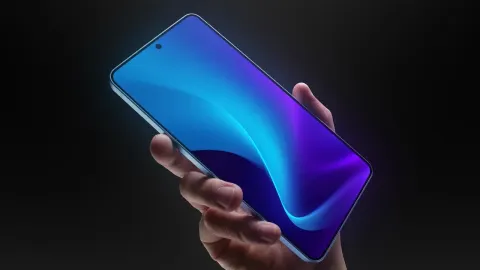
The display of the phone is a large 6.83 in OLED with a high resolution and a 120 Hz refresh rate. The brightness here is quite respectable. In our testing, we measured a maximum of over 1,100 nits in auto brightness mode and over 3,500 nits when measuring a small portion of the screen. That's plenty for comfy use on a sunny day. The display looks nice and sharp in person. The bezels are noticeable, but they're not too thick and there's support for 12-bit color depth as well as HDR10 Plus and Dolby Vision video playback. The screen's smooth 120 Hz refresh rate is able to dial down to as low as 60 Hz or even 30 Hz in certain scenarios. This is to save energy, but it's not as adaptive or efficient as an LTPO panel.
And under the display is an ultrasonic fingerprint reader, which is quite accurate and speedy. The speakers of the Poco X8 Pro Max are symmetrical, one firing up and the other firing down. The speakers can get very loud, maxing out with a loudness rating of excellent. That's in the 400% boost mode, which affects the sound quality. Without that boost on, the sound is clean and rich with decent highs and bass. You can listen for yourself through a comparison tool linked below. Like other Xiaomi devices, the Pro Max has an IR blaster for controlling appliances with. And you can get the phone with 256 or 512 gigs of storage on board.
The Poco X8 Pro Max runs on Xiaomi's latest HyperOS 3 on top of Android 16. Compared to previous versions, it includes an area for shortcuts around the selfie cutout. The connectivity has been improved as well to be compatible with not only Xiaomi devices logged in with the same Xiaomi account, but devices from other manufacturers, too. And you get a full suite of AI-based features here, as well. For support, Xiaomi promises four major OS updates and six years of security patches here. Inside the Poco X8 Pro Max is a fresh new MediaTek chip, a Dimensity 9500S.
It's a bit lower tier than the current flagship Dimensity 9500, but still packs a punch. Looking at the benchmarks, we can clearly see that the Poco X8 Pro Max does fall behind the current flagships, but it is still quite competitive, even coming out a bit ahead of last year's phones running on a Snapdragon 8 Elite. There's more than enough power here for modern gaming. The thermal management leaves more to be desired, though. In our prolonged CPU stress test, the Pro Max throttled down to half of its peak performance.
This Poco X8 Pro Max has a huge 8500 milliamp hour battery on board. And apparently, in India, the battery is even bigger at 9,000 mA hours. In our testing of this EU version, the phone definitely delivers battery-wise. It managed to earn an exceptional active use score of nearly 25 and 1/2 hours. This sits right near the top of the charts as one of the best scoring phones we've ever tested. Such a large battery requires fast charging and it's rated at 100 watts here. With the proper adapter, we were able to charge the phone from 0 to 65% in half an hour and a full charge took 52 minutes. Not too shabby considering the size.
And now, the cameras. The X8 Pro Max has two on the back, a 50-megapixel main cam and an 8-megapixel fixed focus ultra-wide. You don't get a zoom cam here. Daylight photos from the main cam are very good. They have vibrant colors, plenty of contrast, and great dynamic range. The amount of detail is good, though the rendition involves somewhat heavy sharpening at times. Photos of people show lively skin tones and good facial detail. And even in harsh lighting and contrasty scenes, the highlight restoration works pretty well.
The two times digital zoom is good for the class. The detail remains solid even in finer things like grass. Also, as the main cam has a minimum focusing distance of under 9 cm, you can take pretty solid close-ups with the help of the two times zoom. The ultra-wide camera's photos are easy to like. Dynamic range and colors are great and even the detail is solid as long as you have plenty of light to work with. Selfies come out pretty wide and they have more than adequate sharpness for the class. Skin tones look nice and you have wide dynamic range, but no auto focus. In the dark, the main camera does a very good job.
It's not the most natural rendition with plenty of sharpening applied, but it's not bad either. There's plenty of contrast and colors are likable, too. The ultra-wide captures good dynamic range and colors at night, but the detail rendition comes out rather fuzzy. This phone can record videos in up to 4K at 60 FPS with the main camera. The other two cameras are capped at 1080p. The main camera videos are very good. There's good detail, low noise, nice colors, and wide dynamic range. The ultra-wide's 1080p clips are pretty solid. It's not 4K, but it's among the better 1080p renditions around.
The electronic video stabilization does okay, unless you're shooting while walking, in which case it could use some work. And in the dark, the main camera's 4K videos remain solid with good detail in better lit areas, and nice colors and dynamic range for the class. So, there you have it, guys. The Poco X8 Pro Max. It's a great phone with unique LED lights on the backside, and some of the best battery life we've ever seen. Sure, this is no flagship camera phone, but for the price range, the camera experience is quite solid. So, in the end, the Poco X8 Pro Max is a very easy phone to recommend for anyone looking to maximize the bang for their buck.
Thanks for watching, guys. Here are a couple of alternative mid-rangers on our channel, the Poco F8 Pro and the Samsung Galaxy S25 FE. Let us know what you think down below, and I'll see you on the next one.