17:47
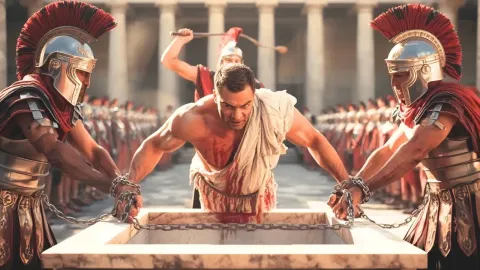



The chieftain is dead and the village is drunk on me and grief. But you are watching the girl in the center of the circle. She is a slave and she has just volunteered to die. She is laughing but her eyes are terrified. An old woman known as the angel of death steps forward with a dagger while men start banging shields to drown out the scream that is about to come. The terror in her eyes. She knows what comes next. This is not legend. This is not saga embellishment or Hollywood invention. This is what actually happened along the vulgar river in the year 922. Witnessed and recorded in excruciating detail by a man who could barely believe his own eyes. His name was Ahmad Iban Fadlan, an Arab diplomat and scholar traveling
through the lands of the vulgar Vikings, a branch of the Norsemen known as the Russ. He had seen much in his travels across the Islamic world. He was educated, refined, a man of letters and law. But nothing, nothing prepared him for what he would witness when a Viking chieftain died. Iben Fadlan did not arrive expecting a funeral. He arrived expecting trade negotiations, diplomatic courtesies, perhaps some cultural curiosities to note in his journals for the caiff of Baghdad. Instead, he became the sole literate eyewitness to one of the most disturbing ritual sacrifices in recorded history. And he wrote it all down, every detail, every moment, every sound, because he understood even then
that the world needed to know what happened when the Vikings honored their dead. What he recorded would shock the civilized world for centuries to come. The chieftain's name is lost to history, but his death was only the beginning. When a Viking leader of significance died among the Russ, the entire community entered a liinal space between worlds, a 10-day passage where the normal rules of life, death, and morality dissolved. The body wasn't buried immediately. It wasn't even the focal point at first. Instead, it was placed in a temporary grave covered with a tent. while the real ritual began. And at the center of this ritual was a
question posed to the dead man's slaves. Who among you will die with him? Think about that for a moment. Not who will mourn him or who will honor his memory? Who will die with him? Because in the Viking conception of the afterlife, a chieftain needed servants in the next world just as he had in this one. He needed someone to tend his fire, pour his drink, warm his bed in the halls of the dead. And according to their beliefs, a volunteer, someone who chose to follow him into death, held special power. They became a bridge between worlds. A messenger. Before we continue, drop a comment and let me know where you're watching from. I'm constantly amazed that a story this ancient, this
brutal, still reaches people across every continent. According to Ibn Fadlan's account, one of the slave girls stepped forward. I will, she said. Whether she understood what this truly meant, whether she was coerced, whether she believed she had any real choice, these questions hung in the air like smoke. But once the words left her mouth, there was no turning back. She had volunteered, and now she belonged to death. What happened next was not a somber vigil. It was a celebration. The girl was taken from her usual duties and given into the care of two other young women, servants tasked with attending her every need.
She was dressed in fine clothes, given jewelry, fed the best food and the strongest drink. Iben Fedlan watched as she was paraded through the camp, taken to the tents of the chieftains, kinsmen and warriors, one after another after another. And in each tent the men waited for her. This wasn't romance. This wasn't even desire in any conventional sense. It was ritual. Each man who lay with her would say the same words. Tell your master I did this out of love for him. She was being transformed through repetition and intoxication and violation into a vessel, a message written in flesh. She was no longer a person. She was a letter to be delivered to the other side. Iben Fuddlin wrote
with remarkable restraint. But you can feel his horror between the lines. He was a man from a culture with its own complexities, its own moral shadows. But this broke something in his understanding of human behavior. He kept watching. He kept writing as if documentation itself was an act of resistance. For 10 days, this continued. The girl drank continuously beer, me, something called Nabid. Never fully sober, never fully present. She sang, she laughed, she participated in her own obliteration with a smile that grew more distant each day. Meanwhile, the chieftain's body remained in its temporary grave, and the community prepared his vessel. Not a small boat, a massive long ship dragged in land and mounted on a wooden platform. Inside
they built a world, a bed with cushions, weapons and shields on the walls, food and drink, slaughtered animals, everything a chieftain might need in the afterlife, arranged with meticulous care. And at the center of it all, they placed his body dressed in fine garments, propped up with pillows, surrounded by the wealth he'd accumulated in life. On the 10th day, everything accelerated. The girl was taken to a strange wooden structure, a door frame essentially, raised high enough that she had to be lifted to see over it. Three times she was raised up. Three times she looked over the frame into the distance, and each time she spoke. First she said she saw her mother and father. Then she saw her dead relatives calling to her. Finally, on
the third raising, she said she saw her master, the chieftain, sitting in a green and beautiful paradise, surrounded by men and young boys. "He calls to me," she said. "Let me go to him." "Iben Fadlan noted every word." But he also noted something else, something the Viking participant seemed not to question. Each time the girl was lifted, the two women attending her would ask, "What do you see?" and the girl would answer. But Ibn Fadlan standing at a distance could see what she saw. Fields, trees, the river. Nothing mystical, nothing supernatural. She was being told what to say. Or she was so intoxicated and terrified that she hallucinated the script they needed her to perform. Or perhaps, and this is
the crulest possibility, she knew exactly what she was doing. She was telling them what they wanted to hear so that her death might mean something. So that it wouldn't just be murder but transcendence. They brought her to the ship. By now the entire community had gathered men, women, children, all drunk, all singing, all beating their shields in a rhythm that shook the ground. The girl was led up onto the deck, and there Iben Feddlin saw something that made him look away, then force himself to look back. Six men followed her onto the ship. These were kinsmen of the dead chieftain, and each of them lay with her one final time on the deck beside the corpse of their leader. When they finished, each man stood and said the
same phrase, "Tell your master, I did this out of love for him, love." They called it love. After the sixth man rose, the girl was given another cup of drink. She drank it quickly, desperately. Then she was led into the tent structure built on the ship's deck where the chieftain's body lay waiting. And here the angel of death made her entrance. This woman, the title passed down through generations, was the executive of sacred deaths, old weathered, carrying the authority of countless rituals. She held a rope in one hand and a broad flat dagger in the other. The girl lay down beside the corpse. Two men took the ends of the rope and pulled it tight around her neck. twisting it from either side. At the exact same moment, the angel of
death began to thrust the dagger between the girl's ribs over and over while the men outside beat their shields louder, louder, louder. Not in celebration, Ibn Fudlan realized, but to drown out the sounds she made as she died. Strangulation and stabbing simultaneously. This wasn't cruelty for its own sake, the Vikings would have argued. This was precision. The girl had to die quickly enough that her soul would catch up to the chieftains, but violently enough that the death itself became a doorway. Her terror, her pain, her final breath, all of it was currency and a transaction with the gods. When it was done, they covered the tent. The chieftain's closest kinsmen, naked, walking backward, set fire to the wood
beneath the ship. Others threw torches from every direction until the entire vessel was engulfed. The flames rose higher than the trees. The heat was so intense that Iben Fedlan had to step back, shielding his face. And as the ship burned, the Vikings stood watching, satisfied. One of them turned to Iban Fadlan and explained almost kindly as if to a confused child, "You Arabs are fools. You take the people you love most and bury them in the ground where worms and rot consume them. We burn our beloved ones in an instant and they enter paradise immediately. Ibn Fadlan had no response. What do you say to that? How do you bridge the gap between two civilizations with such radically different understandings of death,
honor, and human worth? He simply wrote it down. He recorded the man's words without commentary, letting the contrast speak for itself. The fire burned for hours. By evening, all that remained was ash and twisted metal fragments of weapons, melted jewelry, pieces of bone so charred they crumbled at a touch. The Vikings gathered the remains and built a mound over the spot, marking it with a wooden post, inscribed with the chieftain's name and lineage. Then they drank more. They feasted. They told stories of the dead man's exploits until those stories became indistinguishable from myth. And the girl, the slave who volunteered, the messenger, the sacrifice, she disappeared entirely from
their narratives. She had served her purpose. Her name was never recorded. Her life before that final 10 days, never mentioned. She existed in the Viking memory only as a function, not a person. But Iben Fadlan remembered her. He carried her story back across thousands of miles through dangerous territories back to Baghdad where he compiled his observations into a manuscript that would survive for over a thousand years. His account known as the Risala is the only detailed eyewitness description we have of a Viking ship burial with human sacrifice. Without him, this would be myth. Saga, the kind of story we'd dismiss as exaggeration. But Iben Fuddlin was there. He saw it.
He couldn't look away. And neither could the scholars who read his words centuries later in courts and universities across Europe and the Islamic world. The account was copied, translated, analyzed, debated because it forced a question that every civilization has to answer eventually. What does it mean to honor the dead? And when does honor become horror? Archaeological evidence has since confirmed elements of Iben Fadlan's account. Ship burials have been excavated across Scandinavia and Russia, some containing the remains of multiple individuals, masters and servants, men and women, buried together with signs of violent death. The Osberg ship burial in Norway. The Salma boats in Estonia. Each one a time capsule of a worldview we can
barely comprehend. These weren't anomalies. This was practice. This was belief made manifest in fire and blood. But here's what haunts me most about this story. The girl's laughter. Iben Flan mentions it multiple times. How she sang and laughed throughout those 10 days. We want to believe she was drugged into oblivion. That she felt nothing, understood nothing. But the evidence suggests otherwise. She was coherent enough to speak during the doorframe ritual. coherent enough to drink when offered, coherent enough to walk onto that ship under her own power. Which means some part of her was present. Some part of her was aware. And she laughed anyway. Maybe because that was the only
sound she could make that wasn't a scream. Maybe because she believed, truly believed, that she was about to enter paradise beside a master who would reward her service eternally. Or maybe because she understood that her only power left was to perform her own death with grace, to deny her killers the satisfaction of her terror. We'll never know. We don't even know her name. What we do know is this. Ibn Fadlan's account traveled through time and space to reach us here now more than 11 centuries later. It survived the collapse of empires, the burning of libraries, the endless human capacity to forget uncomfortable truths. It survived because he wrote it down with the understanding that witness bears
responsibility. That to see something and say nothing is its own form of violence. He couldn't save that girl. He couldn't stop the ritual. But he could record it. He could make sure she wasn't erased twice. Once by the blade and rope, and again by silence. The Vikings believed the smoke from the funeral p carried souls to the afterlife. They watched it rise and saw transcendence. Iban Fadlan watched the same smoke and saw something else. He saw a young woman's life ending in terror disguised as honor. He saw how easily human beings can convince themselves that cruelty is sacred, that violence can be holy, that
someone else's suffering is an acceptable price for their own peace of mind. He saw all of this and he knew that future generations needed to see it too. The ship burned down to ash. The mound was built. The Vikings went home. But the girl remains suspended forever in Iben Fedlan's pros. In that moment before the rope tightened and the dagger fell, still laughing, still terrified, still waiting for someone to ask her