6:55



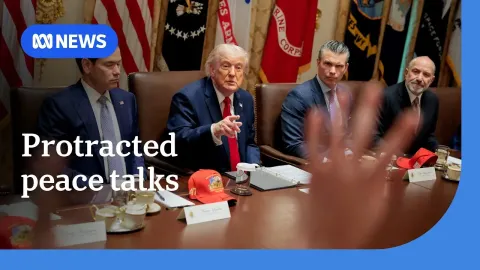
so we'll stay monitoring our top story but we have eaking news on the war with Iran president Trump says he's meeting in the Situation Room right now posting on Truth Social that he'll make a final determination in his words about a potential peace deal with Iran outlining the terms the U.S. is asking for it comes after negotiators for the U.S. and Iran laid out in his tweet because I'm seeing things like nuclear dust is going to be unearthed with close coordination between Iran and the International Atomic Energy Agency.
There's not going to be any money exchanged, he says, until further notice. I mean, it's a lot of the contours of the deal that we've been talking about. And yet the president also still doesn't say whether he's agreeing to it or not. Yeah. And look, I hope there is a deal. That's much better, I think, for the world in general. But the president may have just complicated negotiations again by sort of posting this kind of tweet. It does echo in some ways what's in this memorandum of understanding, this document. But every word is critical. So you're right.
One major thing that he mentions is what you mentioned, and it's this thing about the enriched uranium a concession as far as I'm concerned. Because now President Trump is talking about this nuclear material being dug up out of the ground and destroyed. I just want to point out that before the war began, Iran was offering to what they called downblend, or it makes the enriched uranium less enriched. You blend it with other uranium. And that's one way of destroying this enriched uranium. So, and while President Trump, though, before this has been saying all of that enriched uranium had to be removed from Iran, that the U.S.
had to take control of it specifically just a couple days ago he said Russia and China couldn't take the enriched uranium. Now he's agreeing to some sort of process where it's diluted or destroyed inside Iran. That is a win for Iran. There's other things he says that Iran must pledge, that they will never have a nuclear weapon or bomb. Iran's been pledging that for years. Most people don't trust that. American intelligence officials and Israeli intelligence officials don't trust that. So, again, it's just another confusing claim by the president. So, again, we have to see what comes out
of this meeting in the White House. And most of all, we have to see the text word for word of this memorandum of understanding. Yeah, especially as you hear prominent officials like Marco Rubio or Vice President J.D. Vance saying that at this point they have the broad contours but they're debating and delineating over specific word choices that stuff matters in these memorandums of understanding and then of course in the eventual deal i don't know that as much uh thought is going into these social media posts giving updates on where the deal is at, and yet they are instructive.
So even as the president says that he's in the situation room right now to make a final determination, we will await to see what and if that determination becomes public. But it all sort of speaks to the piece that you've just written for MSNOW, where you talk about how this proposed framework might be viewed as more of a win for Iran than the U.S. Can you talk us through that? Yeah. So there's several ways this helps. I want to be fair. the U.S. The first thing is the reopening of the Strait of Hormuz.
Iran has agreed to that. That would help bring down oil prices. That's an important thing for the Trump administration. But at the same time, the U.S. is lifting its blockade on Iran's That will help Iran, definitely. And there's no mention of this agreement of Iran's missile stockpile. And that's a huge issue for countries in the region, whether it's Israel or the United Arab Emirates or Saudi Arabia. Iran has demonstrated they can fire these missiles at any time at these countries, particularly in the Gulf, and damage their refineries and pipelines. That could cause an oil crisis.
There's no mention of Iran's proxies. The missiles and the proxies were things the president brought up on the night he announced the war as one of his five top demands. So in the end, there's roughly four ways that I think Iran gets wins in this agreement. Also, the nuclear issues that we were just talking about, they're not going to be discussed until a second round of negotiations that will go on for 60 days. Again, that's a concession by President Trump, and that's what the Iranians wanted in terms of the nuclear negotiations.
I did also think that it was notable that at least in his social media posts, there was no tangible mention of Lebanon, which is supposed to be another sticking point in these negotiations and certainly a big priority for the Israelis as they watch to see what this deal ultimately is. So we'll keep watching, of course, that our eyes on the president's social media feed as well as the White House as always. But I also want to get you on a big development in another major conflict, David, because earlier today, a Russian drone crashed into an apartment building in Romania. Talk us through what we know and why this is significant. So, yes, an apartment building near the border with Ukraine.
Two people were injured. No one was killed, thank goodness. And this is an ongoing problem. In the last year, I believe 300 incidents have occurred where Russian drones, sometimes even Russian aircraft have veered over the border into Romania or Poland or other countries in the NATO alliance. And it's a serious thing, because this is a threat to the NATO alliance. And the Romanian foreign minister in a television interview said today they would invoke Article 4. Article 4 is where the alliance leaders talk about how to respond to a violation. Article 5, the next step is when NATO responds militarily.
I don't think we're going to get to Article 5, but it just shows what a serious problem this is and how important Russia's war with Ukraine remains in terms of a threat to the NATO alliance, to Europe. And we are part of NATO still at this point and we have under treaty. We have to help protect these nations if they are attacked. Yeah, really, really important. David Rode, thank you as always.