8:08




Around the world some of the most painful rituals ever performed don't involve fire or blades. They involve insects. From bullet ants to giant murder hornets, today we're diving into the most painful and extreme insect rituals ever performed and why anyone would ever sign up to endure them. So let's begin. There are more than 20,000 known species of bees and bees are found on every continent except Antarctica. Most are harmless pollinators, some barely sting at all, but a few species possess venom so powerful that they can send people to the hospital or worse. In fact, when it comes to human fatalities, bees are
among the most dangerous stinging insects on the planet. Species like the Africanized honeybee, often called the killer bee, are responsible for hundreds of deaths worldwide through massive envenomation where venom overload overwhelms the body. And yet, despite this danger in parts of Africa and Asia, humans don't just fear the bees or harvest their honey. They use them as a stinging tool. These rituals are known as the bee venom ceremonies. Participants are both men and women and are guided by the traditional healer or spiritual leader.
The bees are placed on specific areas of the body, most often joints, shoulders, arms, and along the spine. The number of stings is carefully controlled. For first time participants, they might only receive as little as one to three stings. But for more experienced individuals, they might get up to 10 stings in a single session. Once stung, the pain is a sharp burning pinch followed by some throbbing. The stinger may be removed right away or briefly left in place to allow even more venom to drain fully into the wound. Over the next several hours, participants often experience intense swelling, stiffness, fatigue, and sometimes fever like symptoms.
This largely depends on how many stings were administered. In traditional belief systems, these reactions aren't just seen as an injury, they are seen as the body responding, cleansing and rehabilitating itself. But the danger, oh, the danger is very real. Today we know that bee venom in particular, is capable of triggering severe allergic reactions that can lead to anaphylactic shock. And this can happen into individuals with no warning. And here's the really scary thing. People can develop a more severe bee allergy over time, and if one of the participants did have a severe reaction and went into anaphylactic shock, the ritual would be stopped and traditional remedies would be used.
But survival depends largely on the individual and where they're located. Alright, if you thought bee venom was intense, well, this next ritual includes the insect that has the most painful sting on the Brave Wilderness bite sting index. That's right. This one's all about the king of sting. Now, not every insect ritual in the world was or is centered around pain. In the forest and mountains of rural Japan, one of the most feared insects on the planet flies free. We're talking about the giant murder hornet. These hornets are infamous for their massive size, extreme aggression and powerful venom, and they will relentlessly defend their nests.
Human encounters with them have been deadly, especially during swarmed attacks where victims have received dozens of stings within a matter of minutes. So surviving an encounter with one is never guaranteed, and that is exactly why the giant murder hornet is always to be respected. In the mountainous regions near Tottori Prefecture, some communities have developed a longstanding relationship with these giant hornets, but not by using their sting. Instead, they choose to consume them. Rather than seeing the hornet as something to worship or fear alone, these communities believed that it embodies strength, endurance, and raw vitality. Qualities that can be transferred to the body through consumption.
So this isn't about punishment or pain, it's about taking the power from one of the most formidable insects on the planet and transferring it to another body. Hornets are often collected during specific seasons. The larvae are commonly cooked with rice, while adults are sometimes fried and preserved in alcohol. Creating hornet infused drinks believed to boost energy and resilience rooted in traditions influenced by Shinto beliefs.
The thought is simple. If the insect survives through aggression and power, then consuming it means absorbing that power, even if the insect is loaded up with one of the most intense and potent hornet venoms on the planet. And oddly enough, the brave team and I actually had the opportunity to partake in this ritual after filming the Murder Hornet Challenge last year in Japan. No matter the season, these boots are always ready to go. I've been wearing this pair of TECOVAS for a while now, and they pretty much become my go-to pair for everything.
I've got an adventure coming up that takes me from cold mountain air down to dense jungle heat, so I need a boot that works in every environment. The rugged Chelsea boots were an easy choice. They've got a great modern look, and they're good for all seasons because they're water resistant and have an all weather soul. What really surprised me was the comfort from day one. They already felt broken in from the moment I put them on, they immediately felt ready to go.
I also love the versatility. I could wear them with any pair of jeans, keep them on for a night out, or just throw them on for a casual walk. And if you have a TECOVAS store near you, you should stop by to check out your own pair. They have complimentary drinks, free boot shines, and a friendly staff that's ready to help you find the perfect fit. Actually, I'm headed into the store right now to get my boots custom branded, which is always free. But if you want your own pair of TECOVAS, check out the link in the description or use this QR code. I promise guys, with these boots, you won't be sorry. All right, now back to action. While my arm was still swollen and I was writhing in agony, our guide Richard brought us
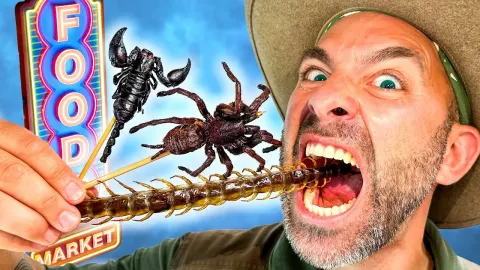
to a small restaurant in Tottori. And sure enough, it was none other than a giant bowl of sauteed and fried giant murder hornets. And unfortunately for us, it would've been very rude to not honor these ancient and well guarded traditions. So we had to dig in. I had hoped that some of the legends were true, and that maybe eating a murder hornet would actually help combat the venom and the histamines that were absolutely driving my body crazy and inflaming my entire arm. Now, I will say I was a tad reluctant at first, but I have eaten insects In the past. The murder hornet actually tasted pretty good and a whole lot like stir fried rice.
Even Chris was actually surprised by the delightful taste, and he felt the soy sauce helped overcome his sense of consuming the murder hornet's venom. Unfortunately, not everyone on the team made it through this experience unscathed. Asa's stomach completely rejected the insects, and he sadly ended up vomiting up his meal all the way back to the hotel. Sorry, Asa. So as the team found out, consuming cooked giant murder hornets was actually rather tasty. But this next ritual, I assure you, will not be tasteful or the least bit enjoyable to any human ever.
Among some indigenous groups in what is now northern Mexico, large quantities of insects have been consumed for ceremonial reasons. One ritual in particular had young men consuming venomous stinging insects all while they were still fully alive. Under the supervision of elders, young men would ingest large quantities of red harvester ants, sometimes by the dozens. Now, not as food mind you, but as part of an ancient tradition. This ritual is extremely painful and intense. If you could just imagine the ants would bite and sting as they were being swallowed, releasing their toxic venom that would rapidly affect the body
of the participant within minutes, they would often enter a weakened trance-like state, marked by nausea, exhaustion, and the intentional hallucinations. Entering this altered state of consciousness was the entire point of performing the ritual itself. Consuming the ants was believed to summon what is known as a dream helper. Spiritual allies meant to guide the individual through adulthood hunting and life decisions. This wasn't about proving toughness in front of the elders by eating living harvester ants.
It was all about a transformation using insects in their venom to open one's mind to the spiritual realm. I can't even imagine the pain of swallowing a stinging harvester ant, not to mention dozens of times. Speaking of unbearable pain, we have now finally arrived to the absolute worst insect ritual ever performed to a human body. And it still happens even today, deep within the Amazon pushing human endurance to its absolute limit. Among the Satere-Mawe people of the Amazon young males must endure the Tucandeira initiation rite. Or as we like to call it, the bullet ant glove ritual. That's right. These gloves are worn with live bullet ants woven inside of them.
The bullet ant is an insect whose sting is considered one of the most painful ever recorded in the insect kingdom. The bullet ants are first collected by hunters and then are temporarily sedated. This allows them to be woven alive into the palm fiber gloves with their stingers facing inward. However, by the time the ceremony begins, the ants have woken up and are aggressive and ready to sting. To start the ritual, the candidate places both hands into the gloves and then must dance continuously for 10 full minutes, enduring dozens and dozens of simultaneous stings.
The pain is immediate and overwhelming. Participants have reported uncontrollable shaking, temporary paralysis, hallucinations, and nerve pain that can last for days. So why would anyone in their right mind be willing to endure such a tormenting situation? Well, that's because in the Satere-Mawe culture, enduring pain is part of proving one's readiness for adulthood. Surviving the bullet and gloves isn't about punishment, it's about demonstrating discipline, endurance and control over fear and the body itself. But here's the part that surprises most people. This ritual isn't just performed once in a lifetime. To be fully recognized as a man, the ritual must be repeated up to 20 times over the course of several years.
Now, I have been stung by bullet ants in the past, but I've only taken one sting at a time, even though one of those stings was for a full 60 seconds. And let me tell you that experience alone makes me never want to take another bullet ant sting as long as I live. So needless to say, this ritual sounds absolutely terrifying. So whether it was enduring pain to prove you were ready for adulthood or for medicinal purposes, these rituals all shared the same belief: nature withholds great power can be faced, endured, and even consumed. And who knows, maybe after surviving a giant murder, hornet sting and then consuming one in a traditional Japanese meal, even I am better off for doing so. Or maybe not.
I guess only time will tell.