26:45



You may have heard of Fermilab's upcoming flagship long-baseline experiment, DUNE, which will explore the origins of the universe. Well, a new short-baseline experiment just started at Fermilab, and it's about to see more neutrinos than any neutrino experiment of its kind ever conducted. How will it see so many elusive neutrinos and why is that so exciting? That's what we're talking about today on Even Bananas Neutrinos are incredibly hard to detect.
They don't have a charge and they only interact by a gravity and the weak force. We have found ways to detect them, and yet some physicists like to poke fun of neutrino scientists because we see so few events, some experiments literally name them. One of our favorite ways to detect neutrinos is using a liquid-argon time projection chamber. We've covered these futuristic sounding contraptions in this episode, so check it out if you haven't already. A new nutrino experiment at Fermilab, the Short-Baseline Near Detector, or SBND for short, uses this liquid-argon-filled time projection chamber technology to see the neutrinos from Fermilab's booster neutrino beam, or BNB.
Here to help me explore this new experiment is neutrino scientist Mônica Nunes from Fermilab. Hi Monica! Hi Kirsty! That's right, this new SBN detector will see more neutrinos than any other experiment. In fact, we will see as many as 7,000 neutrinos from the BNB every day and over a million every year. For comparison, that's around 10 times more neutrino interactions than ICARUS, the far detector for the short-baseline neutrino program. MicroBooNE, which also recorded neutrino interactions from the BNB, saw about 500,000 neutrinos over the course of the full experimental run.
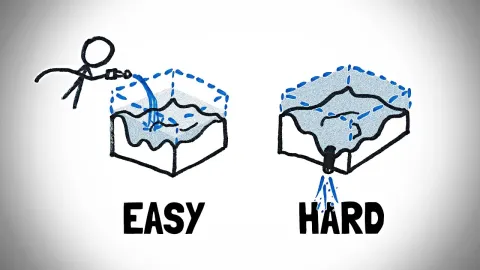
SBND expects to see more than that in just 3 months. So, why does SBND see so many more neutrinos? The main reason is that we are so much closer to the source, the target hall, than any liquid-argon TPC (time projection chamber) neutrino experiment ever run. At a distance of only 110 meters from the source, we get to see the neutrino beam right out of the gate like never before. Think of it like standing right next to a fire hose, versus being 50 ft away. The beam is more focused and intense the closer you are. So why do we need a detector so close to the neutrino source?
What makes this unique compared to the other detectors in the vicinity? We are trying to solve a mystery that has plagued the physics community for decades -- neutrino oscillations. We know that neutrinos oscillate between three flavors and have measured this phenomena at various distances. And we can calculate the amount of each type of neutrino we should measure at different distances from a neutrinos source. But more than one experiment has observed an inconsistency in what theory says and what those experiments have observed.
The Standard Model says that ratio of muon and electron neutrinos should be the same over few hundred meters. In this diagram at point A and point B. But some experiments have measured more electron neutrinos and less muon neutrinos than expected at point B. One explanation for this mismatch is that there could be a fourth neutrino, called the sterile neutrino. SBND is the newest detector in a program that will have outstanding ability to test the existence of these new neutrinos. But that's not all SBND will do, is it? Not at all! With a huge number of neutrinos we will see at SBND, we will be able to make precise measurements of how neutrinos interact in liquid-argon TPCs, which is important knowledge for DUNE.
We will also have sensitivity to other sources of new physics. Perhaps, providing us with the first Glimpse at a "dark sector" of new particles. When we have millions of recorded neutrinos, we'll be able to search for really rare new signals. That's exciting! It's great what we'll be able to do with so much data. 7,000 neutrinos per day, that sounds like a lot of data to process. What would that look like? Yes, it's a massive amount of data coming in. It's the equivalent of 300 megabytes per second, or about the same as sending a hundred 4K videos simultaneously over the same connection.
It will prove to be a new challenge for us and help us prepare for new ways to sort through the data, including using new machine learning techniques to filter it more efficiently. We are even using updated machine learning to remove cosmic ray interactions from our data, so we know we are only looking at neutrinos from the BNB. Overall, it's still going to be a lot of interactions, but we'll be ready. Thanks, Monica. Bye, Kirsty. As you can see, this is an exciting time for neutrino scientists. And we can't wait to share the results when they come out.
What's your favorite neutrino experiment? Let us know in the comments and be sure to like, share and subscribe for more neutrino content. Fun fact: Fermilab actually has two neutrino beams. The BNB serves the short-baseline neutrino program the NuMI beam travels all the way to Minnesota for the NOvA far detector, over 500 miles away. SBND doesn't see neutrinos from NuMI because the detector sits behind where the beam is produced. But MicroBooNE and ICARUS can, and they're developing some cool techniques to use these bonus neutrinos.