53:54


For hundreds of years, pilgrims have come to this street to have their first decent meal after weeks or months of being on the road. And even now, it's still catering for the weary travelers. Just looking around here, it's really wetting my appetite. Everywhere I look, there are appetizing plates of food. There's a good little market near the cathedral. It's called Abastos. It's a bit like a farmers market. And right amongst it is a tiny restaurant run by a couple of young guys called Yago and Marcos. Because their restaurant is so small, they've had to come up with novel ideas on how to use all available resources to the best advantage.
Only 10 seconds. Witness the first time I've ever seen cockals cooked in 10 seconds by the steam from an espresso machine. That's all you need for a tapest dish. The cockals couldn't be better. Sweet and firm and not a hint of coffee. Today we are going to choose uh the best piece. I think that today uh there is a cake, a very good hake and seafood too. I love seafood. It's my passion. Let's go to the seafood. Okay, come on. Let's go. Let's Chigal Chigala How much would they be about?
Three kinds for us. Okay. And how will you cook those? Yeah. Today uh hot water. Uhhuh. And salt. Yeah. And laurel. Lel. Oh. Um bay leaf. Yeah. Bay leaf. Let's He has to work now. He's got to work. Do you want? Okay, fine. Yes, he's got to work. And we'd held him up so much I felt honor band to give him a hand. Well, I must say I didn't know I was going to get enrolled to doing a bit of um prep when I turned up here this morning, but they're so short. They've got this um lunch for 12 people. Um and they're going to shut the restaurant,
but it's really a very elaborate affair. Of course, I could only help them. They've only been open for 3 months. Basically, it's such a good idea and it's so nice to see young people getting involved like this. I mean, gosh, if I was their age, I'd be so excited. set up in this lovely little restaurant next to a lovely market and just going around the market every day buying what you want for that day's cooking only changing the menu every day so you can just cook what's best in the market. I mean it's like every chef's dream this sort of cooking is right up my street. I mean, first of all, he's just saying that he's only cooking these clams alaplancher, which means on
the on the griddle for 2 minutes. And they're saying that quite a lot of the Galysian customers like them cooked longer, but he just likes them cooked as little as that. This is the sort of way that I think Spanish food is so perfect. It's sort of like Japanese food in a way. Just the best ingredients cooked as simply as possible. And now he's just adding a little bit of um oil on top of there. Just look at those on the plate there. Just a little thin stream of oil and then just some fried parsley. I mean, that is just simple, a perfect expression of great seafood. I thought cider was really popular from Somerset to Cormmore. I should know because I've drunk quite enough of it in my time. But here in Aurius, it is
without a shadow of doubt the most important drink in the region. far more important than wine. This festival in Yihon is one of many to celebrate it. It's curious, but after a couple of glasses, you get quite used to the way they pour things. Can we do another one? Stronger than it looks. Whether a beer or cider festival, it's an amazing place to meet people. Yes. Daddy Cornney. He's my husband. He's English. I'm Aurora. Really good. Well, just tell us about Asterius. What does the cider Atorian cider mean to you Atoria people from Atorias?
Well, to me means a culture because the way you pour it. Yeah. If you drink from the bottle, it's not the same. It's not broken. It has to break on this side. Break. We call it break. You break the Yeah. And it looks different. It's not as transparent. It's more cloudy. Yeah. Has to be like that. Yeah. Then you're supposed to leave a little so that you go like that. Why? This is because you all drink from the same glass.
Uhhuh. So the way you drink, you throw it so it gets clean with the alcohol. So the way I drink there, I have to drop it there. It means a lot. We always drink each other. Party. Thank you. Hello to Cornish people. I love Congo. It was a rather rainy, cold early spring evening. It felt more like Shet and Mallet than Spain. I've just been watching three of those guys serving the cider, the Cidra. And I think macho comes very easily to the Spanish. The way they were standing there, handheld high, looking straight in front of them, pouring into the glass. And I was just watching, they were sort of getting it
as close they could to their chest. And I was sort of thinking a bit like a matador in a bull fight. Not quite so dangerous, I have to say. You know, when they stand there and the bull's horn goes so close to their really smart chest. It's like that. It's the same sort of like seriousness on their face. Love it. Love this, too. One of the things I really like at these sort of local festivals is to go and buy some of the food that everybody eats. So, I've got some at some cost to me. I can tell you the queue was enormous. Some local food. I just find it so appetizing. You know, much as I like the odd hot dog, this is much more attractive to me. First of all, we've got favvada. That's a it's a sausage,
pal, and bean stew. Beans being the most important. Then here we've got tripe. A lot of people don't like tripe, but I love it. Particularly with it sausage and pimeon. Really good way of eating it. Here we've got more charita. Well, it is Spain, but this time done in cider. I really like that. It's really nice and acid. And finally, of course, Cabraales cheese. Just on a slice of very nice bread. I've tried some already. Cabbrales, the second most famous cheese in all of Spain after Manego. Number one cheese in the map made from three different milk. Goat, cows, and u milk.
Used milk, sorry. Matured in caves. Fantastic. I'm going to see a friend Chris Hadington, a chef from Plymouth who now owns a house in the Canabrian Mountains. He spoken fondly about the village where he now lives and I had warm expectations. Well, here we are in the village of Sbay. It's not very picturesque. It's beautiful, isn't it? What historic, I must say. Maybe 1,000 m, I think. Really? Yeah. It's cold. Very cold. Especially for May. Yeah. So, where's this bar then? Well, here is this is the bar. Looks like a shed.
Well, literally the guy that runs it, it's he owns the barn. And this is a community bar, so it's not licensed. It has no taxes and it's literally run for the people in the village. Gosh, it never closes. If there's nobody here, you just help yourself to a beer and pop the money on the counter. My gosh. Here we go. This is wonderful. This is a real boy's bar. And here we are. Always nice bowl of uh Is it Yeah, that's a calo. That calo is literally they'll give you a shot just to warm you up, but it's made with the bones from the these are beef
bones and garbanzos, which are the chickpeas, pimeienta, the peppers, carrots, and onions. And you drink it in a little cup or a little glass, and they'll just give you the clear broth. And the stock is just stunning. Well, you'll taste it in a minute. So, it's called Calto. It's just called calo. Calo is just stock. The Spanish word for stock. Yeah. Calo. All the time there. Warm you up. Fernando. Fernando looks after the bar. Very nice to meet you. Fernando. Can we have something to drink? I would have thought some um be Well, I mean it's unbelievably fabulous.
I had no idea. I just thought it was all going to be neat and tidy, but this is rougher. Rougher than I could have imagined. It sort of reminds me like in Cornwall you got all these like pretty villages full of holiday cottages. Then there's a few villages left that got these disused cars, you know, with the wheels off on blocks around. It's like this. Well, this is very much a working village. This is where the people look after the cattle, look after. Would you ever get any tourists up in Never see a tourist up here?
I bet that's the joy of coming up. And what about the food then? Oh, the food in this part of the world. Well, it you know, living amongst the mountains is fantastic. They [snorts] hunt wild boar. They hunt venison. The rivers are full of fresh brown trout. In fact, my neighbor last night when I got home had just fished out two brown trout for my supper. How fantastic is that? Straight out of the river that day. This sounds like Ernest Hemingway. Sounds like it's great. So, what would you eat? What do they eat? I mean, presumably there's no restaurants around here, but no restaurants up here. Down in the valley, you'd get restaurants. You'd eat whatever was available. I mean, when I
first arrived here, you think, "Well, the food's fantastic." And then you find you go to another restaurant and it's the same food and the same food the next restaurant. But what you realize is that they only eat a what's local and b what's in season. So then you start to become very picky who cooks the best cassido. And how important is food and eating to the locals? Oh, they it's it's a religion. It's very much a religion. I tell you these people the day you know whatever happens at 1:00 it's lunch time. For a snack, Fernando fries fatty salted belly pork which goes really well with a
wine and then slices of black pudding. This was made by Audina in the next village down the valley. I know this is not to everyone's taste, but it is to mine and it may not be around for much longer. Our dad's just been mixing some rice which she's boiled and cooled in this lovely terracotta pot. Then she's added um fat, onions fried in fat. Twice as much onion to the fat. And I think the onion, the very slowcooked onion in lard is apart from the blood which is just about to go in. That's what makes really good more theater meat. It's got that slightly sweet taste of onion in it. Now she's adding um sweet paprika dog. Here's what it's a bit like Cataloonia. You've got the sea on one side and the mountains on
the other. It's very lush as you can see. Unfortunately, it's also very rainy which is rather a shame because the bass country that particularly up here in the sort of just going up into the mountains, it's incredibly attractive. got lovely limestone peaks and they're really jagged. So, I'm really disappointed that you can't see them in the mist. But I'm on my way to um a restaurant which I've was recommended to me by a very well-known Australian chef called Neil Perry. The thing I like about it, the sound of it is that everything that the chef there Victor cooks is cooked over homemade charcoal. And apparently it's all to do with his background in the region in the mountains here. Um that he's it's he's
just very familiar with cooking in this way right back to his childhood. So as a bit of a fan of barbecue cooking anyway, I'm utterly looking forward to it. Victor, that's him in the black t-shirt and his chef Lennox run what's been described as the world's best barbecue joint. Victor designed and built these grills that can be lifted or lowered to control the cooking speed. And anyone who has a barbecue will know what a bonus that would be.
Lennox, would you ask Victor why he cooks in this way? Sure. He's saying opening this restaurant was a very emotional journey. as a child brought up in a house without gas or electricity. All the cooking was done over a fire, a wood fire. So his earliest memories of food were always influenced by the flavors of smoke from the charcoal. And the food never tasted better. And now 40 years on, he worked to recapture those flavors from his youth. Even as a young adult, he worked as a forester in the hillsides and would cook just like his grandmother did out on an open fire in the woods. He said it's the most natural and the best way to cook. So basically it is an emotional journey for you.
Very much so. That's really interesting because I'm a cook too. And I mean the funny thing is that I do feel from listening to that I suddenly realized all I try to do is go back to my childhood and recreate those flavors when I was little. That's all I do. And so I'm totally sympatic over the way with what he's saying. These prawns are special. Look at that. So these are the gamas palamos. Could I feel diffident about I'm just going to be very Spanish and Oh, I'm sorry. Ask any chef in Spain where the tastiest prawns come from and they'll say Palamos, a fishing port on the Mediterranean in Catalonia. They're quite amazing.
Just gently warm, just, you know, warm the mouth. The succulent flavors of the Sorry, I'm having a difficult moment. I can't talk anymore. It's just so wonderful. I know this steak is going to be great, too. Victor said it actually came from a dairy cow about 12 years old, not a young prime three-year-old steer. Again, he said when he was growing up this was what they used to eat for a special treat, and he doesn't want to change that. Well, I can't wait to try this, having watched Victor cook it. I mean, this is just central to any meat lover's love.
Today I'm meeting Floren and his wife Mercedes, vegetable growers who supply some of the top chefs in the restaurants in Spain. Chefs who really put Spain on the culinary map. What is it in Spanish? Alacha. Alkacha. Alacha. Is it beans? Oh, broad beans. I love them. Yes. I just discovered you supply faradria and um and Juan Maria that with their vegetables. So you're the vegetable king. He start 25 years ago. So when Juan Mari is not so famous, Fanagra is not so famous, they start to so they all of them start together. So they grow up So you're all a formation of the novel Cacina.
See Floren and Mercedes had the perfect dish to show off their selection of vegetables. a minestra which is like a thick soup made entirely from young vegetables. There are runna beans which take about 30 seconds to blanch and Floren chops up some borage stalks. That's a new one. I've only had it in pins. He then blanches those two. Next, he shows me how he prepares the young freshly picked artichokes. They're soft enough to be peeled and the flour part of the tip removed and then split in half. without this achov we cooked yesterday. Good lord. How come the sort of turquoise just water and salt?
Water and salt. Water have to be 2,000 magnesium is word and more. And the water from here have this. I don't think I can do a recipe for it. It's a great color. Oh, I've got to get that. I've got to take that back to my restaurants. Now, we're gonna clean the spargo. We're going to show you how we clean like that. I love gadgets. Can I just have a look? Yeah, of course. Oh, I've got to have one of those. Some supplies. Feas hasn't got his name on it.
No. Which one? The other one. He's going to present to you. He's nice. Oh, I'm very happy. And go with you everywhere you go. He going to remember us today and our vegetables. It's for you. Present to you. He's going to be your partner in your trip. So, the asparagus will take about 5 minutes to soften. And Floren is ready to start the final part of the process. He's frying off onions again picked a minute ago from his wuerta along with some young tender garlic stalks and all at that stage straight out of the ground.
They're mild and subtle. Now he adds flour because the minestra is quite thick that will absorb some of the oil while it cooks out. And then for the stock, he uses a cup full of water from the asparagus and another from the electric soup. I mean, that is great. It looks a bit like something out of science fiction, but I mean, that will give this the finished minestra such a lovely green spring-like color. Now, he puts in the artichokes. The thing about this dish is that you use whatever is in season when it's just at its tippy top best. And I think it's a great thing to cook in an a lotment. That's if you get the weather.
I like these baby broad beans. Sweet and tender. They'll take seconds to soften. And now for the asparagus. The Spanish love their fat white asparagus. Look at that green. Now just the water. I just somehow can't believe it. Then more runner beans, one of my favorite vegetables, fresh and young. And lastly, tiny peas, which Floren calls the caviar of the land. It's lovely watching this in this a lotment. Lovely cooking outdoors, you know, cuz it seems right. You can go and pick the artich chokes or the broad beans. You know, the queen of the vegetable, right? King. Sorry. Yeah. Well, but he has long hair, so maybe.
Well, it's time for lunch. And that, I'm pleased to say means a glass or possibly two of wine. Although not as famous as its neighbor, Rioa. I think the wines here in Navara are just as good. You see what I mean about this dish? It is just like a thick soup. Cheers. What's really nice about this that they're all friends. They're all restaurant tours, but I think one's got a disco, but maybe he's he or she cooks a disco. One of them cooks at El Bully, which is just around the corner. But what I really like about it is they're all good cooks. So, I'm picking up tons of stuff, and I know that everything they cook will be the best possible dish. So, I'm very excited.
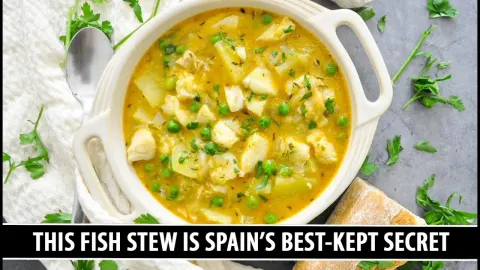
Once the fish is fried and put to one side, the pan is delazed with fish stock. And then in goes some romemesco paste. That's all mixed together and immediately sd to achieve a smoother sauce for the stew. Finally, the fish goes back. And remember, they've chosen fish, which Rafa refers to as duro. That means it won't break up in the cooking. While that simmers, Rafa finishes off the fidua by ladling in fish calo fish stock. I've just been talking to Rafer and he's saying that dishes like this, these fish dishes originated from the fisherman. I mean, basically they would just be coming home from sea, got all sorted all their good fish for market and kept all
the little ones for making a stew for themselves and they'd just boil up sometimes in sea water with whatever was available. olive oil, garlic, tomatoes, sometimes a pinch of saffron, and that would be a dish. And now they fetch big money in top restaurants. Okay. I think I'm writing what Raph has just said cuz I wonder why I was putting this newspaper on top of this pan. And he said it's just to scare the little vermicellis. Yeah. To scare them. And they all come up like this. So they're all pointing upwards. Maybe you put them in the dark and they're saying, "Where's the light?" That's right. And sure enough, as the little pasta
pieces soak up the stock, they begin to point upwards like delicate little flowers searching for sunlight. Finally, it's time for lunch. Late even by Spanish standards. The fidawir is traditionally served with alioli, a fiercely garlicky mayonnaise which works so well with the pasta that has soaked up the good fish stock. Excellent. Really good. Rappers just said what's lovely about occasions like this is not just the food. It's to be here with all his friends who love his cooking as well. After eating the fida, it was time for the fish stew, which has been cooked
with that fabulous romemesco sauce, and it didn't disappoint. With great food like this, everyone got into the celebratory spirit. It may be to do with all the wine they had while making lunch, but in this part of the world, next to their love of food, it's football and their beloved Barcelona. What's up,