8:51
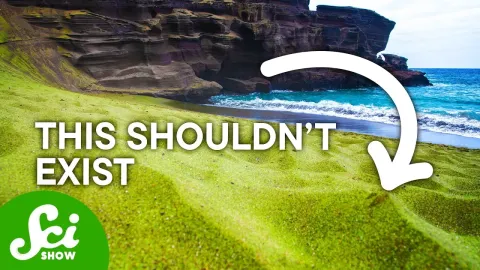


"I've been told they're going to tear this down. So I'm here to find out why." This is the Enobieta dam. Huge dams just like it can be found around the world and more are being built every year. They provide clean drinking water, irrigation for farming and flood protection. And they're one of the most important sources of renewable electricity on the planet. But in Europe, something is changing. Environmental groups want to remove thousands of dams just like this. So why do they want them gone? "By the time you see this video, this big chunk of the dam will be gone."
The Enobieta Dam is named after the river it crosses. This wall of concrete was built in the late 1940s to secure drinking water for San Sebastian, in northern Spain. But the dam already looks different to what I expected. "To me and my untrained eye, this just looks like it's a forest. But what are we looking at here?" "It's indeed a forest, but all this was covered with water. Here we had a reservoir which was 30-32 meters deep." After San Sebastian city council decided to dismantle the dam, the reservoir was emptied in 2019.
Arturo Elosegi led the research into how its removal would affect the river, and the Artikutza forest that surrounds it. The dam had operated for around 30 years, but it quickly became clear that there were geotechnical issues with the location. Its storage capacity had to be reduced and there were also issues with iron and manganese contamination in the water. And in 1976, it was abandoned altogether when a new, larger dam replaced it nearby.
"So they basically built this massive structure…" "In the worst place." "It was obsolete almost immediately." "Yeah, that's it." "So we're now in the former reservoir and it seems mad that only a few years ago, this would've been just a tonne of water." "Here we would be like five meters under water. You can see there these big trees are the ancient ones, and the new ones, which are growing in what was the former reservoir."
Five years was all it took to transform the former reservoir from this… into this. And then something else happened. "The stream started to carve again a channel. And in most of the places, it carved exactly the same channel as it had before." "So the rivers returned to the exact same place… it knew where to go?" "Yeah. It has memory if you want." Humans have harnessed the power of water for centuries. Dams have transformed modern life. And hydropower remains the world's largest source of renewable energy, supplying around 14% of global electricity. In Norway, hydro accounts for 95% of its electricity.
Its ability to reliably generate huge amounts of power means demand is still growing, even as wind and solar expand rapidly. But that comes at a cost. Dams interrupt the movement of fish. They trap sediment, alter water temperatures and transform entire aquatic ecosystems. And it's not just giant hydroelectric dams that can do this. Weirs, culverts, watermills - are all barriers that can disrupt or block a river system. "In Europe there are 1.2 million, at least, barriers." That's Kerry Brink, who works with Dam Removal Europe, a coalition of environmental organizations
working to restore free-flowing rivers across the continent. "These barriers - and a large part of them are small - are really basically cutting up our river systems. The water quality reduces, water is not flowing in a natural way. So you really get changes in the water chemistry. We have declining fish populations, our freshwater biodiversity and freshwater species are the highest impacted species globally." Dam Removal Europe estimates that around 200,000 barriers are already considered obsolete. Although the true number is likely much higher.
It's these structures, which no longer have a societal or financial benefit anymore, that they want to tear down. "We are really not wanting to remove the functional barriers. We are truly wanting to remove the barriers that actually have a flood risk, which actually have no purpose." Across Europe, the push to remove obsolete barriers is gathering pace. In 2025 alone, at least 600 came down across the continent. And the European Union wants to restore at least 25,000 kilometers of free-flowing rivers by 2030. But why does removing them make such a difference?
Part of the reason can be seen at Enobieta. Because when the reservoir here was drained, an entire ecosystem returned. "A small stream, in a place like this one, lives from the forest. In the first year, when there was still no forest, the water was quite hot because the sunlight reached it directly. But then the forest was closing and the water gets cooler." As the forest returned, the food chain started to rebuild. "Especially what you have is leaves. And you see, this leaf is eaten by insects.
There are some fungi, microscopic fungi which grow on top of the leaves. The insects start to eat these leaves, they grow, the fish eat the insects. And so everything is fueled by these leaves. The recovery has been astonishing." But that recovery can only be complete when the dam itself is out of the way. Instead of demolishing the whole dam, engineers and the San Sebastian City Council decided it would be enough to cut out a seven-meter section.
The partial removal has limited the amount of concrete taken out, minimizing heavy traffic and construction and overall disruption to the surrounding Artikutza forest. It also helped protect a bat population that had colonised the dam's internal chambers. And, it was significantly cheaper - costing around €1.6 million. When the removal is finished and the river is reconnected, another big change will occur. The river itself will start to behave naturally again, including how it moves sediment downstream. Upstream there's a diverse mix of sediment, including cobbles, sand and gravel, which is distributed by the river. But the dam continues to block
that natural flow downstream. "What you see here, these are not boulders or cobbles, these are blocks of concrete. Which were thrown here when they lowered the spillway. So this is totally artificial. The new channel will go through there and then new sediments, natural sediments will come. We can see also downstream from the dam, the river habitat was very poor because all these sediments were retained by the reservoir." When the river is allowed to pass through again, it will carry a more diverse range of sediments downstream - helping to rebuild banks, the riverbed and the habitats around it.
"Everything will change and we'll have again forest, the sediments will be much more natural. The habitat is something that is created by the river itself when it moves the sediments. And they will be created again." At Enobieta, removing the dam is helping to restore this forest's unique ancient ecosystem. But reconnecting rivers have other benefits too, particularly for migratory fish. Which is what happened at Hiitolanjoki in Finland. Three small hydropower dams had blocked movement access for the endangered landlocked Ladoga salmon. Authorities decided it made sense to remove the plants and restore the rivers.
"What we've seen is straight after the removals, in actual fact, a week or two weeks after the removals, there was footage of these landlocked salmon spawning in the region just upstream of the barrier. So it really is something that you can actually visibly see." "At this point, it all sounds and looks pretty convincing. Remove the barriers, the rivers reconnect, and nature returns. But it's not always that simple." Because while Europe is removing dams that have outlived their purpose, parts of the world are still building them. Much of the Global south still needs to meet growing demands. In the Democratic Republic of Congo only 1 in 5 people have access to electricity.
The proposed Grand Inga hydropower project could eventually generate about 42 gigawatts of power - that's about 15 times the DRC's current capacity. "In many cases, there are barriers that need to be developed. We do need barriers, but we just want to make sure that the barriers that are there are well functioning." Meanwhile in India, the issue is more than just electricity. The country of more than 1.4 billion is investing heavily in its dam network.
The government says they're being built to secure water supplies, support agriculture and to help control flooding. But many communities, particularly in the Himalayas, have fought these new developments. They claim that these dams are a threat to fragile ecosystems and disrupt the lives of local residents. And as drought and flood risk increases, questions are being raised about how long some of these new dams and reservoirs can even remain effective. "We need them. We have to survive. So the question is to try to have as few dams as possible and to keep them working for as long as possible."
Some dams will remain essential for decades to come. And new dams will still have to be built. But Enobieta shows us that our relationship with dams needs a major rethink. "Wherever you build something, you have to take into account the whole life cycle. You have to take into account that someday this will be considered obsolete, it will be a danger, a hazard or whatever, and will be removed. When we first started out removing this reservoir, we didn't believe we would see it. I work in the environment and mostly we give bad news.
We look at the environment and we see problems: climate change, pollution, extinction, whatever. And to see something that was barely imaginable some years ago and that's happened. That's really a nice thing." "Are there obsolete dams or barriers close to where you live? And how do they affect your river systems? Let us know in the comments, and if you wanna see more videos like this, you know what to do - hit subscribe."