10:26



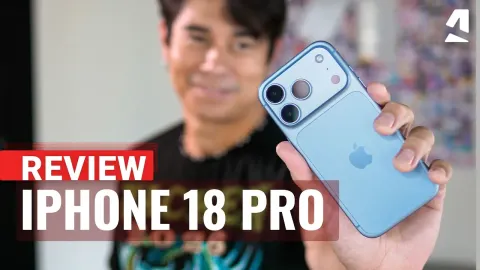
It's been 602 days since the iPhone lost its title as the champion of PhoneBuff-style speed tests. And since then, the Galaxy has dominated: the S26 Ultra beat not only the iPhone 17 Pro Max, but also all the other flagships we compared it with. But today, the iPhone 18 Pro Max intends to finally change that. With the new A20 Pro processor, which has a 20% faster CPU and a 40% faster GPU. In addition, the iPhone now has 50% more memory bandwidth, and the new evaporation chamber has three times the surface area, which Apple says provides up to 40% better stable performance. Will this be enough for the iPhone to reclaim its crown, or will the Galaxy remain the undisputed champion? Let's find out. This episode is sponsored by Zapier, which unlocks
the potential of AI models like Claude and ChatGPT by connecting them to over 9,000 apps through Zapier MCP. Lately, I've been using this to rake through my mail every day; Instead of switching between applications like mail, our database, Google Sheets, and a bunch of different search tools, I just ask Claude to sort through my incoming messages and he does it all himself. First, Claude connects to my Gmail account via Zapier MCP to view emails. It then checks our Google Sheets database to see if we have already checked this sender. And if not, it digs deeper: not only does it search the web, but it also uses the Whois service to check things like the age of the domain and whether everything is real. When it's done, it labels the emails with
the tags I've set up, such as " verified" or " questionable." He updates the Google Sheets database with his findings and then sends me a short report in Slack. This way, when I open my mail, I can immediately see which emails are really worth paying attention to. And because Zapier gives me granular control over what the AI can do, I don't have to worry about Claude accidentally deleting emails or, worse, sending something on my behalf. Since I simply turned off these permissions, it ultimately allowed me to spend significantly less time checking email and more time testing. You can learn more at the first link below. Well, let's start as usual: we start
the stopwatches on both phones and move on to the first stage, where the Galaxy manages to slightly beat the iPhone when scanning the QR code. In the portrait test, we take 10 shots as quickly as possible: five with the model at a distance, and then five up close, and here Both complete this task and move on to 4K video recording. The purpose of this test is not to measure speed, as they both record exactly 1 minute, but we sped up the video so you don't have to watch a boring minute-long clip. However, we consider it important to include this task because it places a load on the cooling system that corresponds to real-world usage conditions. Now that both phones are done, we'll see how that affects the rest of the first round. But at least now
both phones are flying in the browser test. Where we upload everything from videos and 3D models to maps, and even perform calculations on our local site. Where they again demonstrate identical results. So, when we move to the second row, there is zero gap between them, which is somewhat surprising, because when the S26 Ultra competed with the iPhone 17 Pro Max, it was already ahead by one or two programs at this stage. But this time, the iPhone is not giving up a single step. Every time it seems like the Galaxy is about to leap ahead, the iPhone immediately follows Let's see if the defending champion can create a gap while working with the final two games in the third row. At least in "Going Balls," the phones' results are almost
identical, with the iPhone having a slight advantage thanks to one extra swipe. But in "Zombie Fire" Galaxy is a bit faster, which again equalizes the forces before starting work in Adobe Acrobat. This task is the hardest of all, where each phone needs to recognize text in a 25- page PDF; The iPhone instantly copes with this breaking ahead and gaining the first significant advantage in this test. And since Galaxy is still running Acrobat, he's actually in a tough spot. Let's see if it can catch up with Lightroom, where every phone has to edit the same massive 68- megapixel photo. Unfortunately, it seems that the Galaxy does this more slowly, allowing the iPhone to widen its gap by the time it starts exporting the video. Now,
it's the video export task-this is where the Galaxy had a significant advantage. But given that the iPhone improves year after year, the Galaxy is noticeably catching up. And while the Galaxy is still significantly faster at this video export, it may be too late. Unless the iPhone slows down here during unpacking, but no, that doesn't happen. iPhone completes the first lap first with a time of 3 minutes 30 seconds. So, a huge improvement for the iPhone over last year's model, it's even 10 seconds faster on the first lap, which is impressive, because when we tested the 17 Pro Max just a few months ago, it was 30 seconds slower than the Galaxy in a similar test.
It's clear that the iPhone 18 Pro Max has completely new hardware, and iOS 27 also likely contributes to improved performance. But be that as it may, the iPhone completes the entire task in exactly 4 minutes. Galaxy, for its part, does just as well on the second lap, finishing just 12 seconds later. So, if you look at the data, the two phones are almost identical in the first 10 apps, and the real difference appears towards the end of the test, where the Galaxy was slightly faster in Zombie Fire and editing on Instagram, while the iPhone was faster in more CPU-intensive tasks. So the performance you get really depends on how you use the phones. Since this is a championship duel, we wanted to test the phones even harder and check their long-term
performance: instead of recording 4K video for just 1 minute, like in the previous test, this time we record for 10 minutes straight. Then we'll go back and test the heavier apps from the bottom row one by one to see which phone maintains performance better under such extreme load. For comparison, we also check each phone against its own baseline result, obtained when the devices were fully cooled, to see exactly how much performance they lose after the stress test. At least in Adobe Acrobat, it looks like the iPhone's performance is about the same, with no signs of slowing down. Whereas in Galaxy, the basic startup seems much faster- it completes the task in 24 seconds, while after the stress test it takes almost 5 seconds longer. This
may explain why the iPhone had such a big advantage in that test. But we'll see if this holds true in Lightroom, which is another tough task and an area where the iPhone proved faster. And at least initially, all four races are performed almost identically. But here, in the object removal part, we see a difference, where, surprisingly, the Galaxy's baseline run actually matches the iPhone's results almost exactly. Whereas after the stress test, the Galaxy is clearly lagging behind, finishing about 6 seconds later. The good news for Samsung is that neither phone showed any significant slowdown when editing on Instagram, with the Galaxy still handling it significantly
faster than the iPhone. And when extracting files, both phones perform very well: all four attempts complete with a difference of only one second. So, looking at the data, the conclusion is pretty obvious: the iPhone does a better job of maintaining speed under load. In fact, if the Galaxy had n't had any slowdowns, it's likely that I would have had to declare this test a draw. But this, of course, did not happen, so the winner and new undisputed champion of PhoneBuff-style speed tests was the iPhone 18 Pro Max. Anyway, that's all from me in this video. Thanks for watching, and as always, see you in the next episode.