20:49




In the heart of the jungle, something is in the air. Romeo's looking for love. Splash on a unique cologne before they make their move. On the ice, divorce gets messy, leaving jilted lovers out in the cold. And across the savanna, close-knit families come together to mourn the loss of a loved one. This is a new way of seeing the natural world. Where wild animals act just like we do. One of the fascinating things about studying animals is discovering how many aspects of their behavior have parallels with our own.
Around the globe, animals continue to astound us with their intelligence The amazing thing is, the more we learn about them, the more we realize animals are a lot like us. When it comes to attracting a mate, male lemurs do their best to stand out from the crowd. Just like any of us would. But for these primates, it's less about how you look and more about how you smell. After months of heavy rainfall, the woodlands here are covered with lush vegetation. And this month, something else is in the air. This time of year, Madagascar turns into a bit of a love island. And that's because females don't have a huge window in which to breed. They become fertile for about one day a year.
All the female lemurs looking for a fella will pick the one with just the right fragrance. The female lemurs are ready. Their precious few days of fertility are fast approaching. It might seem that the female has poor odds of mating, but actually, seasonal breeding is an advantage because all the babies are born in the summer and are therefore weaned when the trees are full of fruit. With thousands of potential females to mate with, there's only one question on the male lemur's mind. How do I get noticed? The energy of lemurs is great and these ring-tails are no exception.
There's definitely some sort of strife going on in this group and it's always really complex to tease apart these social relationships. In lemur troops, the females write the rulebook when it comes to dating. And as mating season begins, the males start preparing themselves. Each is determined to be considered the most irresistible. Male lemurs have a dominant hierarchy and it's all to do with age. If you're older, you're higher up the ladder and you have a greater chance of becoming a father. Although these guys can't dress up in the latest fashion, they can still do something to stand out from the crowd and impress the ladies.
They have the ability to create their very own cologne. Each lemur has scent glands on its wrists and shoulders. And in the lead-up to mating season, they produce a heavily scented liquid. They'll rub the scent on their tails and wave them near the object of their affection. These lemurs are taking their preparation a little bit seriously. It's just a bit like us slapping on the aftershave and getting ready on a Friday night out. The closer mating season gets, the more they'll slap on the scent. I always think how lucky we are that we don't rely on scent too much, but many of our cousins within the primate world heavily rely on scent and you can see this lemur here is
using the scent glands on its wrist to mark its tail and this will be really important for social cues, for health-based cues, for other members of the community. As the mating window approaches, the lemur's scent glands ramp up production. And these Lotharios kick up a stink. It's super interesting because many animal pheromones smell really horrible to us. But researchers say that this particular smell belies its stinky reputation and actually, it smells kind of floral, a bit like a pear. The lemur's cologne might not be for us, but to a love-struck female, it can be intoxicating. A recent study has revealed why this lemur cologne is so effective.
There are some secret ingredients to the lemur's love potion. Within this group of 200 or so chemicals, there are three, including pheromones, which prove irresistible to the females. The three special chemicals are in higher concentration during the mating season and it intoxicates the ladies. This lemur is not content with just applying his scent. He waves his tail around hoping to catch the eye or nose, not of a female, but a rival. This other male is clearly not impressed.
Intoxicating for the gals and infuriating for the guys. These so-called stink fights establish who gets the rights to breed with the females. This is a showdown. Trying to see who's the dominant one and each individual is trying to overpower the other. It's a little bit like two humans having a fight spraying aftershave each other. It's a useful way of resolving conflicts that doesn't involve the risk of injury. You might think typical males always showing off trying to outdo each other, but all this tail waving has a very specific purpose.
Eventually, one of the males backs down. And to the victor go the spoils. But the male's cologne is much more than just a strong smell. Females can tell so much just from the male's scent. It's kind of like a health report. It'll tell her how healthy his immune system is and that means how good he's going to be at fighting off diseases and parasites which might otherwise affect her offspring. Once the females have made their choice, they make the most of the small mating window. And just over 4 months later, the trees of Madagascar are filled with newborns.
This seasonal breeding might also have another advantage by overwhelming predators and so babies are more likely to survive. It comes down to sheer numbers and odds. With so many newborn lemurs appearing all at once, there's a greater chance an individual will survive and reach adulthood. Lemurs reach sexual maturity at around 2 to 3 years of age. So, if all goes well, they'll be out there stink flirting in no time.
Chemicals and pheromones play a variety of roles in animal behavior, helping them to not only find a mate, but to communicate and ward off rivals. Wolves and coyotes, for example, scent mark their territories using their own urine and feces to send a signal to other wild dogs to back off. Ants rely on pheromones to distinguish between members of their own colony and outsiders. And for honeybees, pheromones are involved in almost every aspect of colony life. From reproduction and mating to swarming and defense.
But these amazing little insects also communicate in some other surprising ways. Bees are one of Earth's most important pollinators. Essential in the animal kingdom for transferring pollen to fertilize our crops and wild plants. Like humans, many bees are social creatures. Living and working together in a community. A colony can be up to 80,000 strong, making a cooperative society of one queen, tens of thousands of female workers, and hundreds of male drones. As some bees are social insects, they found
ingenious ways to communicate. While we use words and dolphins use clicks, bees have come up with their own complex language. Language plays a vital role when bees are tracking down pollen and nectar. They can forage as far as 5 km away from their nest in search of the best flowers. This is usually a scout off on a solo hunt for these valuable resources. When the scout has found a good food source, what it needs to do is very quickly gather some nectar, gather some pollen, and then head make a bee-line back to the colony.
And then it's got to tell the other bees where this food source is, and it's not like you can just drop a pin on an app. It has to be able to share this information somehow. Time to get busy. The bee will actually perform a unique dance for the other members. It's known as the waggle dance. By performing it, bees can communicate directions and the distance from the best flowers around. This may look like a bee moving to its own beat, but hidden in these movements are important details. It's an incredible language because the angle and the duration of the waggle will indicate what direction this food source is in, and then the number
of waggles will actually tell the bees how far the food source is. The other bees watch and learn. When they've gotten the message, they rush to the same flower patch. The waggle dance is like getting directions from a satnav, telling the bees where to go, just like when we tell our friends our favorite places to eat. But this dance is not the only way they chat to each other. Bees also have a human-like method of communication that's only recently been discovered. In Japan, you'll find the Japanese honeybee.
Japanese honeybees are similar in size to the western honeybees, and they've adapted to really extreme weather conditions. But they've also come up with a very human-like way to communicate. Japanese honeybees build their nests in hollowed-out trees, crevices, and caves. The queen lays eggs that hatch into larvae. They're fed a diet of honey. But the honey's alluring scent, as well as the protein-rich larvae, can attract deadly predators.
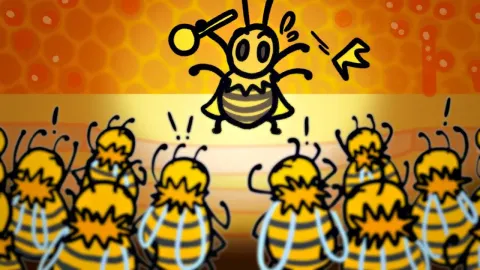
Like the Japanese giant hornet. With sharp mandibles, a hornet can crush a honeybee in half, and its sting is strong enough to dissolve human tissue. Giant hornets um are really well-armed and can certainly easily overwhelm a colony of bees. A giant hornet launches its attack on a hive. Even though it's outnumbered thousands to one, the hornet sees those as good odds. But it hasn't counted on this. Honeybees have their own strategy to fight back. And that actually involves letting out a scream. Just like we might scream to alert others of a home intruder, this high-pitched shriek spreads rapidly throughout the hive.
It's harsh, it's noisy, and it does exactly what it's designed to do, which is alert the other bees that there's a danger. It sounds like a warning call, which is what it is. It would also signal to me if I was walking past that to get well back from that nest. I think this is pretty intimidating. It's like a war cry. As the scream spreads, more and more bees rush to defend their hive. This rapid alarm call leads to an amazing behavior called bee balling. Hundreds of bees form a ball around the hornet, vibrating their flight muscles to produce an intense heat.
The bees can tolerate this rise in temperature, but the hornet doesn't fare so well. So the bees here have surrounded this hornet. It's being cooked alive. So these bees are all over it, and they're just vibrating their bodies. Each of them producing a little bit of heat. The hornet thought he could solo all these bees. But he was wrong, and he came up against a coordinated team in these bees, and this is now a baked hornet. As it turns out, bees are constantly chatting in their own special way. Bees don't just communicate to share information about food or to alert one another about danger. They also communicate to share really important information about the hive. For instance, bees communicate with each other to make sure the right individuals
mate with the queen, or to notify everyone when it's time to move to another hive. It's what scientists call swarm intelligence. Thousands of honeybees can pool their knowledge and make a collective decision. It's a steady buzz that keeps these incredibly social insects together. Finding a happily ever after with our one true love. A romantic dream for many of us. And that is true of a number of animals, too.
Gray wolves partner up for life. Their pack becoming a family affair, made up of their young. On the plains of Colorado, the beginning of a beautiful relationship. These two sandhill cranes dance their way into each other's hearts. And then stay together for life. Of course, some lovebirds take fidelity to the extreme. And there can be severe consequences for anyone who strays. Antarctica. The coldest, windiest continent on Earth. An isolated outpost. Too extreme and too cut off for people to be permanent residents. But there are animals that can thrive in this barren landscape.
One way is by having the support of a lifelong partner. Like these gentoo penguins. Raising a newborn in the Antarctic is no picnic. It takes two dedicated partners willing to work round the clock Penguins could win prizes for being the perfect couple. They do everything together. They're like ideal partners, putting aside their own selfish needs to take care of each other and their kids. They even come up with like a special call for their kid. It's like nicknames we have for our own children. How sweet is that? Once their youngster is hatched and waddles away from the nest, the parents leave the breeding ground separately, knowing that they will meet up next breeding season.
Nearly a year later, when the penguins return, they look for their partners. The males arrive first, followed by the females. But a year is a long time in the wild. Some couples are reunited. Others faithfully search for their true love, But after a while, they have a tough decision to make. Do they move on? We all know that feeling, the feeling of being dumped. It hurts. But penguins seem not to dwell on this negative emotion for too long. They understand that really the breeding season is about producing that egg and raising that chick, and
they just move on to find a new partner. But this is a risky move. Their partner might just have been delayed on their journey back. When they return, they could see the love of their life in the wings of another. When a female partner has arrived from the previous season and finds that her lonely mate has shacked up with a new female, she doesn't take it well. And the couple has trouble keeping its affair private. Word gets round and others in the colony stick their beaks in. Divorce is a complex issue for birds, just as it is with humans, and it can be triggered by many causes. For gentoos, besides physical separation, it could be poor reproductive
performance, or it might be that her partner has a low-quality territory and she simply wants to trade up. A fight breaks out between the two females, apparently over the male, and things escalate quickly. The penguin's flippers are made of solid bone instead of being hollow like most bird bones. This helps them dive deep in the sea. But the flippers can also be weapons and deliver painful whacks at a rate of eight blows per second. The jilted female chases away the bird that moved in on her mate. Bloody and beaten, the would-be homemaker is kicked out.
Finding a new partner is obviously less than ideal, and it makes what was already a long endeavor way more complicated. But all hope is not lost for the gentoo penguins because they breed from June all the way through until October. So time is on their side to find a new partner. And who knows, the new partner might give you better reproductive success than the ex. Despite all this, gentoos do have high rates of mate fidelity compared to other penguins. More than 80% of individuals will breed with the same partner for more than two consecutive seasons. And considering all the challenges these
birds have to go through, that's not bad. It takes effort and commitment to raise young, especially when you're living in an extreme environment. So for penguins like these gentoos, it makes a lot of sense to stay true to one partner, the bird they know best and trust. Hooking up in the same place at the same time year after year is good for them and the survival of the colony. Something we humans share with all living creatures is death. Just like us, animals are born, live their lives, and die. But perhaps surprisingly, many animals seem to mourn the loss of family and friends.
Elephants take great interest in the bones of the dead, even paying tribute. Magpies have been known to put grass and twigs on top of their dead, almost like a burial, and dolphins have been known to carry their dead loved ones for days. And in some species, when a dead loved one is acknowledged, it brings a whole community together. In the face of a loss, giraffes seem to unite in their grief. The world's tallest creatures are found across sub-Saharan Africa in countries like Tanzania, home of the Serengeti. Here, thousands of giraffes move gracefully across the open savannas and woodlands.
They travel in large herds of 10 to 20 animals and sometimes as many as 50. These elegant creatures form tight-knit groups, but also like to mingle with the neighbors. For giraffes, this large savanna can have a small-town feel where everyone knows each other. Giraffes are social creatures that don't just stick to their own herd and mix with other herds in the same area. For decades, giraffes have been mistakenly described as socially aloof. The perception was that their groups were fluid with no lasting bonds between individuals that were free to come and go.
We now know that giraffe society is complex and structured, a lot like the elephants. You know the expression it takes a village to raise a child? Well, giraffes take that to heart. The males might be off forming bachelor groups, but the females stay together and they form a crash where they collectively look after the young and generally just look out for each other. Being such a caring and close community, giraffes are hit hard when one of their own or a neighbor dies. Word has gotten out. The body of an old giraffe has been discovered. A handful of giraffes gather round their fallen friend.
Over time, more giraffes arrive to pay their respects. They seem so curious. We can all understand what it's like to lose a loved one. And watching these giraffes, you can really see that they know something's wrong. This giraffe may have lived as long as 25 years. As it aged, it would have become increasingly vulnerable to big cats or hyenas out here on the savanna. Or it could have gotten sick, just like we sometimes do. However it happens, a loss of life always seems to deeply affect the whole community. Death is something we share with all living creatures. But we tend to think of grief and having that sense of loss as something that's a uniquely human experience. And for
decades, scientists really struggled to accept the idea that other species, other animals, might be able to feel these complex emotions. But when you watch giraffe, especially when they're around other dead loved ones, it's really clear that they must be feeling something akin to grief. Scientists believe that status within the group will produce different levels of interest after they die. A minor player in the group might be passed by, whereas a matriarch or leader might see every member of the group coming to pay a visit after they've gone. This death has attracted a lot of attention. While we can't say they are suffering grief as we understand it, they're obviously deeply affected by this loss.
We have to be careful not to project our own emotions here. But just like giraffes, we're mammals driven by hormones, so it's pretty unsurprising that they might feel the same things that we feel. Grief seems to be a experience, a behavior that we observe in social animals. So, it suggests that it has something to do with breaking the bonds and the pain of losing a relationship. So, on some level, even in animals, that's social animals particularly, they have to have a period of mourning or at least feeling the loss of this relationship. Gathered around a fallen comrade, it certainly seems like the giraffes are paying their respects or tribute to the deceased.
It's an incredible display that perhaps shows us that the animal world and we humans are not that far apart in how we deal with the loss of someone we love or admire. There are so many different aspects of human nature that we share with members of the animal kingdom. For example, deception. Like some less scrupulous people, animals can use ingenuity and cunning to exploit and deceive each other. Some toads puff themselves up to look bigger to avoid being eaten. While the orchid mantis disguises itself as a flower to fool unwitting
insects into becoming its next meal. And in Africa, there's a sneaky little bird that uses mimicry to get a free meal. Meet the fork-tailed drongo, also known as the great impersonator. covering over 900,000 square kilometers of Southern Africa. The Kalahari is a desert of extremes. In the summer, it can reach temperatures of 115° Fahrenheit, and in the winter, it can go down to as low as 10° Fahrenheit. So, that means for half the year, it's way too cold for insects to be flying around. And that's the drongo's favorite food. To survive, this brainy bird has turned to a life of crime, relying on deception and manipulation to feed itself.
The first part of its strategy is to build up good relationships with some of the other locals, meerkats. Some animals live in mixed groups because it often pays to have lots of different pairs of eyes and ears looking and listening out for danger. Some animals do this so much that they get switched on to each other's alarm calls, so they know when danger's about. There are many examples of different species living and working together. You've got baboons and impala and wildebeest and zebra. So, you can see why these meerkats would think the drongo was on their side. But this sneaky bird has other plans. While watching the meerkat feast, it makes a warning call usually raised
by the meerkat sentries. They scatter. But the drongo knows something the meerkats don't. This is a false alarm. For this bird, crime really does pay. With the area clear, the drongo flies down and tucks in. This cheeky drongo has had a hard morning of swindling meerkats. They've cleared off because he's mimicking their alarm call, and now he's sweeping down to claim the spoils of war. Deception is a sign of intelligence. This bird can exploit others' fear for its own gain, but that's not the only skill that the drongo has.
These meerkats aren't stupid. They won't keep falling for the same trick. Like the boy who cried wolf, these meerkats have wised up. The drongo is in danger of going hungry. So, the crafty bird tries something different. Meerkats have a myriad of different calls that reflect the degree of danger and the urgency. We can't notice any difference between them, but the meerkats can. So, let's take a listen to both calls and see if we can tell the difference.
First, the meerkat. Okay. And now, the drongo. Me personally, I'm not being fooled by that, but I don't know. If I was a meerkat with loads of young to protect, I might not take the risk. The drongo has tweaked its impersonation to a much more urgent alarm call. The meerkats run for their lives. With the meerkats gone, the drongo fills up once more. So, there is such a thing as a free meal. By stealing, the drongo can vary its diet to include food that it normally wouldn't be able to get for itself, such as spiders, scorpions, and geckos, which usually have to be dug up from underground.
It isn't just the meerkat that the drongo impersonates. They can mimic up to 51 different species, which includes babbler alarms and starling warning calls. This bird is the perfect impersonator and a pathological liar. By listening to the calls in the wild, it has worked out which ones are the warning calls and mimics them. You can hardly blame the meerkat for being fooled. The drongo's impersonation skills are second only to the lyrebird. Found in Australia, the lyrebird is an incredible impersonator. It can mimic human voices, it can do chainsaws, it can even do laser blasts.
The drongo has chosen to live a life of crime, like some humans. But this bird has to be careful. If these meerkats ever discovered they were being fooled, there might be swift justice. To survive out here in the heart of Africa, it takes more than just cunning and guile. For some creatures, family is key, Kenya is one of the most species-rich countries on Earth, boasting an abundance of colorful and charismatic animals. Chief among them, lions. Individually fearsome and strong, a true king of beasts. But to really thrive here, these wildcats pull together and rely on each other, especially a pride of related females, moms, daughters, and aunts that do everything together,
a true sisterhood. But there comes a time in most lionesses' lives when they have to go it alone. Pregnancy. Lionesses give birth by themselves. There are no midwives out here. When it's time, a pregnant female will slip away from the pride, find somewhere quiet and safe, and bring new lives into the world all on her own. While pregnant, she's been busy. She's built herself a secret lair that she can go to give birth uninterrupted. Once she does, she'll give birth to two to six cubs. Lion cubs are really cute and surprisingly defenseless uh when they're first born. They really are completely dependent on their mothers, not just for nourishment.
I mean, they can't even open their eyes, but also for safety. This proud mom certainly has her paws full with these new arrivals. She must keep them fed and hidden away, safe from predators. Lion moms have earned their fierce reputation. They're incredibly protective, and once they give birth, they'll spend a few weeks alone with their cubs bonding with them and ignoring everything else. They remain in hiding until they're old enough and strong enough to keep up with the pride. And only then will the lioness bring them home to meet the rest of the family.
Just like with human moms, uh the early days go very quickly, maybe not quick enough for some, but um certainly for the cubs, it takes just 8 weeks until they're old enough to be introduced to the pride. When they do eventually return to the pride, there's a good chance the cubs won't be alone. When one lioness gives birth, other lionesses in the pride often give birth around the same time. Lions don't have a breeding season, but all females have a synchronized ovulation cycle. This means a pride can have a lot of cubs look after at one time.
This makes perfect sense. Having cubs at the same time means that mother lions can rely on each other to nurse, babysit, and protect the youngsters. It's a savanna safety net. One that boosts the cubs' chances of survival in what is obviously a pretty tough neighborhood. But having a large number of cubs to look after at one time is a big responsibility. And the daunting task, considering that at some point, every new mom will have to resume her hunting duties. And so lionesses have come up with a solution. They do collective child care.
It's kind of like a feline daycare center. The lionesses take it in turns. They have working shifts, if you like. So, they'll rotate out. So, some will be looking after the young, others will be out hunting, and some get to sleep. These working moms, having dropped off their young, are on the hunting shift. This can take them away from the pride for hours at a time. Lions need to hunt every 3 to 4 days. And with so many hungry mouths to feed, the pressure is on. While the hunting party works hard to bring home dinner, a couple of the lionesses stay behind.
Today, they are the designated daycare workers. When it comes to mealtimes, these lionesses will make sure all the little ones are well fed, even the cubs that aren't their own. Most mammals will only nurse from their own mother, but lion moms aren't fussy at all and will nurse any of the cubs in the pride. It's a perfect arrangement. As they're all lactating, they can all provide food for the daycare. But this daycare is not just about playing and feeding.
The lionesses also have an additional role. Security guards. Protecting the little ones against unfriendly neighbors that might see lion cubs as a tasty meal. Daycare is the perfect system for keeping the cubs together, and it means that the lionesses can keep the cubs safe from any predators. Predators like leopards, hyenas, and wild dogs. These are the kind of intruders the daycare workers will watch out for. Cubs need this protection until they're about 2 years old. Then, they'll have to fend for themselves.
Daycare doesn't last forever, of course. Just like with our young, the cubs will get old enough they want to go out into the world and start exploring their surrounds. By the age of 2 or 3, male lions leave the pride. Setting off alone, they'll look to start a family of their own. The young females, however, remain with the group. In time, they will produce their own cubs. And someday this young lioness will become a daycare provider, just like her mom. Many animals make an effort to prepare their food just the way they like it.
Big-headed ants spit out enzymes to make their dinner more digestible. Orcas will slap seals with their tails to loosen up the pelt before eating them. And there's a very clever primate that has passed on its chef skills through generations in a way we once thought only humans do. On the small islet of Koshima in southern Japan lives a troop of macaques that is very particular, This macaque will demonstrate. He carries a sweet potato that he's harvested over to the shoreline and starts to wash the dirt away. This is no different to what we would do. If we eat a potato that's covered in dirt, it ruins the flavor. And like us, they've learned to wash their food
to improve that flavor. One monkey washing a vegetable to get the dirt off is just part of it. The potato washing behavior slowly spread through the rest of his group. One monkey doing this could be considered a quirk, but after a few years, scientists returned and saw that many more in the troop were doing exactly the same thing. They'd learned how to prepare food like this. Then something really interesting happens. The macaques get their hands on more sweet potatoes, but these are free of dirt. The macaques continue to wash their food in the salty seawater. And the dipping into the water continues after each bite.
Meaning there is more to this than just washing their food. How things taste is clearly important to them. Just like us adding that little bit of salt onto our food, it appears these macaques are doing exactly the same. They're adding salt. They're flavoring their food. And we've seen this because they've transitioned from washing these potatoes in freshwater rivers to moving to the seawater to benefit from that salty flavor taste. Preparing and seasoning your food seems like a uniquely human trait. But macaques have also been shown to have sophisticated tastes when it comes to relaxation.
More than a thousand kilometers north is the home of another more hardy group of macaques. These guys are also known as snow monkeys for good reason. In this part of the country, it tends to be frigid and snowy all year round. Their thick fur insulates them against the cold. But when the chill gets too much, these primates have a very civilized way of kicking back and relaxing. While chilling out in these hot springs, it's the perfect time for some bath time pampering. That warm water looks so nice. It looks inviting, and it looks as though everyone's having quite a bit of fun there, too.
Male, female, old and young, all the macaques in this troop have come to appreciate the decadent delights of soaking their troubles away. These are the only monkeys in the world to spend hours soaking in a hot tub. Macaques of all ages and sizes enjoy the soak, and everyone's got their favorite spot in the pool. Makes you wonder, how did this all happen? Well, apparently, in the 1960s, an apple fell in the pool, and one monkey went in to retrieve it. He liked it so much, he stayed. Within months, all the monkeys were bathing in the hot pools.
This showed that the macaques were quick to learn and pass on their knowledge. It's what we call culture. It's kind of like taking family trips to the beach, a summer tradition for many of us. Between salty vegetables and saunas in the snow, it seems these monkeys are a lot like us.