38:13



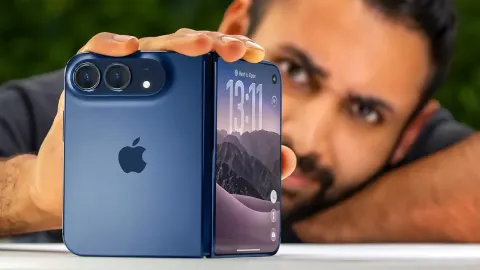
The iPhone Duo is one of the best foldable smartphones you can buy, but you probably shouldn't get it anyway. You see, I've been using foldable phones since 2019. I'm a big fan of this form factor. The idea of having a regular phone in your pocket that turns into an iPad when you need it is just great. But at the same time, many are considering the Duo as their first foldable phone, and there are quite a few things to consider before spending $2,000 on a shiny new gadget. It's easy to forget that foldable phones have been around for quite some time. Back in 2019, Samsung released the Z Fold, and it was crap. I say this with respect, because it was a very early concept
of what foldable devices would later become. And while it looks ridiculous today with its tiny external display and huge cutout when you open it. It was also infamous for breaking almost immediately when people started removing the protective film from the screen. But the important thing is that Samsung wanted to release these devices and start testing them in public. I don't doubt for a moment that Apple worked on iPhone Duo prototypes for as long as Samsung delivered the Z Fold to the market. Of course, there are advantages to the fact that everyone expects Apple to do everything right when it enters a new category. And many aspects of Duo are
really well done. But as someone who has been using foldable phones since 2020, I will say: there are things here that are clearly still "raw." If you're interested in eventually moving to a foldable smartphone, be prepared for the serious drawbacks inherent to all such devices. And while I personally have come to terms with these downsides, you may not be ready. For years, the most popular question about foldable phones has been: "What about durability?" Regular smartphones are very durable, aren't they? I mean, whether it's Gorilla Glass or Ceramic Shield, the screens are extremely durable. I would say that a regular smartphone is almost a perfect design. So when you add a hinge, a foldable display, when you
literally take the phone and cut it in half, you have to make compromises. The good news about a foldable phone is that when closed, you can usually use it like a regular smartphone. But the most dangerous part of a foldable phone is the internal display. Even in a device like the iPhone Duo, which is, frankly, very reliable, any foldable phone has a compromise in the internal display, simply because it has to have a flexible screen. And flexible screens have generally been very soft up until this point. So, on the first generation of Samsung phones, it was easy to leave permanent marks with your fingernail. And I would even say that even now it's not too difficult. I'm kind of used to it now. I know I should close my
phone when I'm not using it, and I think the iPhone Duo has the most reliable internal display we've seen yet. You just have to be a little more careful, right? And I don't think that's a huge problem, but what is a huge problem is the repair bill if you break something. iPhone Duo internal display repair without Apple Care costs $1,000. So Apple Care Plus doesn't seem like such a bad idea. This is the number one thing to consider if you're going to use a foldable phone in the long term. Apple isn't the only one releasing new products. Our sponsor Ridge has finally released its power bank. Whether you just got a new iPhone or love your old one too much to part with it, Ridge's new power bank is for you. The 10,000mAh battery is enough for three full
phone charges, and it has MagSafe wireless charging that even works with Apple Watch. A stand, a built-in USB-C cable, and even Lightning if you want to be fully insured. The decoration is also great. I like the transparent phantom color, but they have other options, including atomic purple. There are even some that match the new iPhone 18 Pro, like this burgundy one. This isn't just shiny new technology. I've been using the Ridge wallet for years, and paired with the Ridge tracker card, you get Apple Find My and Android Find Hub support in an extremely convenient form factor. It even charges wirelessly, providing up to 10
months of battery life. Look at this. This is what vertical integration is. So if you're ready to upgrade your phone, wallet, or anything else, you can get up to 40% off right now during their sale. They also offer a "buy two, get the third one free" promotion on bank transfers via the link in the description. And thanks again to Ridge for sponsoring this video. Another thing to look out for in a foldable phone is the hinge. These hinges are actually incredibly complex. I mean, look at the X-rays. This is incredibly cool, but it's still mechanical engineering parts that wear out over time. People have done similar bending tests. I know Samsung claims
hundreds of thousands of bends. The feeling of the hinge on the first day and on the 90th day is not the same at all. Even on my Z Fold 8, right? Even this hinge has a little play. So, there is a little bit of free play from left to right. You should consider that these are more complex devices. A common question: "What about the iron on the screen?" So, this is my Samsung Galaxy Z Flip 5G. This phone is over 5 years old. This is one of the first generations of foldable phones. And he had a very noticeable crease, did n't he? It was visible and could be felt. Over the years, the situation has improved. I think the iPhone Duo does a great job of this because not only is the crease quite small, but they also have a fantastic anti-glare
coating that really helps hide it. I'll just say that the notch is there on every phone, but the iPhone Duo definitely handles it the best we've seen. A few words about IP ratings. Apple did indeed implement an IP68 rating for the iPhone Duo. I'm not going to test it, but since it's water and dust resistant, I think it's a great addition, as most other foldable devices, while water-resistant, aren't very resistant to sand. You might not be taking your foldable smartphone to the beach, but the Duo actually has the best rating among all foldable devices.
However, if you are a little careful, these foldable phones are very durable. Hardware is an interesting topic because these things are just amazing. Even a thicker and heavier foldable device like the iPhone Duo feels great in your hand. And when you open it, you get a device that feels very thin to the touch. It really does feel a bit like a first- generation device. I think they really hit the mark with the aspect ratio. I don't know how the strange D-shaped external display will look over time. I still think he looks very strange. If you compare it to the Z Fold 8, the latter is a device with rectangular shapes, which, in my opinion, is a better piece of hardware in many aspects.
It's thinner, it's lighter. Going back to the iPhone Duo is, to be honest, a bit disappointing. And one more thing that you, as a user of previous iPhones, will definitely not like is the lack of Face ID. Now there's a Touch ID sensor on the power button, which is pretty typical for foldable phones. This is one of those things where you have to compromise because of the form factor. You know, with foldable phones like the Duo, it can be hard to form a clear opinion. I just spent a year with the iPhone Air. Yes, it was a device with certain limitations, but it felt incredibly light and comfortable in the hand. To some extent, when you open it up, the iPhone Duo seems similar. But in other aspects,
such as when closed, it is significantly heavier and thicker than a regular device. This is fine when considered in isolation, but the problem is that it is not really necessary to make such compromises. If you've used something like the Galaxy Fold 7 or this year's Fold 8, you'll realize that these phones are typically about the same thickness as regular smartphones. In general, they also weigh about the same as regular devices. But of course, they have all the benefits of being able to open up and get that huge internal display. Part of this is because, in my opinion, Apple may have gone a little overboard with the engineering of the iPhone Duo. It's a little thicker and heavier than it really needs to be.
Cooling is one of those things that isn't a big deal unless you're actively gaming. But one of the drawbacks of a foldable phone is that due to the thinner thickness, everything has to be packed tightly into one half of the body, so the cooling level is usually lower here than in the iPhone 18 Pro or similar models. For most people, the iPhone Duo will be perfectly acceptable, and it's helped a lot by the fact that the Apple A20 is a fantastic chip. It's really effective and very powerful, but it's worth considering, especially when you're outside on a sunny day and the phone's brightness is at 100%.
The camera is a controversial thing. Almost all foldable phones have compromised cameras. Part of it is just the laws of physics. You have a thinner phone, which means it's impossible to fit a large lens, sensor, periscope zoom, and everything else in the same size. So, you have a decent regular camera and a pretty decent ultra-wide lens, but no zoom lens, and the iPhone Duo also lacks all the pro features. That is, you don't have variable aperture, ProRes or log formats, and for me, as someone who takes a lot of photos and videos on my phone, such tools are very important. But I will say that this is not a purely iPhone feature. The iPhone Duo has a very real tradeoff that I think is actually worth it-it's the under-screen selfie camera. Samsung did
this a few years ago and then abandoned the idea. The idea is that the selfie camera on the internal display is completely invisible, but as soon as you open FaceTime or take a photo or video, the pixels seem to turn off. This is only needed for FaceTime, but it's worth noting that it looks very neat when the camera is hidden. Speaking of compromises, many people mention apps, as they didn't work the best at the time of the iPhone Duo's release I think the main reason is that the iPhone Duo was announced, well, a month ago, and developers didn't have much time to adapt their apps for Duo. Android has already gone through this, and there are still some apps that aren't fully optimized, but it's not that big of a problem.
I don't have a crystal ball to say whether all iPhone apps will work well in 3, 6 months, or a year. And now the main problem, just a huge elephant in the room-the damn price. The iPhone Duo, of course, starts at $1,999. And that's before you add a terabyte or two of storage. Foldable phones have always been expensive. The only truly affordable foldable phone is the Z Flip. And even that seems to be worth $1,200 now. And, as we've already discussed, there are trade- offs here. I don't want to say it's worth it, because I just can't say it is. You could buy yourself an iPhone 18 Pro, a MacBook Neo, and still have money left over.
I think I spend a lot of time on why foldable phones are bad. And for someone who has been using them for several years, this may seem strange. But I just want to be honest about all the flaws. If you've watched this far and haven't yet convinced yourself that this is a terrible idea and that you should run away from it as soon as possible, then let me tell you: foldable devices are simply incredible. There is something here at the level of primal instincts, like: "Wow, it's coming together." Cool, that's really cool. Plus, especially with the Duo model, it's a great phone for using two apps at once. You have a big screen for watching videos or reading books. It really is like having a small iPad in your pocket. And I'll give
Apple credit for the quality of iOS, for the animation-of course, that's all everyone talks about. But there are many nice little touches, even the way the elements are arranged on the side is just wonderful. While I've listed many trade-offs, if I had made this video three or four years ago, this list would have been considerably longer. These phones really feel like the future. And that's because the future has finally arrived. Regular rectangular phones have been around for about 20 years. And I think that over the last 20 years, their design has been practically perfected. But I believe that foldable phones still have many years of development ahead of them. And the main question for you: do you want to go on this journey
? As for me, the answer is yes. I think in many ways the Duo reminds me of the original MacBook Air. That laptop was incredible. When Steve Jobs took it out of the envelope, it was completely unlike any other laptop on the market. And while that laptop had a lot of compromises, especially when the second generation was released, Apple clearly defined what a thin and light laptop should be. It's been 15 years and we're all using laptops that look a lot like that MacBook Air. And I think the iPhone Duo will be a similar situation. They were obviously inspired by Samsung and all the other companies that have created foldable phones over the past 7 years. I think a lot of the issues we have with the iPhone Duo will be resolved within the next few
years. Many of these things seem like problems that can be fixed in one, two, or three generations. And that's why it's a little hard for me to recommend a phone that still needs some work, even though it might not be such a bad idea. You know, the first draft is never the best. So, who should actually buy the iPhone Duo? Well, in my opinion, the answer is quite simple. I think if you like new things and can really take advantage of multiple apps at once, then go for it, why not? This is a very, very reliable first generation device. But for most people, I think it's worth being patient. I mean not only that application support will definitely be fixed in a year or two, but also things like durability and some software
bugs. I think most of these minor issues I noticed with the iPhone Duo will likely be fixed within a year or two. And one more thing: although technology is getting more expensive, a Duo 2 or Duo 3 will probably cost more than this model. Most people should remember that a regular smartphone is so advanced that it won't disappear anywhere. While foldable phones have been around for a few years, this is Apple's first attempt at this niche. There is still a lot of room for improvement here. You have to understand that the iPhone Duo is the worst foldable phone Apple will ever make. Do you want to spend two or three thousand dollars on a good foldable phone and then use it for the next 5 years? Because it seems to me that most Duo buyers
will want to upgrade to Duo 3 or something similar. This is a very, very strong first step, but it's not perfect. If you're buying a foldable phone, there are a lot of things to consider. Believe me, friends, I've been through this. The first time is not always the best. You have to be a little patient. Good wines get better with age. You become wiser with age. They used to do better than they do now. Unc Mode, on call.