11:23



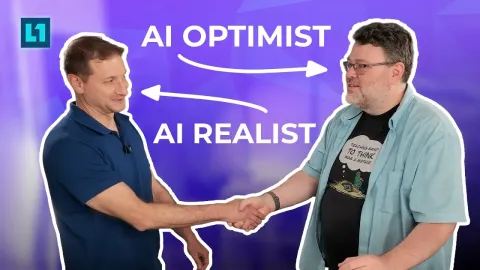
Nuance. This is one of those words that the internet is allergic to. In general, on any topic on the Internet, everything is either very good or bad. There is no middle ground. Case in point: Earlier this week, OpenAI, which I would probably call one of the most hated companies, did something truly remarkable. They claim to have over 300 examples of tremendous progress in solving large unsolved mathematical problems, and in some cases they have been completely solved. Mathematicians all over the world are going crazy, and in a good way. This is a real earthquake. My God. I'm just beside myself with excitement. I'm having an out-of-body experience here.
I shake my own hand. I am outside my own body. That's how excited I am about all of this And in a negative sense There's a difference between mathematicians using AI to solve problems, then presenting them and gaining insights, and a multi-billion dollar company simply taking on solving all the math problems in a row, not giving a clear description of the work, and just saying, "Well, guys, figure it out." You can read it. I would say it's much worse. If it is later found that these proofs are independently confirmed, it could be one of the most remarkable moments in the history of mathematics. But I know what some of you are thinking. Hey, you hate AI. So what's going on here? Well, that's what I mean by nuance.
Not everything is binary, and two things can be true at the same time. So, on the one hand, are the labs developing LLMs losing billions of dollars because people don't want to pay a lot of money for something that can be obtained elsewhere as open source? Yes. Is the data center industry an irresponsible financial risk? Yes. Are AI diffusion models destroying human art? Yes. Is AI being used as a shortcut for lazy people to cheat, swindle, and steal from others? Yes. Are the de facto leaders of the AI industry, especially Sam Altman, playing politics and acting quite recklessly in their decisions? That's right.
You know, I think AI is probably going to end the world, but in the meantime, there will be great companies built on serious machine learning. We believe that the world should put up with some bad things for the sake of the benefits of this technology and for people to have the tools of influence. But there's another side to it-what AI can actually do quite well. I've been saying for almost a year that coding and higher mathematics are some of the strongest points of large language models. Regarding programming, take a look at the Rust revolution currently happening in the gaming industry.
Even in medicine, projects like the Mammut Foundation's AI model are poised to revolutionize drug development. I say all this because in 10 years of covering AI on this channel, I've realized one thing: the industry is becoming increasingly fragmented. I hope you now understand my position a little, and that brings me back to the topic of this issue: on Tuesday, September 8, OpenAI announced that it had solved one of the most difficult mathematical problems-the Navier-Stokes equations , the "Millennium Problem " with a reward of $1 million. The best minds in the world have been trying to do this for 90 years, but the problem remains unsolved. Whether through poor communication or outright theft, OpenAI is accused of stealing one of the
greatest mathematical discoveries in history from another mathematician's chat room. But that's not all. The mathematician claims that an OpenAI employee threatened him to keep his mouth shut. So, on the one hand, we have a potentially huge breakthrough among over 300 unsolved mathematical problems, and on the other, serious accusations that OpenAI stole answers from a mathematician's correspondence. It's a complicated story, but it's worth talking about. This is a story about trust, the confrontation between man and machine, and the existential questions that arise along with it. Let's dig into this. world's best mathematicians have been battling over this problem for almost a century. This is the
Navier-Stokes equation. One of the greatest unsolved mysteries of mathematics, and now AI has burst into the scientific community, and a company claims to have solved it. Quite a serious breakthrough. Which also brought trouble. After all, OpenAI is now accused of stealing work from competitors, while mathematicians question the dominance of AI in this field. When one of the most difficult mathematical problems is solved, you expect the world to be delighted, expressing its congratulations. But instead, there was anger, and not just because it was done by artificial intelligence. People accused OpenAI of theft. As strange as it may sound, a hydrodynamics proof case turned into a public scandal of theft and intimidation. But if we go back a
week from the day we solved the problem, we will get a mathematics degree from New York University. He found himself at the center of an unpleasant discussion. What actually happens to AI users' chat history? But we are getting ahead of ourselves. We need a little context to understand what exactly was resolved and to grasp the full impact of this story. It will only take a moment. In 2000, the Clay Mathematics Institute selected seven problems that it considered to be the most important unsolved problems in mathematics. A reward of $1 million was set for each of them. In 26 years, only one has been solved. Grigory Perelman proved the
Poincaré conjecture and, as is well known, refused both the money and the Fields Medal. Here he is in this photo, and we can honestly say that he won this prize as a challenge, and he wasn't interested in the money. Another of the seven " millennium problems" was the Navier-Stokes problem. These equations were first written down in the 19th century. They describe how liquids and gases, such as water or air, move. Engineers use them every day to design airplane wings and predict the weather . I even encountered them while studying at university. But it is shameful for humanity that no one has been able to prove that these equations always hold true.
The millennium problem posed a deceptively simple question. If we start with a smooth, steady fluid flow, will the equations always remain stable, that is, smooth, at any point in time? Or perhaps the equations allow for impossible things, predicting that under certain conditions the fluid reaches infinite speed and energy in finite time. So why am I telling you all this? Well, the next part is key to this story. There are two ways to solve this problem. Either prove that the equations always remain stable, or prove the opposite. In the presence of a smooth external force, the equations " go crazy". This whole story revolves around the second method of proof. This approach was proposed by two Spanish mathematicians: Diego Córdoba and Luis
Martínez Zorrilla. Just a few years ago, they developed a new strategy-a very specific sequence of carefully calibrated " push" that causes the liquid to accelerate to infinite speed. Almost no one else was working in this direction, so it was a kind of rare secret in the world of mathematics. Meet the main character of our story-a mathematician from New York University, Tristan Buckmaster. Together with his colleague, he picked up this unusual idea of the Spaniards and developed it further. Later, Tristan spoke to Brady from one of my favorite channels- Numberphile. He talks about his experience during the controversy surrounding OpenAI. Some of the answers have been shortened to save time, but I'll leave a link to the full interview below
. Tristan's colleague was Levent Alpoge, a mathematician who works at Anthropic. And that's a little hint, if you know what I mean. It was, according to Buckmeister, and I quote: "a purely personal collaboration, free from any institutional agreements," end of quote. Buckmeister set the task, Alpoge entered it into the model, they refined the result and repeated the process. Buckmeister continues, and I quote: "We have used several LLMs: Claude from Anthropic, Codex from OpenAI, especially with GPT-5.6 Soul, and
most recently-Astra. End of quote. Importantly, their OpenAI chat log sessions for this project were preserved. Did you make a mistake by putting all this in the Codex? Do you regret using their product? We.yes, we made many mistakes. You know, if there hadn't been a leak, there wouldn't be this alarm. I.I've seen a lot of crazy things. I did n't think they would go this far. Progress has been slow for most of last year. And then, on August 15, everything changed. The couple was making progress in their experiments with artificial intelligence.
Buckmeister states, and I quote: "The first LLM-generated proof that Levent sent me was the most horrible thing I have ever read. End of quote. But by August 22, it was officially confirmed as correct. So, to be clear: they did not completely solve the " millennium problem," but they paved the way for its solution. Then came Thursday, September 3rd. Buckmeister states, and I quote: " As rumors spread that Anthropic had solved an important open problem, I wrote to a prominent mathematician at OpenAI. End of quote. The message was essentially: "Hey, Anthropic didn't solve this problem. "It's just us two mathematicians." Do n't you think that these rumors arose because of the progress you were secretly making with Euler's equations?
Er.that's what they came from. Yes. The primary rumor was simply that it was the company Anthropic. And then they realized it was Levent. And then the people at OpenAI started addressing Levent like old friends. It was something like, "Are you in New York? I contacted them by email. Finally I said, "Let's meet next week." Then we got a message from that mathematician that OpenAI was going to do something really stupid. That's exactly what they thought. Right. By Sunday, September 6, Buckmeister had already spoken by phone with Sebastian Boucher, a mathematician at OpenAI.
It turned out that the company was simply working on the same problem. A mathematician at OpenAI told him that an internal OpenAI model had produced a roughly 100- page proof of the discontinuity of the Navier -Stokes equations in finite time. When Alpigeus asked what method they had used, the answer matched the same unusual path that Buckmeister had been secretly working on for a year. This method was so specific that OpenAI's choice of exactly the same path became, quote, "a red flag," end of quote. I wanted to know if they had used our method, because if they had solved a forced problem, that was a definite red flag to me. Er, and that's exactly what they solved.
OpenAI's own statement coincides with Buckmeister's graph. Rumors of Anthropic's breakthrough apparently reached the company in late August. And in the words of Sam Altman, and I quote, "we wondered if our model could do the same," end of quote. Work began on September 1. A multi-agent system driven by an internal model was used, and I quote: "significantly more powerful than GPT-6 Astra", end of quote. It deployed 10,000 agents for approximately 88 hours, exchanging 2.7 million messages and spending about 130 billion source tokens. Then GPT -6 Astra itself spent 17 hours formalizing the result. The proof, if correct, shows that a flowing fluid at rest, under the action of a flowing force with finite energy, can form a singularity, reaching
infinite velocity in finite time. The liquid swirls and stretches like spaghetti until the mathematical calculations break down. This can be compared to what happens to the physical equations near the center of a black hole. So, the answer to the question of the millennium has been found. Yes, the Navier- Stokes equations can give explosive solutions. Mathematics has received significant contributions, but the question arises: who really deserves the recognition? This is where the situation becomes tense. Buckmeister, a mathematician at New York University, laid out his version in a large PDF statement describing what happened. His arguments are based on two things. The first is time.
OpenAI suddenly and frantically began working on the problem only after news of its progress reached the company. Yes, they thought it was Anthropic, not two people, but it started the process. Even more suspicious is that the company managed to do it in less than a week using his highly specialized approach. And they didn't want to talk when they started working on it. You know, I kept asking, "When did you start working on this?" "And they just said, 'Oh, we have these amazing models.' We have these amazing models."
Alpge was also informed by OpenAI mathematician Sebastian Bubek that, quote: " Minimum human intervention was used," end of quote. Buckmeister denies this: "That turned out to be untrue," end of quote. He claims that the entire OpenAI team worked on this, first solving the simplest problems. The second thing his case is based on is data. Buckmeister writes: "I asked if the model was trained in our Codex sessions, or had access to them, where we contributed all our drafts for the project," end quote. He was told that the model does not view user data. He continues: "I asked again about training. I didn't get a response," end of quote.
All the major architectural elements in that unpublished Euler solution were in our work, which they had on their servers. And it hasn't been published yet. It wasn't published, no. This was not published. Then things started to get weird. Tristan Buckmeister claims that OpenAI told them that they could both publish the results first and receive the $1 million prize, but only on one condition. His colleague Alpge should have been removed from the list of authors of the discovery because he, quote: "Works at Anthropic," end of quote.
Buckmeister refused and said he would publish the story. Then the threats began. OpenAI was asked: "Why would you ruin your career?" Buckmeister replied that he was a scientist and did not understand why publicity should ruin his career. The next response seemed like a veiled threat: "If you don't want me to be good, then I don't have to be good," end of quote. Uh, well, it took us a while to figure out what happened. The first suspicion is that they started lying. For example, the first thing they did during the call was to show us a prompt. At this point, I said that I knew they were going to lie because they had already lied before about the query they used to solve other math problems.
They showed me on the screen how they had literally just copied and pasted the Millennium Prize problem. They said they took the problem, pressed "enter" and got the solution. And at that moment I just had to laugh because it was so ridiculous. Within a few minutes it became clear that this was a lie. And the fact that they had worked on other tasks before, that they had given other clues, and that lie was dispelled in a matter of minutes. Buckmeister remains cautious in his words. At the end of his document, he writes, quote: "I am not accusing anyone of anything." Although, when The New York Times asked whether OpenAI's LLM agents found a solution based on its chat logs in ChatGPT,
he stated that the events that transpired were, and I quote, "very indicative that's exactly what happened." "End of quote." He went on to say that the visit to the OpenAI office looked like an attempt to bribe him. Quote: " They couldn't understand why I wouldn't agree to this deal." "End of quote." OpenAI told X that his story was, quote, "false and provocative." Bubek , a mathematician at OpenAI, denies that he asked to remove Alpaca from the list of authors. He posted a long text he sent to Alpaca, letting them know that they would get all the credit for the discovery and that they were willing to show the clues they used
. He describes it as an offer to help, not pressure. Regarding bringing Alpaca on as a co-creator, Bubek told The New York Times that it would seem strange for the company. Quote: "How can we have an internal OpenAI project involving an Anthropic employee?"" End of quote". The story of OpenAI changed throughout the week. The company's statement noted that neither researchers nor agents had seen the pair's work until it became public, but they left room for retraction. Quote: " While it is unlikely, we cannot rule out that de-identified data obtained from their use of our products helped improve our models." "End of quote." By Wednesday evening, after backlash
and questions from The Times, their version had changed. Now it was, quote, " absolutely impossible that Buckmeister's Codex prompts could have affected the system." OpenAI stated, quote: "No input after July 3rd could have affected the system." "End of quote." Altman wrote that the team, quote, " acted honestly and generously at all times." "End of quote." So how could OpenAI's story change so quickly? The question remains: was most of the solution to the million- dollar math problem hidden in the user's chat logs and used by OpenAI to solve it? But two things are undeniable. OpenAI went for it because there were rumors that Anthropic
would do it first, and the mathematicians just ended up in the middle. Tristan Buckmeister states, quote, "I am just a bystander in these petty games." " End of quote." The second undeniable thing is that the internet has already made up its mind. Look at this. The ball is knocked to the ground. Pulisic made a terrible mistake, and Subotic will score the easiest goal of his career. appeared on Hacker News, Reddit, and X within hours. Hacker News was dominated by reactions of suspicion and concerns about user data. As one commentator put it quote: "Everything that is not protected at gunpoint will be used to train AI." "End of quote." Renowned mathematician Terence Tao called Buckmeister's work outstanding, while warning against companies using scientific
problems as marketing events. He compared it to, quote: "using excavators to loot archaeological sites." "End of quote." A few days later, he wrote an open letter with other mathematicians, essentially stating that AI can solve these problems, but we are losing the understanding and insights gained in the process. He says we shouldn't let this happen. A statement from the Clay Mathematics Institute, the actual creators of the " millennium problems," called these events, quote: "a fascinating day" and promised to conduct a review that would be balanced and absolutely meticulous. While this process continues, the Navier-Stokes equation remains on the Clay Institute's list of unsolved problems. OpenAI said they would not claim $1 million.
What I want to challenge is the "move fast and break everything" culture that is causing a head-on collision with the mathematical community, and in the future it will cause a collision with all of us. So, let's take a step back. Let's put aside all personalities and ask the most important question-the one that Buckmeister asked during the call and to which he received no answer. Was my work used to train the model that beat me? OpenAI's final answer is no. There is a cut-off date, and that's it. But the fact that the company's initial statement was based on de-identified data, the coincidence that OpenAI chose exactly the same rare path as the mathematicians, and that their lead
researcher was unable to respond in real time, reveals something very inconvenient. If OpenAI's LLM agent was guided, even indirectly, by Buckmeister's work, it implicitly means that the work you entrust to the AI can be used by others. Even if the original data is never viewed, it can shape the model in ways that are almost impossible to verify from the outside. Millions of researchers, lawyers, doctors, and engineers contribute unpublished and sometimes confidential work to AI tools every day. And this may mean that this data is used for training unless the user opts out. History now goes beyond mathematics. Can
AI vendors simply appropriate human labor? Melissa Lee from Monash University puts it bluntly. Researchers need confidence that unpublished work contributed to the AI system will not be used for competitive developments by that company. Indeed, once again it seems like this is another case where the legal framework has to catch up with technology. This had a huge negative impact on the mathematical community, because now no one wants to talk about their open problems. will suddenly come along and, you know, start using them as benchmarks. People don't trust any of these AI products. This had a huge negative impact on the academic environment.
Buckmeister Quote: I would rather talk about mathematics, the ideas of Lewis and Diego, and what it all means for the rest of us. End of quote. He continues to argue that it is Spanish mathematicians who deserve the Fields Medal. As for the practical implications of this discovery, they are likely to be limited. Formulas and calculations have always worked quite well in the real world. Now we just know their limits and where they fail. But in the world of pure mathematics, it was certainly a huge moment with a lot of drama to go with it They'll say they didn't
do anything, you know? But if they went into Codex and took your work that you added there with good intentions, it feels like you've been ripped off. Yes. And that's why I'm upset. As for OpenAI, after their release of around 300 solutions to long-standing mathematical problems, they may well be legitimate this time, but again, there are nuances. After an argument with Buckmaster, a spoonful of tar appeared in a barrel of honey. People are now wondering whether OpenAI's agents hacked their way to success, or whether they got help from ChatGPT logs from unknown users. This remains to be seen. But no matter how it turns out, as is often the case in
history, the results of these mathematical breakthroughs can have implications for current and future technologies. So hold on tight, boys and girls. One important theme in this episode, highlighted by mathematicians, is that LLMs can solve these complex problems, but it doesn't always contribute to understanding. This is also true for today's students when they use AI to get answers. That's why I find what Brilliant is doing very interesting. Brilliant is an interactive tutor for math and programming. It is designed to really help students think through problems on their own, rather than just giving a ready-made answer.
Brilliant's tutor, named Koji, asks questions, breaks down problems into parts, and guides students through the solution step by step. I was taking the "Thinking in Python" course and got stuck at this point. So instead of just guessing, I asked Koji for help. And that's exactly the part that I really like. Koji sees what you're working on and helps you figure it out. It's much more like someone is sitting next to you and helping you understand the task. As someone who regularly covers technology on this channel, I think this is a much more interesting use of technology in education: not to replace the student's thinking, but to help them improve. You can get started with Brilliant for free by clicking the link below or scanning the QR code
on the screen. You can upgrade to a premium subscription for full tutor support and unlimited access to all courses. And right now, ColdFusion viewers can save 20% on an annual subscription at brilliant.org/coldfusion. Thanks to Brilliant for supporting ColdFusion. This concludes this story. So what do you think about this? Is OpenAI telling the truth, or did they really steal a breakthrough from a mathematician's chat rooms? Let us know in the comments below. My name is Dagogo, you watched ColdFusion, and I'll see you again in the next episode. Goodbye, friends. All the best. ColdFusion. This is new thinking.