17:07
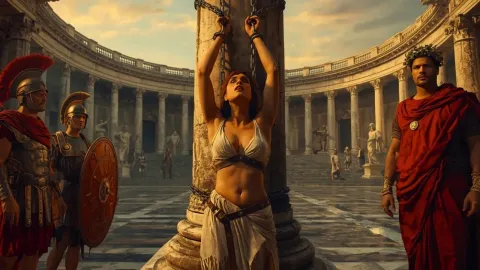



Imagine being dragged from your bed at midnight because a neighbor heard you mention a Hebrew word in your sleep. No lawyer, no witnesses, and no idea what you've been charged with. You are now a guest of the secret prisons of Seville. Behind these three-foot thick walls, silence isn't just gold. It's the only thing keeping you from the Gaua. But even if you stay quiet, the Inquisition has ways of making your bones speak for you. The year is 1478. The Catholic monarchs Ferdinand and Isabella have just authorized the establishment of the Spanish Inquisition. But this isn't just about faith. It's about power, conformity, and the terrifying machinery that emerges when a state decides to police the soul
itself. For the next three and a half centuries, an estimated 150,000 people will stand trial. Thousands will die. But the true horror isn't in the numbers. It's in the methods. The Spanish Inquisition didn't just execute heretics. It perfected the art of breaking them first. The tribunals kept meticulous records. We have their manuals. We have their correspondence. We have diagrams of the devices they used sketched with the same precision an architect might use for a cathedral. And what those records reveal is this. Torture wasn't a loss of control. It was policy calculated, sanctioned, refined over generations. They called it questioning. They gave it rules, time limits, supervision by clergy. They made
horror bureaucratic. and the people who endured it. Most weren't powerful heretics or dangerous rebels. They were merchants, farmers, mothers. The Inquisition hunted whispers. A neighbor's testimony that you didn't eat pork. A servant who saw you facing east while praying. A child who mentioned grandma lighting candles on Friday night. These fragments could drag you into the chamber. So what did they do to you once you were inside? Spain still reaches people across every continent. Still makes us ask the same question. How far can fear push human cruelty? Let's start with the rack. But the reality is worse than the Hollywood version because the movies get one thing
wrong. They make it quick. The Inquisition's version was slow, methodical. The victim, let's call her Maria, because there were hundreds of Maras, would be laid on a wooden frame. Her wrists and ankles strapped to rollers at opposite ends. The Inquisitor would ask a question. She would answer, just a quarter rotation. Her shoulders would strain. Her hips would begin to separate. The pain was immediate, but not yet unbearable. That was the point. The question would come again. Her answer hadn't changed. Another quarter turn. Now the ligaments were stretching beyond their natural limit. Her joints beginning to dislocate. She could feel
the precise moment when tendons started to tear from bone. And still they would wait, give her time to think, to reconsider, to imagine the next turn. Because the rack's real power wasn't in the tearing. It was in the anticipation. You could see exactly what was coming. You could hear the mechanism. You knew there were more rotations left. Historical records from the Valencia Tribunal in 1590 describe a woman who lasted through 11 rotations before she confessed to practicing Jewish rituals. 11. By the fifth rotation, most victims had already lost the ability to ever use their arms normally again. She went to 11. What did she confess to? Lighting candles. That's what broke her body
forever. Candles. But here's what the Inquisition understood about human psychology. Physical pain has limits. The body can only hurt so much before it shuts down, goes into shock, becomes numb. So they developed techniques that added psychological dimensions, layers of horror that transcended mere flesh. The strapedo. Simple in design, devastating in execution. Your hands are tied behind your back. A rope connects your wrists to a pulley in the ceiling. You're hoisted up. Your entire body weight suspended by shoulders wrenched backward into an impossible position. Already, this is agony. The shoulders dislocate almost immediately. But that's just the foundation. The inquisitor
would then drop you. Suddenly, just a few feet, the rope would catch. Some victims arms would simply tear from their sockets. Others would hear their spine crack. A man named Diego testified in 1567 that he was subjected to the stedo six times in one session. Six drops. Between each one, they would lower him just enough for his toes to touch the ground, not to give relief. Then they'd hoist him again. Start over. This wasn't about getting information anymore. This was about destroying the idea that your body belonged to you. And they innovated added refinements. weights tied to the feet during suspension, heated rooms that made dehydration set in faster.
They would perform the stpedo in front of family members, forcing parents to watch children, spouses to watch each other. The confession wasn't the goal. The confession was almost beside the point. The goal was to demonstrate that the inquisition owned you completely, your pain, your dignity, your mind. Then there was the water torture, not water boarding as we understand it today, though the principle is similar. The victim would be strapped to a ladder-like frame, tilted with a head lower than the feet. A cloth would be placed over their mouth and nose. Then water slowly poured. The cloth would cling to the face, making breathing
impossible. The sensation of drowning would be immediate and total. But here's the refinement. They measured it precisely. One jug of water, two jugs, three. The inquisitors kept count, wrote it in their reports. Subject received four jugs before confession. They were scientists of suffering. The physiological response is pure terror. Your body is screaming that you're dying, drowning, suffocating even though you're not. Not yet. But your brain doesn't know that. It just knows it can't breathe. Every survival instinct is fiery at once. And between jugs they would remove the cloth, let you gasp, ask the question again, give you just enough air to stay conscious, then start again. Some sessions lasted hours. The
tribunal records from Corduba note one case where a man received the water torture over three consecutive days, 21 jugs total. He confessed to nothing because there was nothing to confess. He died on the fourth day from fluid in his lungs. But perhaps the most psychologically devastating device was the simplest. The garat, a chair with an iron collar. You sit. The collar closes around your neck. A screw mechanism tightens it from behind. Slowly, the executioner would turn the screw one rotation at a time. Your windpipe would begin to close. Breathing would become harder. Harder still. You could feel the pressure building in your head as blood flow restricted. Your vision would start to tunnel. And all the while you're
sitting calm, still watching the Inquisitor watching you. The Gat was often used as an execution method, but the Inquisition also employed it for torture. They would tighten it to the edge of consciousness, then stop, loosen it slightly, let you recover, ask their questions, then tighten again. Some victims would endure this cycling for hours. The psychological impact was profound. You knew with absolute certainty that the next tightening could be the last. That the man behind you turning the screw held your final breath in his hands. And the choice of when to release it was entirely arbitrary. Here's what breaks your mind about studying these records. The Inquisition had rules, limits. Torture couldn't
exceed 1 hour in a session. It couldn't be repeated, though they found a loophole. calling resumed sessions continuations rather than repetitions. A doctor had to be present to ensure the subject didn't die prematurely and there had to be a confession that implicated others. This was the logic. We're not monsters. We have guidelines. They built an entire theology around it. Thomas Aquinas had written that heresy was worse than counterfeiting money because it corrupted the soul rather than mere currency. And if counterfeiting warranted execution, how much more did heresy? The Inquisition's manuals cite scripture, canon, law, precedent. They made torture holy. They turned screaming
into prayer, and the confessions almost worthless. Under that kind of pain, people will say anything. They'll confess to witchcraft, devil worship, conspiracies that never existed. They'll name names, friends, family, anyone, just to make it stop. The Inquisitors knew this. Their own records acknowledged that torture-induced confessions were unreliable. But reliability wasn't the point. The point was to demonstrate power, to make heresy not just wrong, but unthinkable. To ensure that every converso, every secret Jew or Muslim lived in constant terror of the whispered accusation, the midnight knock, the descent into those stone chambers. The Inquisition's reach extended beyond Spain, into Portugal,
into the New World colonies, into Sicily and the Netherlands. Unaware Spanish power touched, the tribunals followed. They established a network of informants, a culture of suspicion. Children were encouraged to report parents, servants to report masters, the punishment for protecting a heretic, becoming one yourself. But here's the paradox that haunted the Inquisition's final centuries. It worked too well. By the 1700s, there were barely any heretics left to find. The Converso communities had been destroyed or driven underground so completely that the tribunals struggled to justify their existence. So they expanded their definition of heresy. Started
prosecuting blasphemy, bigamy, sodomy, started hunting witches. Though Spain's witch trials were less numerous than northern Europe's, they had built a machine that required fuel. And when the original fuel ran out, they found substitutes. The last execution by the Spanish Inquisition occurred in 1826. A school teacher named Kayatano Ripple accused of teaching dismalia while crowds watched. By then the enlightenment had swept through Europe. The Inquisition was an anacronism, an embarrassment, but it had lasted 348 years. longer than the United States has existed. Long enough that people alive today have grandparents whose grandparents remembered it. They left behind archives, thousands of pages
documenting trials, confessions, executions. These records survive in Seamankas, in the National Archives, and Vatican collections. Historians can trace individual cases, read the questions asked, see the annotations where inquisitors noted which torture method produced which result. The bureaucracy of agony preserved in meticulous handwriting. And here's what those records reveal in their accumulated weight. The Spanish Inquisition wasn't an aberration. It was an institution. It had career paths, pensions, institutional knowledge passed from one generation of inquisitors to the next.
Young men studied to become torturers. They apprenticed, learned technique. There were manuals on proper application of the stpedo. Debate over whether the rack or the water torture was more effective for different types of suspects. They professionalized human suffering. The victims, when they survived, carried the marks forever, ruined shoulders that never healed, spines bent at wrong angles, lungs scarred from aspirated water, but the psychological scars ran deeper, communities fractured by forced betrayals, trust destroyed when children testified against parents. Faith itself became a source of terror rather than comfort. How do you pray when prayer is what condemned you? Some confessed
immediately, hoping mercy would follow cooperation. It rarely did. Others held out through unimaginable pain, maintaining innocence even as their bodies broke. A few recanted their confessions afterward, knowing it meant a return to the chamber, but unable to live with a lie. The tribunals called this relapsing, and it carried the harshest penalties. You could confess under torture and be spared. But if you confessed, we're released and then took it back. That was proof of heresy that earned you the stake. The auto daf, the public ceremony where sentences were pronounced and carried out, turned punishment into theater. Thousands would gather to watch the condemned parade through streets
wearing sandonitos, penitential garments that mark them as heretics. Some would be reconciled, forced to perform public penance. Others would be relaxed to the secular arm, the Inquisition's euphemism for handing someone over to civil authorities for execution. Because the church couldn't technically shed blood. They could break your body in the torture chamber, but the actual killing that had to be outsourced. They found God in the loopholes. The fires burned in plazas in front of cathedrals. They used green wood sometimes to make the burning slower. The smoke would choke you before the flames reached you if you were lucky. If you weren't, you'd burn conscious, feeling everything.
Eyewitness accounts describe people screaming prayers, screaming for mercy, screaming names of family members, screaming until their lungs filled with smoke and heat, and their voices turned to wet rasping and then silence. But the majority never made it to the flames. Most died in the torture chamber or in the Inquisition's prisons, waiting for trials that could take years. The cells were small, lightless, crawling with rats. Disease was rampant. Food was minimal. Some prisoners went mad before they ever faced the rack. Others took their own lives, though the church considered suicide a mortal sin that damned the soul forever. Even in death, there was no escape. Even in death, the
Inquisition followed you. Children were watching all of this. Growing up in cities where torture chambers existed beneath churches, where plazas hosted burnings, where neighbors disappeared and returned broken or didn't return at all. This was normal to them. Generational trauma woven into the fabric of society. The Spanish Inquisition didn't just destroy individuals. It warped entire cultures. Taught populations that safety meant silence. That survival meant betrayal. That the greatest sin was being different. And yet people resisted in small ways. Secret Jews continued practicing in hidden rooms, saying prayers and whispers, keeping dietary
laws and code. Secret Muslims preserved fragments of their faith through oral tradition, through symbols only they could recognize. The Inquisition hunted these traces with obsessive precision, but they never fully stamped them out. Memory proved harder to kill than flesh. When Spain finally abolished the Inquisition in 1834, there was no ceremony, no apology. It simply ceased to exist, dismantled by royal decree. The buildings remained. Some became government offices. Others fell to ruin. A few were converted into museums. Their torture chambers preserved as reminders. But for decades, Spain didn't talk about it. The subject was too raw, too shameful, too close.
The chambers beneath Seville are quiet now. You can visit them. Walk through rooms where screams once echoed. The walls are still thick, the stone still cold. There's a rack on display, restored to working condition, though no one turns its wheels anymore. Tourists take pictures. Children press their faces against the glass cases, staring at iron collars and leather straps without fully understanding what they were for. But sometimes in the silence of those chambers, you can almost hear it. The echo of the man from the opening of this story, still screaming five centuries later. His crime was a prayer.
His punishment was the machine, and the machine ground on indifferent, bureaucratic, holy, and its own twisted logic for longer than most nations survive. They remembered, they recorded, they could not look away. And now neither can