3:25


Judgement day for the Republican party and Donald Trump. The scale of the Democrat's midterm win amounts to a repudiation of the American president's politics. I mean, if I were on the ballot, we would have won. And the USIsraeli war against Iran. Serbian journalists spent years producing propaganda for President Alexander Vuch. Now that he's the ex-president, some of those journalists are being purged. and a moment of moral despair that turned into a new publication for a post American world. Equator magazine and how it's doing things differently. It was the most expensive election in American history. Nearly 12 billion spent, much of it on ads and message control, with the majority of that money going to Republican candidates. But most
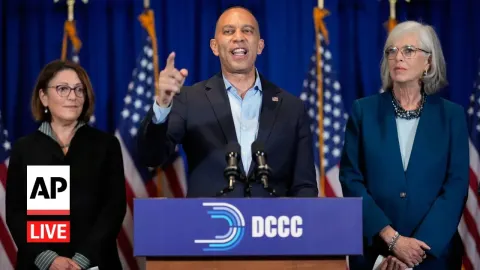
voters weren't buying it. The result, a Democratic sweep on a scale not seen in half a century since the postwatergate midterms of 1974. Democrats now hold 253 of the 435 seats in the House and 54 of the Senate's 100 seats, up from 47. Seven red states have flipped to blue. Amongst those voted into office are the US's first Native American and black female governors, the country's first Muslim senator, and a record number of women. Make no mistake, this was a verdict on Donald Trump's governance and also a blow to his grip on the narrative. And he threw himself at these midterms, holding rockous rallies across the country.
We love We're not going to let Iran have a nuclear weapon. You want to see A MET. SO I'M ASKING YOU TO PRETEND THAT I'M ON THE BALLOT. Donald Trump has long been able to turn controversy and crisis into spectacle. But this was an election in which the president lost control of the message. Minoxi Ravi has been following the political fallout since the voting. Mina, we're seeing this rare consensus from Democrats, Republicans, even from people within the Trump administration that this election was all about the war on Iran.
Yes, Richard. Iran was the killer for the Republicans. Now, the conventional wisdom is that foreign policy doesn't usually move elections in the United States. But when the domestic costs are this high at the gas pump, in household bills, in the billions of dollars being spent by the Treasury to run the war effort, then becomes impossible to ignore. Vice President JD Vance was the one who made the link most explicit between the war in Iran and the losses in the election. He posted a 600word essay on X. I asked two people about this. Alex Shepard who's with the New Republic magazine and Rob Arlet who is a Republican strategist and used to work with the Trump campaign. Let's start
with what Arlet had to say. It is very significant for a sitting vice president of the United States to come out basically acknowledging that the Iran war was significant in the voters's decision and that's very historic and very significant because it's admission of a truth and I think it was a very warranted message because it's an honest message. Uh, I think prior to that message, perhaps the administration, perhaps President Trump and even JD Vance himself, they kind of lost track of that narrative, it was a justified war in their opinion, but they didn't make the connection to the voters on Tuesday. It's not unusual after a bad midterm elections, and most of them are bad midterm elections
for incumbent presidents, for the vice president to go out and kind of take one for the team. Um, but that's not what Vance is doing here. Vance is not saying, you know, we, you know, we could have done things better or, you know, this, you know, this is a tough break for us, but we're still moving ahead with our priorities. What he's saying is that, you know, the core thing, the most important thing that this administration did this year was a stupid mistake and it hurt them. And I think it's also worth remembering that Vance hoped it would be fast, right? That he was advocating for a short war. Obviously, that is not what we got. And so Vance here is, you know, he's throwing Trump
under the bus. He's essentially trying to outflank Trump. He's trying to steal the movement that Trump started by saying that, you know, Trump is too erratic, right? He's too prone to making these foolish decisions that punish everybody else. And if you had somebody who is more disciplined, more focused on, you know, mass deportations and uh trade war, that you'd be able to kind of do real Trumpism. So, you know, I think there's always been this question for the last 10 years about what the MAGA movement looks like after Trump about if you can do Trumpism without Trump. And I think this was Vance's play to say I can do it right now. Donald Trump has conceded that the Iran war was a major factor in the
electoral outcome, but he's still arguing that it made the right call to go to war. And that hasn't gone down well with some MAGA media voices. And we're hearing criticism from there of Trump, the kind that we've never really heard before. So the MAGA information ecosystem is not a monolith, Richard, and there have been divisions that have gone on for a while. The Iran war is one factor. Then US's support for Israel is another one. Let me start with the pro-Israel camp. Their argument is that the problem wasn't going to war in the first place. Is that Trump just didn't go far enough and didn't win decisively.
I'm distinguishing between quote unquote the war in Iran as sort of why it was initiated and the execution of said war. Go fast, go hard, finish it fast, and achieve your ends. Right? That is a way to actually win a war. So that's one side of the MAGA narrative, Richard. But there is the other side, the one that you referred to, and it is railing against Trump for decimating the Republican party. These are some really powerful voices we're talking about. I spoke with Maya Berry, who's the executive director of the Arab-American Institute, and this is how she explains what we're hearing. When President Trump ran for his office, uh the idea that he would be ending all wars everywhere was something that
resonated with a particular base uh including those who call themselves America first. So after the Iran war was launched, it ran so contrary to what he said he would do that part of the MAGA base, a really important and vocal part of the MAGA base. And yes, it does include folks like Tucker Carlson and Megan Kelly and Candace Owens have really come out pretty adamantly in their opposition. They see it as a betrayal of the agenda that he put forward. But we don't want a bunch of about how Iran is two weeks away from getting a nuclear weapon months after you bombed their three main nuclear facilities into oblivion. We don't want it.
Figures like Tucker Carlson, Megan Kelly, Benny Johnson, among others. They tend to not be on Fox News, for instance. They tend to have uh streaming shows. They're on YouTube. They're on, you know, Kick or Rumble or whatever else. And they wield enormous influence. And what's been so interesting about the Iran war is how many of these people from the jump were like this is a bad idea. And again, Tucker Carlson here is probably the most influential and the most interesting. And what Carlson has been doing in particular is they understand that Trump's a lame duck, right? They understand that he is 80 years old and his influence is waning. And so they are trying to position themselves for whatever comes next.
The repudiation of the Republicans was complete. That repudiation of course was a repudiation of Trump. And so we can say without hyperbole or gloating, this is the end of the Trump era last night. We're done. The people we've just heard from, Tucker Carlson, Megan Kelly, they have influence, but they operate outside the mainstream media space. What did election night tell us about the state of the mainstream media in the US? What did the numbers say about where Americans are turning to get their political news? So, watching television on election night was interesting, Richard. Uh, the ratings seem to tell a story about how the country is feeling politically. At the top were channels
classified as centrist in the US, ABC and NBC, although they'd probably be considered center right in most other countries. In third place was Fox News, Trump's regular call-in network. Fourth was MS Now, which is seen as left-leaning in the US. And in fifth place was CBS News, which people might remember was bought out by the pro-Israel Trump affiliated Ellison oligarchs last year. Of course, these numbers don't capture the millions who are tuning into the YouTube streams of political and news commentary channels. So, where do Trump watchers now see this relationship with the media going given that he faces an adversarial Congress and has just two years left in office? I spoke with Rob Barlet and he's that
Republican strategist who worked with Trump. This is what he said. Well, the relationship that President Trump has had with mainstream media here in America has been one that's been very divisive, I might add, because of the lies uh that have come out of mainstream media. And you know, President Trump has called him out. But as we continue to focus on the last two years of his presidency, I believe it's all about his legacy and what the world will look back and reflect on him as the president of the United States with two different terms. Uh, President Trump would even say three different terms because I think he still believes he won that election back in 2020. But I think he cares mostly about the uh the
messaging and uh and as the large audience that he can try to achieve. So he will engage with the American media and I think at the same time the American media will embrace that because they care about ratings uh and we all know President Trump is very divisive on those outlets. Therefore it brings up ratings and people will watch. Then there's the question of the Democrats, what they're going to do with the power that they now hold. And there's plenty of reason to be skeptical here. The Democratic party is just as addicted to big corporate pack money as the Republicans are. Democrats have offered very little challenge on the US position on Israel. So what should people realistically expect of the Democrats now?
So the Democrats had a very compelling story to tell during the midterm election campaign. Trump and his handpicked candidates provided ready-made villains. But the party also had media stars of its own. These are politicians who generated headlines. They cut through the noise. They captured voters attention. I'm talking about people like John Oaf in Georgia, James Talico in Texas, and Abdul Saied in Michigan. J D there is this delicious irony in the fact that you're constitutionally obligated to swear me in January. But for all the excitement around these candidates, Richard, when it comes to governing, the Democratic establishment remains firmly in place. And this is not a party that is known for bold
systemchanging politics. Also, Donald Trump has made very clear that he's not going to make life easy. On camera, he has said now and again that he'd be happy to work with the Democrats, but take a look at these two posts from the White House on social media. That second post is a reference to the power of the presidential veto. In essence, what Trump is saying is, "You might control Congress, but I still have the power to block your agenda." So, the bad lines have been drawn. Absolutely. Thanks, Mina. In election fallout, the stunning defeat of the former Serbian president Alexander Vuchich two weeks ago has set off a political reckoning there with a focus on the news media. Broadcasters that spent years giving the government
favorable coverage are finally being held to account. Tarak Nafa has been tracking this story. Alexander Vhuch dominated Serbia's media for 14 years. He used threats, lawsuits, and intimidation against independent voices. Now, the student-led movement responsible for forcing him from power has made media reform a top priority. Top of the agenda, the state broadcaster RTS. The director general of the network, Mana Gretchic, resigned last week following public pressure just one day after she'd ruled out stepping down.
There are also changes at regional public broadcaster RTV where the editor-inchief resigned and viewers were offered an extraordinary admission about years of one-sided coverage. Private channels are also in the political crosshairs. Outlets that just weeks ago were smearing the students as traitors and enemies of the state. Chief among them is in former TV which has played an ugly role in Serbia's media discourse. Around 30 protesters stormed the TV station as it was broadcasting live surrounding editor and chief and owner Draan Buchevich calling for his arrest.
This week, Serbia's media regulator banned Informer TV from airing one of its programs for seven days over its politicized coverage during the election campaign. The regulator also suspended programming on another broadcaster, Preva TV, and opened investigations into three other channels. It marks a significant shift in a country where the media regulator was paralyzed during Vhuch's time in power. Serbia's new political leadership has yet to form a government, but the country's media institutions are already being purged of propagandists and being forced to confront their record under VHIC. Now comes the hard work rebuilding a media ecosystem that serves all Serbia's citizens.
Imagine it's late 2023 or early 2024. You're a journalist. Israel is a few months into its annihilation of Gaza and the news outlet you are working for is trying to minimize what is quickly becoming a genocide by censoring Palestinian voices forefronting Israeli ones. Do you go along with it, stay quiet, or do you speak up, blow the whistle on crimes against journalism and risk your job? Or do you just quit and try something different? the way the founders of Equator magazine did. Equator is the brainchild of a group of writers and editors from multiple countries, some of them ex mainstream media who came together in what they call a moment of moral despair. One year
after its launch, Equator has produced some quality work, long- form stories and essays on global politics, culture, and art. All presented with an eye for design. Exguardian editor Jonathan Shenan is one of the magazine's founders. We spoke with him about what Equator is all about and how it's going. The fundamental premise of so much western journalism is the idea that it's better to be us than to be them. And I don't think most of the world still believes that. You know, what you're seeing is the emergence of a world that no longer sees America as the default model for its own future. We wanted to make a magazine that takes places on their own terms rather than presenting them as societies who are on their way to becoming more
like the West or more like America. My name is Jonathan Shaman and I'm one of the editors of Equator. It's been about a year since we launched the magazine. It's been intense uh but in a good way. We started with a kind of hypothesis about the way the world was changing and the world has changed faster than even we predicted it would. The old media organizations that many of us used to work for were struggling to keep up with those changes. The way that you start changing the world is by changing the way that the world is represented. And I think that has been something people have really reacted to.
Equator is a group of people who have known each other for a long time and who I think have been having versions of these conversations about the way that predominantly western or angophone media represents the rest of the world for a long time working together being friends editing one another. what happened kind of winter of early 2024. As we're having these conversations about the magazine, you're watching this genocide on your phone every night. You're seeing the numbers of dead tick upward and upward. There was a feeling that the media that we worked for, we had a faith in, that we believed in, began to feel seriously inadequate to the kind of moral and intellectual emergency that was taking place.
Equator is we like to say it's a magazine for the post-american world. It's a magazine of ideas. It's a magazine that does journalism, but I don't think is wholly journalistic. I don't think that our goal is to compete with the New York Times or the FT or the Guardian in terms of reporting the facts on the ground. Maybe the premise of it is that you know those facts don't speak for themselves. They require analysis and interpretation and that's part of what we are trying to do. The other thing I would say is that I think it's a magazine that takes art and design very seriously. We want to have visuals that are every bit as original as the pieces.
We want to work with artists who are maybe not already familiar to our readers and give them space to do interesting work. Part of the ethos of Equator is feeling like we want to be a place that is publishing pieces that we don't think anyone else would publish, but that we think other places will look at after we've published them and say, "Wow, I wish we had done that." A few pieces from the first year really embody what we're about. One of them is a story that we called the Xi Jinping School of Journalism which was written by a young journalist called Sonbo Bourjin.
It's a very funny personal story of working at a staterun Mongolian language newspaper in Hohhat, the capital of the Inner Mongolia Autonomous Region. He teaches himself how to be a journalist and then his whole newspaper is shut down during these kind of protests about retaining Mongolian language teaching and he sees a way out by going to America and going to Colombia journalism school and learning how to be a kind of you know proper English language uh professionally accredited journalist and then he ends up working for uh kind of these like American human rights organizations writing reports about human rights viol violations in the Mongolian areas of China. And then he gets doed and he loses his job when Elon Musk cuts the
budget for all of these things. But it's just like a very funny piece, a very human, you know, it's like a pickerque kind of story of what it's like working in Chinese journalism. Anyone could publish this kind of thing, but I don't think anyone else is like taking this guy's calls and deciding that, you know, his sort of 6,000word life story is worth telling. We published two pieces about the war in Sudan by a Sudin writer called Makdal Gazuli. The first one of these pieces is a kind of inside account of the Sudanese war as Makti experienced it in cartoon.
It is unlike anything else that's been published on the war in Sudan. It captures what is treated in so much of the global media as a faceless humanitarian crisis. as something that is meaningful and urgent and significant to the people who are living through it. I don't think anything really has been published like this about the war in Sudan. And interestingly, one of my co-founders, uh, Nessarin Malik is herself Sudin. And after this piece was published, she told us that she was just getting, you know, message after message from other Sudin readers who were saying things like, you know, we've never seen ourselves written about like this.
There is a temptation I think to say that this is a golden age um for new media launches. I would hesitate to use the phrase golden age because I think the circumstances uh that have led so many of us to strike out on their own are not necessarily encouraging. But I think there is a deep hunger for an alternative to legacy media organizations that maybe have, you know, lost their grip on what's happening in the world. And I think there is an ability now for people to participate, for people to support, for people to kind of have a degree of two-way interaction with these new media organizations. You look at some place like Sateo. You look at some place like Drop Site. You look at magazines in America like Jewish Currents.
They have just this sense of urgency about them. When we think about Equator, ideally I think we see it as in a lineage of smaller independent publications that come into being at these kind of moments of rupture and crisis. I always think that like a great magazine kind of is based on an audience that's out there but like doesn't know that it's the audience yet. The idea is that you're like, you know, you see this thing happening and you're like, these people are out there and they're waiting for this and what's going to bring them together is the existence of some new publication. It is like a hopeful moment in that regard. And finally, just before Americans headed to the polls last week, in a midterm election affected by the
USIsraeli war on Iran, former Fox News host turned podcaster Tucker Carlson posted a message on X. It was chilling. Under pressure from Israeli Prime Minister Benjamin Netanyahu, the Trump administration may be within days of launching a nuclear strike on Iran. Carlson is not the only one foreshadowing the possibility of nuclear war. This AI generated video showing what a nuclear strike on Iran might look like has been doing the rounds on social media, racking up millions of hits. Iranian state media has also weighed in with an 8-minute video that came with instructions on how to survive a nuclear attack.
The pounding that Trump Republicans took in the election was in part a result of his war on Iran. But will the Democrats surge in Congress be of any comfort to Iranians? Probably not, since the new Congress will not take office until January, and Trump has already attacked Iran, not once, but twice, without congressional approval. with his close ally Benjamin Netanyahu also fighting for his political future. It is unlikely that Iran will be coming off a war footing anytime soon. Thanks for watching. Now, leave a comment. Let us know what you made of this week's program. If you'd like to follow the show and stay updated, you can find links to our social media channels and our newsletter in the description below.