3:30


When a continent is cut adrift for millions of years, That world is called Australia. It's a place of bizarre beauty, Earth's ultimate reality, and evolution's test kitchen. Here, unique landscapes inspire radical designs. And animals too strange for the rest of the world make perfect sense. Taking to the sky over Australia, we get the whole picture, how the pieces fit together, and how the land made the life. Up here, there's a new perspective. The journey begins here, the spiritual and symbolic heart of the continent. Uluru stands like an iceberg in a barren sea, a single slab of rock extending underground for up to 5 and 1/2 km.
All that remains after millions of years of slow erosion. More than a landmark, Uluru is the embodiment of a continent, dry, vast, For 30 million years or more, Australia has been left to follow its own path. Over 1/3 of the continent, more than 2 and 1/2 million square kilometers, is desert. These challenging conditions demanded an animal that can easily cover distances like this in search of food and water. And the red kangaroo rose to meet the challenge. Kangaroos are the quintessential Aussie animal for two key reasons. They're marsupials, mammals that bring up their babies in pouches, and they're macropods, literally meaning long foot.
They're not native to any other continent, but they rule this one. Those hind legs are an engineering marvel forged in the Outback. When a kangaroo hops, spring-like tendons capture the energy from each landing and use it for the next launch. An equal-sized mammal running on four legs would have to spend about 30% more energy to cover the same ground. That efficiency is critical in a place where food and water can be a long way off. And there's something else that gives kangaroos the edge here. The famous kangaroo pouch. The hallmark of a marsupial mammal. Baby kangaroos are known as joeys. And this mother's caring for not one, but three.
A 10-month-old daughter by her side. A 3-month-old developing in her pouch. And an embryo in her womb waiting to be born. But for the past few months, the heat has been relentless. Without water, she can barely provide enough milk for the two joeys she's already got. So she puts the embryo in her womb on pause. When at last she finds water, the cycle resumes. Her oldest daughter becomes independent. A flexible birth cycle is an ingenious way of dealing with an unpredictable environment. But even with their advantages, some don't make it to the water in time.
A perentie lizard has a different strategy, grabbing any opportunity it can, hunting live prey or sniffing out carrion with a snake-like tongue. It's over 2 m long, the largest lizard in Australia. But even a small kangaroo will provide several meals. A perentie can live on less because it doesn't need to spend energy regulating its body temperature. As the day heats up, it raises its body off the scorching sand to stay a bit cooler. Hot days and chilly nights, it ducks into its burrow, hiding from the elements or staying on the move. That's how to deal with life in the Australian desert. For the last 30 million years,
the lone continent has been slowly inching toward the equator, growing ever hotter and drier. Once upon a time, it was a greener, wetter place. Leaving the arid center and heading 1,700 km to the Queensland coast, there is one remaining sliver of this bygone era. It's called the Daintree. 9,000 sq km of tablelands, estuaries, and coast. Most of it cloaked in tropical rainforest. It may be small, but it's older than the Amazon.
Some say it's the oldest rainforest on Earth. Descending from the canopy is like stepping into a time machine. Most of the animals that now populate Australia started out in a climate like this. The musky rat kangaroo is the most ancient living line of the macropods that conquered Australia. He's got the legs, but the hop wasn't perfected until kangaroos left the forest. In the higher elevations of the rainforest, another kangaroo found a different niche. The tree kangaroo probably once hopped on the open ground. Then it's evolutionary path took a twist. It returned to the rainforest where its ancestors once lived. And it took to the trees.
This kangaroo's forelimbs have grown stronger for grabbing branches. While it's hind limbs have shrunk. Better for independent movement than hopping power. It's paws have even developed traction pads for moving about on smooth tree limbs. Other prehistoric animals really look the part. Flightless birds likely evolved from dinosaurs. They began gardening this forest around 65 million years ago. The cassowary is their direct descendant.
It still can't fly. But it can find everything it needs on the forest floor. Mostly fruit. Some contain seeds too big for other animals to ingest. But the cassowary manages. A detour through a cassowary's gut can improve some seeds chances of sprouting as much as 20-fold. Rainforest and cassowary have been partners for so long. Each needs the other to survive. Where birds patrol the ground, mammals take to the trees. Flying foxes have access to fruit that the cassowary can't reach. By day, they roost in colonies numbering in the thousands.
Older, more dominant males seize the higher branches, forcing younger bats to roost near the water. A hunter nearly as old as the forest itself. 5 m long and 450 kilos is average size for a saltwater crocodile. They're the largest living reptile in the world. 80 million years ago, their ancestors began to prowl the murky fringes where land and water meet. They're so well suited to the job, their basic designs have changed very little since then. Eyes and nostrils sit high just above the waterline. With all but the very top of its body submerged, it can take its time picking out a target.
Sweeping its tail like a massive oar, the crocodile launches 2 and 1/2 m out of the water. One of the strongest bites ever measured does the rest. Going airborne isn't the only boundary this predator can break. Even the coast is no limit. True to name, saltys are more at home in salt water than any of their relatives, allowing them to hunt outside the brackish estuaries, venturing beyond the confines of the coast, and into another world. Australia's Daintree Rainforest is a brilliant flash of green in an often barren continent.
Just 16 km offshore is a place equally rich and far more vast. An explosion of life that stretches from the tip of the continent 2,000 km to the south. The Great Barrier Reef. From above, the patchwork pattern reveals its origins. 20,000 years ago, this was dry land. Then ocean levels rose, and coral began to grow. First, gathering around islands, then building on its own skeleton. In these nutrient-poor tropical waters, the Great Barrier Reef is like an oasis in a desert, and predators that use the reef for cover. In the calm water between reef and land,
beds of seagrass beckon green sea turtles. They spend their young lives in deep water eating small sea creatures. But as adults, they go vegetarian. Weighing an average of 200 kg and protected by a tough shell, it has little to fear from most residents of the reef. But there's one very big exception. A tiger shark has a reputation for eating just about anything. But it's especially well equipped for hunting turtles. As long as the turtle hugs the bottom, it's safe.
The turtle can't pull in its head or flippers. But even if it could, the tiger's sheer-like jaws slice right through the shell. Collisions like these are inevitable in a place where such a huge number of animals all come together. This single reef supports over 1,600 species of fish. species of sharks and rays, 3,000 kinds of mollusks. Many creatures live their entire lives in or near the reef walls. In the complex of tunnels, caves, and crevices, a staggering diversity of animals can live virtually side by side.
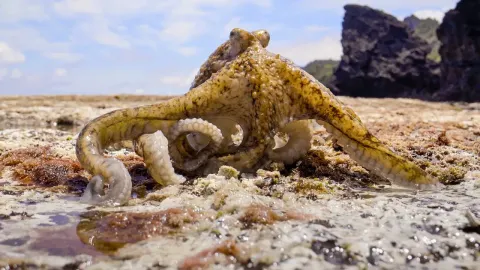
Each puts its own little patch to slightly different use. The blue ring octopus has evolved in perfect harmony with the reef, able to glide stealthily over ridges and through cracks. Its iridescent rings are a warning to other predators that it's armed with a defensive toxic bite. But, when the octopus is doing the hunting, it bites with a different type of venom, specially designed for killing crabs. The world's largest coral reef could only have formed under just the right conditions. The first coral grew on a sunken plateau of built-up sediment.
Sediment that had to come from somewhere. flowing fresh water, and mountains of rock to scour and wash downstream. In Australia, all that is delivered by the Great Dividing Range. These mountains tower over the east coast for 3,700 km. To this day, they capture rain, sending water and fertile soil downstream. Not surprisingly, most of the country's human inhabitants live in the fertile east. Just beyond Sydney, the Blue Mountains hold temperate rainforests and tall stands of eucalyptus.
[snorts] But, this is Australia. Heat and drought are never far away. These forests must face the possibility of destruction in order to survive. In New South Wales, the hills are ablaze. In a typical year, as much as 10% of Australia's forest goes up in flames. And this fire is especially intense because these trees are eucalyptus. They contain volatile oils that burn twice as hot as oak. A bushfire can rage at 1,000°C. Hot enough to melt glass. But the inferno doesn't mean the end of this forest. Eucalyptus trees have evolved not just to survive fire, but to exploit it.
The heat triggers dormant shoots under the bark to awaken. The trees burst back to life while competing plants are thinned out. The first eucalyptus began developing these abilities over 30 million years ago in a much wetter climate. When Australia grew hotter and drier, the trees seized their moment and spread across the continent. As the eucalyptus was evolving to make the most of bushfires, a unique animal was evolving to make the most of the eucalyptus. The oils that make the leaves so flammable also make them hard to digest. But a koala eats almost nothing else.
Like most Australian mammals, she's a marsupial, but one that rose to meet a different set of challenges. Her liver is able to deactivate the toxic compounds. And her gut is fortified with microbes to extract the most nutrition from the leaves. But such specialization doesn't come easy. This little Joey may live for 18 years, but he'll spend the equivalent of 13 of them asleep. A koala's diet is so low in nutrients that it can only afford to be awake for about 6 hours a day. And when awake, koalas only move when they have to.
Their home, their food, and most of the water they need can all be obtained in the branches. Their bond with the trees consigns koalas to the country's milder east coast. Beyond the Great Divide, forests give way to scrub. The highlands that send rain to the east rob the land to the west of its water. At least on the surface. Far below some of the world's driest land lies one of its biggest reservoirs. From the mountains to the arid center, Australia's Great Artesian Basin spans over 1.5 million square kilometers.
The water flowing beneath it could fill all of North America's Great Lakes two times over. In the Simpson Desert, the longest parallel dunes in the world stretch up to 200 kilometers across the surface. Beneath the sand, water creeps at a pace of about 10 millimeters a day until it finds an outlet. The water that bubbles up in some springs fell as mountain rain 2 million years ago. Desert oases, such as Dalhousie Springs, are gathering points for all kinds of thirsty animals, including a newcomer from a faraway land who happens to fit in a little too well.
[snorts] Everywhere there is desert, animals have found ways of adapting to the environment. Australia's separation from the other continents allowed some unique adaptations to flourish. But traditional designs can work just as well. And something totally out of place can make itself right at home. Dromedaries, one-humped camels, were imported here in the 1800s as a tried-and-true way of getting around. With the rise of the automobile, the camels were abandoned. They were well equipped to take advantage of the situation. To keep out the sand, they've got double eyelashes and nostrils that can seal up tight. And of course, there's the famous ability to go without a drink.
Thanks in part to kidneys and to intestines that retain water. The hump actually has nothing to do with water conservation. It serves as fat storage for times when food is in short supply. Wild dromedaries have long been extinct in their natural range. Australia is now the only place where they still exhibit wild behavior, including a very creative courtship ritual. For a dominant male, the goal is to look seductive to females and intimidating to other males. That's achieved in a few different ways.
First, he inflates a bubblegum-like sack called a dulla. Then he adds a few flourishes, grunts, gurgles, and a liberal amount of foamy saliva. And if rivals don't back down, a good body check is always an option. Bizarre courtship aside, feral camels are so good at reproducing that they've become a problem. There are about 300,000 camels at last count, and without official population control, their numbers could double every 10 years. There are no native camel predators in this new world. But there is a voracious hunter of another kind. It's built like a tank with armored spines able to take whatever the desert can dish out. So fearsome in appearance and demeanor,
it earned the name thorny devil. It's equipped to kill its victims by the hundreds. Desert life is good for this little devil. Most mornings, after warming up in the sun, it locates a trail of foraging ants. Not a difficult task in the desert. Then it lets the conveyor belt deliver food one bite at a time. A single ant isn't that nutritious, so the thorny devil has to eat a lot of them. Around 750 a day. This sit-and-wait approach to eating works for drinking as well.
Those thorny scales aren't just for protection. They're one of the most ingenious desert adaptations. Whenever the little devil encounters water, all it has to do is touch it. The scales on its body work on the capillary principle, channeling water through grooves towards its mouth, even against gravity. The lizard only has to get its feet wet to receive a sip of water. It may be one of the hardiest desert survivors on the planet. But in Australia, there are places too inhospitable, even for devils.
Such a place is only 300 km south of the Simpson Desert. At 15 m below sea level, it's the lowest point on the continent. Kati Thanda, Lake Eyre. European settlers called it the dead heart. Once, this was a lush inland sea fed by rivers. From above, the channels of ancient waterways are still visible. As Australia drifted toward the tropics, the climate warmed, and the rivers dried. Now, all that remains is 9,300 sq km of salt crust and sand, burning as hot as 50° in the summer. In a year, Lake Eyre might only receive 13 cm of rain. But every so often, the past returns.
Weather and geography conspire, and together awaken a sleeping giant. When rain finally comes to Australia's deserts, it arrives as an explosion. Minor floods can strike every few years. A few times a century, things get biblical. When a storm of the decade hits, much of the water doesn't flow toward the sea. Instead, rain that falls over nearly 1/6 of the continent pours into ancient river channels, rushing inland towards the lowest elevation.
Suddenly, it's the largest lake in Australia. And when it's full, about as salty as the ocean. The transformation sets off a chain reaction. Somehow, birds from hundreds of kilometers away can sense the change. Whether they can smell the water or are guided by some other force, no one knows. Corellas arrive by the thousands. Wedge-tailed eagles follow the promise of abundant prey. Australian pelicans from the coast seize the moment and launch a spontaneous festival of feasting and breeding.
Strange as it may seem, there is suddenly plenty to eat. Hardy heads, perch, and other fish flushed from upstream have spawned and multiplied in a matter of days. The pelicans operate as a team, driving fish into shallow water, then scooping them up with the longest bill of any bird. Pelicans breed whenever the time feels right. Lake Eyre began evaporating as soon as it filled up. Over the next 2 years, the lake slowly vanishes.
The raucous visitors move back to the coast. Silence descends upon the desert, but not completely. One animal hangs on without any special adaptations, just brains and tenacity. The dingo has carved out a niche for itself, even in Australia's harshest places. But its presence here is controversial. DNA evidence confirms their ancestors were Asiatic wolves. So, it's likely they arrived here in the company of Asian voyagers 3,500 years ago or more. When the travelers left, the dogs stayed behind.
Australia's animals had faced marsupial carnivores, but they'd never seen anything like this. And a family structure where sharing the spoils of the hunt increases everyone's chances of survival. When European settlers arrived, dingoes quickly adapted to a new source of prey. There will always be people who want them dead In a land where few Australians tread, there stands an impressive human creation. The dog fence slices through more than 5,000 km of the country. An early 20th-century solution intent on banishing dingoes to the desert. And heading west, it's desert for days.
The colors change from the salt white of Lake Eyre to the iron oxide red of the Great Victoria Desert. It's the largest desert in Australia, 700 km across. Beyond the Great Victoria, the southwest coast brings relief at last. The Stirling Range is cloaked in morning mist. Below the mountains lie heathlands and coastal dunes. In the sandy soil, wildflowers bloom. Western Australia boasts over 12,000 species of flowering plants, with the southwest being especially rich. At any time of year, there will be blossoms.
The marsupial honey possum eats only nectar and pollen, one of only a few mammals to do so. Without year-round blooms, it couldn't survive. Its tongue is a specialized tool outfitted with a brush-like surface to dip into flowers and scrape off the pollen. In return, honey possums pollinate the plants, just as a honeybee would. Plants that keep the dunes from blowing into the sea. In Australia, there may be no better example of the interconnection of the land and the life it holds. On the southern coast, gentle dunes are the exception to the rule.
The land looms ever higher and more rugged. Heading back eastward where the barren Nullarbor Plain is cut off in a long arch, it forms a broad open bay called the Great Australian Bight. One of Australia's most remote places is also one of its most dramatic. Part of the longest stretch of coastal cliffs in the world. Beyond Land's End, a warm coastal current collides with cooler water from the Southern Ocean. When summer winds push the warm water offshore, a cold upwelling rises to replace it, whipping up banks of coastal fog and creating a sea rich in life.
Fur seals live here year-round to take advantage of plentiful fish and squid. When they're not hunting, they stick close to rocky islands and coves, enjoying prime access to Australia's best surfing. Heading eastward from the Australian Bight, the ocean continues to cool until it meets the shores of a green island, a world apart and a last refuge. Australia's geographic isolation has defined the evolution of its wildlife. As Australia is to the world, the island of Tasmania is to Australia.
More than 1,500 km from the Great Australian Bight, once it was the mountainous southeastern corner of the continent, until rising seas cut it off from the mainland. Separated for 14,000 years, Tasmania has avoided some of the new species introduced to the north. And its southerly location makes it the most cool temperate part of the country. The streams still run cold in the highlands around Cradle Mountain, offering the perfect safe haven for one quintessential Aussie creature.
The duck-billed platypus is not uncommon in Australia, but it's a rare thing in the world at large. It's one of only two living types of monotreme, platypus and echidna, an ancient kind of mammal that lays eggs, only found in Australia and New Guinea. When the first platypus specimen was sent back to Europe, biologists checked it for stitches, convinced it was a hoax. It may look like an animal built out of spare parts, but the world's weirdest creature is no evolutionary mix-up. It's actually a highly evolved hunter. More than just a mouth, that duckbill is a sophisticated sensory device. A bit like a personal metal detector. As the platypus hunts, electroreceptors on the bill pick up minute impulses from its prey.
Tiny invertebrates hiding under the rocks and leaf litter. Some species of fish have this ability, but the platypus is the only mammal that can hunt underwater this way. Protecting the last strange creatures is Tasmania's gift to the world. The island is the only place where these screams still pierce the quiet of a wild forest. A female Tasmanian devil homes in on the unmistakable sound of her own kind. She follows her ears and nose to the [screaming] source of the noise.
A dead wallaby has attracted a crowd. [screaming] Sharing is not a Tassie devil's strong point. [screaming] Their vocal threats are supposed to keep her off the carcass, [groaning] [screaming] but she gives as good as she gets, and then some. [screaming] They're no bigger than a small dog, but ferocity makes up for stature. Oversized heads and muscular jaws deliver one of the most powerful bites of any mammal for its size, easily ripping through muscle and crushing bone. [groaning] In just over an hour, five devils strip the carcass to nothing. Today, Tasmanian devils are the largest living marsupial carnivore. But now they're battling disease. So, devils are being reintroduced to nearby islands to create separate populations.
And plans are afoot to restore them to the mainland. The island isolation that once protected its creatures also leaves them vulnerable to sudden change. It's a story told across all of Australia, from the deserts of the interior to the green fringe to the wild reef beyond. In fragile realms offering glimpses of the past and evolutionary paths that the rest of the world never tried. Australia's life is balanced on the edge of time and place and truly one of a kind.