12:22
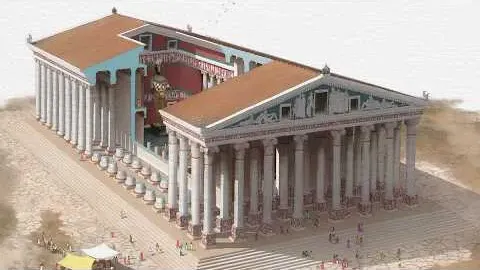



Dura Europus was not an important city. It was located far from the great trade routes and cultural centers of the Roman East. Its population never exceeded 5,000. But today's video will explore how this insignificant settlement in the Syrian desert transformed our understanding of the Roman world. This is a collaboration with my friends at Histori Militum who will be covering the siege and fall of Dura Europus. You'll find their video linked in the description. Dura stood on the banks of the Euphrates in what is now eastern Syria. Founded by the Salucids in the generation after Alexander the Great's conquests, it fell to the Parththeians around the end of
the 2nd century BC. It remained under Parthion control for more than 250 years. The Romans briefly overran Dura during Trajan's Parthion War and definitively annexed the city during the reign of Marcus Aurelius and Lucius Ferris. Thereafter, Dura was a stronghold on Rome's eastern frontier with a large garrison housed in a separate military quarter. Despite or because of this protection, the city was attacked twice by the armies of Sassined Persia. The first assault around 253 seems to have been repelled. In the aftermath, however, Dura's civilian population fled or was
evicted, and the Roman garrison occupied the entire settlement. The most vulnerable section of the city wall was reinforced with a massive embankment of sand and rubble, which buried and so preserved whole blocks of buildings. The Persians returned around 256. This time, after a hard-fought siege, they captured Dura. The city was pillaged and its ruins were abandoned to the desert. Dura Eropus was never reoccupied. The site remained virtually untouched until 1920 when British soldiers digging a rifle pit revealed a wall glowing with ancient paintings. This discovery inspired an excavation campaign jointly
sponsored by Yale University and the French Academy of Inscriptions and Literature. Between 1928 and 1937, a team that often included upwards of 300 workmen cleared nearly a third of the site. Later, a Franco Syrian team continued work on a smaller scale until the dig was ended by the Civil War. Most of Dura's buildings were made of mud brick and have left only foundations. But throughout the site, and especially beneath the embankment that the Romans built to strengthen the city wall, archaeologists have discovered a dazzling range of artifacts. Some of the most interesting were connected with the Roman military. The 20th Palmy cohort, a mixed unit of infantry and cavalry, was stationed at Dura along with detachments from several
eastern legions. Military buildings occupied about a quarter of the city. Most followed designs current throughout the empire, from the baths supplied with Euphrates water by an aqueduct to an amphitheater with room for a thousand spectators. Some civilian houses were subdivided to serve as barracks. Others were occupied by officers. The so-called house of the scribes featured a portrait of Heliodoris the actuarius, an officer responsible for dispersing wages. The aid environment of Dura preserved an impressive array of military equipment, including the only scutum, the curved rectangular shield carried by legionaries, ever found intact.
Another remarkable discovery was the oldest extent map of Europe, apparently sketched on a leather shield cover to commemorate a campaign. Archaeologists also found two sets of horse scale armor and three oval shields painted with scenes from the Trojan War. The most significant find connected with the military, however, was the archive of the 20th Palmy cohort. Housed in a small temple next to the base. Among the more than 200 documents uncovered there was the Fial Duranum, a unique calendar of the festivals and sacrifices by which Roman soldiers honored the emperors and gods. Along with a roster listing the names and ranks of more than a thousand soldiers, the archives also contained a number of daily reports, each indicating
the day's password, orders, and honor guard for the unit standards. We'll explore the most fascinating finds from Dura Europus after a brief word about this video's sponsor. Even before the Civil War, few of Dura's buildings were well preserved. It was the kind of site that was hard to imagine as anything but a ruin. But now with Portal, any ruin can be reconstructed. Portal is a groundbreaking app that transports you into the ancient world using historically accurate reconstructions and photorealistic CGI.
It creates immersive XR experiences that allow you to walk through history. In Rome, for example, you can witness a triumphal procession at the Colosseum and feel the energy of thousands of spectators at the Stadium of Domission. Scan the QR code on screen with your mobile device and you'll receive five free tickets with the app. Enough to watch some of history's greatest monuments come to life. Returning to our topic. Although Dura was founded as a Greek city and always maintained the institutions of Apolis, Greek was only one element in its cultural constitution.
Many citizens had both Greek and Semitic names. Inscriptions mention Demetrius known as Nabus, Alexander who is Amio, Heliodoris called Samspanis. Greek names seem to have often been used in political contexts, non-Greek in the contexts of religion and commerce. The gods of Dura also had multiple names. Zeus curios was Balshaman. Artemis was Naniah or Azenoth Kona. Alongside the Greek pantheon, the gods of Palmyra, Hatra, and a nearby city called Anath were worshiped.
The city's 19 temples blended classical, Mesopotamian, and local architectural traditions. Most had a central courtyard ringed by shrines and rooms used for ritual dining. The principal sanctuary was usually painted with images of the god surrounded by worshippers. An example found in the temple of Bell showed a Roman officer named Julius Trentius offering sacrifice. Beneath the embankment that buttressed the city wall, the Yale expedition discovered a 3 century synagogue decorated with paintings. Apparently untroubled by the commandment against graven images, the Jews of Dura had frescoed almost every part of their main
assembly room. The fresco depicted the sacred history of the Jewish people. Among the 58 surviving scenes were the discovery of the infant Moses, the parting of the Red Sea, the anointing of David by Samuel, and Esther with Mori. Their style closely recalled that of the paintings in Dura's pagan temples, the same artists were likely responsible for both. Greek and Aramaic inscriptions commemorated the work of decoration and Persian depinti apparently left by visitors from Mesopotamia commented appreciatively on the paintings. A short distance from the synagogue in what at first appeared to be a typical house. The archaeologists discovered a Christian church dating to the early 3rd
century. On one side was a meeting hall with space for about a 100 worshippers. on the other a baptistry with a large font. The baptistry had been decorated with fresco, though less well preserved than those in the synagogue. Some scenes could be identified. They illustrated both the Old and the New Testaments, Adam and Eve, David and Goliath, Christ walking on water, the three Marys visiting the tomb. Like so much else from Dura, these fresco are unique, shedding a precious and unexpected light on early Christian iconography.
The end of Dura Europus was brought about by an epic clash between the Roman Empire and assassined Persia. Follow the link on screen and in the description to watch Histori Militum's video on the siege and fall of Dura Europus. In the video description, you'll also find links to my spring 2026 trips, the Roman ruins of Spain, and In the Footsteps of Alexander the Great. You'll also see a link to the Tolden Stone Patreon page, and to my other channels, Tolen Stone Footnotes and Scenic Roots to the Past. Thanks for watching.