49:20
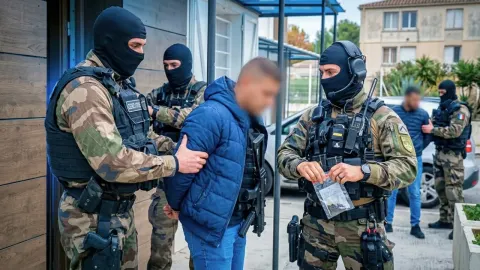



Troops have been hastily deployed in Kaise Doris, a small town in central Lithuania. A group of pro-Russian activists are threatening to take over the town hall by force. The demonstrators don't hesitate. They attack cars belonging to the town hall employees. All at once, the demonstrators try to force an entry. These men in khaki uniforms are the last line of defense protecting the town hall.
A few rioters have succeeded in getting inside, but they are rapidly overcome. But in fact, this demonstration is a drill. The rioters are actors, and these soldiers are volunteers. They belong to the Lithuanian Riflemen's Union, a paramilitary organization.
They are students, businessmen, even civil servants. Their mission is to support the Lithuanian armed forces in case pro-Russian operatives try to destabilize the country. Rolandas is a new recruit. This is the first time that this 54-year-old senior manager has ever used a riot shield. We are quite sure that we will be able to defend ourselves. We want to be prepared, to be ready. We can be ready for any aggression. But what kind of aggression? I don't know. We will see.
Anything can happen. But we will be prepared. We will be less aggressive. If the Lithuanians are preparing for the worst, it's because they fear their powerful opponents. Kaliningrad is a peaceful neighbor. The Russian state is relentlessly building up its military strength. Kaliningrad is a little piece of Russia wedged between the north of Poland and the south of the Baltic states. With its miles of beaches and timber-framed houses which recall its German past, it's far from the traditional image of Russia. For good reason, this area was cut off from the rest of the country after the fall of the Soviet Union.
Today, it is a strategic enclave for Moscow, serving as a fortress against NATO. This region serves as the headquarters for the Russian fleet in the Baltic Sea. 30,000 soldiers are stationed here. But more importantly, this is where Vladimir Putin keeps his nuclear missiles. The missiles are capable of striking Paris, London or Berlin within just a few minutes.
We gained access to film in this region, which has been almost inaccessible since the war started in Ukraine, a region where journalists are closely monitored. Against a backdrop of war in Ukraine, Kaliningrad now poses the threat of a second front between Russia and the West. This situation is a serious concern for its neighbours, the Baltic states. Aggression could happen in Ukraine, and we understand the Baltics are next. The former Soviet republics of Lithuania, Latvia and Estonia are members of both NATO and the European Union, having joined in 2004.
Today, they are ready to do whatever it takes to defend themselves against Moscow. In Lithuania, ordinary citizens have taken up arms and are training to become soldiers. In Latvia, the government wants to erase its Soviet past. It has ordered that old monuments that glorify the Soviet Union should be torn down.
This decision has angered the Russian-speaking minority, who make up almost a third of the population. To free itself from Russian influence, Latvia has even restricted the use of the Russian language in public spaces. I am Russian-speaking. If someone from Latvia hears me, I will be fined. In the grip of a culture war over collective memory and threatened by a highly militarized territory, we investigate the tensions between Kaliningrad and the Baltic states.
A train enters the station in the south of Kena in the southeast of Lithuania. About 15 border guards come out in the freezing cold onto the platform. This train is under careful surveillance because it originated in Moscow. War has not stopped the railway line linking continental Russia to Kaliningrad. It leaves from Russia and crosses Belarus before entering Lithuania. 120 Russian passengers are on board, bound for Kaliningrad.
The customs officers go into each carriage. They carry out a thorough identity check of each and every passenger. Since the war in Ukraine, Russian passengers are no longer allowed to get off the train. And yet, after about 10 minutes, to our great surprise, there are a few passengers on the platform. Natasha was able to leave the train because she has dual Russian and Lithuanian nationality, and she is not the only one to get off the train.
Eugène has also gotten off the train, clearly feeling the effects of the journey and of the past few months spent in Russia. This traveler is no longer in Russia, but he is still afraid to speak freely. He is the last passenger to get off the train. Before the train leaves, one of the border guards puts a small device on the train. The officer is not allowed to answer us.
In fact, he has fitted a GPS beacon. It will confirm that the train hasn't moved. The train has not made any unexpected stops within Lithuania to illegally unload any material or any people. Lithuania is concerned that Russian agents could foment unrest within its territory. A half hour later, the train continues on its way. Before reaching Kaliningrad, it makes one last stop at the station at Vilnius, the Lithuanian capital.
Once again, passengers are not allowed to disembark. But the Lithuanian authorities have ordered a 10-minute stop to deliver a message to any Russian travelers. A dozen or so photos showing the conflict in Ukraine are displayed on the platform. The display is designed to force Russians to see the horror of the war. Despite these upsetting images, very few passengers turn away. Three hours later, they arrive at Kaliningrad station.
Situated beside the Baltic Sea, Kaliningrad is a small territory, 15,000 square kilometers in area. Not much more than the area covered by metropolitan New York City. Before falling under Russian control, it was a Prussian enclave. Then, for over 700 years, it was German. Its capital, once known as Königsberg, still bears a few remnants of its past. Such as this Gothic cathedral, which is the final resting place of the philosopher Immanuel Kant. In 1945, at the end of the Second World War, the Third Reich was dismantled. The Potsdam Conference agreed that Kaliningrad would be annexed by the Soviet Union.
Today, this Russian enclave in the heart of Europe has a population of nearly a million people. Elena, a 38-year-old psychologist, takes her two children to school every morning. The new school year is starting with an emphasis on national pride. A ceremony begins in the playground. The director inspects each college student to ensure that they are dressed properly.
Everyone must be smartly dressed. The best students are selected to help raise the flag. The others are sent to class. It is a solemn moment of patriotic pride for these young Russians. They now sing the national anthem at the start of every week.
This is something which began in the previous school year. Patriotism is instilled from a young age. Elena, their mother, approves. It was strange that it didn't exist. Why do we live in Russia? Why don't we know the anthem in class? I really like what they do, because they talk about terrorism, security, support, love, family. They raise such important topics. As well as raising the flag, Vladimir Putin has also ordered that schools should teach history and current affairs lessons from a Kremlin-approved curriculum.
The Russian president used this major program of school reform as the pretext for a publicity stunt. On the 1st of September 2022, with the war in Ukraine raging, he went to Kaliningrad, bypassing the Baltic countries which no longer allow Russian planes in their airspace. The boss of the Kremlin delivered the first lesson in the patriotism class himself live on television. It was a calculated move in a strategic territory just a stone's throw away from major European capital cities.
Vladimir Putin delivered his version of the conflict to this hand-picked group of schoolchildren. They protect the people of Donbass and protect Russia. And of course, it deserves all the support from the society. It is very important. In Kaliningrad, propaganda is not only broadcast on television. You can see posters glorifying Russian soldiers in the streets. And on the quays in the city centre, Russian naval power is on display for all to see.
After school, Elena and her two children, Vadik and Irina, decide to visit the naval museum, one of the city's big attractions. They don't have an aquarium here, but they do have warships. This military cruiser still displays communist markings 30 years after the fall of the Soviet Union. And they have a B-413, a 50-year-old conventional attack submarine.
Vadik and Irina are finding out what it's like to live on a submarine. This visit doesn't seem to have motivated them to join the navy. In the wardroom, a portrait catches the visitor's eye. Everyone wants their photo taken with Vladimir Putin.
The head of the Kremlin is portrayed as the protector of his country in a military style. In just a few years, he has transformed Kaliningrad into a military outpost that threatens all of Europe. The port remains ice-free all year round, and so the enclave serves as headquarters for Russia's Baltic fleet. 130 warships are based here. The Baltic fleet alone is bigger than any other navy in Europe. And more importantly, since 2018, Iskander ballistic missiles are also based here.
These missiles can be fitted with nuclear warheads and are pointed directly at Europe, barely 500 kilometers from Berlin. And since the war in Ukraine, Moscow has threatened to move an even more fearsome weapon to Kaliningrad - Sarmat missiles. With a very long range and capable of speeds over 7,000 kilometers per hour, as well as evading defense systems, the Sarmat is the largest nuclear missile ever designed. This information was presented on Russian public television. It is surreal to watch.
In this program, journalists imagined what would happen in a Third World War and marveled at the strike force of the new Russian hypersonic missiles. Here's a picture. Count seconds. Why are you in time? Hello, it's flying. Let it think. Give it a stopwatch. Count 200 seconds. That's how you should do it. They don't understand. The Kremlin's aggressive rhetoric has the unfailing support of the governor of Kaliningrad. Anton Alekhanov is thought to be one of Vladimir Putin's protégés.
He's 36 years old and has been the leader of this Russian enclave since 2017. We started filming just as Anton Alekhanov was seeking a second term. He was the odds-on favorite for the election. He didn't even think it worth his while to campaign. When Elena goes to vote, her choice comes as no surprise. Who do they choose and what are the candidates? I don't know what the candidates are. We're choosing Alekhanov today, as usual. Although Elena doesn't know of any opponents to the governor, six other candidates did, in fact, put their names forward.
One among them is Maxim Bulanov, leader of the local Communist Party. How are things? There are portraits of his heroes in his office. Lenin, who played a leading role in the October Revolution. And his successor Stalin, who was responsible for the deaths of between 15 and 20 million people. But this doesn't diminish the candidates' admiration. Vladimir is the founder of our party. Joseph is the successor of our party. Thanks to his contribution, we achieved victory in the Second World War.
European nations were liberated. Maxim Bulanov represents himself as an opponent to the governor. But for a supposed political adversary, his words sound very similar to the official party line. We fully support the president's leadership. We believe that this was a forced measure. I hope that we will go all the way. And I think we should act more vigorously. The Communist candidate has differentiated himself from the party in power by campaigning on the theme of electoral fraud.
After several hours of filming with us, Maxim Bulanov finally offered a few words of criticism of the regime. In the last parliamentary elections of 2021, Vladimir Putin's party was accused of massive fraud by its opponents. You see, there are some shady commissions. They say that everyone who, according to the rules of the party, tries to distort the people's will, is usually in favor of the party in power. But despite this outward show of integrity, the candidate has prepared a staged meeting for the cameras worthy of the old days of Soviet propaganda.
So, just a demonstration, no violations? No, only there. So, when we asked the head of the office about the election, the answer comes as no surprise. Were there any violations, maybe, of the commission's members, recorded on your site? No, everything is done correctly, as we follow all the instructions. This stunt undermines all of Bulanov's rhetoric. In reality, no opposition is tolerated in Kaliningrad, just as in the rest of Russia.
When dissident parties are authorized by the Kremlin, it is only to give the appearance of political pluralism. And they are closely watched, just like journalists. Our film crew was in the communist candidate's car near to the exit of the polling station when we were stopped by the police. The candidate, Maxim Bulanov, is ordered to get out of the car.
Next, our team is questioned by the police. May I speak to Maxim? May I ask you for your ID? In Russia, journalists risk up to 15 years in jail for spreading false information. Well, not really. Our team was finally released by the police, but only because they were with the communist candidate. After this incident, Maxim Bulanov refused to continue filming with us.
Since the beginning of the conflict in Ukraine, the few independent Russia media outlets have been either closed or forced to flee the country. People can only access officially sanctioned news. Out in the countryside, just a few kilometers outside Kaliningrad, Lyudmila, a 65-year-old retiree, gets all of her news from state television.
Russia Today, Russia One, or Russia 24. All these channels were banned in Europe after the outbreak of the war in Ukraine, accused of being propaganda outlets for the Kremlin. If I'm at home, I watch TV, and if I'm not, I work. I'll start working when I get home. I'll watch TV, no matter what. This retired blue-collar worker never leaves the region of Kaliningrad, and so television is her only window on the world. This is the chairman, Ursula. She's the one who deserves the court. See, the blue-collar worker is yellow. This is the beauty, she deserves the court.
She deserves it 100%. Lyudmila is angry with the European Union, which she blames for the economic crisis in Russia. She has been struggling to make ends meet for the past few months. The prices are rising, and rising, and rising. But not twice. I don't know what to compare it with. If I compare it with. I was in a shop once. It's a nightmare. Look at the price. This is a bleach box, 258 rubles. You can go crazy with this box. It's a nightmare.
258 rubles. That's about 4 euros for a packet of detergent, five times more than before the war. On average, the price of food products has increased by 30%. So Lyudmila grows her own vegetables to fill up her fridge. This is corn, the last harvest. This is an old tree. It's young, it's been giving us nuts for a year. It's still young. I have five of these. But her real treasure lies at the bottom of the garden. She has three tons of coal stored here. This stock of coal will be essential to get her through the winter in Kaliningrad.
Coal is an increasingly rare commodity here, and the pensioner fears that she won't be able to afford any more. This year we bought coal, 12,000 tons. We bought three tons, 36,000 tons, and a car, 1,200 tons. 12,000 rubles, or 200 euros, is about two-thirds of her monthly pension. We need to put some coal here, so the stove doesn't go out. Coal has become expensive because it is increasingly scarce in Kaliningrad.
It fell under a European embargo last April, along with iron and other building materials. The Russian enclave is particularly affected by these sanctions, which weaken the entire local economy, especially the tourist trade. Before the war, Kaliningrad was a popular destination for most tourists. This region is home to the Koronean Spit, a little-known gem of Russia. A strip of sand, 100 kilometers long, on the shores of the Baltic Sea, classified as a UNESCO World Heritage Site.
Leona and Katya spend a few days in this seaside resort every year. But she was very hesitant about booking her usual trip this year. I was planning to come here in April, but I was afraid and cancelled it. I was very worried. Katya was worried because since the war in Ukraine, Russian planes are no longer allowed to fly in European airspace, which has further isolated Kaliningrad.
The flight route is changed now. We fly over neutral waters, there are very narrow corridors, and sometimes NATO planes accompany us. Ever since the outbreak of war in Ukraine, the beaches have been deserted, as has the hotel where the Muscovite couple usually stays. Hi, guys! Happy birthday! Nikolai, the director, comes to greet them. We were swimming this morning. Really? This young entrepreneur has invested nearly half a million euros in this luxury campsite, which opened in 2019.
We haven't wiped it for a long time. We have 25 beds like this. They look like this. There is an electric bed, two heating zones for each bed. There is Wi-Fi in the whole area. There is electricity in the tent. Before the invasion of Ukraine, Nikolai's campsite was booked solid. Now the tents are empty. Tourists are afraid to come to Kaliningrad. We were called from time to time. They said, we booked a room for you, and then we read the news about your trip.
We booked a room. We took a ticket to Kaliningrad on the weekend. Everything is calm, we will return. The missiles are not flying to Kaliningrad yet. If Russian tourists are not coming to Kaliningrad, at the same time, those from Kaliningrad cannot cross the border to neighboring countries. The Baltic states and Poland closed their borders to Russian tourists last September, which contravenes European policy on free movement. The situation particularly affects young people who are used to traveling to neighboring countries. The Yeltsin, a bar in the center of Kaliningrad, named after the first president of the post-Soviet era, attracts a fashionable young crowd.
Anastasia, a local tourist guide, is meeting her friends for a drink tonight. Everyone is worried about their future. When new laws are introduced in Poland, maybe the most unfriendly ones, you feel that Poland is right next to you. Because if in Russia it seems that some sanctions are very far away, here they are closer to us. Anastasia and her friends grew up in the heart of Europe, so they feel both Russian and European. Like 80% of young people in Kaliningrad, they have never set foot in mainland Russia.
Lithuania is a country of peace and order. It is the same for all of us. We all want to live in peace and order. We all have the same attitude towards the EU. Ever since the war began, Lithuania has been at the forefront of opposition to Russia. The conflict has revived painful memories of the Soviet occupation. Lithuania was occupied by the USSR from the end of the Second World War and lived under the control of the Kremlin for nearly half a century. So people are especially worried by the threat of a new Russian invasion.
In Kaunas, the country's second largest city, Smilta's family attends Mass every Sunday at this Catholic church. The practice of religion was forbidden during their childhood, but today Smilta and her husband Rolandas are fervent practitioners. They pray for the end of the war in Ukraine. The conflict has renewed fears of their expansionist Russian neighbour.
I'm glad to see you. When they were children, Smilta and Rolandas witnessed family members being deported to Siberia. Lithuania was scarred by the deportation of hundreds of thousands of its citizens during the Soviet occupation. The trauma of this still lives on among its people today. When you remember the times when you couldn't speak your heart out, now you can speak freely, you can speak your own language, you can open your heart to the future. And when you know that what is happening now, that the Ukrainian walls are very, very few, very few, and they can be repeated by us. And we don't want our children to live like that. That's why we have to be prepared.
On weekdays, Smilta works at a university as the Director of Communication. On the weekends, she puts on her combat fatigues. About a year ago, she joined the Lithuanian Riflemen's Union, a paramilitary militia. All the leaders are coming today. There are people from the morning. I'm coming in about five minutes. I am truly patriotic. I love my country. We remember that the people of our country have committed themselves very gravely.
We don't need to look for anything to protect us. It is my duty to do everything so that my children live in safety and in peace. Today, Smilta is traveling to Kasyadoris in the west of the country. She will take part in an induction ceremony. Your eyes are being blinded by the oath. Be faithful to the people's will. A hundred new recruits take the oath. We want to build a peaceful and constitutional society.
There are men, women, but also young people aged between 11 and 18. The Lithuanian Riflemen have more than 13,000 members, slightly more than the regular army. There is a great interest. The war in Ukraine has begun. Our army has now recruited a third of the new recruits, more than 500 new recruits, in just one month after the spring. Recruitment is on the rise, and it is not surprising. According to the commander-in-chief Albertas Dapkus, the enemy is at the gates.
You know from the news, from the press, what is happening in Ukraine. The Ukrainians did not have time. They are now learning the coordination, the operations, where they see it necessary, and we have time. In Ukraine, the defenders have halted the advance of Russian troops. So, having learned the lessons from this war, the Union of Riflemen have created a specialized training program, combat in an urban environment. The next day, a hundred men are mobilized for a large-scale military exercise that will push them to their limits. It's not easy to turn civilians into elite fighters.
A few minutes before the exercise begins, Captain Savikas gives some final words of advice. The Lithuanian riflemen are separated into two teams. The first team plays the role of enemy soldiers entrenched in this building. The second team's mission is to neutralize them.
This is the first time that these men have used weapons of war. They have Swedish machine guns loaded with blanks. But the assault does not go as planned. The group on the front line is already on the ground. Despite their best efforts, the trainee soldiers seem to be overwhelmed. They don't know which direction to shoot in.
They haven't managed to get inside the building yet, and they are already out of ammunition. This lack of preparation will cost them dearly. Because in urban combat, rationing ammunition is one of the keys to victory. After an hour, the enemy is finally neutralized. But at a great cost. If it was a real battlefield, nearly a third of the militiamen would have been killed. Captain Savikas says that becoming a fighter doesn't happen overnight.
This is just one of the episodes. And the war can be a big episode, and it takes time to see it. Lithuania is not the only Baltic country which fears Russian invasion. To the north, another former Soviet republic, Latvia, has come to hate Russia so much that it wants to wipe out all of their shared history. Last June, the Latvian parliament passed a law which ordered the destruction of 69 monuments to the glory of the Red Army.
This obelisk was the most emblematic of all. It was located in the heart of the capital city, Riga. On the 25th of August, it finally fell. Its demolition angered some of the population. The Russian-speaking community represents a third of the population of Latvia. The town of Daugavpils is a bastion of the Russian-speaking community. They are trying to oppose the destruction of these Soviet monuments.
Alexej Vasilyev and his friends come to Victory Square every week to pray in front of this memorial. Dedicated to the Soviet soldiers of the Second World War, this monument is also threatened. Alexej is deputy mayor. He fears that the cultural heritage of his city will disappear. 80% of the people in Daugavpils are Russian-speaking.
This destruction would be painful for his friend Valery, too. His ancestors fought in the ranks of the Red Army to drive the Nazis out of Latvia. It is unclear how the people who fought the Nazis would react to the events in Ukraine. They are using the occasion of the events in Ukraine to try to eradicate the Russian-speaking community. Daugavpils City Hall has opposed destruction of the monument, but all appeals have been exhausted. In desperation, Alexej's turned to the Russian-speaking community.
He has appealed to the Latvian Constitutional Court and the European Court of Human Rights. The deputy mayor is still hoping for a miracle. But there is not much hope of that. Latvia has embarked on a culture war against the Russian-speaking minority. Speaking Russian is now forbidden in certain places, such as government buildings, banking and educational establishments. As in this working-class neighborhood about 20 kilometers from Riga. The city is under the threat of a war. Elena is 54 years old.
She lives in this apartment with her daughter Valeria. This former dance teacher is in a situation which is almost unheard of in Europe. This is Valeria's passport. This is a Latvian citizen's passport. This is my passport. I am not a citizen. I gave birth to three children, and I was not given citizenship.
Can you imagine? Elena is one of 200,000 non-citizens in Latvia. They are Russian-speakers who arrived or were born in Latvia during the Soviet occupation in 1940 and were refused Latvian nationality after the fall of the USSR. I am a discriminator. They are citizens, and I am not. I am a second-class citizen. Did you ask for Latvian nationality? No. We have to pass the first language test. Then I will be given a citizen's passport. Otherwise, I will not be given it.
Her daughter Valeria obtained Latvian nationality at birth, just like all of those who were born after the fall of the USSR. I am a citizen, and I can work in public services. I can be a police officer, a doctor, a firefighter. I can work in security services. I can work in higher education. I can work for the Soviet people. The two generations don't always see eye to eye. I am proud of my nationality.
Do you feel Latvian? Why? Do you feel Latvian? Don't you have a Russian spirit? Then I am sorry. You are not my child. I didn't raise you right. Are you Latvian? Do you want to be Latvian? Pack your things and get out of here. Unlike her daughter, Elena refuses to abandon her Russian culture. This heated discussion comes up often, but things always calm down in the end.
In the city of Daugavpils, Alexej Vasiljev is also fully committed to his heritage. The deputy mayor is responsible for education and culture. Today, he is the guest of honor at a concert organized in the village hall. Nearly 400 people have gathered for a folk celebration of Slavic culture. They sing so beautifully.
I am proud of my nationality. Thank you very much for being here. This is our common history. We are now fighting for this history with all our citizens of Daugavpils. I hope you understand what I am talking about. I feel like a Russian living in Latvia. I think it all came from my parents. I grew up like this. I will stay like this for the rest of my life. But behind his smile and his reassuring words, Alexej is worried.
We will live together. He is right. Slavs should live together. He knows that the fight to defend his Russian-speaking culture has already been lost. Thank you very much. The attempt to halt the demolition of the Soviet monument ultimately came to nothing. Two weeks later, bulldozers rolled into the city center. The monument was torn down in the middle of the night. It was one of the last remnants of the Soviet past.
Since the war in Ukraine, Russian speakers in Latvia have been worried about the rise of anti-Russian sentiment. Some residents, like Elena, have withdrawn into their community. Russians, Russians, Russians, Russians. Everywhere, Russians are here. Elena lives in one of the poorest suburbs of Riga. In Latvia, nearly a quarter of the population lives below the poverty line, including a large proportion of the Russian-speaking community. Hello, Galina. We are being filmed by French television.
400, 250. I need to take the heating and the light, the gas. 400. Goodbye. Have a nice day. I feel the pressure. The destruction of the Russian language, the Russian population, the Russian-speaking population. You should know your language. You should be illiterate. The state wants to break with its Soviet past, and so it restricts the use of Russian in public spaces. There are no longer any signs in Cyrillic. You have to pay a contribution to the state to have the right to use the Cyrillic alphabet, so many businesses do without it.
Here, look. I don't understand everything that is written there. I am Russian-speaking, so I only studied Russian speech. I mean, I went to a Russian school, I didn't study Latin. If someone from Latvia hears this and complains, I will have a fine. Most Russian speakers do not dare publicly denounce these reforms, even if they consider them to be stigmatizing because they fear reprisals.
Elena refuses to remain silent, and so does her daughter Valeria, who has accused her former high school of discrimination. The events took place a year ago at this school. At the time, Valeria was a high school student in second grade. I remember at school, I was with my friend, I spoke Russian, and my teacher came up to me and said, if you speak Russian again, we will exclude you. He said, and my classmate writes to me, if you don't like something, you can leave the group and leave school. Because when you are boycotted, the whole class ignores you.
I think it's a radical, nationalist attitude. Because you are Russian, you were just thrown out. When the new school year begins, Latvian will be the only authorized language at school. Officially, this is to help the Russian-speaking minority to integrate. But in rejecting Russian influence, Latvia may be shutting out part of its own population. The European Union is worried by the situation and have urged the Latvian government to resolve the status of non-citizen.
The elections in Kaliningrad ended with the communist candidate winning only 5% of the vote. Anton Alekhanov was re-elected with over 80% of the vote. The result confirms the Kremlin's hold on this Russian outpost right in the heart of Europe.